








What's the purpose?

Thread Starter
Race Director


Joined: Aug 2003
Posts: 13,421
Likes: 8
From: Lake Mary Florida
 What's the purpose?
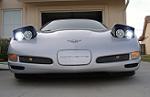
I wonder what is the purpose of the two large indentations in the nose. I can understand the brake cooling ports but the other two? Sure they house the fog lamps but what about air flow?
Surely that doesn't make for a smooth air flow nose over the hood. I would think air builds up in there and the following flow gets burbled as it travels over the air in those pockets and the sleekness of the rest of the nose. C6 flow is totally different, so it makes me wonder about the C5 nose.
Wonder if it creates a down force on the nose?
Any history about the design?
Your thoughts?
Surely that doesn't make for a smooth air flow nose over the hood. I would think air builds up in there and the following flow gets burbled as it travels over the air in those pockets and the sleekness of the rest of the nose. C6 flow is totally different, so it makes me wonder about the C5 nose.
Wonder if it creates a down force on the nose?
Any history about the design?
Your thoughts?
Melting Slicks


Joined: Oct 2006
Posts: 3,447
Likes: 6
From: Los Angeles
There are also inserts with open holes to allow air flow. A Vararam would definitely make that area functional  As far as the original design concept of the closed-off inlets, your guess is as good as mine
As far as the original design concept of the closed-off inlets, your guess is as good as mine

Administrator


Joined: Mar 2001
Posts: 368,063
Likes: 24,731
From: In a parallel universe. Currently own 2014 Stingray Coupe.
C7 of the Year - Modified Finalist 2021
MO Events Coordinator
St. Jude Co-Organizer
St. Jude Donor '03 thru '25
NCM Sinkhole Donor
CI 5, 8 & 11 Veteran
Not sure about the downforce issue, but the openings do not allow for any airflow to the engine unless you open it up. Just there for a place to put the fog lights I guess.
Corvette Stories
The Best of Corvette for Corvette Enthusiasts

Top 10 Most Explosive Corvettes Ever Made: Power-to-Weight Ratio Ranked!
Joe Kucinski
150 hp to 1,250 hp: Every Corvette Generation Compared by the Specs That Matter
Joe Kucinski
8 Coolest Corvette Pace Cars (and Replicas) of All Time
Verdad Gallardo
Top 10 Corvette Engines RANKED by Peak Torque (70+ Years of Muscle!)
Joe Kucinski
Corvette ZR1X Will Be Pacing the Indy 500, And Could Probably Race, Too!
Verdad Gallardo
Top 10 Corvettes Coming to Mecum Indy 2026!
Brett Foote
Top 10 C9 Corvette MUST-HAVES to Fix These C8 Generation Flaws!
Michael S. Palmer
10 Revolutionary 'Corvette Firsts' Most People Don't Know
Joe Kucinski
5 Reasons to Upgrade to an LS6-Powered Corvette; 5 Reasons to Stay LT2
Michael S. Palmer
Thread Starter
Race Director
Joined: Aug 2003
Posts: 13,421
Likes: 8
From: Lake Mary Florida
There's has to be some reason the designers and engineers incorporated them. They weren't there on the C4 nor the C6. C4 had lenses over the fog lamps that nearly made them flush, and C6 had nothing even similar.
Surely this question doesn't stump CF!
Surely this question doesn't stump CF!

Burning Brakes


Joined: May 2005
Posts: 992
Likes: 2
From: Granville Ohio
St. Jude Donor '06-'07-'08-'09-'10-'11-'12-'13-'14-'15-'16'17-'18-'19-'20-21


Drifting

Joined: Oct 2004
Posts: 1,597
Likes: 1
From: Columbus, OH

correct, but i think the general design of the front fascia was in stone before the thought of the details on the Z06 option. Unless letting air in was always the intent, but concluded sealing them off was benificial for the coupe and convertible.


Melting Slicks
Joined: Apr 2005
Posts: 3,469
Likes: 4
I think it's jus part of the Corvette legacy styling. Starting with the C2 the center of the car was visually "split" with the ridge running down the center of the hood, then the C3s had the front plate area flanked by grilles (which did send cool air to the radiator) and then the C4 continued that theme (not sure if there was cooling functionality on the C4). So the C5, then, was just evolutionary.
And really, they are "functional" -- their function is to help make the car look good.
And really, they are "functional" -- their function is to help make the car look good.
 best explanation.

Le Mans Master


Joined: Dec 2001
Posts: 7,788
Likes: 6
From: Winchester TN
Cruise-In III Veteran
Cruise-In IV Veteran
Cruise-In V Veteran
St. Jude Donor '03-'04-'05-'06-'07-'11
Hi Jet-Jock -
I submit that in 1997 they may have already had designs on the performance model (Z06) and may have designed the car this way to accommodate later performance alterations.
I also question your assumption that these areas would cause turbulence over the hood of the car. I don't think that would be the case.
At speed, air would "fill" those openings and provide a buffer, and in my opinion, there would be little or no aerodynamic loss as a result of that cavity.
That is just my opinion, since I have no facts to back up my assertion.
I will add that the C5 is still one of the best designs in terms of aerodynamic flow, one of the reasons they get such great mileage at highway speeds.
Interesting topic that I had never really though about before.
best regards -
mqqn
I submit that in 1997 they may have already had designs on the performance model (Z06) and may have designed the car this way to accommodate later performance alterations.
I also question your assumption that these areas would cause turbulence over the hood of the car. I don't think that would be the case.
At speed, air would "fill" those openings and provide a buffer, and in my opinion, there would be little or no aerodynamic loss as a result of that cavity.
That is just my opinion, since I have no facts to back up my assertion.
I will add that the C5 is still one of the best designs in terms of aerodynamic flow, one of the reasons they get such great mileage at highway speeds.
Interesting topic that I had never really though about before.
best regards -
mqqn
Thread Starter
Race Director
Joined: Aug 2003
Posts: 13,421
Likes: 8
From: Lake Mary Florida
A valid argument however I based my assumption for turbulence on that air building up in there and air flowing from one direction against air trapped or even attempting to flow out of the inlets would be much different then a smooth flow of consistent material as seen in the C6 nose. I initially thought it wouldn't be an issue but then that trapped air would not necessarily be static and is trying to flow back out against the in flow. Hence my burble theory.
Yes I agree that the C5 had one of the lowest co-efficient of drag of most cars on the road. The C6 did improve on that value too.
Yeah I figured I'd throw this one out just to see if someone has the straight scoop from GM design. Could be some interesting theories as well as practical application in what they learned during wind tunnel tests.
Yes I agree that the C5 had one of the lowest co-efficient of drag of most cars on the road. The C6 did improve on that value too.
Yeah I figured I'd throw this one out just to see if someone has the straight scoop from GM design. Could be some interesting theories as well as practical application in what they learned during wind tunnel tests.