








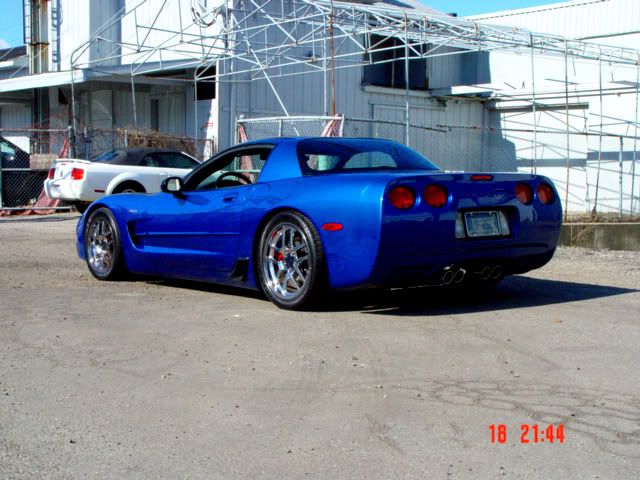

Lowering question (slightly technical)

Thread Starter
Drifting


Joined: Apr 2006
Posts: 1,876
Likes: 0
From: Edmond OK
 Lowering question (slightly technical)
I have read plenty of lowering how-tos (none were impressive, IMO). It's obviously very simple to do.
My question is: do the bolts directly control ride height, and is the adjustment linear? In other words, can I use the thread pitch and number of turns of the bolt to gauge exactly how much I'm dropping?
Or, is it a function of the spring? In other words, if I drop the car, will the spring be loaded more and therefore give a non-linear drop?
Or, does the composite leaf spring give a fixed spring rate, and lowering will give a linear drop based on the spring and not the thread pitch?
I want to be able to to measure my drop (even if indirectly) without having to put the tires back on, drive around, let it settle, measure and repeat.
 Hopefully my question is clearer than mud.
My question is: do the bolts directly control ride height, and is the adjustment linear? In other words, can I use the thread pitch and number of turns of the bolt to gauge exactly how much I'm dropping?
Or, is it a function of the spring? In other words, if I drop the car, will the spring be loaded more and therefore give a non-linear drop?
Or, does the composite leaf spring give a fixed spring rate, and lowering will give a linear drop based on the spring and not the thread pitch?
I want to be able to to measure my drop (even if indirectly) without having to put the tires back on, drive around, let it settle, measure and repeat.
Hopefully my question is clearer than mud.

Le Mans Master


Joined: Dec 2001
Posts: 7,788
Likes: 6
From: Winchester TN
Cruise-In III Veteran
Cruise-In IV Veteran
Cruise-In V Veteran
St. Jude Donor '03-'04-'05-'06-'07-'11
Hi Kerry1 -
No, it is not directly linear in your terms.
Differences in the shocks, even between the same type, and the springs cause a variation in the total amount the car will lower.
For instance, I find that standard c5's (non Z06) will lower slightly more than Z06's will.
The amount you lower if you go all the way from the factory setting to as low as you can go on the stock adjusters is just less than an inch, and that is consistent across all of the cars I have lowered.
You do not have to remove the wheels to lower the car - just get it in the air.
Many use the measure of the center of the outer wheel wells to the ground both before and after the bolts are turned.
In my experience, once the tires have seated themselves on the ground, the car does not lower itself in any measurable way by "settling" - but that is just my experience after having lowered as many C5's as I could talk the owners into doing so.....

best regards -
mqqn
No, it is not directly linear in your terms.
Differences in the shocks, even between the same type, and the springs cause a variation in the total amount the car will lower.
For instance, I find that standard c5's (non Z06) will lower slightly more than Z06's will.
The amount you lower if you go all the way from the factory setting to as low as you can go on the stock adjusters is just less than an inch, and that is consistent across all of the cars I have lowered.
You do not have to remove the wheels to lower the car - just get it in the air.
Many use the measure of the center of the outer wheel wells to the ground both before and after the bolts are turned.
In my experience, once the tires have seated themselves on the ground, the car does not lower itself in any measurable way by "settling" - but that is just my experience after having lowered as many C5's as I could talk the owners into doing so.....
best regards -
mqqn

Pro

Joined: Aug 2004
Posts: 575
Likes: 0
From: Richmond Hill Ontario
When you lower the car do you not change the amount of travel available in the shock? I don't think I've read anywhere of someone replacing their shocks with a shorter or stiffer set after lowering. Is there enough travel left in the stock shocks that this really doesn't present a problem? I ordered lowering bolts for both the front & back but I'm a bit concerned about what other effects this may have on suspension components now. I'd sure like to get rid of some of that big air gap in the wheel wells.
Thread Starter
Drifting
Joined: Apr 2006
Posts: 1,876
Likes: 0
From: Edmond OK
After much thought, it occurred to me that it is for all practical purposes linear. The bolts control the spring's position in relation to the lower control arms. By adjusting the bolts and reducing this gap, we're only allowing the control arms to rotate along the radius they naturally follow. This radius is huge, and since we're only moving through a very small angle, it might as well be a line and not an arc. But, it is significant enough that you have to realign the wheels. The shocks no doubt prohibit the motion somewhat, and this must be what people are experiencing when they say it "settles."
Thoughts, anyone?
Thoughts, anyone?
Corvette Stories
The Best of Corvette for Corvette Enthusiasts

8 Coolest Corvette Pace Cars (and Replicas) of All Time
Verdad Gallardo
Top 10 Corvette Engines RANKED by Peak Torque (70+ Years of Muscle!)
Joe Kucinski
Corvette ZR1X Will Be Pacing the Indy 500, And Could Probably Race, Too!
Verdad Gallardo
Top 10 Corvettes Coming to Mecum Indy 2026!
Brett Foote
Top 10 C9 Corvette MUST-HAVES to Fix These C8 Generation Flaws!
Michael S. Palmer
10 Revolutionary 'Corvette Firsts' Most People Don't Know
Joe Kucinski
5 Reasons to Upgrade to an LS6-Powered Corvette; 5 Reasons to Stay LT2
Michael S. Palmer
2027 Corvette vs The World: Every C8 vs Its Closest Competitor
Joe Kucinski