









Differences between years?

Thread Starter
Instructor


Joined: Apr 2008
Posts: 147
Likes: 50
 Differences between years?
So now that I convinced my buddy to buy a Vette, the only thing left for him to decide is what year he wants.
I don't know a whole lot about Vette's myself, so I couldn't really answer this question for him. Is there any reason he shouldn't buy a 97, 98, etc and should go for a newer one? Are the newer ones more reliable at all? I know he has his heart set on a 2000-2002 model year, but personally, I would think that a 97 would be just as good as a 2004? Or am I wrong here?
I don't know a whole lot about Vette's myself, so I couldn't really answer this question for him. Is there any reason he shouldn't buy a 97, 98, etc and should go for a newer one? Are the newer ones more reliable at all? I know he has his heart set on a 2000-2002 model year, but personally, I would think that a 97 would be just as good as a 2004? Or am I wrong here?

Administrator


Joined: Mar 2001
Posts: 368,611
Likes: 24,865
From: In a parallel universe. Currently own 2014 Stingray Coupe.
C7 of the Year - Modified Finalist 2021
MO Events Coordinator
St. Jude Co-Organizer
St. Jude Donor '03 thru '26
NCM Sinkhole Donor
CI 5, 8 & 11 Veteran
They are all good, but generally the advice is buy the newest and lowest mileage car you can afford. Here are some of the differences between the model years to help your friend decide.
1997
• Completely new, redesigned Corvette. Base (FE1) and Z51 (FE3) suspension packages.
• All Z51 cars include: Power Steering Cooler
• 97-00 C5 LS1's produce 345 HP @ 5600 RPM and 350 Ft Lbs of torque @ 4400 RPM.
1998
• Convertible becomes available
• Active Handling becomes available late in year
• The two slots of a 1998 (and possibly late 1997s) curve toward the rear at the bottom. (versus straight down)
1999
• 26# injectors substituted for 28#
• Fuel pump revised to reduce noise
• FRC "Fixed Roof Coupe" aka the hardtop, becomes available. All FRC's are MN6 (6-speed) cars with the Z51 suspension package, and are about 60lbs lighter than coupes.
• HUD introduced
• Only one line in driver's side fuel rail cover (no fuel return line?)
• Power telescoping wheel becomes an option
• Steering hardware changed to combat wandering
• Door sill trim plates added
2000
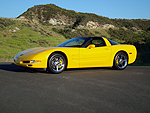
• Millennium Yellow available
• "Thin Spoke" versus "wagon wheel" design wheels become standard.
• Pup cats added to all models for LEV emissions requirements (5hp loss relative to 97-99)
• Steel swaybar endlinks instead of plastic on Z51 equipped cars
• Z51 swaybar diameters grow (25.4/21.7 to 28.6/21.7 to 28.6/23.6 (note: new rear same as Z06)
• No keyhole on passenger side doorhandle
• Passenger airbag 'off' switch added to console (light by TC/AH button)
2001
• Return to 28# injectors for all models.
• Second Generation Active Handling
• Nassau Blue discontinued
• Alternator 'clutch' pulley added on A4 cars
• New soundproofing + foam in all cars
• Smaller keyfob
• Electrochromic dimming rearview and driver's mirrors
• Lighter AGM battery
• Thickness + Material in Convertible change
• Chrome exhaust tips for coupe + Convertible
• 85MM MAF with integral temp sensor (versus 74mm with separate plug for IAT)
• LS1 cam profile changed to: .500/0.500, 198/208 on 115.5LSA (From: 0.472/0.479, 202/210 on 117)
• All Corvettes now have the LS6 intake manifold
• All Corvettes now have the LS6 engine block (windage passages in block), which includes a beefier oil pump.
• LS1 changes result in new output of 350 HP @ 5200 RPM and 375 Ft Lbs of torque @ 4400 RPM (MN6)
• Hardtop/FRC discontinued
• Stronger synchros in all transmissions
• Exhaust manifolds revised (5hp regained) - thin wall cast replacing SS manifolds
• Metal valvestem caps (late year)
• Torque Tube changed from metal-matrix composite to aluminum alloy 6061, increased in diameter from 55 to 63 mm.
• Driveshaft couplings have also been upgraded on manual-equipped models for additional strength and durability
• Introduction of the Z06, which has as differences:
• Hardtop body style
• Rear brake ducting
• Screened inlets on front fascia, without foglights
• F1 Supercar tires 265-17 front, 295-18 rear, on 17x9.5 and 18x10.5 (one inch wider, respectively
• New LS6 top-end with new style head design (10.5:1 compression, 64cc chamber), LS6 cam (0.525/0.525, 204/211 on 116) - 385hp
• M12 transmission with shorter gearing (1-2-3 analagous to MN6 with 3.90 rear diff
• Titanium exhaust system
• Lightweight windshield
• New, stronger clutch with redesigned master + slave cylinder
• Stronger rear differential (shotpeened ring gear)
• Red brake calipers (otherwise identical)
• Transmission overtemp warning light on DIC
• 6500 redline gauges with special checkering + Z06 font
• Redesigned PCV system to help combat oil burning
• Red LS6 Fuel Rail Covers (FRC's)
• FE4 Z06 suspension - uprated springs, bars (30mm/23.6mm), shocks (note front spring and rear bar same as Z51)
2002
• Z06 Changes:
• Z06 LS6 cam changed to: 0.551/0.547, 204/218 on 117.5
• Less restrictive intake airbox lid
• Descreened MAF
• Removal of pup-cats (total with changes = 405hp)
• Z06 shocks revised with less rebound for better launching
• Z06 brake pads revised for better stopping (generate more dust)
• Lighter, sodium filled valves w/ stronger valve springs
• Higher tension rings installed to prevent oil burning problems
• Slight piston redesign *
• Clutch strength upgraded.
• HUD available on Z06 (not avail '01 model year)
• Wheel supplier changed to Speedline, moved from forged to cast. Weight nearly identical
• Electron Blue color offered
• Steel endlinks changed to aluminum
2003
• Late model-year new fuel system design from C6's
2004
• Z06 shocks further refined. Accompanying upper front control arm bushing, and rear swaybar bushing changes.
1997
• Completely new, redesigned Corvette. Base (FE1) and Z51 (FE3) suspension packages.
• All Z51 cars include: Power Steering Cooler
• 97-00 C5 LS1's produce 345 HP @ 5600 RPM and 350 Ft Lbs of torque @ 4400 RPM.
1998
• Convertible becomes available
• Active Handling becomes available late in year
• The two slots of a 1998 (and possibly late 1997s) curve toward the rear at the bottom. (versus straight down)
1999
• 26# injectors substituted for 28#
• Fuel pump revised to reduce noise
• FRC "Fixed Roof Coupe" aka the hardtop, becomes available. All FRC's are MN6 (6-speed) cars with the Z51 suspension package, and are about 60lbs lighter than coupes.
• HUD introduced
• Only one line in driver's side fuel rail cover (no fuel return line?)
• Power telescoping wheel becomes an option
• Steering hardware changed to combat wandering
• Door sill trim plates added
2000
• Millennium Yellow available
• "Thin Spoke" versus "wagon wheel" design wheels become standard.
• Pup cats added to all models for LEV emissions requirements (5hp loss relative to 97-99)
• Steel swaybar endlinks instead of plastic on Z51 equipped cars
• Z51 swaybar diameters grow (25.4/21.7 to 28.6/21.7 to 28.6/23.6 (note: new rear same as Z06)
• No keyhole on passenger side doorhandle
• Passenger airbag 'off' switch added to console (light by TC/AH button)
2001
• Return to 28# injectors for all models.
• Second Generation Active Handling
• Nassau Blue discontinued
• Alternator 'clutch' pulley added on A4 cars
• New soundproofing + foam in all cars
• Smaller keyfob
• Electrochromic dimming rearview and driver's mirrors
• Lighter AGM battery
• Thickness + Material in Convertible change
• Chrome exhaust tips for coupe + Convertible
• 85MM MAF with integral temp sensor (versus 74mm with separate plug for IAT)
• LS1 cam profile changed to: .500/0.500, 198/208 on 115.5LSA (From: 0.472/0.479, 202/210 on 117)
• All Corvettes now have the LS6 intake manifold
• All Corvettes now have the LS6 engine block (windage passages in block), which includes a beefier oil pump.
• LS1 changes result in new output of 350 HP @ 5200 RPM and 375 Ft Lbs of torque @ 4400 RPM (MN6)
• Hardtop/FRC discontinued
• Stronger synchros in all transmissions
• Exhaust manifolds revised (5hp regained) - thin wall cast replacing SS manifolds
• Metal valvestem caps (late year)
• Torque Tube changed from metal-matrix composite to aluminum alloy 6061, increased in diameter from 55 to 63 mm.
• Driveshaft couplings have also been upgraded on manual-equipped models for additional strength and durability
• Introduction of the Z06, which has as differences:
• Hardtop body style
• Rear brake ducting
• Screened inlets on front fascia, without foglights
• F1 Supercar tires 265-17 front, 295-18 rear, on 17x9.5 and 18x10.5 (one inch wider, respectively
• New LS6 top-end with new style head design (10.5:1 compression, 64cc chamber), LS6 cam (0.525/0.525, 204/211 on 116) - 385hp
• M12 transmission with shorter gearing (1-2-3 analagous to MN6 with 3.90 rear diff
• Titanium exhaust system
• Lightweight windshield
• New, stronger clutch with redesigned master + slave cylinder
• Stronger rear differential (shotpeened ring gear)
• Red brake calipers (otherwise identical)
• Transmission overtemp warning light on DIC
• 6500 redline gauges with special checkering + Z06 font
• Redesigned PCV system to help combat oil burning
• Red LS6 Fuel Rail Covers (FRC's)
• FE4 Z06 suspension - uprated springs, bars (30mm/23.6mm), shocks (note front spring and rear bar same as Z51)
2002
• Z06 Changes:
• Z06 LS6 cam changed to: 0.551/0.547, 204/218 on 117.5
• Less restrictive intake airbox lid
• Descreened MAF
• Removal of pup-cats (total with changes = 405hp)
• Z06 shocks revised with less rebound for better launching
• Z06 brake pads revised for better stopping (generate more dust)
• Lighter, sodium filled valves w/ stronger valve springs
• Higher tension rings installed to prevent oil burning problems
• Slight piston redesign *
• Clutch strength upgraded.
• HUD available on Z06 (not avail '01 model year)
• Wheel supplier changed to Speedline, moved from forged to cast. Weight nearly identical
• Electron Blue color offered
• Steel endlinks changed to aluminum
2003
• Late model-year new fuel system design from C6's
2004
• Z06 shocks further refined. Accompanying upper front control arm bushing, and rear swaybar bushing changes.
Racer

Joined: Apr 2008
Posts: 408
Likes: 6
From: Santa Clarita CA
Probably the best bang for your buck is going to be a 2002 regardless of the model (FYI I own a 2K Vette so this is an unbiased opinion). Most of the major enhancements came in 2001 as you can see from the list of changes that was posted, but the 2001's (many of them at least) burned oil pretty bad. 2002's didn't and they're nearly identical to the 2004 but you save $$ because it's 2 years older. Obviously if money isn't a factor (rare), then the newer the better.
The most important thing though is to find one that has been treated right. Preferably one owner and obviously the lower the miles the better, but these things will last a long time if treated right so the mileage isn't super important as long as it was properly maintained and cared for.
If this is for a first time Vette owner I wouldn't buy one that had been heavily modded, you don't really know what you're getting (this includes audio/lighting mods). Some people don't do anything unless they're gonna do it right, but for every one of those there's another that doesn't know what they're doing, and if they've been playing around with the wiring it could be a real mess.
Also, if it's been significantly modded for hp/performance, it's a pretty safe bet the owner made good use of that power. If it's stock or nearly stock you know exactly what you're getting as long as it's been cared for. Most cars are going to have an aftermarket exhaust and probably a cold air intake which is fine, and maybe some aftermarket wheels. Anything beyond that I'd be very careful if I were your friend.
Obviously, all the proper precautions should be taken whether he's buying a Vette or any other expensive vehicle. Have him read the whole "Buyer Beware eBay Nightmare" thread that's been active lately here: http://forums.corvetteforum.com/show....php?t=2020847. It's a good horror story but more importantly there's a ton of good buying advice in there, such as never buy a car sight unseen, never buy one at night, always get it inspected by an independent mechanic before paying for it, run an AutoCheck on it (not Carfax it's worthless) before buying etc. etc.. There's also a member on this site that can tell you the compltete options lists and service history for any Corvette if you give him the VIN privately and ask him nicely . That's very useful.
Hope he finds one!
The most important thing though is to find one that has been treated right. Preferably one owner and obviously the lower the miles the better, but these things will last a long time if treated right so the mileage isn't super important as long as it was properly maintained and cared for.
If this is for a first time Vette owner I wouldn't buy one that had been heavily modded, you don't really know what you're getting (this includes audio/lighting mods). Some people don't do anything unless they're gonna do it right, but for every one of those there's another that doesn't know what they're doing, and if they've been playing around with the wiring it could be a real mess.
Also, if it's been significantly modded for hp/performance, it's a pretty safe bet the owner made good use of that power. If it's stock or nearly stock you know exactly what you're getting as long as it's been cared for. Most cars are going to have an aftermarket exhaust and probably a cold air intake which is fine, and maybe some aftermarket wheels. Anything beyond that I'd be very careful if I were your friend.
Obviously, all the proper precautions should be taken whether he's buying a Vette or any other expensive vehicle. Have him read the whole "Buyer Beware eBay Nightmare" thread that's been active lately here: http://forums.corvetteforum.com/show....php?t=2020847. It's a good horror story but more importantly there's a ton of good buying advice in there, such as never buy a car sight unseen, never buy one at night, always get it inspected by an independent mechanic before paying for it, run an AutoCheck on it (not Carfax it's worthless) before buying etc. etc.. There's also a member on this site that can tell you the compltete options lists and service history for any Corvette if you give him the VIN privately and ask him nicely
. That's very useful.Hope he finds one!
Last edited by EDenney; May 29, 2008 at 08:03 AM.

Pro


Joined: Jul 2004
Posts: 500
Likes: 1
From: Anna Ohio
I wouldn't get too hung up on the newest and lowest mileage one you can afford. I bought my first vette 8 months ago. Wanted a C5, could pretty much "afford" whatever I wanted, but found the best value to be in the 97/98's. Ended up paying cash for my 97 with 50K on the clock.
Absolutely 100% happy with my purchase. Good luck!
Absolutely 100% happy with my purchase. Good luck!

7th Gear
Joined: May 2008
Posts: 7
Likes: 0
From: Leesburg GA
"the 2001's (many of them at least) burned oil pretty bad. 2002's didn't"
EDenney - I'm new to this forum. Where did that info come from? Is it fact and if so, what is the reason for it? I can't imagine what is different enough in the engine to cause this problem.
Anybody?
EDenney - I'm new to this forum. Where did that info come from? Is it fact and if so, what is the reason for it? I can't imagine what is different enough in the engine to cause this problem.
Anybody?
Corvette Stories
The Best of Corvette for Corvette Enthusiasts

5 Best & 5 Worst Corvette Daily Drivers
Joe Kucinski
The Headlights of Every Corvette Generation Explained
Joe Kucinski
5 Best & 5 Most Overrated Corvette Track Packages of All Time!
Joe Kucinski
Every 2027 Corvette Engine Explained
Joe Kucinski
Designer Imagines A Corvette That Looks More Like a Corvette Than the Corvette
Verdad Gallardo
10 Ugly Corvettes That We Still Kinda Love
Joe Kucinski
Top 10 Most Expensive Corvettes Ever Sold on Bring A Trailer
Brett Foote
10 Things Every Corvette Owner Needs (2026 Edition)
Michael S. Palmer
8 Most "Only Corvette Owners Understand" Quirks and Problems
Pouria Savadkouei
Safety Car

Joined: May 2006
Posts: 3,799
Likes: 1
From: Northern Virginia
St. Jude Donor '08
"the 2001's (many of them at least) burned oil pretty bad. 2002's didn't"
EDenney - I'm new to this forum. Where did that info come from? Is it fact and if so, what is the reason for it? I can't imagine what is different enough in the engine to cause this problem.
Anybody?
EDenney - I'm new to this forum. Where did that info come from? Is it fact and if so, what is the reason for it? I can't imagine what is different enough in the engine to cause this problem.
Anybody?
Oil woes
Many late 2000 thru 2001 Vette's burn a lot of oil when the engine is kept constantly over 4,000 rpm's. This is caused by ring flutter, which allows extra oil to seep past the oil control rings, but doesn't seem to cause any extra wear to the engine. Chevrolet has rebuilt and replaced engines for owners that complained about excessive oil consumption. Their policy is that while the engine isn't normally operated like that outside of racing, it is the owner's prerogative to drive around in second gear all the time if they want to. It is covered under the warranty.
The PCV system also has a tendency to suck oil back into the intake at high rpm's. It doesn't seem to cause any problems, other than a slight mess inside the intake manifold. The newer style PCV system can be installed, but this requires removing all the components in the top of the engine valley. Usually only racer's bother with the hassle. Several generations of PCV systems have had the problem, and at this time, December 2004, the PCV system still sucks oil into the intake.
The oil-sucking problem will cause carbon buildup in the cylinders. The dealership sells GM Top End Cleaner, and Napa sells SeaFoam. The Top End Cleaner is not available in some smog states like California. Run a tube from the bottle into the hole for the PCV system behind the throttle body on the passenger side. Start the car, then start slowly sucking the solution into the engine. Don’t go too fast or the engine could lockup. As soon as the solution is gone, stop the motor for >4 hours, but preferably 12 hours. Be aware that when the engine is restarted, there will be a LOT of smoke!
The oil-sucking can be prevented by installing a catch can. AMW and Greddy make catch cans, but a homebuilt catch can may be built using a Campbell-Hausfield air tool oil separator from most tool stores, including AutoZone. The AMW and Greddy cans are ~$100, but look great. The CH can is $15-25 for all the parts, and you can see how much oil is in it.
Source:
http://forums.corvetteforum.com/showthread.php?t=984927
Safety Car
Joined: May 2006
Posts: 3,799
Likes: 1
From: Northern Virginia
St. Jude Donor '08
If you are looking for information about the various years I suggest you look here.
http://www.corvetteactioncenter.com/specs/
http://www.corvetteactioncenter.com/specs/
