







torque vs. H.P., whats better ?

Thread Starter
Drifting

Joined: Nov 2007
Posts: 1,554
Likes: 2
 torque vs. H.P., whats better ?
OK, moving right along then, my particular Vette measures 331RWHP and 347RWTorque, would my car be faster the other way around ??
Why do some cars have HP and torque about even, some, HP is much higher than torque and others, like me the torque is higher than the HP, why the 3 different seperations, is it the tune ? Gears ?
In laymans terms, how would you define HP and then torque ? Why do I ask so many questions?
My quess is torque is better, dunno really.
Thanks,

Why do some cars have HP and torque about even, some, HP is much higher than torque and others, like me the torque is higher than the HP, why the 3 different seperations, is it the tune ? Gears ?
In laymans terms, how would you define HP and then torque ? Why do I ask so many questions?
My quess is torque is better, dunno really.
Thanks,

Drifting
Joined: Sep 2007
Posts: 1,442
Likes: 1
The amount of hp and tq an engine has depends on how the engine is setup. If it is a high rpm engine it will have more hp than tq pretty much every time. Our engines dont rev real high so you will see the tq and hp values be about the same. All engines that rev below 5200 rpm will have more tq than hp.
As to which one is more important, it would be torque but not just torque.. it has to do with how high it revs and what the gearing is like. Gears multiply torque so you will want your gears to be as short as possible when you you accelerate (so you will have more thrust). But there is a down side to aggressive gears... if your engine does not rev high enough then you cant go too crazy with the gearing because you will be shifting too often and the terminal speed in each gear will be reduced.
Horsepower will give you the best idea on the performance of a car though. High hp and low tq cars can be geared very aggressively to make up for the lack of tq. Usually you will see cars with similar hp to weight ratios perform pretty close.
Im not real good at explaining some of this but if there is anything you want me to elaborate on let me know.
As to which one is more important, it would be torque but not just torque.. it has to do with how high it revs and what the gearing is like. Gears multiply torque so you will want your gears to be as short as possible when you you accelerate (so you will have more thrust). But there is a down side to aggressive gears... if your engine does not rev high enough then you cant go too crazy with the gearing because you will be shifting too often and the terminal speed in each gear will be reduced.
Horsepower will give you the best idea on the performance of a car though. High hp and low tq cars can be geared very aggressively to make up for the lack of tq. Usually you will see cars with similar hp to weight ratios perform pretty close.
Im not real good at explaining some of this but if there is anything you want me to elaborate on let me know.
Last edited by RespondsWithGif; Oct 27, 2008 at 04:23 PM.

Drifting
Joined: Sep 2008
Posts: 1,410
Likes: 2
From: Chicago IL
I read an article about this a while ago. It explains how you calculate torque and horsepower. I think at like 4500rpm (somewhere around there) HP and TQ are equal. I don't remember the details, but you can just google this.

Former Vendor
Joined: Nov 2005
Posts: 8,995
Likes: 2
From: Spring Texas
St. Jude Donor '08
Torque is instantanious power. HP is power at a certain engine speed. Think of it like this:
A waterwheel creates a LOT of torque, but the speed is rather low so the HP is low
An average walk-behind mower motor spins rather quickly and has 5-7hp, but doesn't have a lot of torque to cut un-tamed grass.
Personall Tq and HP take a back seat to lbs of thrust

Drifting
Joined: Sep 2007
Posts: 1,442
Likes: 1
Originally Posted by TheRadioFlyer
Lol
Torque is instantanious power. HP is power at a certain engine speed. Think of it like this:
A waterwheel creates a LOT of torque, but the speed is rather low so the HP is low
An average walk-behind mower motor spins rather quickly and has 5-7hp, but doesn't have a lot of torque to cut un-tamed grass.
Personall Tq and HP take a back seat to lbs of thrust
Torque is instantanious power. HP is power at a certain engine speed. Think of it like this:
A waterwheel creates a LOT of torque, but the speed is rather low so the HP is low
An average walk-behind mower motor spins rather quickly and has 5-7hp, but doesn't have a lot of torque to cut un-tamed grass.
Personall Tq and HP take a back seat to lbs of thrust
Corvette Stories
The Best of Corvette for Corvette Enthusiasts

5 Best & 5 Worst Corvette Daily Drivers
Joe Kucinski
The Headlights of Every Corvette Generation Explained
Joe Kucinski
5 Best & 5 Most Overrated Corvette Track Packages of All Time!
Joe Kucinski
Every 2027 Corvette Engine Explained
Joe Kucinski
Designer Imagines A Corvette That Looks More Like a Corvette Than the Corvette
Verdad Gallardo
10 Ugly Corvettes That We Still Kinda Love
Joe Kucinski
Top 10 Most Expensive Corvettes Ever Sold on Bring A Trailer
Brett Foote
10 Things Every Corvette Owner Needs (2026 Edition)
Michael S. Palmer
8 Most "Only Corvette Owners Understand" Quirks and Problems
Pouria Savadkouei
Thread Starter
Drifting
Joined: Nov 2007
Posts: 1,554
Likes: 2
I was doing ok understanding but then 'thrust' entered the equation ?
THRUST, isn`t that for a jet engine ? Bubbles from the Chi-Chi Room, she has excellent thrust.
A dyno chart would show correlations at various RPM`s very well, I think.
THRUST, isn`t that for a jet engine ? Bubbles from the Chi-Chi Room, she has excellent thrust.
A dyno chart would show correlations at various RPM`s very well, I think.
Pro


Joined: Oct 2007
Posts: 607
Likes: 29
From: Tulsa Oklahoma
Torque is a rotational force. It is a measurable quantity. Horsepower is a derived quantity. By definition, it is impossible to have horsepower with out torque. 1 hp = 550 ft-lbsf/sec. We can also rate our cars power using Watts...the common measure of the power of a light bulb. In fact, most European cars use the Watt as the standard measure of power in automobiles. The term horsepower gets thrown around so much it is no wonder why the confusion exists. As to which is better, the question is impossible to answer, at 5252 rpm they are equal. It depends on the application. 


Race Director

Joined: Jan 2006
Posts: 10,554
Likes: 33
From: Not on either liberal coast.
Horsepower...
http://en.wikipedia.org/wiki/Horsepower
Torque...
http://en.wikipedia.org/wiki/Torque
Torque is what you feel in your buttnometer. Horsepower is what you bench race.
BHP...
http://en.wikipedia.org/wiki/Horsepower
Torque...
http://en.wikipedia.org/wiki/Torque
Torque is what you feel in your buttnometer. Horsepower is what you bench race.
BHP...
SAE gross horsepower
Prior to the 1972 model year, American automakers rated and advertised their engines in brake horsepower (bhp), frequently referred to as SAE gross horsepower because it was measured in accord with the protocols defined in SAE standards J245 and J1995. As with other brake horsepower test protocols, SAE gross hp was measured using a blueprinted test engine running on a stand with no belt-driven accessories, air cleaner, mufflers, or emission control devices and sometimes fitted with long tube "test headers" in lieu of the OEM exhaust manifolds.[citation needed] The atmospheric correction standards for barometric pressure, humidity and temperature were relatively idealistic. The resulting gross power and torque figures therefore reflected a maximum, theoretical value and not the power of an installed engine in a street car. Gross horsepower figures were also subject to considerable adjustment by the manufacturer's advertising and marketing staff under the direction of product managers.[citation needed] The power ratings of mass-market engines were often exaggerated beyond their actual gross output, while those of the highest-performance muscle car engines often tended to be closer in actual output to their advertised, gross ratings.[citation needed]
No pre-1972 engine in its unaltered, production line stock form, as installed in the vehicle, has ever yielded documented, qualified third party validated power figures that equal or exceed its original gross rating.[citation needed] Claims that such engines were "under-rated" are therefore dubious; for example, the 1969 427 ZL1 Chevrolet, rated at 430 bhp (320.7 kW), is frequently cited[who?] as an "under-rated" high performance engine, yet it produced only 376 horsepower (280 kW).[9
Prior to the 1972 model year, American automakers rated and advertised their engines in brake horsepower (bhp), frequently referred to as SAE gross horsepower because it was measured in accord with the protocols defined in SAE standards J245 and J1995. As with other brake horsepower test protocols, SAE gross hp was measured using a blueprinted test engine running on a stand with no belt-driven accessories, air cleaner, mufflers, or emission control devices and sometimes fitted with long tube "test headers" in lieu of the OEM exhaust manifolds.[citation needed] The atmospheric correction standards for barometric pressure, humidity and temperature were relatively idealistic. The resulting gross power and torque figures therefore reflected a maximum, theoretical value and not the power of an installed engine in a street car. Gross horsepower figures were also subject to considerable adjustment by the manufacturer's advertising and marketing staff under the direction of product managers.[citation needed] The power ratings of mass-market engines were often exaggerated beyond their actual gross output, while those of the highest-performance muscle car engines often tended to be closer in actual output to their advertised, gross ratings.[citation needed]
No pre-1972 engine in its unaltered, production line stock form, as installed in the vehicle, has ever yielded documented, qualified third party validated power figures that equal or exceed its original gross rating.[citation needed] Claims that such engines were "under-rated" are therefore dubious; for example, the 1969 427 ZL1 Chevrolet, rated at 430 bhp (320.7 kW), is frequently cited[who?] as an "under-rated" high performance engine, yet it produced only 376 horsepower (280 kW).[9
Last edited by hotwheels57; Oct 27, 2008 at 06:27 PM.
Pro
Joined: Oct 2007
Posts: 607
Likes: 29
From: Tulsa Oklahoma
The use of thrust is not necessarily accurate in this situation. A thrust is internal to a system. Thrust is a force which acts equally and opposite a system or mass.

Race Director
Joined: Dec 2004
Posts: 13,760
Likes: 75
From: Haymarket VA
There is no simple answer. It depends how YOU want to use the car. For drag racing, peak RWHP is king since you're always in the upper RPM. For overall driving, autocross and road racing, you would want a power curve that enables you to merge and come out of corners without having to rev the engine sky high or wait to make power.
This is my dyno graph. I make 380 RWT at 2200RPM and 400RWT from 3k up. Tip is is insane and I can roast the tires from just off idle. The average power is usable and a blast to drive.
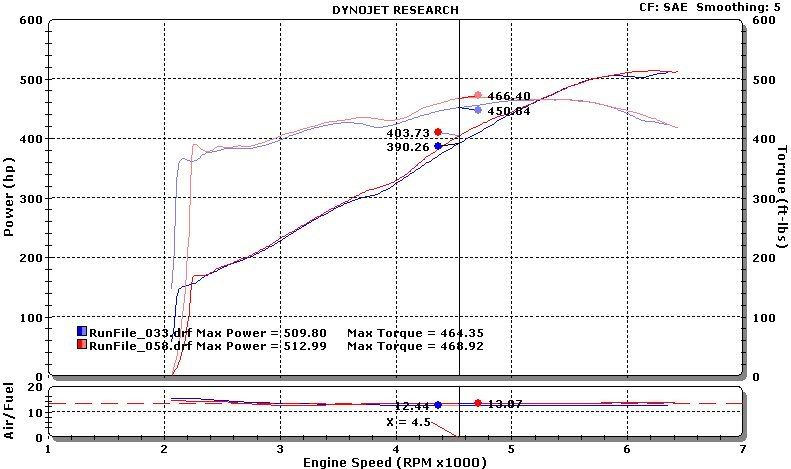
This is my dyno graph. I make 380 RWT at 2200RPM and 400RWT from 3k up. Tip is is insane and I can roast the tires from just off idle. The average power is usable and a blast to drive.
Thread Starter
Drifting
Joined: Nov 2007
Posts: 1,554
Likes: 2
Aha, so you mean like, "for very action there is an opposite and equal re-action"? Wow kinda gettin more complicated, so keeping it simple for a simpleton like me, and using Bubbles (something I am more "learned" about), she does something, a movement or sequence with more "energy" and I throw more "higher energy" money, like that or ?

Pro
Joined: Oct 2007
Posts: 607
Likes: 29
From: Tulsa Oklahoma
Aha, so you mean like, "for very action there is an opposite and equal re-action"? Wow kinda gettin more complicated, so keeping it simple for a simpleton like me, and using Bubbles (something I am more "learned" about), she does something, a movement or sequence with more "energy" and I throw more "higher energy" money, like that or ?



Race Director


Joined: Apr 2007
Posts: 11,152
Likes: 890
From: South Western Ontario
If you just give a rear wheel torque number and a rear wheel HP number then they are useless to compare to another car. You need to know the rpm at those number or even better the torque curve and rpm curve.
Torque is a force causing a rotation.
HP is the measure of how much work that torque does.
HP = Torque x rpm / 5250
1 HP = 33,000 lb-ft per minute.
A simple example - lifting a 1lb weight 33,000ft in 1 minute is 1HP of work done.
If you kept lifting for 1 minute at 0.99999lbs of force so didn't actually move the weight then you would have done no work - 0 HP.
The important parts;
If the torque is the same and the rpm goes up then the HP is greater. Many people say torque gets you out of the hole and HP is the top end acceleration but that's not really true. It's just that the torque is always greater than the HP below 5250 rpm. Simple math. Many people wrongly think that since torque is a greater number it must have a greater effect on acceleration down low.
The most available rear wheel HP over the operating range of the engine will make the car accelerate the quickest. You could have a low revving high torque engine or a high revving low torque engine and still achieve the same basic goal. It all depends on the torque curve, gears and such how that torque is converted to rear wheel horsepower.
This is the reason you want to get the engine up in rpm at the top of it's power band. Sure, the LSx engines have a nice flat torque curve but with a completely flat torque curve you always have more HP at a higher rpm. So, get the rpm up and the car accelerates quicker. Gears allow you to do this. A nice spread between gears helps too. The new cars with the CVT (continually variable transmissions) should in theory accelerate better because the engine can be put at the rpm where the best power transfer to the ground occurs.
Not true. HP and torque are not measuring the same thing.
Peter
Torque is a force causing a rotation.
HP is the measure of how much work that torque does.
HP = Torque x rpm / 5250
1 HP = 33,000 lb-ft per minute.
A simple example - lifting a 1lb weight 33,000ft in 1 minute is 1HP of work done.
If you kept lifting for 1 minute at 0.99999lbs of force so didn't actually move the weight then you would have done no work - 0 HP.
The important parts;
If the torque is the same and the rpm goes up then the HP is greater. Many people say torque gets you out of the hole and HP is the top end acceleration but that's not really true. It's just that the torque is always greater than the HP below 5250 rpm. Simple math. Many people wrongly think that since torque is a greater number it must have a greater effect on acceleration down low.
The most available rear wheel HP over the operating range of the engine will make the car accelerate the quickest. You could have a low revving high torque engine or a high revving low torque engine and still achieve the same basic goal. It all depends on the torque curve, gears and such how that torque is converted to rear wheel horsepower.
This is the reason you want to get the engine up in rpm at the top of it's power band. Sure, the LSx engines have a nice flat torque curve but with a completely flat torque curve you always have more HP at a higher rpm. So, get the rpm up and the car accelerates quicker. Gears allow you to do this. A nice spread between gears helps too. The new cars with the CVT (continually variable transmissions) should in theory accelerate better because the engine can be put at the rpm where the best power transfer to the ground occurs.
Peter