


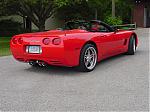





 Wonder how Anniversary Red would hold up or turn out ?


Dr.Colorchip

Thread Starter
Burning Brakes


Joined: Aug 2010
Posts: 1,060
Likes: 85
From: Richmond VA Everyone should have a VetteGuard
 Dr.Colorchip
So I ordered and tried this stuff and it seems to work pretty well as long as you keep in mind its a repair and not a repaint job. I did something stupid, I didn't take before/after pic's. However, if you follow the directions it does work pretty well. I'm the 2nd owner (which means I didn't do it!!! ) and had an area on the drivers door where it looked like someone opened it onto some rough area, and there was a 3" rash on the door edge. First I used some nail polish removed on the areas to repair, thanks wife! To remove the wax. I applied the "colorchip paint, as per the directions, layering it on in the deep areas, then wiping it off right away with the glove supplied. Had another area on the corner near the back edge about the size of a nickle. Cleaned with polish remover, then applied the paint heavy, and wiped right away. The you apply this removed, putting a little on a cloth supplied, and gently moving, not rubbing across the paint area. It seems to re-flow the paint into the damaged area, and remove any excess from the surrounding. Then buff with a mirco rag. It turned out good, if you didn't now it was there before you would probably not notice. My Vette is Torch Red, the color in the heavy nickel area is just a 1/2 shade darker . Questions let me know. I think the stuff works pretty well, results depend on your color and size and area. I'm good with it.
) and had an area on the drivers door where it looked like someone opened it onto some rough area, and there was a 3" rash on the door edge. First I used some nail polish removed on the areas to repair, thanks wife! To remove the wax. I applied the "colorchip paint, as per the directions, layering it on in the deep areas, then wiping it off right away with the glove supplied. Had another area on the corner near the back edge about the size of a nickle. Cleaned with polish remover, then applied the paint heavy, and wiped right away. The you apply this removed, putting a little on a cloth supplied, and gently moving, not rubbing across the paint area. It seems to re-flow the paint into the damaged area, and remove any excess from the surrounding. Then buff with a mirco rag. It turned out good, if you didn't now it was there before you would probably not notice. My Vette is Torch Red, the color in the heavy nickel area is just a 1/2 shade darker . Questions let me know. I think the stuff works pretty well, results depend on your color and size and area. I'm good with it.

Administrator


Joined: Mar 2001
Posts: 368,611
Likes: 24,865
From: In a parallel universe. Currently own 2014 Stingray Coupe.
C7 of the Year - Modified Finalist 2021
MO Events Coordinator
St. Jude Co-Organizer
St. Jude Donor '03 thru '26
NCM Sinkhole Donor
CI 5, 8 & 11 Veteran
Have been wondering about that stuff. Saw a demo at Bloomington Gold this year and was impressed. Good to hear the average Joe has good results with it.

Race Director


Joined: Aug 1999
Posts: 11,126
Likes: 673
From: SE Pennsylvania
St. Jude Donor '03 thru '26
Oldtimer

Melting Slicks

Joined: Dec 2003
Posts: 2,857
Likes: 2
From: pawleys island sc
for the price of this stuff I can't understand why you guys are holding off. I'll bet at least 2 of you have spent 3 times as much for a fuzzy ball for you shift lever (lol).
Seriously, for the price, ease of application and results on stone chips this is the absolute best touch up system I've used in the past 54 years. It REALLY works - on sone chips and SMALL scratches.
You CAN NOT re-paint your car with this stuff.
Try it, you'll like it.
Seriously, for the price, ease of application and results on stone chips this is the absolute best touch up system I've used in the past 54 years. It REALLY works - on sone chips and SMALL scratches.
You CAN NOT re-paint your car with this stuff.
Try it, you'll like it.
Corvette Stories
The Best of Corvette for Corvette Enthusiasts

5 Best & 5 Worst Corvette Daily Drivers
Joe Kucinski
The Headlights of Every Corvette Generation Explained
Joe Kucinski
5 Best & 5 Most Overrated Corvette Track Packages of All Time!
Joe Kucinski
Every 2027 Corvette Engine Explained
Joe Kucinski
Designer Imagines A Corvette That Looks More Like a Corvette Than the Corvette
Verdad Gallardo
10 Ugly Corvettes That We Still Kinda Love
Joe Kucinski
Top 10 Most Expensive Corvettes Ever Sold on Bring A Trailer
Brett Foote
10 Things Every Corvette Owner Needs (2026 Edition)
Michael S. Palmer
8 Most "Only Corvette Owners Understand" Quirks and Problems
Pouria Savadkouei


Drifting


Joined: Apr 2007
Posts: 1,517
Likes: 160
From: Lafayette Louisiana


Safety Car


Joined: Aug 2008
Posts: 4,306
Likes: 1
From: Red city in deep blue Oregon
St. Jude Donor '17
My kit arrived today. 3 days since I ordered. 
I haven't even opened it yet cuz we left for a couple day trip.
I'll post when we get back and I apply the kit. Before/after pics will be included.
Stay tuned.
I haven't even opened it yet cuz we left for a couple day trip.
I'll post when we get back and I apply the kit. Before/after pics will be included.
Stay tuned.




Burning Brakes


Joined: Mar 2010
Posts: 921
Likes: 134
From: Chicago Illinois
Safety Car
Joined: Aug 2008
Posts: 4,306
Likes: 1
From: Red city in deep blue Oregon
St. Jude Donor '17
OK....here we go, as promised. 
I opened up the kit and here are the contents:
Instruction sheet, small bottle of LMB paint, 1 nitrile glove, lint-free cloth, double-ended brush with a very tiny pointed tip on one end, and a bottle of blending solution.

The instructions say to be sure the areas you're gonna work on are clean and dry. Then use rubbing alcohol to remove wax from the affected areas. Next you apply the paint with the supplied brush, and immediately but gently wipe excess paint off with the flat of your nitrile-gloved thumb. You want the new paint flat with the existing surface.
Let the paint dry at least 2 minutes and then use the blending solution on the supplied lint-free cloth to remove paint from where it shouldn't be, and finally buff with a microfiber cloth or fluffy cotton towel of your own.
I went around the car with the paint, immediately wiping with the nitrile glove. Took me about 10 minutes, so I figured I was ready for the blending solution. It did a nice job of re-flowing the paint, while removing it from non-affected paint surrounding the scratch. About 15 minutes to go around the car. I probably had about 10 areas to repair, mostly tiny rock chips. The worst scratch is on the rear fascia, and it was pretty deep. I think I'm gonna redo it and layer paint in there better as mentioned in a post above.
Again, most of mine were tiny, so I've got a lot of paint and blending solution left over to work with.
Here's a couple of before/after pics, as best I could capture them.
Before: Driver's side headlight cover, with 6 or 7 tiny rock chips.

After: The stickies were placed as I painted so I didn't miss any areas with the blending solution. I placed the stickies ABOVE the treated scratches, so look below.

Before: Deep fascia scratch

After:

Here's what the wiping cloth looked like after completing the blending solution wipedown.

Here's the supplied brush with the tiny tip, after use.

Again, I've got a couple of spots that I'm gonna hit again, but I think it did a better job than any of the standard "touch-up" paints I've used before.
I opened up the kit and here are the contents:
Instruction sheet, small bottle of LMB paint, 1 nitrile glove, lint-free cloth, double-ended brush with a very tiny pointed tip on one end, and a bottle of blending solution.
The instructions say to be sure the areas you're gonna work on are clean and dry. Then use rubbing alcohol to remove wax from the affected areas. Next you apply the paint with the supplied brush, and immediately but gently wipe excess paint off with the flat of your nitrile-gloved thumb. You want the new paint flat with the existing surface.
Let the paint dry at least 2 minutes and then use the blending solution on the supplied lint-free cloth to remove paint from where it shouldn't be, and finally buff with a microfiber cloth or fluffy cotton towel of your own.
I went around the car with the paint, immediately wiping with the nitrile glove. Took me about 10 minutes, so I figured I was ready for the blending solution. It did a nice job of re-flowing the paint, while removing it from non-affected paint surrounding the scratch. About 15 minutes to go around the car. I probably had about 10 areas to repair, mostly tiny rock chips. The worst scratch is on the rear fascia, and it was pretty deep. I think I'm gonna redo it and layer paint in there better as mentioned in a post above.
Again, most of mine were tiny, so I've got a lot of paint and blending solution left over to work with.
Here's a couple of before/after pics, as best I could capture them.
Before: Driver's side headlight cover, with 6 or 7 tiny rock chips.
After: The stickies were placed as I painted so I didn't miss any areas with the blending solution. I placed the stickies ABOVE the treated scratches, so look below.
Before: Deep fascia scratch
After:
Here's what the wiping cloth looked like after completing the blending solution wipedown.
Here's the supplied brush with the tiny tip, after use.
Again, I've got a couple of spots that I'm gonna hit again, but I think it did a better job than any of the standard "touch-up" paints I've used before.

Drifting
Joined: Nov 2001
Posts: 1,319
Likes: 1
From: Lincoln Nebraska