



2000 Navy Blue- difficult to match?
Thread Starter
Racer


Joined: Mar 2005
Posts: 286
Likes: 36
From: Scituate, MA
 2000 Navy Blue- difficult to match?
About 5 years ago, I had the nose of my 2000 coupe painted, after having a crack at the end of the turn signal/parking lights repaired. The crack was about an inch long, and not that noticeable. I had the work done any way because I had confidence in my body man, who had made several accidents on other cars completely go away. Also, at that time the car had only 25,000 miles on it.
Body Shop #1 tried to match it twice. The first time it was close, but there was a milky haze at the top of the bumper cover. I had paid $750 for the work and thought that it should be done again. The second time it came out too dark, discernible in any light, but easiest to see with overhead lights, as in my garage. Body shop #1 is thought to be the best in the area, and I had many mistakes repaired before. I was buffaloed as to why they couldn't match it, and just chalked it up to a fall off in their quality control.
This past winter I hit the same area again, trying to get out of my garage, hitting a huge bank of ice and snow at the entrance. I hadn't driven the car in 5 weeks, and I needed to give it a run.
This past week I brought it in to Body Shop 2, to fix the returned crack, and to re-shoot the bumper cover for a better match.
The price was much better, and I really liked the owner, who had a lot of high end work in his shop. Upon picking up the car today I was really disappointed again with the color match, which was virtually the same as the tone of the work as done by Body Shop #1, second attempt.
The car is 11 years old, perhaps the rest of the hood is faded? Or, maybe there is more than one formula for Navy Blue? Whatever the reason, I am 0 for 3 on this work- with first class shops, and I'm starting to think there is some trick to matching the color.
Does any body out there have any experience with matching this color?
Thanks,
Bluemill
Body Shop #1 tried to match it twice. The first time it was close, but there was a milky haze at the top of the bumper cover. I had paid $750 for the work and thought that it should be done again. The second time it came out too dark, discernible in any light, but easiest to see with overhead lights, as in my garage. Body shop #1 is thought to be the best in the area, and I had many mistakes repaired before. I was buffaloed as to why they couldn't match it, and just chalked it up to a fall off in their quality control.
This past winter I hit the same area again, trying to get out of my garage, hitting a huge bank of ice and snow at the entrance. I hadn't driven the car in 5 weeks, and I needed to give it a run.
This past week I brought it in to Body Shop 2, to fix the returned crack, and to re-shoot the bumper cover for a better match.
The price was much better, and I really liked the owner, who had a lot of high end work in his shop. Upon picking up the car today I was really disappointed again with the color match, which was virtually the same as the tone of the work as done by Body Shop #1, second attempt.
The car is 11 years old, perhaps the rest of the hood is faded? Or, maybe there is more than one formula for Navy Blue? Whatever the reason, I am 0 for 3 on this work- with first class shops, and I'm starting to think there is some trick to matching the color.
Does any body out there have any experience with matching this color?
Thanks,
Bluemill
Le Mans Master


Joined: Nov 2009
Posts: 6,119
Likes: 156
From: Huntington tx
GM even had trouble building C5's that all the body panels perfectly matched from the factory. I've had several attempts made at various body panels to get the best "possible" look from different paint formulas using VIN, scan, and color codes. Then upon getting very critical about trying three different color matches.....I noticed that the original body panels also had different "aspects" of color depending which material the body panels used. SMC stuff(front and rear bumpers) looked different from main body stuff.
Anyway...the point I wanted to make was....don't beat yourself up over worrying about the perfect match.
Anyway...the point I wanted to make was....don't beat yourself up over worrying about the perfect match.

Le Mans Master
Joined: Nov 2005
Posts: 6,993
Likes: 25
Don't really have to use flex additive with Urethane paint.
When I painted my Navy Blue front facsia, MCM hood and rear spoiler the match was nice. When I bought the car, it had some rock nicks on the head lamp covers and the tonneau cover from the top rubbing and the outfit I bought the car from had it those parts painted, nice match too. It's almost impossible to get a 100% match without painting the entire car-blending helps but even slight variations in metallic density can make it look different to the eye in different lights.
When I painted my Navy Blue front facsia, MCM hood and rear spoiler the match was nice. When I bought the car, it had some rock nicks on the head lamp covers and the tonneau cover from the top rubbing and the outfit I bought the car from had it those parts painted, nice match too. It's almost impossible to get a 100% match without painting the entire car-blending helps but even slight variations in metallic density can make it look different to the eye in different lights.
Safety Car


Joined: Jan 2000
Posts: 3,902
Likes: 248
From: Orlando FL
I just had a top painted to match my 2000 NBM. The match is dead perfect. A friend painted mine, we discovered that there are 2 NBM on the color chip for the 2000 model year. One is slightly darker, we took the chips and matched to the car, can't tell it was painted.

Racer
Joined: Sep 2008
Posts: 310
Likes: 0
From: Coral Springs Fl
UV rays from sunlight and washing with harsh detergent will fade the paint. You really only see it when new is next to old though the color matching should have taken care of that. Car is 11 yrs old, I'm sure there is some paint fading. And most likely, you are the only one that sees the darker repair because you know it's there. Ask someone else to look at the area and see if they see anything. I bet not. Have a beer and don't worry about it. 
Le Mans Master
Joined: Nov 2005
Posts: 6,993
Likes: 25
UV rays from sunlight and washing with harsh detergent will fade the paint. You really only see it when new is next to old though the color matching should have taken care of that. Car is 11 yrs old, I'm sure there is some paint fading. And most likely, you are the only one that sees the darker repair because you know it's there. Ask someone else to look at the area and see if they see anything. I bet not. Have a beer and don't worry about it.
Racer
Joined: Sep 2008
Posts: 310
Likes: 0
From: Coral Springs Fl
Most modern car finishes consist of a base coating that contains the color, topped with a protective clear coat that is designed to keep the pigmented paint from oxidizing. This outer clear coat adds UV protection that helps prevent the sun's rays from drying out the base paint. Oxidation was an obvious problem ten years ago because you quickly saw the color fade. Now that the outer layer is usually clear, oxidation is less obvious, YET IT STILL OCCURS. The sun dries out top paint layers and natural oils are lost. If these oils aren't replaced, the paint oxidizes and the surface gradually becomes duller and duller.
Corvette Stories
The Best of Corvette for Corvette Enthusiasts

10 Most Common Corvette Problems of the Last 20 Years!
Joe Kucinski
5 MOST and 5 LEAST Popular Corvette Model Years in History!
Joe Kucinski
2027 Corvette Buyer's Guide: Everything You Need to Know!
Joe Kucinski
10 Things C8 Corvette Owners Hate (But Won't Tell You)
Joe Kucinski
10 Best Corvettes Coming to Barrett-Jackson Palm Beach 2026!
Brett Foote
Every Corvette Grand Sport Explained! (C2, C4, C6, C7, & C8)
Joe Kucinski
Grand Sport & Grand Sport X Launch Alongside All-New 535hp LS6 V8!
Michael S. Palmer
5 Reasons Bad Drivers Crash & 5 Ways to Avoid a Costly Mistake!
Joe Kucinski
7 Bolt-On Upgrades From Extreme Online Store to Level Up Your C6 Corvette
Pouria Savadkouei
Le Mans Master
Joined: Nov 2005
Posts: 6,993
Likes: 25
From Meguiar's:
Most modern car finishes consist of a base coating that contains the color, topped with a protective clear coat that is designed to keep the pigmented paint from oxidizing. This outer clear coat adds UV protection that helps prevent the sun's rays from drying out the base paint. Oxidation was an obvious problem ten years ago because you quickly saw the color fade. Now that the outer layer is usually clear, oxidation is less obvious, YET IT STILL OCCURS. The sun dries out top paint layers and natural oils are lost. If these oils aren't replaced, the paint oxidizes and the surface gradually becomes duller and duller.
Most modern car finishes consist of a base coating that contains the color, topped with a protective clear coat that is designed to keep the pigmented paint from oxidizing. This outer clear coat adds UV protection that helps prevent the sun's rays from drying out the base paint. Oxidation was an obvious problem ten years ago because you quickly saw the color fade. Now that the outer layer is usually clear, oxidation is less obvious, YET IT STILL OCCURS. The sun dries out top paint layers and natural oils are lost. If these oils aren't replaced, the paint oxidizes and the surface gradually becomes duller and duller.
Racer
Joined: Sep 2008
Posts: 310
Likes: 0
From: Coral Springs Fl
The pigments in paint do the UV blocking. The best UV ray blocker is a pigmented paint. Clear coatings have no pigments unless it was added and it is expensive, hence, while they add additional gloss and ‘depth’ to a fine paint job, they are generally considered to be performance inferior to the pigment coatings.
A very minimal ‘UV Package' is generally added to clear urethanes. Since most clear urethanes are applied over pigmented urethanes the manufacturers tend to let the pigments in the bottom coating perform the UV blocking, thus the fade.
A very minimal ‘UV Package' is generally added to clear urethanes. Since most clear urethanes are applied over pigmented urethanes the manufacturers tend to let the pigments in the bottom coating perform the UV blocking, thus the fade.
Thread Starter
Racer
Joined: Mar 2005
Posts: 286
Likes: 36
From: Scituate, MA
Looks like two shades of Navy blue
I wished I checked this site first before having the work done, although I did caution the body shop owner that there maybe two codes out there for navy blue. He showed me yesterday a section of urethane bumper they tried painting "another formula." He showed it to me and told me they thought it looked too light.
Looking at the code on the glove compartment sticker, I did find a definite code number there.
Can anyone out there tell me what the code for the lighter formula Navy Blue is? -or by process of elimination, the code for the darker of the two codes?
Best,
Bluemill
Looking at the code on the glove compartment sticker, I did find a definite code number there.
Can anyone out there tell me what the code for the lighter formula Navy Blue is? -or by process of elimination, the code for the darker of the two codes?
Best,
Bluemill
Racer
Joined: Sep 2008
Posts: 310
Likes: 0
From: Coral Springs Fl
I wished I checked this site first before having the work done, although I did caution the body shop owner that there maybe two codes out there for navy blue. He showed me yesterday a section of urethane bumper they tried painting "another formula." He showed it to me and told me they thought it looked too light.
Looking at the code on the glove compartment sticker, I did find a definite code number there.
Can anyone out there tell me what the code for the lighter formula Navy Blue is? -or by process of elimination, the code for the darker of the two codes?
Best,
Bluemill
Looking at the code on the glove compartment sticker, I did find a definite code number there.
Can anyone out there tell me what the code for the lighter formula Navy Blue is? -or by process of elimination, the code for the darker of the two codes?
Best,
Bluemill
Corrected: I found 2 paint codes used for '99 NBM. WA352E and WA353E but only one for '00. That's where the lighter shade may come in. For GM WA353E, the PPG # is 5387, Dupont is B9820 and S-W is 54694. Your best answer as to the light/dark difference will probably be to drop in to a S-W store and talk with them and bring their part numbers. I still think the paint is faded to a certain degree, even though it was garaged.
I had the same exact problem with '99 magnetic red, it's a metallic red. Car has always garaged, waxed, no repaint, never hit, no bodywork, no wet sand on the clear coat, ever, but it is under the Florida sun and the paint color, not the clearcoat, has faded somewhat from the original. I know what it looked like originally and now it's slightly more orange-ish than when the red was new. I see the difference inside the door jambs and if you look closely you may see yours too. Looks like your in MA, not FL but I still say the paint is not 100% the original shade and that's what body shops complain about all the time, that it's difficult to match aged paint. That's why they always want to paint much more than what's absolutely necessary.
Last edited by Florida99; Apr 16, 2011 at 01:59 PM.

Racer
Joined: May 2010
Posts: 300
Likes: 1
From: rochester new york


Melting Slicks

Joined: Jul 2006
Posts: 2,084
Likes: 12
From: Rutherfordton NC
St. Jude Donor '10
I just got my 2000 NBM out of the shop about 2 weeks ago. We painted the nose, hood, rockers, drivers door and moth mirrors.
Paint was a dead match the first attempt. We used Dupont Chroma Base, I had heard that the Dupont paint matches blues better and it did.


Paint was a dead match the first attempt. We used Dupont Chroma Base, I had heard that the Dupont paint matches blues better and it did.

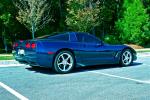
Burning Brakes


Joined: Aug 2010
Posts: 930
Likes: 13
From: Aiken SC
Just got mine painted about 2 months ago. Absolute perfect match. Guy does great work, only one that touches my vette. Sanded, primed, & painted....$225.00 + tax.
Mine is NBM also. But I removed it and re-installed it by myself. Not hard at all.
Gregg
Mine is NBM also. But I removed it and re-installed it by myself. Not hard at all.
Gregg
Last edited by tracer1; Apr 17, 2011 at 11:11 AM.
Thread Starter
Racer
Joined: Mar 2005
Posts: 286
Likes: 36
From: Scituate, MA
Went to a Stewart Warner paint store....
Wow was that eye opening! First the 353, NBM is much darker on the chip than what is supposed to be on the car, WA352E. Even under the 352E chip there was a base color, and two other noticably different colors, Alt A and alt B, both lighter than base.
I'm going back tomorrow to match it to the car.
Best,
Bluemill
I'm going back tomorrow to match it to the car.
Best,
Bluemill