





wheel lug torque specs

Thread Starter
Intermediate

Joined: Jun 2012
Posts: 30
Likes: 0
 wheel lug torque specs
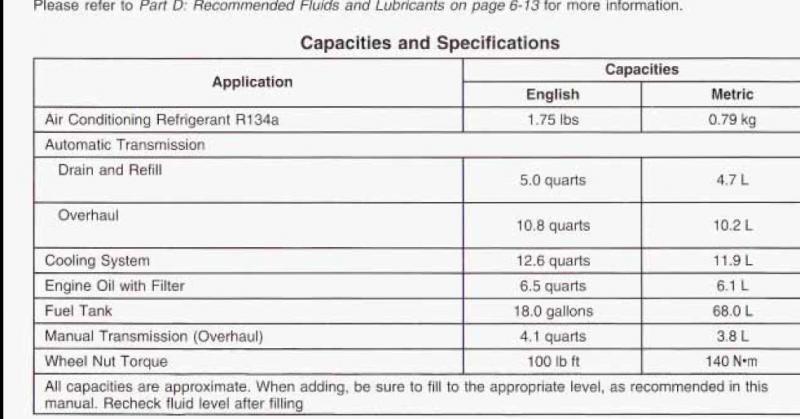
Got a 2001 with chrome rims. On page 3-92 of the service manual it states to tighten the lug nut in sequence ( which is not a star pattern ) and tighten to 100 lb ft. On page 3-98 it states to tighten the lug nuts in a criss/cross pattern to 140 lb ft. Well we all know to criss/cross. So what is up with the two different torques.

Melting Slicks

Joined: Jul 2013
Posts: 2,012
Likes: 23
From: Anaheim CA
Look again, it's the same torque spec: 100 ft-lbs (English) = 140 N-m (metric).
(And "in sequence" refers to the diagrams, the 5-bolt one is a star pattern.)
(And "in sequence" refers to the diagrams, the 5-bolt one is a star pattern.)
Last edited by Lee DeRaud; Jul 6, 2014 at 04:35 PM.

Team Owner


Joined: Jul 2006
Posts: 22,182
Likes: 4,178
From: Kannapolis NC
Congrats on reading the manual, many don't try that first. Just some info, if you have chrome wheels, they are aftermarket or have been chromed since made. C5's came with polished aluminum wheels with clear coat over them. Except for 01-03 Z06 which were painted.
Thread Starter
Intermediate
Joined: Jun 2012
Posts: 30
Likes: 0
OK. my bad on the chrome wheels they are the stock aluminum with clear coat. thanks for the clarification on page 3-92. if any body has a manual im not kidding, page 3-98 says tighten to 190 N-m ( 140 lb ft )

Administrator


Joined: Mar 2001
Posts: 368,299
Likes: 24,776
From: In a parallel universe. Currently own 2014 Stingray Coupe.
C7 of the Year - Modified Finalist 2021
MO Events Coordinator
St. Jude Co-Organizer
St. Jude Donor '03 thru '25
NCM Sinkhole Donor
CI 5, 8 & 11 Veteran
Corvette Stories
The Best of Corvette for Corvette Enthusiasts

Top 10 Most Expensive Corvettes Ever Sold on Bring A Trailer
Brett Foote
10 Things Every Corvette Owner Needs (2026 Edition)
Michael S. Palmer
8 Most "Only Corvette Owners Understand" Quirks and Problems
Pouria Savadkouei
10 Reasons the C6 Z06 is Still A Performance Benchmark After 20 Years
Joe Kucinski
How Much Horsepower Every Corvette Engine "LOST" in 1972
Joe Kucinski
Top 10 DOs and DON'Ts for Protecting Your Convertible Top!
Michael S. Palmer
Top 10 Most Explosive Corvettes Ever Made: Power-to-Weight Ratio Ranked!
Joe Kucinski
150 hp to 1,250 hp: Every Corvette Generation Compared by the Specs That Matter
Joe Kucinski
8 Coolest Corvette Pace Cars (and Replicas) of All Time
Verdad Gallardo
Racer
Joined: May 2013
Posts: 365
Likes: 19
From: Hugo MN
Not sure what manual you're looking at. I've got the 2001 Corvette Owner's Manual and the lug specs are on page 6-75 and spec 100 lb-ft (140 N-m). The pages you reference are NOT in the manual and section 3 only goes through 3-32!
Racer
Joined: May 2013
Posts: 365
Likes: 19
From: Hugo MN
Sorry, I didn't notice that you are referencing the SERVICE MANUAL until after I sent the above response. Owner's Manual specs are what I have used!

Melting Slicks
Joined: Jul 2013
Posts: 2,012
Likes: 23
From: Anaheim CA
Possible typo...what year is it? (I was quoting from a 2004 service manual: its page numbers are one off from what you gave.)

Le Mans Master

Joined: Mar 2011
Posts: 6,835
Likes: 302
From: Columbia SC
I have found some other errors in the FSM but they have been in the schematics.

Le Mans Master


Joined: Apr 2012
Posts: 7,814
Likes: 2,266
From: Brighton MI
Errors happen in Service Manuals. Dealers are sent bulletins to correct these errors that are discovered after printing. Those of us (private individauls) who have manuals do not get these bulletins.
Correct spec is 100 ft/lbs in the standard 5 point star (criss cross) pattern.
I NEVER use an impact to install lug nuts. I would also advise torquing in two steps, first to 50 ft/lbs then to the full 100 ft/lbs. Probably overkill, but I have never warped a rotor!
Correct spec is 100 ft/lbs in the standard 5 point star (criss cross) pattern.
I NEVER use an impact to install lug nuts. I would also advise torquing in two steps, first to 50 ft/lbs then to the full 100 ft/lbs. Probably overkill, but I have never warped a rotor!
Le Mans Master
Joined: Mar 2011
Posts: 6,835
Likes: 302
From: Columbia SC
Not overkill, but the proper way to torque joints. I use 3 passes when doing lug nuts. I use more passes when critical gasket joints are involved. This is standard practice in industrial applications. Procedurally mandatory in the Nuclear industry.
Team Owner


Joined: May 2005
Posts: 31,497
Likes: 1,313
From: Huntsville AL
Errors happen in Service Manuals. Dealers are sent bulletins to correct these errors that are discovered after printing. Those of us (private individauls) who have manuals do not get these bulletins.
Correct spec is 100 ft/lbs in the standard 5 point star (criss cross) pattern.
I NEVER use an impact to install lug nuts. I would also advise torquing in two steps, first to 50 ft/lbs then to the full 100 ft/lbs. Probably overkill, but I have never warped a rotor!
Correct spec is 100 ft/lbs in the standard 5 point star (criss cross) pattern.
I NEVER use an impact to install lug nuts. I would also advise torquing in two steps, first to 50 ft/lbs then to the full 100 ft/lbs. Probably overkill, but I have never warped a rotor!
I do 50, then 75, then 100, then 100 again.

Team Owner


Joined: May 2001
Posts: 87,357
Likes: 1,592
From: Western NY