



[Z06] DYNO SHEETS Optic VS Zo6LES

Thread Starter
Former Vendor
Joined: Aug 2001
Posts: 1,756
Likes: 0
From: Atlanta GA
 DYNO SHEETS Optic VS Zo6LES
This will speak for it's self. http://www.misshowardstern.com/zo6/index.html

Drifting


Joined: Nov 2001
Posts: 1,684
Likes: 0
From: Jacksonville Florida
Re: DYNO SHEETS Optic VS Zo6LES (opticZ06)
Your time is coming grasshopper - uh I mean Optic :) I wouldn't call today QUITE getting waxed but a win is a win, enjoy it - your time is limited.
Nice link BTW, you should have a pic of your girlfriend added (I am happy to report that Optic has switched to females now - very pretty too)
Les
:yesnod: :yesnod: :smash: :smash: :cry :cry
Nice link BTW, you should have a pic of your girlfriend added (I am happy to report that Optic has switched to females now - very pretty too)
Les
:yesnod: :yesnod: :smash: :smash: :cry :cry

Advanced


Joined: Jun 2001
Posts: 56
Likes: 0
From: Atlanta GA
Re: DYNO SHEETS Optic VS Zo6LES (opticZ06)
It was great fun to watch these two "interact".
These results give a pretty good idea of what to expect from LS6Edit tuning with a couple of simple mods (Intake/Temps/Long Tubes). Amazing to get results this close.
Say, who is the great looking guy in the window behind the car?
These results give a pretty good idea of what to expect from LS6Edit tuning with a couple of simple mods (Intake/Temps/Long Tubes). Amazing to get results this close.
Say, who is the great looking guy in the window behind the car?
Drifting
Joined: Nov 2001
Posts: 1,684
Likes: 0
From: Jacksonville Florida
Re: DYNO SHEETS Optic VS Zo6LES (NickS)
Nick,
Glad you could join us. Spending 5 hours with Optic is right up there with a visit to the proctologist :)
AKA it is amazing how little variation there actually is between like cars - and if over 380 RWHP is of interest Optic and I got there about the same way, so all you have to do is pay your money.
Les :yesnod:
Glad you could join us. Spending 5 hours with Optic is right up there with a visit to the proctologist :)
AKA it is amazing how little variation there actually is between like cars - and if over 380 RWHP is of interest Optic and I got there about the same way, so all you have to do is pay your money.
Les :yesnod:

Intermediate
Joined: Feb 2002
Posts: 35
Likes: 0
Re: DYNO SHEETS Optic VS Zo6LES (opticZ06)
Did these 2 cars undergo dyno tuning with LSxEdit? I'm confused, the Z with only Vararam dynoed 1 rwhp and several rwtq higher than the Z with intake, headers, MAFT, injectors?!? Am I reading this correct or has tuning yet to be done on one or both of the cars. I would think that Les's car has some untuned potential yet to be exploited.
Drifting
Joined: Nov 2001
Posts: 1,684
Likes: 0
From: Jacksonville Florida
Re: DYNO SHEETS Optic VS Zo6LES (02C5Z06)
Both cars were LSX Edit tuned by the same guy at the same time and tested on the same dyno, both cars were very hot etc. etc. but this is a very fair comparison, and the results are basically identical (unless other than bragging rights 1 RWHP concerns anyone) - the 7 difference on torque is either the headers (difference between TPIS Vs. FLP) or Optic's underdrive, or I am actually losing some torque with no cats (very possible) or a little of all of these things, we shall see.
My car had a MAFT but it was removed to do the LSX Edit tuning. 30# injectors do not create power, but especially with stock tuning will cause the ECM to not pull timing when 85% duty cycle is achieved. The tuning makes that a non-issue, though Optic will need 30# in order to keep the injectors cool and not risk lock-up.
So the only real differences between these cars is his has TPIS and an underrdrive pulley with harmonic balancer, I have the T1 bridge on the Vararam (which probably counts when moving, not on the dyno) and FLP headers. I have the FLP X-Pipe and Optic has something else
I still like the FLP headers best since they have flanges already, no cutting, no welding, comes with an X-pipe as well as high-flow cats and the off-road pipes, but what these tests show to be is that there is basically no difference. Optic and I use some of the same stuff and some a little different and still have only a whopping 1 RWHP difference. Neither of us is complaining.
Les
:cheers:
My car had a MAFT but it was removed to do the LSX Edit tuning. 30# injectors do not create power, but especially with stock tuning will cause the ECM to not pull timing when 85% duty cycle is achieved. The tuning makes that a non-issue, though Optic will need 30# in order to keep the injectors cool and not risk lock-up.
So the only real differences between these cars is his has TPIS and an underrdrive pulley with harmonic balancer, I have the T1 bridge on the Vararam (which probably counts when moving, not on the dyno) and FLP headers. I have the FLP X-Pipe and Optic has something else
I still like the FLP headers best since they have flanges already, no cutting, no welding, comes with an X-pipe as well as high-flow cats and the off-road pipes, but what these tests show to be is that there is basically no difference. Optic and I use some of the same stuff and some a little different and still have only a whopping 1 RWHP difference. Neither of us is complaining.
Les
:cheers:
Did these 2 cars undergo dyno tuning with LSxEdit? I'm confused, the Z with only Vararam dynoed 1 rwhp and several rwtq higher than the Z with intake, headers, MAFT, injectors?!? Am I reading this correct or has tuning yet to be done on one or both of the cars. I would think that Les's car has some untuned potential yet to be exploited.
Corvette Stories
The Best of Corvette for Corvette Enthusiasts

Top 10 Most Expensive Corvettes Ever Sold on Bring A Trailer
Brett Foote
10 Things Every Corvette Owner Needs (2026 Edition)
Michael S. Palmer
8 Most "Only Corvette Owners Understand" Quirks and Problems
Pouria Savadkouei
10 Reasons the C6 Z06 is Still A Performance Benchmark After 20 Years
Joe Kucinski
How Much Horsepower Every Corvette Engine "LOST" in 1972
Joe Kucinski
Top 10 DOs and DON'Ts for Protecting Your Convertible Top!
Michael S. Palmer
Top 10 Most Explosive Corvettes Ever Made: Power-to-Weight Ratio Ranked!
Joe Kucinski
150 hp to 1,250 hp: Every Corvette Generation Compared by the Specs That Matter
Joe Kucinski
8 Coolest Corvette Pace Cars (and Replicas) of All Time
Verdad Gallardo



Le Mans Master


Joined: Jun 2001
Posts: 7,331
Likes: 518
From: Admit Nothing, Deny Everything, Make Counter Accusations.
Re: DYNO SHEETS Optic VS Zo6LES (opticZ06)
This will speak for it's self. http://www.misshowardstern.com/zo6/index.html
Who is the Howard fan?
Baba Booey
Drifting
Joined: Nov 2001
Posts: 1,684
Likes: 0
From: Jacksonville Florida
Re: DYNO SHEETS Optic VS Zo6LES (rschiltz)
With my car having the 30# injectors and the MAFT removed before baseline my before is not too valuable, Optic's would be as he has stock injectors and the only change was the tuning.
That said he was lean on his baseline (about 13.5+ as I recall) and making around 370 RWHP. When they got the fuel right he actually dropped a little power (to be expented) but smoother/better. Then when they got the timing dialed in he went up to the 381 number.
In my case baseline was 362 RWHP (again running fat) and it improved to 381.
IMO LSX Edit tuning will achieve 10-15 RWHP gain in the hands of an experienced tuner. You also get the benefit of adjusting torque management, CAGS elimination (no light even), high and low speed fan control, and turning off the test for the rear 02's if you are running without cats - all a good thing for me :)
Les :cheers:
That said he was lean on his baseline (about 13.5+ as I recall) and making around 370 RWHP. When they got the fuel right he actually dropped a little power (to be expented) but smoother/better. Then when they got the timing dialed in he went up to the 381 number.
In my case baseline was 362 RWHP (again running fat) and it improved to 381.
IMO LSX Edit tuning will achieve 10-15 RWHP gain in the hands of an experienced tuner. You also get the benefit of adjusting torque management, CAGS elimination (no light even), high and low speed fan control, and turning off the test for the rear 02's if you are running without cats - all a good thing for me :)
Les :cheers:
Advanced
Joined: Jun 2001
Posts: 56
Likes: 0
From: Atlanta GA
Re: DYNO SHEETS Optic VS Zo6LES (ZO6Les)
Les,
Don't forget the major benefit of LSxEdit is in having a linear air/fuel ratio curve across the entire powerband. Taking out the spikes and dips will make for a more positive driving experience IMHO.
Don't forget the major benefit of LSxEdit is in having a linear air/fuel ratio curve across the entire powerband. Taking out the spikes and dips will make for a more positive driving experience IMHO.
Le Mans Master
Joined: Jun 2001
Posts: 7,331
Likes: 518
From: Admit Nothing, Deny Everything, Make Counter Accusations.
Re: DYNO SHEETS Optic VS Zo6LES (ZO6Les)
My car had a MAFT but it was removed to do the LSX Edit tuning. 30# injectors do not create power, but especially with stock tuning will cause the ECM to not pull timing when 85% duty cycle is achieved. The tuning makes that a non-issue, though Optic will need 30# in order to keep the injectors cool and not risk lock-up.
If you run a modded car with the stock injectors you will probably end up with positive LTFTs because of inaccurate MAF readings. Most people have been solving this with a MAFT set in a BASE rich position. The MAFT BASE rich position tells the PCM that there is more air coming in, which means more load, which can mean less timing. So it is really the MAFT rich setting that can pull timing, not the injector duty cycle.
When you install bigger injectors you can dial-in a BASE lean setting on your MAFT and still get near 0 LTFT. This will tell the PCM that there is less air, less load, and you can get more timing.
Once you get rid of the MAFT and tune with LS1Edit you can change the timing curves at all load and RPM levels.
Le Mans Master
Joined: Jun 2001
Posts: 7,331
Likes: 518
From: Admit Nothing, Deny Everything, Make Counter Accusations.
Re: DYNO SHEETS Optic VS Zo6LES (NickS)
Taking out the spikes and dips will make for a more positive driving experience IMHO.
Advanced
Joined: Jun 2001
Posts: 56
Likes: 0
From: Atlanta GA
Re: DYNO SHEETS Optic VS Zo6LES (rbartick)
That will require a lot of dyno tuning to get them all out.
Do you think that PCM relearning might antagonize the static results on the dyno as the cars are driven in the real world?
Also noticed that none of the tuners in Atlanta seem to pay any particular attention to LTFT's happily deriving them from idle on a Snap-On scantool. In my case, when I dyno tuned with an MAFT, it took a ton of data acquisition with Autotap to know with any accuracy where to BASE should be set. Does LSxEdit have any functionality with LTFT's?
Drifting
Joined: Nov 2001
Posts: 1,684
Likes: 0
From: Jacksonville Florida
Re: DYNO SHEETS Optic VS Zo6LES (rbartick)
rb,
I agree with your analysis on other factors that go into timing, but I can tell you, and several of us have proven, that when you exceed 85% duty cycle on the injectors (which happens once you increase HP by about 15) that the ECM will pull 4 degree's of timing out at WOT from 4K RPM to red line. I learned of this from a GM insider, tested it with a scanner, my car was doing it. 26 degrees total timing up to 4K, 22 degrees from 4K to 6500. Installed the 30# injectors and MAFT and it stopped (cool day, IAT temp was not an issue). I can't say if fooling the ECM with the MAFT and stock injectors would have had the same result. I can say running injectors at over 85% duty cycle over extended periods of time is trouble looking for a place to happen.
Les :cheers:
I agree with your analysis on other factors that go into timing, but I can tell you, and several of us have proven, that when you exceed 85% duty cycle on the injectors (which happens once you increase HP by about 15) that the ECM will pull 4 degree's of timing out at WOT from 4K RPM to red line. I learned of this from a GM insider, tested it with a scanner, my car was doing it. 26 degrees total timing up to 4K, 22 degrees from 4K to 6500. Installed the 30# injectors and MAFT and it stopped (cool day, IAT temp was not an issue). I can't say if fooling the ECM with the MAFT and stock injectors would have had the same result. I can say running injectors at over 85% duty cycle over extended periods of time is trouble looking for a place to happen.
Les :cheers:
My car had a MAFT but it was removed to do the LSX Edit tuning. 30# injectors do not create power, but especially with stock tuning will cause the ECM to not pull timing when 85% duty cycle is achieved. The tuning makes that a non-issue, though Optic will need 30# in order to keep the injectors cool and not risk lock-up.
Actually, the injectors and their duty cycle have nothing to do with timing at all. The timing is related to airflow (load) and RPM. It really works like this:
If you run a modded car with the stock injectors you will probably end up with positive LTFTs because of inaccurate MAF readings. Most people have been solving this with a MAFT set in a BASE rich position. The MAFT BASE rich position tells the PCM that there is more air coming in, which means more load, which can mean less timing. So it is really the MAFT rich setting that can pull timing, not the injector duty cycle.
When you install bigger injectors you can dial-in a BASE lean setting on your MAFT and still get near 0 LTFT. This will tell the PCM that there is less air, less load, and you can get more timing.
Once you get rid of the MAFT and tune with LS1Edit you can change the timing curves at all load and RPM levels.
Actually, the injectors and their duty cycle have nothing to do with timing at all. The timing is related to airflow (load) and RPM. It really works like this:
If you run a modded car with the stock injectors you will probably end up with positive LTFTs because of inaccurate MAF readings. Most people have been solving this with a MAFT set in a BASE rich position. The MAFT BASE rich position tells the PCM that there is more air coming in, which means more load, which can mean less timing. So it is really the MAFT rich setting that can pull timing, not the injector duty cycle.
When you install bigger injectors you can dial-in a BASE lean setting on your MAFT and still get near 0 LTFT. This will tell the PCM that there is less air, less load, and you can get more timing.
Once you get rid of the MAFT and tune with LS1Edit you can change the timing curves at all load and RPM levels.
Le Mans Master
Joined: Jun 2001
Posts: 7,331
Likes: 518
From: Admit Nothing, Deny Everything, Make Counter Accusations.
Re: DYNO SHEETS Optic VS Zo6LES (NickS)
>>there were probably over 30 pulls with
>>the wide band O2 between the two
>>cars yesterday with adjustments made
>>between each. Final results were ruler
>>flat air/fuel curves.
That is a lot of pulls. The A/F ratio curves will probably change a bit on the road.
>>Do you think that PCM relearning might
>>antagonize the static results on the dyno as
>>the cars are driven in the real world?
You can pretty much guarantee that the A/F ratios will change a bit on the road in different weather conditions. I really would not worry about that too much. You will have a hard time getting it perfect in all situations. I am sure that the tuner got it "close enough".
>>Also noticed that none of the tuners
>>in Atlanta seem to pay any particular
>>attention to LTFT's happily deriving them
>>from idle on a Snap-On scantool.
Hey, if that is their method then so be it. There is more than one way to tune these cars. You could drive around with really high LTFT values and just concentrate on timing and A/F ratio if you really wanted to, but I would not do that. I am not sure if high closed loop LTFT values would really cause any major problems as long as you tune WOT and timing with LS1Edit, unless you are getting close to the limits of a closed loop lean code.
>>Does LSxEdit have any functionality with LTFT's?
The whole basis of high (or low) LTFT values is the MAF is not accurately reporting airflow and the PCM adjusts for it. There is more than one way to bring the LTFT values to near zero. The easiest and most logical method would be to modify the MAF table so that the MAF reading is more accurate. You could also modify the injector flow rate table, but I think that would be more difficult. This page has some solid info.
http://ls1edit.slowcar.net/faq.html
--rb--
I have LS1Edit and I am dangerous :hat
>>the wide band O2 between the two
>>cars yesterday with adjustments made
>>between each. Final results were ruler
>>flat air/fuel curves.
That is a lot of pulls. The A/F ratio curves will probably change a bit on the road.
>>Do you think that PCM relearning might
>>antagonize the static results on the dyno as
>>the cars are driven in the real world?
You can pretty much guarantee that the A/F ratios will change a bit on the road in different weather conditions. I really would not worry about that too much. You will have a hard time getting it perfect in all situations. I am sure that the tuner got it "close enough".
>>Also noticed that none of the tuners
>>in Atlanta seem to pay any particular
>>attention to LTFT's happily deriving them
>>from idle on a Snap-On scantool.
Hey, if that is their method then so be it. There is more than one way to tune these cars. You could drive around with really high LTFT values and just concentrate on timing and A/F ratio if you really wanted to, but I would not do that. I am not sure if high closed loop LTFT values would really cause any major problems as long as you tune WOT and timing with LS1Edit, unless you are getting close to the limits of a closed loop lean code.
>>Does LSxEdit have any functionality with LTFT's?
The whole basis of high (or low) LTFT values is the MAF is not accurately reporting airflow and the PCM adjusts for it. There is more than one way to bring the LTFT values to near zero. The easiest and most logical method would be to modify the MAF table so that the MAF reading is more accurate. You could also modify the injector flow rate table, but I think that would be more difficult. This page has some solid info.
http://ls1edit.slowcar.net/faq.html
--rb--
I have LS1Edit and I am dangerous :hat
Le Mans Master
Joined: Jun 2001
Posts: 7,331
Likes: 518
From: Admit Nothing, Deny Everything, Make Counter Accusations.
Re: DYNO SHEETS Optic VS Zo6LES (ZO6Les)
several of us have proven, that when you exceed 85% duty cycle on the injectors (which happens once you increase HP by about 15) that the ECM will pull 4 degree's of timing out at WOT from 4K RPM to red line. I learned of this from a GM insider, tested it with a scanner, my car was doing it. 26 degrees total timing up to 4K, 22 degrees from 4K to 6500.
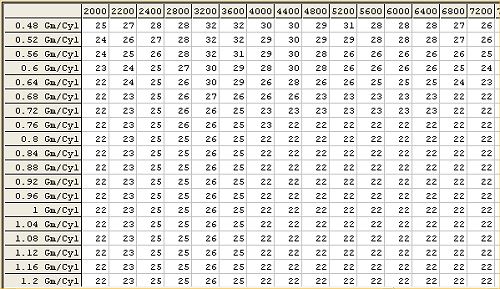
I am basing my statement on the LS1Edit tables. Timing advance is determined by RPM and perceived load (airflow). It can get also get pulled because of IAT heat. There are no tables that relate injector pulse width to timing.
BTW – The stock timing tables only allow 22 degrees TA at 4000 RPM and up when there is high airflow. You can see that in the table below. When I scanned my stock car I never saw more than 22 degrees at WOT over 4000 RPM. Plenty of members over at the other Z06 forum have also reported a max of 22 degrees after 4000 RPM. I do not know how you were possibly getting 26 degrees after 4000 RPM unless your stock MAF is really inaccurate, you programmed in a BASE lean setting with a MAFT, or your airbox is clogged ;)
[Modified by rbartick, 1:25 PM 8/16/2002]