When you click on links to various merchants on this site and make a purchase, this can result in this site earning a commission. Affiliate programs and affiliations include, but are not limited to, the eBay Partner Network.
Well, for anyone that wants to try the relay mod, it doesn't work. The white wire needs to be grounded for the headlights to close, so they just stay open when the relay is put in.
I haven't tried it, but sure seems like it should work.. White wire cut.
From relay pin 87 to pin A of HCM. White wire end from switch to relay pin 86. Relay pin 85 to ground. Relay pin 30 to always on 12v. Dark green wire cut. Relay pin 87a to HCM pin C. Like so:
I haven't tried it, but sure seems like it should work.. White wire cut.
From relay pin 87 to pin A of HCM. White wire end from switch to relay pin 86. Relay pin 85 to ground. Relay pin 30 to always on 12v. Dark green wire cut. Relay pin 87a to HCM pin C. Like so:
Like I said, it won't close unless the white line to the headlight control module is connected to ground. I experimentally confirmed this after 2 hours of trying to figure out why it wouldn't close. I need to wire in two relays, one for switching the white wire from ground to 12v and the other to switch green from 12v to ground.
This would also be a good alternative way of doing the high 4 mod. Tying in the low beams to the white line would ensure that the low beams are on whenever the headlights are up, and maintain the stock foglight flash to pass without triggering the headlights.
Thank you for the great write up on the Head light Control Module
I drive a 2001 Firebird that uses the same module and have been trying to fiz a passenger side head light that will not pop open or close. I have replaced the motor and it still will not open. When I test the motor using jumpers it will both open and close. The lights work as advertised but the door does not move. I pulled the plugs on both sides and get the same readings on both sides. When I found your module test I ran it and had the predicted results on all but the
"Neg lead to Pin D Pos lead to Pin C Reading should be zero volts" test about half way trhough, I got 12 volts readout.
Any idea what that might indicate?
Thank You very much for your efforts
Tom Hough (wylie@madisontelco.com)
ps I got another HCM form a junk yard firebird with the same results but may have just gotten a bad one. Before I spend $300 on a new one I had ask someone who obviously knows what they are talking about.
Originally Posted by UM Rebel
This is very long and some of you will not like it!, but it was a fun project.
First let’s make sure it’s your HCM that’s bad.
• Check Fuses 3 and 4 in under hood fuse box
• Check Fuse 6 in fuse box under passenger side floorboard
• Raise passenger side headlight
• Remove 3 Phillips head screws from headlight bezel and remove bezel
• Remove 4 Torx screws from headlight lid (will have lower light some for rear screws)
• Remove nuts from both pivot screws (take care not to drop nuts)
• Support light fixture and remove the pivot screws. Gently lower the fixture out of the way.
• Remove nut from motor drive shaft and remove control arm from shaft. This will get the fixture further out of the way. You can disconnect the bulbs and completely remove the fixture.
• The HCM is mounted on the fender just behind the headlight.
• Remove the two connectors from the HCM
• With headlights off, Use a voltmeter to verify in 5 pin connector
• Neg lead of voltmeter to Pin D (Black Wire) Pos lead to Pin A (White wire) Reading should be zero volts
• Neg lead to Pin D Pos lead to Pin B (Orange wire) Reading should be 12volts
• Neg lead to Pin D Pos lead to Pin C (Dark Green wire) Reading should be 12 volts
• Neg lead to Pin D Pos lead to Pin E (Orange wire) Reading should be 12 volts
• Switch headlights on.
• Neg lead to Pin D Pos lead to Pin A Reading should be 12volts
• Neg lead to Pin D Pos lead to Pin C Reading should be zero volts
• If any of the above tests fail HCM is not the problem. It will probably be fuses, wiring or switch.
• If all of those tests are good, plug 5 pin connector back into HCM
• Connect a test light to HCM 4 pin output Pin A and Pin B
• Turn headlights off and on. Test light should come on momentarily each time you turn off or on.
• Connect the test light to HCM 4 pin output Pin C and Pin D
• Turn headlights off and on Test light should come on momentarily each time you turn off or on.
• If either one of last two tests fail HCM is bad.
• If both of those tests are good problem is either wiring or the motors.
If the HCM is bad, you can try to fix it. Remove the HCM from fender. Look at the back of the module. If the back is loose, water probably got into the circuit board. The back is just stuck on with some tar like stuff. You can easily pry it off with a flat blade screwdriver. I tried re-soldering some of the pads and IT WORKED for about 2 days.
You can get a used one off Ebay. You might even find one new old stock from a dealer.
I saw that one of the popular Corvette catalogs advertises new HCM for about $600.
If you are crazy, like me, you can build one!
Here’s the wiring diagram of the Headlight Door Circuit.
The motors run one way when the lights are turned on. They run the other way when lights are turned off. The direction is changed by switching the polarity of the wires. There is no switch that determines when light is fully up or fully down. The HCM has a timer circuit that shuts the motors off after a split second. HCM determines polarity based on signals on Pin A or Pin C of 5 pin connector.
So I need a Double Pole Double Throw switch to change polarity to the motors, a relay to sense on/off signals and a timer to shut the motors off. I know 555 IC is a timer circuit so that’s where I started my search. Found this little circuit with adjustable timer and relay.
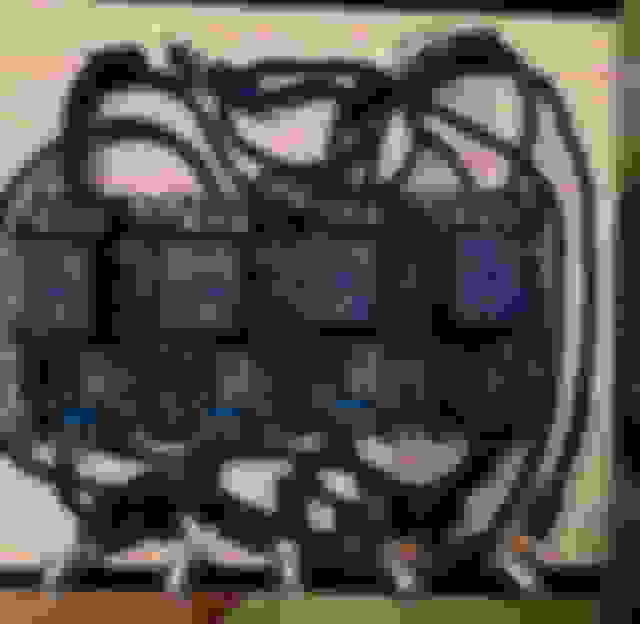
Four of them wired like this.
]
I didn’t even have to change the delay time. Factory default was perfect. There is a bit of difference from the way original HCM works. With original fuse 3 and 4 circuits control the motors separately. Home made HCM fuse 3 and 4 control Up or Down functions of both motors at once. I replaced the 10 amp fuses with 20 amp.
Here is the final product which I relocated between battery and fuse box.
It was a fun project and works perfectly. Total cost about $20. I'm sure some of you with more electronic building skill can make one that looks much more professional.
Thank you for the great write up on the Head light Control Module
I drive a 2001 Firebird that uses the same module and have been trying to fix a passenger side head light that will not pop open or close. I have replaced the motor and it still will not open. When I test the motor using jumpers it will both open and close. The lights work as advertised but the door does not move. I pulled the plugs on both sides and get the same readings on both sides. When I found your module test I ran it and had the predicted results on all but the "Neg lead to Pin D Pos lead to Pin C Reading should be zero volts" test about half way trhough, I got 12 volts readout.
Any idea what that might indicate?
Thank You very much for your efforts
Tom Hough (wylie@madisontelco.com)
ps I got another HCM form a junk yard firebird with the same results but may have just gotten a bad one. Before I spend $300 on a new one I had ask someone who obviously knows what they are talking about.
Since you are troubleshooting a Firebird the circuit is probably not the same, but considering it uses the same control module, the operating voltage sequences should be the same. I'm going to describe the C5 circuit, but you can apply this process to your Firebird to determine what's wrong.
Considering you already replaced both, motor and module, and still have the same problem, and that it works when you use jumpers to provide the controlling signals, it seems your multifunction switch is probably the culprit. But to be sure I would check before buying more stuff.
I would start by checking voltages to see if they follow the proper sequence.
Power Sequence
BAT voltage is constant to Headlamp Opening Door Actuator Control Module (DACM) from the HDLP MOT L MiniFuse #4 (CKT 2940) and from the HDLP MOT R MiniFuse #3 (CKT 3040).
Headlamp Switch to HEAD position:
BAT voltage is applied to Headlamp ON Input on DACM via CKT 103.
LH door opens with BAT VOLT to LH opening door assy via CKT 576 & GND is applied to CKT 577.
RH door opens with BAT VOLT to RH opening door assy via CKT 578 & GND is applied to CKT 579.
When HL switch is OFF:
BAT voltage is applied to Headlamp OFF Input on DACM via CKT 306.
LH door closes with BAT VOLT to LH opening door assy via CKT 577 & GND is applied to CKT 576.
RH door closes with BAT VOLT to RH opening door assy via CKT 579 & GND is applied to CKT 578.
The Headlamp Opening DACM (front RH side below RH HL Assy) is grounded by CKT 150 via Splice Pack#100 (forwardlamp harness, attached to G102 - Point #8 in diagram below).
Thank you for the great write up on the Head light Control Module
I drive a 2001 Firebird that uses the same module and have been trying to fiz a passenger side head light that will not pop open or close. I have replaced the motor and it still will not open. When I test the motor using jumpers it will both open and close. The lights work as advertised but the door does not move. I pulled the plugs on both sides and get the same readings on both sides. When I found your module test I ran it and had the predicted results on all but the
"Neg lead to Pin D Pos lead to Pin C Reading should be zero volts" test about half way trhough, I got 12 volts readout.
Any idea what that might indicate?
Thank You very much for your efforts
Tom Hough (wylie@madisontelco.com)
ps I got another HCM form a junk yard firebird with the same results but may have just gotten a bad one. Before I spend $300 on a new one I had ask someone who obviously knows what they are talking about.
With headlights on Pin C to D of 5 Pin connector should be zero volts. If you are getting 12 volts, sounds like you have a wiring or switch problem. Post what you find out.
Firstly, I'm grateful to UM Rebel for clearly listing the procedure for testing the HCM. Today, I did all the tests but I cannot understand the logic of my results.
Going back 5 years (yes that long ago) my 2001 C5 convertible started blowing the sidelight fuse #6 in the passenger footwell. Obviously, when this fuse blows you loose all rear lights and front side lights + IP lights etc. Hence, nigh-time driving is not an option.
I've had most parts of the car apart trying to find the gremlin with no success.
The headlamp control module has always been under suspicion as I get approx 9.5v at ground 102 when everything is 'off'. I have a spare unit and get the same readings.
The module/s pass the tests you suggest except "with headlights on / pin D to pin C should be zero volts" but I get 0.3v? When I remove either or both fuses 3&4 the voltage drops to approx 2v. These tests were done with ignition off but I'm sure it makes no difference. Clearly there should be no voltage at pin D?
Could the Body Control Module be causing this fault and is it related to the #6 fuse issue?
Any ideas as to which direction I should turn next would be most welcome.
Notes: I have stripped the headlamp switch several times and it looks like new. The car has only done 50k miles. I have replaced the battery. All grounds have been checked and modified (credit to Bill C). I have a workshop manual. The side-lights tend to blow soon after engine start / warm-up but stay on if stationary with ign off. I've swapped relays around (especially 43). If I disconnect the front and rear light looms the fuse still blows.
Firstly, I'm grateful to UM Rebel for clearly listing the procedure for testing the HCM. Today, I did all the tests but I cannot understand the logic of my results.
Going back 5 years (yes that long ago) my 2001 C5 convertible started blowing the sidelight fuse #6 in the passenger footwell. Obviously, when this fuse blows you loose all rear lights and front side lights + IP lights etc. Hence, nigh-time driving is not an option.
I've had most parts of the car apart trying to find the gremlin with no success.
The headlamp control module has always been under suspicion as I get approx 9.5v at ground 102 when everything is 'off'. I have a spare unit and get the same readings.
The module/s pass the tests you suggest except "with headlights on / pin D to pin C should be zero volts" but I get 0.3v? When I remove either or both fuses 3&4 the voltage drops to approx 2v. These tests were done with ignition off but I'm sure it makes no difference. Clearly there should be no voltage at pin D?
Could the Body Control Module be causing this fault and is it related to the #6 fuse issue?
Any ideas as to which direction I should turn next would be most welcome.
Notes: I have stripped the headlamp switch several times and it looks like new. The car has only done 50k miles. I have replaced the battery. All grounds have been checked and modified (credit to Bill C). I have a workshop manual. The side-lights tend to blow soon after engine start / warm-up but stay on if stationary with ign off. I've swapped relays around (especially 43). If I disconnect the front and rear light looms the fuse still blows.
I'm thinking the 0.3 volt reading on pins C & D is just artifact and not too be concerned.
The fuse #6 issue has got to be a short somewhere. I would start by checking each of the light housings on that circuit. Hopefully it's not a short in the IP. Good Luck!
I'm thinking the 0.3 volt reading on pins C & D is just artifact and not too be concerned.
The fuse #6 issue has got to be a short somewhere. I would start by checking each of the light housings on that circuit. Hopefully it's not a short in the IP. Good Luck!
Thought I'd update you on my C5 electrical problem. The car was off the road for a whole 12 months with a problem that got progressively worse over the last 5 years.
The no.6 sidelight fuse kept blowing and I couldn't find the gremlin. I've had the dash out, the lightswitch apart (twice), the BCM apart (twice), the IP fuse box in pieces, the front of the car off 3 times, the headlamp module apart etc etc.
Then 2 weeks ago after remembering a post on Corvette Forum about poor female contacts in the doors, I noticed something odd when I moved the headlamp connector on the LH chassis rail behind the up/down motor. After pulling it apart and closely checking the 5 pins I saw that the earth wire (black) was not mating properly and giving an intermittent contact. It was the same on the RH side too. All 4 12v feeds to the headlamps & motors were fine - just the earths (going to G101) were affected.
It is difficult to re-tension the female clip so I cut the black wires and connected them externally with spade connectors (soldered and insulated, of course). Hey presto, no more problems!! So frustratingly simple, I couldn't believe it. The car has passed it's MoT (Ministry of Transport road worthiness test here in the UK) and is now back on the road.
I have a copy of the workshop manual and therefore, all the wiring diagrams but what I cannot understand is why would a poor earth from the headlamps/motors affect the sidelight fuse? The sidelight circuit has a 10 amp fuse (#6 in the IP box). The separate headlamps/motors circuits (to the HL module) have their own 10amp supplies via fuses 8,9,10,12,3&4 in the engine compartment fuse box. How are they related such that the voltage can find it's way back to the sidelights and blow the fuse? The only clue I can think of, is that when the sidelights fuse, the headlamps will not go down until the fuse is replaced. Is this connected through the HL module or perhaps the BCM? Having spent so much time on this perplexing problem, I'd sleep better if I could understand the logic of it.
When I tested my pin D to C it was 1v instead of 0v and my D to A is 10.9v instead of 12v... I know the D to A is ok, but the D to C, is that ok? It reads 1 instead of 0
UM Rebel, were you a Navy nuke ET? Man, this is just the kind of foolery we did after ET A school on Treasure Island back in teh 60's Foolign around with R/C time ckts. Thanks for the ideer. former, and very old nuke ET.
UM Rebel, were you a Navy nuke ET? Man, this is just the kind of foolery we did after ET A school on Treasure Island back in teh 60's Foolign around with R/C time ckts. Thanks for the ideer. former, and very old nuke ET.
Ha! Also old but, no, not a Navy nuke ET. I like my boats on top of the water!
BTW, headlights still working perfectly after over a year.
This is very long and some of you will not like it!, but it was a fun project.
First let’s make sure it’s your HCM that’s bad.
• Check Fuses 3 and 4 in under hood fuse box
• Check Fuse 6 in fuse box under passenger side floorboard
• Raise passenger side headlight
• Remove 3 Phillips head screws from headlight bezel and remove bezel
• Remove 4 Torx screws from headlight lid (will have lower light some for rear screws)
• Remove nuts from both pivot screws (take care not to drop nuts)
• Support light fixture and remove the pivot screws. Gently lower the fixture out of the way.
• Remove nut from motor drive shaft and remove control arm from shaft. This will get the fixture further out of the way. You can disconnect the bulbs and completely remove the fixture.
• The HCM is mounted on the fender just behind the headlight.
• Remove the two connectors from the HCM
• With headlights off, Use a voltmeter to verify in 5 pin connector
• Neg lead of voltmeter to Pin D (Black Wire) Pos lead to Pin A (White wire) Reading should be zero volts
• Neg lead to Pin D Pos lead to Pin B (Orange wire) Reading should be 12volts
• Neg lead to Pin D Pos lead to Pin C (Dark Green wire) Reading should be 12 volts
• Neg lead to Pin D Pos lead to Pin E (Orange wire) Reading should be 12 volts
• Switch headlights on.
• Neg lead to Pin D Pos lead to Pin A Reading should be 12volts
• Neg lead to Pin D Pos lead to Pin C Reading should be zero volts
• If any of the above tests fail HCM is not the problem. It will probably be fuses, wiring or switch.
• If all of those tests are good, plug 5 pin connector back into HCM
• Connect a test light to HCM 4 pin output Pin A and Pin B
• Turn headlights off and on. Test light should come on momentarily each time you turn off or on.
• Connect the test light to HCM 4 pin output Pin C and Pin D
• Turn headlights off and on Test light should come on momentarily each time you turn off or on.
• If either one of last two tests fail HCM is bad.
• If both of those tests are good problem is either wiring or the motors.
If the HCM is bad, you can try to fix it. Remove the HCM from fender. Look at the back of the module. If the back is loose, water probably got into the circuit board. The back is just stuck on with some tar like stuff. You can easily pry it off with a flat blade screwdriver. I tried re-soldering some of the pads and IT WORKED for about 2 days.
You can get a used one off Ebay. You might even find one new old stock from a dealer.
I saw that one of the popular Corvette catalogs advertises new HCM for about $600.
If you are crazy, like me, you can build one!
Here’s the wiring diagram of the Headlight Door Circuit.
The motors run one way when the lights are turned on. They run the other way when lights are turned off. The direction is changed by switching the polarity of the wires. There is no switch that determines when light is fully up or fully down. The HCM has a timer circuit that shuts the motors off after a split second. HCM determines polarity based on signals on Pin A or Pin C of 5 pin connector.
So I need a Double Pole Double Throw switch to change polarity to the motors, a relay to sense on/off signals and a timer to shut the motors off. I know 555 IC is a timer circuit so that’s where I started my search. Found this little circuit with adjustable timer and relay.
Four of them wired like this.
]
I didn’t even have to change the delay time. Factory default was perfect. There is a bit of difference from the way original HCM works. With original fuse 3 and 4 circuits control the motors separately. Home made HCM fuse 3 and 4 control Up or Down functions of both motors at once. I replaced the 10 amp fuses with 20 amp.
Here is the final product which I relocated between battery and fuse box.
It was a fun project and works perfectly. Total cost about $20. I'm sure some of you with more electronic building skill can make one that looks much more professional.
Thanks for the detailed write-up, UM Rebel!
I am thinking of attempting this fix (checked my HCM using your procedure), but am wondering how you relocated your new module to the fuse box and battery box.
I am assuming you soldered the wires that connected to the original HCM together at the passenger headlight and then spliced in earlier/closer to the fuse box? If that's correct - which wires were connected at the passenger headlight? And which wires were connected to your new HCM?
I can figure out that to splice in earlier, I will trace back the harness and pull A/B/C/D/E to connect as you've labelled them onto my new HCM, but then I'm left with a 4 pin connection and 2 posts. Which go where? And I've got the same problem at the passenger headlight - 5 wires to connect to 4?
I'm comfortable with mechanical fixes, but electrical is not my forte. No better way to learn than to do though! Any help would be appreciated. Thanks!