When you click on links to various merchants on this site and make a purchase, this can result in this site earning a commission. Affiliate programs and affiliations include, but are not limited to, the eBay Partner Network.
On my way back to the house two nights ago, I had a deer run out in front of me. Clipped it at 55 MPH with the driver side corner. Going to need a new bumper, quarter panel, Headlight assembly (including mount bracket), turn signal assembly, hood.
I'll be doing most of the work (sans paint) by myself, but it doesn't look too complicated. Would be very interested in trusted vendors for body parts... can be used.
Update: I spent a lot of time tearing it down and figuring out what I needed. VetteNuts was great at getting me almost everything I needed. When I got to taking the inner fender lining off, I knew I was over my head and found a local body shop owned by father/son corvette owners. They got my all fixed up, and I am glad to have the Vette back on the road!!
Glad it wasn't worse. With our cars so low, I can imagine a deer coming through the windshield or going over the car. I've killed two deer with different vehicles and my insurance totaled both of them (not Corvettes, thank God). It must have been dark out cause it sure looks like the headlight was up during impact. I second Marc at Vettenuts
Man, I hate to see a fellow Z driver experience a bad encounter with Bambi's cousin. Glad you weren't physically harmed.
If you decide to file an insurance claim, turn it under your homeowners policy, not as an automobile accident. There may not be a deductible and it won't count toward your auto insurance premium. State Farm works that way. Check with your agent, other carriers may be similar.
Bambi encounters are usually covered on your comprehensive part of the policy, not collision or liability. There may or may not be a deductible depending on what you have. I've done this twice but not with a Corvette.
Aw crap!!! Sorry about your vette. Deer can really do some damage but most importantly you weren't hurt. I'll go with others above on Marc at Vettenuts. Great source for parts and help! Good luck with your repair!
From: In a parallel universe. Currently own 2014 Stingray Coupe.
C7 of the Year - Modified Finalist 2021
MO Events Coordinator
St. Jude Co-Organizer
St. Jude Donor '03 thru '25
NCM Sinkhole Donor
CI 5, 8 & 11 Veteran
Sorry to see the damage to your car, and sure glad that you were not injured. You have already received a good recommendation for used parts (and there are other forum used parts vendors that you could check with).
While you're at the repair, I'd put a couple of deer whistles on it...
Deer whistles are a concept that currently needs fine tuning as shown by researchers at the University of Georgia:
Unlike some deer whistles, all sound frequencies tested were known to be audible to deer. Therefore, given the lack of deer response, the investigators suggest the following: 1. Deer may have too little time to react as desired. 2. Deer may lack the neurological ability to process the alarm information efficiently to respond as desired, or 3. Deer might not recognize the sounds as threatening.
Because these results were obtained using pure tones similar to vehicle-mounted deer whistles, it was concluded that such commercially available products would not be effective for prevention of deer-vehicle collisions.
Conclusions
Given their research experience, the Georgia-based researchers concluded the following: “Considering the challenges of producing sound at appropriate intensities and distances from a moving vehicle, deer hearing capabilities, human safety concerns, and our observed lack of behavioral responses of deer to sound treatments, auditory deterrents do not appear to be appropriate for prevention of deer-vehicle collisions.”
Deer whistles are a concept that currently needs fine tuning as shown by researchers at the University of Georgia:
Unlike some deer whistles, all sound frequencies tested were known to be audible to deer. Therefore, given the lack of deer response, the investigators suggest the following: 1. Deer may have too little time to react as desired. 2. Deer may lack the neurological ability to process the alarm information efficiently to respond as desired, or 3. Deer might not recognize the sounds as threatening.
Because these results were obtained using pure tones similar to vehicle-mounted deer whistles, it was concluded that such commercially available products would not be effective for prevention of deer-vehicle collisions.
Conclusions
Given their research experience, the Georgia-based researchers concluded the following: “Considering the challenges of producing sound at appropriate intensities and distances from a moving vehicle, deer hearing capabilities, human safety concerns, and our observed lack of behavioral responses of deer to sound treatments, auditory deterrents do not appear to be appropriate for prevention of deer-vehicle collisions.”
VERY interesting! I've been using them since my wife hit two deer in less than two months many years ago. Haven't hit another one since and have witnessed many of them turn and run away from the side of the road as we approached. Doesn't seem to work as well on elk, but for $5.95 and 5 minutes to mount them, I;ll continue to use them.
VERY interesting! I've been using them since my wife hit two deer in less than two months many years ago. Haven't hit another one since and have witnessed many of them turn and run away from the side of the road as we approached. Doesn't seem to work as well on elk, but for $5.95 and 5 minutes to mount them, I;ll continue to use them.
Thanks for sharing your experience. We will be taking a trip through forest roads so I will install a couple. Can't hurt unless some women think am whistling at them. Jk, I know no sound for human ears.
Update: I spent a lot of time tearing it down and figuring out what I needed. VetteNuts was great at getting me almost everything I needed. When I got to taking the inner fender lining off, I knew I was over my head and found a local body shop owned by father/son corvette owners. They got my all fixed up, and I am glad to have the Vette back on the road!!



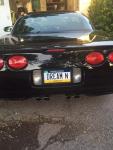


 Deer vs. Z06