When you click on links to various merchants on this site and make a purchase, this can result in this site earning a commission. Affiliate programs and affiliations include, but are not limited to, the eBay Partner Network.
my car has been running with what I'd call a "dealership alignment" with exactly 0° camber all around since I bought it.
I use mainly for autocross and trackdays so purchased camber gauge, toe plates, and turntables to do a diy alignment. No strings yet. (I know the local speed shop just send alignment out to goodyear for a lazer machine job anyways).
I have a general idea of what specs I want and the basic idea oh how to do it and have read the manual, but are there any "gotcha's" when doing alignments on this car?
I don't think I need a camber lock kit yet because I use street tires that are not very sticky.
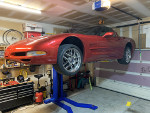
I understand your desire to "do it right", but I have only one question. How to you plan on getting the car high enough so you can reach the adjustment bolts, etc, to make the necessary adjustments?
either put the turn plates on a stack of 2x8s or go use the 4 post rack at work.. depend on whether I feel like rolling around on the floor or spending extra time at the office.
either put the turn plates on a stack of 2x8s or go use the 4 post rack at work.. depend on whether I feel like rolling around on the floor or spending extra time at the office.
My vote is that you use the lift. Your body will appreciate it!
Interested in results here. I want to do this. The alignment rack at my job (a dealership, hilariously) can't hold my car. The arms won't grip the wheels and it's very annoying.
These set the car a little higher so i can sit on a stool and reach all the bolts, and leave the whole suspension and arms exposed while sitting on the ground. Added bonus if you have installed the upper shim kit (highly recommended) it makes shim swaps super fast.
Already, there is a problem. The center bore of my wheel is ~70 mm but the magnet is 75 mm. The hub does not stick out past the wheel so the magnet cannot reach the hub and sit flat.
I am going to see if a friend with a lathe can make it fit since the magnetic part is aluminum with small magnets inside. I am worried might hit the magnet, guess we'll see what happens.
To check the camber (preliminary check) I used the brake disc. All were -0.25 except the RR was -0.5 So not all 0 as my phone had indicated, but pretty close.
I am gonna follow roughly the pfadt guide, 1.25f/1.0r. I did not check caster yet (will do it at work tomorrow or friday once I have turn plates out).
Front toe is 1/16 and rear 1/8. Car goes straight quite nicely so I have a good starting point.
Maybe I should have got the hub stands instead. Maybe later, lol. I could make my own and I don't consider particularly handy.
I am going to see if a friend with a lathe can make it fit since the magnetic part is aluminum with small magnets inside. I am worried might hit the magnet, guess we'll see what happens.
Made a nice little iron spacer that would allow the gauge to sit flush and found out somehow it blocks the magnetic field. So we wound up turning down the adapter after all. Plenty of room to clear the wheel now and we did not find the magnets.
BUT!
Getting the toe set was tricky at first. I'm pretty sure the rear thrust angle didn't change because I knew what I was doing at that point. But I may have turned the front the wrong way a few times, then tried to put it back, etc. Steering wheel is off a degree or two now but the car rides straight. Have to re set it soon I guess.
FWIW, I've used the strings method to set the toe (and align the steering wheel dead center) on several vehicles, including my Vette. When taking the vehicles to the shop for an alignment check, the toe is surprisingly close to dead on. The worst I've seen is a wheel with 0.3 degree toe error.








 diy alignment tips