When you click on links to various merchants on this site and make a purchase, this can result in this site earning a commission. Affiliate programs and affiliations include, but are not limited to, the eBay Partner Network.
I’m pretty sure LS6 intake manifold came standard on all C5 in 2002.
Originally Posted by hyperv6
The 350 HP engines came with the LS6 Block and intake in all 2001-2004.
Thank you guys for response
So these came with the standard heads or did they come with the 243 heads???
I think I figured out my own question lol. The Z06 came out with the 243 heads. I think I’m just gonna get a set of 243 heads a a different CAI set up.
So with the street tune, do you think I’ll be pushing around 450hp?
I know I’ll need supporting mods like a clutch, timing chain, etc
see why I’m asking about the engine is I checked the Vin code and it showed that it was a LS1 engine. So I’m quite not understanding why it would show it being an LS1 and everyone says the 2001 up came with LS6.
am I missing something here? I really appreciate the help.
Last edited by Speedy9159; Jan 11, 2024 at 06:47 PM.
From: In a parallel universe. Currently own 2014 Stingray Coupe.
C7 of the Year - Modified Finalist 2021
MO Events Coordinator
St. Jude Co-Organizer
St. Jude Donor '03 thru '26
NCM Sinkhole Donor
CI 5, 8 & 11 Veteran
I do not think you will be at 450 hp with just the intake and probably not with revised heads. The Z06 was only 405 hp and had other performance goodies to get there.
I do not think you will be at 450 hp with just the intake and probably not with revised heads. The Z06 was only 405 hp and had other performance goodies to get there.
i’m looking these Trick Flow GenX® 215 cathedral port cylinder heads for GM 5.7L LS1 engines are fully CNC-machined
I'd call Texas Speed, KaTech, BTR or Tony Mamo for a recipe for your goals. Line a up a tuner and get their input as well
If I were to do my head/cam swap again I'd just buy these TSP Brawler heads instead of sending the used 243 heads to TSP for CNC porting/five angle valve job like I did in spring 2023. Mine work fine but these look nice, plus they are new: https://www.texas-speed.com/p-18424-...retainers.aspx
These Brawler heads came out in October of 2023. Made, cast and machined in the USA...
I've been telling folks about the "while your there" cost of swapping cam/heads. It can be substantial with lots of rabbit holes.
Mine was 430 hp and 400 tq on the dyno at Speed Inc who tunes hundreds maybe thousands of cars here in the Chicago area over the decades. Some have said my car was a bit inflated on their dyno. I think it is due to the attention to detail I put into everything, at least that is what I tell myself. I'm happy, I'd do it again in heartbeat, very rewarding project.
My story last spring: https://www.corvetteforum.com/forums...-coupe-m6.html
i’m looking these Trick Flow GenX® 215 cathedral port cylinder heads for GM 5.7L LS1 engines are fully CNC-machined
maybe I can get somewhere near 430 at the wheel?
These Trick Flow heads flow extremely well and are highly regarded. They also boast a CARB exemption.
I've heard good things about the Texas Speed Brawler heads and, indeed, their intake ports flow very nearly as well as the Trick Flow heads. But, the Trick Flow heads flow a wee bit better on the exhaust side. Is this difference important, or even detectable seat of the pants? Probably not, especially if you pair the Texas Speed parts with a cam that has a wee bit more exhaust duration.
Either head is a viable choice (as are others) just be sure to match it to a cam that compliments the flow characteristics of the head. On this subject, I would get as many opinions as you possibly can and then closely examine the recommended cams for their similarities, differences and street manners.
These Trick Flow heads flow extremely well and are highly regarded. They also boast a CARB exemption.
I've heard good things about the Texas Speed Brawler heads and, indeed, their intake ports flow very nearly as well as the Trick Flow heads. But, the Trick Flow heads flow a wee bit better on the exhaust side. Is this difference important, or even detectable seat of the pants? Probably not, especially if you pair the Texas Speed parts with a cam that has a wee bit more exhaust duration.
Either head is a viable choice (as are others) just be sure to match it to a cam that compliments the flow characteristics of the head. On this subject, I would get as many opinions as you possibly can and then closely examine the recommended cams for their similarities, differences and street manners.
i’ve already picked up the cam and it will be in Tuesday so I need to work with the cam I listed above. I want to thank you guys for your advice, it is taken with high regards. Both them heads sound real good so with the cam I have, what do you think my best option would be
i’m looking these Trick Flow GenX® 215 cathedral port cylinder heads for GM 5.7L LS1 engines are fully CNC-machined
maybe I can get somewhere near 430 at the wheel?
Think about what you are saying here. Nothing wrong with optimistic thinking, as long as some reality is also included. To get 430whp, you will need to be pushing 500chp!! The LS7, with a better OEM cam, 80 more cubic inches, and heads that far outflow the heads youre mentioning, is rated at 505hp. You wont get 430whp from an LS6 with only those heads and a tune. Not going to happen.....
Speedy,
I almost went with that cam you ordered. I decided to shy away from the 7,000 rpm capabilities (Yes, I know myself and I'd push that 7k often) and went with a .550 milder low lift, basically a truck cam, for my engine. The one I picked uses single beehive GM springs and starts to drop off at about 6000-6200 rpm, just like a stockish engine. You need 500 crank hp to get to a 122 mph trip at the 1/4 strip. I was playing at the strip and got to 115 mph when the clutch started to slip at a max effort launch. I now have a new organic lined McLeod RST twin disc with steel flywheel clutch in the car now. When the earth is warm I'll go shoot for that elusive 122mph mark.
Idle video. I asked the tuner to not make this a max effort and wanted idle as a street car (Duh, That's what it is) without the ricer farting and popping on deceleration. I love the car even more now with the parts I added
So what am I not seeing here. I see people say they have the ls6 intake, ported heads, larger cam, headers, x-pipe and they are reaching over 400rwhp+
I think I am wasting my money. I’m not a supercharger kind of guy I really like the sound of a well tuned car with a nice cam
I think I need to stop trying to reach 400+ and just run the cam and be happy with that
Any competent tuner can give you a choppy idle, without cracking open the engine.
What is your true objective, a lumpy idle, an arbitrary HP target, a specific ET at the strip, good power consistent with good street manners, or something else?
Any competent tuner can give you a choppy idle, without cracking open the engine.
What is your true objective, a lumpy idle, an arbitrary HP target, a specific ET at the strip, good power consistent with good street manners, or something else?
thank you so much for your reply. I’m looking for power with good street manners. It’s not a daily driver but I do drive it quite a bit. By the time it’s all said, and done, my son will eventually get the car and I’d like for it to be something that he would really enjoy.
thank you so much for your reply. I’m looking for power with good street manners. It’s not a daily driver but I do drive it quite a bit. By the time it’s all said, and done, my son will eventually get the car and I’d like for it to be something that he would really enjoy.
In the following ramblings, I've used the late production (405 HP) C5 Z06 as a reference point. Here is some food for thought ...
Discalmer #1 - No, I'm not a professional engine builder, nor do I play one on TV.
Rule #1 - Unless your really know what you are doing, always select a daily driver street cam "one size" smaller than what you think you want. 99 times out of 100 you will be happier in the long run ... unless this a street/strip car, with an emphasis on strip.
Since you are here and have a grasp of things mechanical, I'm going to jump right into the middle of a very complex and controversial subject and I am going to make some assumptions and generalizations which will not please all readers. But, that's OK; there is more than one way to skin a cat, eh? For a street, autocross, or road racing car, you typically want a broad, flat torque curve, with as much area under the curve as possible. Drag racing is a different animal all together, as there is typically much more emphasis placed on the peak horsepower produced at the extreme reaches of the RPM range. This does not typically make for good street manners for a daily driven car, unless significant compromises are made on the maximum amount of power that is actually produced.
If you talk to a cam grinder and ask for a recommendation, they will typically go on at length about intake valve timing, specifically the Intake Valve Close (IVC) event and exhaust valve timing, specifically the Exhaust Valve Open (EVO) event. Have a quick browse through this post as an example: https://ls1tech.com/forums/generatio...editorial.html These events largely define the character of a camshaft and different timing is required for each specific combination of displacement, # of cylinders, compression ratio and cylinder head flow characteristics (yes, there are other important variables). You will no doubt be able to follow along with this valve event conversation, but unless you are a diehard engine geek, you may not fully grasp the subtleties that these numbers imply. These timing events will determine critical cam characteristics such as valve overlap and Lobe Separation Angle (LSA).
Lift is another critical camshaft characteristic, but it is largely independent of valve timing events except, for instance, when considering the need for valve relief cuts in the pistons for clearance. LS6 street engines with decent street manners likely will not need valve relief cuts in the pistons, but YMMV. ALWAYS measure your valve to piston clearance!!! Therefore, the concern for these street engines is more likely to be how much lift can I get away with, before the wear and tear on the valve guides, for instance, becomes a concern. Because on a street engine, most folks won't want to replace their valve guides annually, eh? Obviously, this will vary with engine architecture, but for the LS6 engine I personally think that if you have less than about 0.600" lift, you are leaving power on the table. And, if you go too much more aggressively than 0.600" you begin to approach wear and tear and longevity concerns. Obviously, opinions are like ********, so again, YMMV.
Getting back to the valve timing discussion there is another school of thought, that if you start with the basic architecture of the engine, such as the displacement, # of cylinders, compression ratio and head flow characteristics and take into consideration what we know about the valve timing preferences of different engines, it is possible to calculate the ideal LSA required, in order to produce the most torque under the curve. If you then adjust the duration for the vehicle application (street, road racing, drag racing, etc.) then the combination of LSA and duration will automatically place the valve timing events at the appropriate places for best performance. When approaching things from this direction, I think that it's far easier to get your arms around the concepts involved, thereby simplifying things tremendously. It is also much more likely that you will select a cam that will reach your desired performance target.
Note that an incorrect LSA sacrifices low RPM torque and perhaps even medium RPM torque and once it is gone it can never be recovered except, perhaps, with forced induction.
Note also that a tight LSA tends to promote valve overlap, which increases the likelihood of a choppy idle. Similarly, with the correct LSA, you may not need quite as much duration to make the desired power, which will allow you to decrease overlap, thus improving idle quality. Tinker with the cam timing calculator below to see how these variables interact with each other.
References:
Finding the correct LSA for an engine will produce the most torque under the curve -
Calculating the correct LSA for your engine (hint - For the stock 5.7L LS6 engine, it's right around 108 degrees. For a 5.7L LS6 engine with competition porting, valve job and oversize valves, the LSA would be closer to 109, or perhaps even approaching 110 degrees) -
I stumbled onto this playlist a while back and the more I look at the cam that was chosen for this track car, the more I think that it would be a great street cam, especially with massaged 243 (LS6) cylinder heads and headers -
Here is the dyno chart for the yellow Corvette track car w/ stock 243 heads and the "Track Weapon" cam. Notice the broad, flat torque curve peaking at 378 lb*ft and the HP peaking at 391 at the wheels:
If you wanted to get closer to your arbitrary target of 450 HP at the wheels, you could add a bit more lift and/or duration, but I think this would be an excellent street cam that you could live with without any compromise in terms of driveability. And, all of the torque will be right there (and lots of it), in the RPM range where you spend most of your time.
Disclamer #2 - No, I don't work for Cam Motion.
For reference, the later production OE LS6 (405 HP/400TQ at the flywheel) cam specs are:
204/218 duration, 0.555"/0.551" lift and 117.5 LSA
The "Track Weapon" with headers makes about 35HP and 40 lb*ft torque (at the wheels) more than a late model C5 Z06, but with a broader torque curve. Obviously, this upgrade would be even more impressive for a base car.
Want to make even more torque, without sacrificing driveability? Swap the ring and pinion gears out for something more aggressive. Summit, for example, offers 3.73, 3.90, 4.10 and 4.11 options for the C5. Going from the stock Z06, equipped with 3.42 gears, to a 3.90 ring and pinion adds an additional +/-600 lb*ft of tire shredding torque to the rear wheels.
So, for a ridiculously fun, but in no way radical, nor temperamental car (and this is the current plan for my own C5 Z06):
The "Track Weapon" cam (or something very similar) and all the "while you are there" bits necessary to install it,
Ported 243 heads,
Headers,
Keep the stealthy cat-back Ti exhaust,
3.90 gears
and top it off with a tune.
This combination is guaranteed to put a stupid grin you your face (and keep it there), without over stressing the car, or your neighbors.
Are there other ways to get there? Absolutely. I'm merely sharing some of my own research, conclusions and preferences.
Cam design...
Google:
Harold Brookshire
I used to race cars. If you called Harold he would bend your ear. He did not care if you bought his cam or not. There are so many thing you can and cannot change in designing a cam shaft lobe. He used to make my head spin. Smart....
The guy was the best of the best.
This is what I have setting and ready to install as soon as it gets warm
Texas Speed TSP 233/239 Camshaft/cam only
kooks 1 7/8 headers
kooks x-pipe w/cat
stock axle back
I was looking at 215 maybe 225cc heads.
I was thinking about getting a thin gasket, since I am only .600
Maybe these heads???
Trick Flow tfs-3061t001-c02 - TRICK FLOW Alum Cyl Head CNC GM LS1 65cc A/P 225cc Bare.
Cylinder Head - Gen X - Assembled - 2.055 / 1.575 in Valves - 225 cc Intake - 65 cc Chamber - 1.300 in Springs - Angle Plug - Aluminum - GM LS-Series
I would like to change the gear set when I have to pull everything and change the clutch. I’m gonna do this all at the same time but I’m not really a differential kind of guy. never done it before.
I think I got enough airflow with the cam to support them heads. What do you guys think?
A lot of this is going to depend on the tuner. From whatI’ve been reading, I have a few good choices out here in northern Kentucky.
I was thinking maybe doing a fast 92. I don’t know if the LS6 intake is going to handle what I’m trying to do here.
this is no track car.
This is not a drift car.
This is just a car to jump in have a blast in and if someone pulls up beside you, give them a damn good run for their money :-)
in my day, I’ve had a Camaro, Firebird, Chevelle Buick Skylark GS and Mustang believe it or not.
this is my second Corvette, but the first one I had, I sold it faster than it would drive. Some guy wanted it and asked if I would sell it and gave me a good price. Could not refuse it
The fastest car I had was the 78 Camaro punched 60 over with a mild cam. It had very good street manners, but you had to be careful when you punched it or you Going sideways off the road.
Originally Posted by Prop Joe
Cam design...
Google:
Harold Brookshire
I used to race cars. If you called Harold he would bend your ear. He did not care if you bought his cam or not. There are so many thing you can and cannot change in designing a cam shaft lobe. He used to make my head spin. Smart....
The guy was the best of the best.
Originally Posted by Tron Z
In the following ramblings, I've used the late production (405 HP) C5 Z06 as a reference point. Here is some food for thought ...
Discalmer #1 - No, I'm not a professional engine builder, nor do I play one on TV.
Rule #1 - Unless your really know what you are doing, always select a daily driver street cam "one size" smaller than what you think you want. 99 times out of 100 you will be happier in the long run ... unless this a street/strip car, with an emphasis on strip.
Since you are here and have a grasp of things mechanical, I'm going to jump right into the middle of a very complex and controversial subject and I am going to make some assumptions and generalizations which will not please all readers. But, that's OK; there is more than one way to skin a cat, eh? For a street, autocross, or road racing car, you typically want a broad, flat torque curve, with as much area under the curve as possible. Drag racing is a different animal all together, as there is typically much more emphasis placed on the peak horsepower produced at the extreme reaches of the RPM range. This does not typically make for good street manners for a daily driven car, unless significant compromises are made on the maximum amount of power that is actually produced.
If you talk to a cam grinder and ask for a recommendation, they will typically go on at length about intake valve timing, specifically the Intake Valve Close (IVC) event and exhaust valve timing, specifically the Exhaust Valve Open (EVO) event. Have a quick browse through this post as an example: https://ls1tech.com/forums/generatio...editorial.html These events largely define the character of a camshaft and different timing is required for each specific combination of displacement, # of cylinders, compression ratio and cylinder head flow characteristics (yes, there are other important variables). You will no doubt be able to follow along with this valve event conversation, but unless you are a diehard engine geek, you may not fully grasp the subtleties that these numbers imply. These timing events will determine critical cam characteristics such as valve overlap and Lobe Separation Angle (LSA).
Lift is another critical camshaft characteristic, but it is largely independent of valve timing events except, for instance, when considering the need for valve relief cuts in the pistons for clearance. LS6 street engines with decent street manners likely will not need valve relief cuts in the pistons, but YMMV. ALWAYS measure your valve to piston clearance!!! Therefore, the concern for these street engines is more likely to be how much lift can I get away with, before the wear and tear on the valve guides, for instance, becomes a concern. Because on a street engine, most folks won't want to replace their valve guides annually, eh? Obviously, this will vary with engine architecture, but for the LS6 engine I personally think that if you have less than about 0.600" lift, you are leaving power on the table. And, if you go too much more aggressively than 0.600" you begin to approach wear and tear and longevity concerns. Obviously, opinions are like ********, so again, YMMV.
Getting back to the valve timing discussion there is another school of thought, that if you start with the basic architecture of the engine, such as the displacement, # of cylinders, compression ratio and head flow characteristics and take into consideration what we know about the valve timing preferences of different engines, it is possible to calculate the ideal LSA required, in order to produce the most torque under the curve. If you then adjust the duration for the vehicle application (street, road racing, drag racing, etc.) then the combination of LSA and duration will automatically place the valve timing events at the appropriate places for best performance. When approaching things from this direction, I think that it's far easier to get your arms around the concepts involved, thereby simplifying things tremendously. It is also much more likely that you will select a cam that will reach your desired performance target.
Note that an incorrect LSA sacrifices low RPM torque and perhaps even medium RPM torque and once it is gone it can never be recovered except, perhaps, with forced induction.
Note also that a tight LSA tends to promote valve overlap, which increases the likelihood of a choppy idle. Similarly, with the correct LSA, you may not need quite as much duration to make the desired power, which will allow you to decrease overlap, thus improving idle quality. Tinker with the cam timing calculator below to see how these variables interact with each other.
I stumbled onto this playlist a while back and the more I look at the cam that was chosen for this track car, the more I think that it would be a great street cam, especially with massaged 243 (LS6) cylinder heads and headers - https://www.youtube.com/playlist?lis...HsP8QZjpmukouw
Here is the dyno chart for the yellow Corvette track car w/ stock 243 heads and the "Track Weapon" cam. Notice the broad, flat torque curve peaking at 378 lb*ft and the HP peaking at 391 at the wheels:
If you wanted to get closer to your arbitrary target of 450 HP at the wheels, you could add a bit more lift and/or duration, but I think this would be an excellent street cam that you could live with without any compromise in terms of driveability. And, all of the torque will be right there (and lots of it), in the RPM range where you spend most of your time.
Disclamer #2 - No, I don't work for Cam Motion.
For reference, the later production OE LS6 (405 HP/400TQ at the flywheel) cam specs are:
204/218 duration, 0.555"/0.551" lift and 117.5 LSA
The "Track Weapon" with headers makes about 35HP and 40 lb*ft torque (at the wheels) more than a late model C5 Z06, but with a broader torque curve. Obviously, this upgrade would be even more impressive for a base car.
Want to make even more torque, without sacrificing driveability? Swap the ring and pinion gears out for something more aggressive. Summit, for example, offers 3.73, 3.90, 4.10 and 4.11 options for the C5. Going from the stock Z06, equipped with 3.42 gears, to a 3.90 ring and pinion adds an additional +/-600 lb*ft of tire shredding torque to the rear wheels.
So, for a ridiculously fun, but in no way radical, nor temperamental car (and this is the current plan for my own C5 Z06):
The "Track Weapon" cam (or something very similar) and all the "while you are there" bits necessary to install it,
Ported 243 heads,
Headers,
Keep the stealthy cat-back Ti exhaust,
3.90 gears
and top it off with a tune.
This combination is guaranteed to put a stupid grin you your face (and keep it there), without over stressing the car, or your neighbors.
Are there other ways to get there? Absolutely. I'm merely sharing some of my own research, conclusions and preferences.
Best of luck with your project.
Last edited by Speedy9159; Jan 18, 2024 at 12:10 AM.



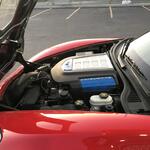








 2001 base model questions