




Typhoon better than FAST 90?

Thread Starter
Burning Brakes

Joined: Jun 2006
Posts: 933
Likes: 0
From: St. Paul MN

Well stated Drako and ZeeOSix. You guys took the time to more clearly state what I was trying to point out with the thermal coefficients. Unfortunately, this topic is a little difficult to understand for some people though...
Despite all this great debate regarding intake manifold materials, my first Generation SBC sure runs well with it's Edlebrock Victor Jr. aluminum heat sink. Just imagine how much more than 660 hp it would have with a plastic intake It's funny how back when that was the only choice, we didn't really care - we just put bags of ice on the intake to compensate.
On another topic - I enjoyed driving my Corvette to work today. How about you Northern guys?
Despite all this great debate regarding intake manifold materials, my first Generation SBC sure runs well with it's Edlebrock Victor Jr. aluminum heat sink. Just imagine how much more than 660 hp it would have with a plastic intake
It's funny how back when that was the only choice, we didn't really care - we just put bags of ice on the intake to compensate.On another topic - I enjoyed driving my Corvette to work today. How about you Northern guys?

Please allow me to state the conclusion of my discussion again:
Yes, the aluminum manifold will transfer more heat to the intake airflow but will it have a significant influence on performance and if so is the performance loss acceptable? That is, for example, if the aluminum construction ultimately costs 20% of the performance potential of the intake but it still provides substantial performance improvements then maybe the loss is acceptable.
Thermodynamics is a difficult subject and most people don't fully appreciate the matter, which is somewhat apparent in the discussion of this thread. That's not a knock on anybody, it's just a fact.
I'm glad that you were able to drive your vette to work today...I had to shovel two feet of snow from my driveway so that I was able to get to work today. That was almost as exciting as driving the vette wouldn't you agree?

Burning Brakes

Joined: Apr 2003
Posts: 908
Likes: 2
From: TROY MI
Use some of your mod money and install a roll-up door.You are missing out on driving the vette when it has the most power.My vert. feels like it has 50 more ponies in this 25/30* weather.

Le Mans Master

Joined: Mar 2002
Posts: 5,955
Likes: 161
From: PNW


Le Mans Master


Joined: Feb 2002
Posts: 5,970
Likes: 19
From: San Marcos Texas
I think this whole argument is  There's no way that the thick aluminum intake has an efficient enough heat transfer rate to transfer any notable amount of heat to the incoming air charge at anything above idle speeds...The air just doesn't spend enough time in the intake for the transfer to take place and the inside of the intake doesn't have enough surface area to make it an efficient heat exchange..
There's no way that the thick aluminum intake has an efficient enough heat transfer rate to transfer any notable amount of heat to the incoming air charge at anything above idle speeds...The air just doesn't spend enough time in the intake for the transfer to take place and the inside of the intake doesn't have enough surface area to make it an efficient heat exchange..
Le Mans Master
Joined: Mar 2002
Posts: 5,955
Likes: 161
From: PNW
I think this whole argument is There's no way that the thick aluminum intake has an efficient enough heat transfer rate to transfer any notable amount of heat to the incoming air charge at anything above idle speeds...The air just doesn't spend enough time in the intake for the transfer to take place and the inside of the intake doesn't have enough surface area to make it an efficient heat exchange..
There's no way that the thick aluminum intake has an efficient enough heat transfer rate to transfer any notable amount of heat to the incoming air charge at anything above idle speeds...The air just doesn't spend enough time in the intake for the transfer to take place and the inside of the intake doesn't have enough surface area to make it an efficient heat exchange..If you think about it, there is quite a bit of internal surface area in these intake manifolds. This makes them pretty efficient heat exchanges, just like a radiator is due to it's large surface area.
I think the place the people would see the biggest effects of heat soak would be at the drag strip, as a heat soaked intake manifold would be adding heat to the intake charge all the way down the track.
Cars that are running on road courses at WOT for long periods will not see the heat transfer effects of an aluminum vs. plastic intake manifold as much. This is because once the mass of the intake manifold has been cooled down by intake air, the main path of heat transfer is where the manifold connects to the heads. The aluminum manifold will still definitely transfer more heat in this mode, but the amount of intake air heating is much less at steady state WOT then during a heat soaked run down the 1/4 mile.
Last edited by ZeeOSix; Dec 26, 2007 at 02:32 PM.
Le Mans Master
Joined: Feb 2002
Posts: 5,970
Likes: 19
From: San Marcos Texas
A radiator is designed to transfer heat..Thousands of **** thin little fins creating a huge surface area for the air and water to transfer heat through. Not a 1/2" block of aluminum with very little surface area as compared to the volume of air flowing through it...
Le Mans Master
Joined: Mar 2002
Posts: 5,955
Likes: 161
From: PNW
There is actually quite a bit of surface area inside the intake manifold ... anyone just looking at it can see that.
Do this test. Put some thermocouples on the aluminum intake manifold. Heat soak the intake manifold to 200 deg F. Make a WOT run down the 1/4 mile while doing some high speed temperature recording down the strip to see how much the temperature drops. If you want to do it the poor man's way, then simply feel it with your hand just before and after the run. You will feel a huge difference in the manifold's temperature. No rocket science required.
Guess where all that heat went?


Safety Car


Joined: Sep 2003
Posts: 3,558
Likes: 2
From: Cape Coral FL
Another factor directly related to this and one nobody has taken into account is heat radiation. It occurs at the speed of light and can have significant effect on the intake charge. Probably more so than convection, or conduction. You have to take all three factors into account when talking about heat transfer.
Corvette Stories
The Best of Corvette for Corvette Enthusiasts

10 Most Common Corvette Problems of the Last 20 Years!
Joe Kucinski
5 MOST and 5 LEAST Popular Corvette Model Years in History!
Joe Kucinski
2027 Corvette Buyer's Guide: Everything You Need to Know!
Joe Kucinski
10 Things C8 Corvette Owners Hate (But Won't Tell You)
Joe Kucinski
10 Best Corvettes Coming to Barrett-Jackson Palm Beach 2026!
Brett Foote
Every Corvette Grand Sport Explained! (C2, C4, C6, C7, & C8)
Joe Kucinski
Grand Sport & Grand Sport X Launch Alongside All-New 535hp LS6 V8!
Michael S. Palmer
5 Reasons Bad Drivers Crash & 5 Ways to Avoid a Costly Mistake!
Joe Kucinski
7 Bolt-On Upgrades From Extreme Online Store to Level Up Your C6 Corvette
Pouria Savadkouei
Melting Slicks

Joined: Nov 2004
Posts: 3,495
Likes: 0
From: Paducah Ky
Pics, Pics ????
Does anybody else think it's strange that a guy making all this fuss about a few hundred dollars difference on an intake just goes out and then buys both of them, just so he can actually see which one is best??
Sorry, but I call .
Does anybody else think it's strange that a guy making all this fuss about a few hundred dollars difference on an intake just goes out and then buys both of them, just so he can actually see which one is best??
Sorry, but I call
.
Le Mans Master
Joined: Mar 2002
Posts: 5,955
Likes: 161
From: PNW
Another factor directly related to this and one nobody has taken into account is heat radiation. It occurs at the speed of light and can have significant effect on the intake charge. Probably more so than convection, or conduction. You have to take all three factors into account when talking about heat transfer.
Conduction and forced convection is definitely the main modes that will transfer heat in to the intake air flow.
Last edited by ZeeOSix; Dec 27, 2007 at 12:13 AM.

Tech Contributor


Joined: Sep 2005
Posts: 1,731
Likes: 82
From: New Market AL
 I have called him out multiple times to produce pictures of his alleged intake manifold collection, but he has conveniently not responded.
Thread Starter
Burning Brakes
Joined: Jun 2006
Posts: 933
Likes: 0
From: St. Paul MN

Thread Starter
Burning Brakes
Joined: Jun 2006
Posts: 933
Likes: 0
From: St. Paul MN
Check out this link:
http://www.lingenfelter.com/90mmintaketests.htm
Lingenfelter Performance ran a test of the FAST 90 vs LS6 (with 90mm TB).
Engine:
LS7 427 Shortblock
65cc Edelbrock heads (which produced 12:1).
FAST 90
HP: 575
TQ: 561
LS6 (with 90mm TB)
HP: 571
TQ: 559
Although the FAST shows 4hp greater peak the LS6 manifold seems to have more area under the curve (atleast that is what these doctored-up images suggest).
http://www.lingenfelter.com/90mmintaketests.htm
Lingenfelter Performance ran a test of the FAST 90 vs LS6 (with 90mm TB).
Engine:
LS7 427 Shortblock
65cc Edelbrock heads (which produced 12:1).
FAST 90
HP: 575
TQ: 561
LS6 (with 90mm TB)
HP: 571
TQ: 559
Although the FAST shows 4hp greater peak the LS6 manifold seems to have more area under the curve (atleast that is what these doctored-up images suggest).

Melting Slicks

Joined: Dec 2004
Posts: 2,847
Likes: 1,144
From: Sleepy Hollow- NJ
I have a friend at Edelbrock, and he said they are working on an LS intake due out in 2008. He claims it is currently in testing.
My dumb *** forgot to ask him if it is aluminum....which I would imagine it is. I'll try to get a hold of him this weekend and let you all know.

My dumb *** forgot to ask him if it is aluminum....which I would imagine it is. I'll try to get a hold of him this weekend and let you all know.
Le Mans Master
Joined: Mar 2002
Posts: 5,955
Likes: 161
From: PNW
I see an aluminum intake manifold having advantages if:
1) Using nitrous injection.
2) Running pretty high boost pressures.
Both of those have possible high internal manifold pressure scenarios ... which could potentially destroy a plastic manifold.
IMO, heat soak would be forgotten over a manifold that could take some abuse from 1) and 2) above.
1) Using nitrous injection.
2) Running pretty high boost pressures.
Both of those have possible high internal manifold pressure scenarios ... which could potentially destroy a plastic manifold.
IMO, heat soak would be forgotten over a manifold that could take some abuse from 1) and 2) above.
Last edited by ZeeOSix; Dec 29, 2007 at 12:15 AM.
Tech Contributor
Joined: Sep 2005
Posts: 1,731
Likes: 82
From: New Market AL
Check out this link:
http://www.lingenfelter.com/90mmintaketests.htm
Lingenfelter Performance ran a test of the FAST 90 vs LS6 (with 90mm TB).
FAST 90
HP: 575
TQ: 561
LS6 (with 90mm TB)
HP: 571
TQ: 559
Although the FAST shows 4hp greater peak the LS6 manifold seems to have more area under the curve (atleast that is what these doctored-up images suggest).
http://www.lingenfelter.com/90mmintaketests.htm
Lingenfelter Performance ran a test of the FAST 90 vs LS6 (with 90mm TB).
FAST 90
HP: 575
TQ: 561
LS6 (with 90mm TB)
HP: 571
TQ: 559
Although the FAST shows 4hp greater peak the LS6 manifold seems to have more area under the curve (atleast that is what these doctored-up images suggest).
 . Take a look again: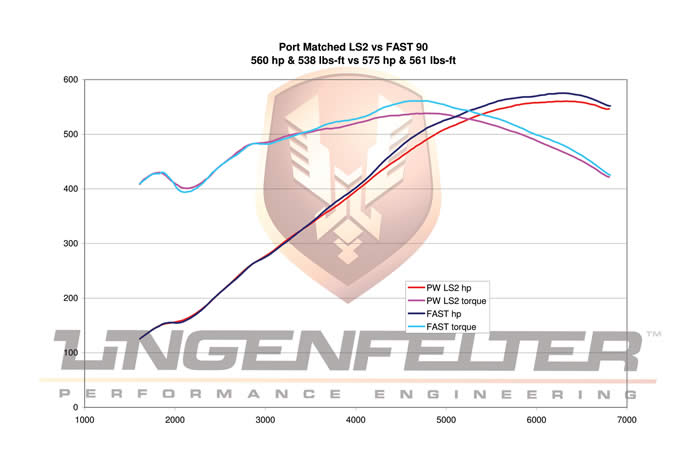
FAST 90:
575 hp / 561 ft*lbs
LS2 port matched with 90mm:
560 hp / 538 ft*lbs
So the modified LS2 intake is still 15 hp and 23 ft*lbs less than the stock FAST 90. Thanks for sharing a good report (once again) for the FAST intake.

Last edited by chevy406; Dec 29, 2007 at 12:59 AM. Reason: added dyno chart from LPE website
Thread Starter
Burning Brakes
Joined: Jun 2006
Posts: 933
Likes: 0
From: St. Paul MN
Dude, I finally took the time to double check one of your threads, and you didn't exactly tell the truth. Take a look again:
FAST 90:
575 hp / 561 ft*lbs
LS2 port matched with 90mm:
560 hp / 538 ft*lbs
So the modified LS2 intake is still 15 hp and 23 ft*lbs less than the stock FAST 90. Thanks for sharing a good report (once again) for the FAST intake.
. Take a look again:FAST 90:
575 hp / 561 ft*lbs
LS2 port matched with 90mm:
560 hp / 538 ft*lbs
So the modified LS2 intake is still 15 hp and 23 ft*lbs less than the stock FAST 90. Thanks for sharing a good report (once again) for the FAST intake.
 This is the graph you want to look at:
The tpis intake is the LS6 intake with a 90mm mouth.
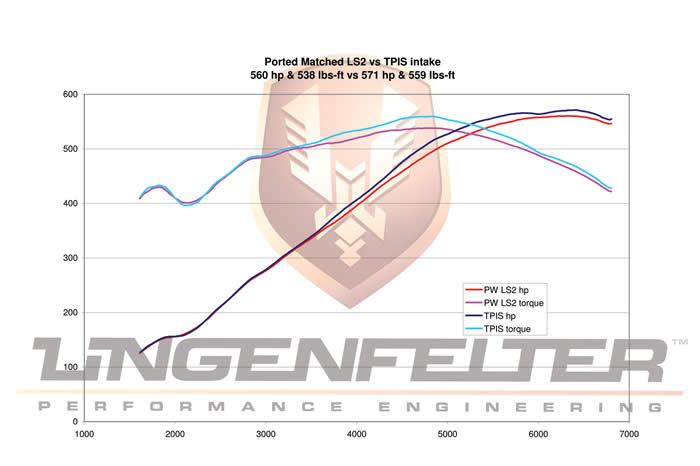
The LS6 intake gains 11hp over the LS2 and appears to have more area under the curve than the fast.
Last edited by verano29; Dec 29, 2007 at 02:01 AM.
Le Mans Master
Joined: Mar 2002
Posts: 5,955
Likes: 161
From: PNW
Besides, the "area under the curve" is only useful if one defines between what RPM range. Once you are near redline and going through the gears, the "area under the curve" becomes a pretty small range of RPM, so it becomes less important than the amount of peak HP near the area of RPM range due to gear shifting.
I suppose the "area under the curve" might make the most difference in accelerating out of the hole in first gear, but once you make that first gear shift the area under the curve pretty much goes out the window.

Former Vendor
Joined: Mar 2004
Posts: 1,518
Likes: 7
From: Valencia CA
Lets not forget this was a heavily modified LS6 intake with a 90mm snout plastic welded on the end versus a stock untouched FAST. With that much work invested in the snout I would be surprised if the runner exits were not cleaned up and port matched as well.
And no one ever said the LS6 was a bad choice for a guy on a budget....in fact a few of us recommended it.
Im gonna have to send Verano a finders fee....ever since this thread has obilterated the Tech section for a week inquiries about a ported FAST have never been stronger....
I plan on hitting the engine dyno in 30-60 days or so when I break in and test a big stroker destined for my C5....If someone will loan me a BBK I will be more than happy to test it against the reigning heavyweight champ....
Happy New year everybody....Im looking foward to an exciting 08'
Tony
And no one ever said the LS6 was a bad choice for a guy on a budget....in fact a few of us recommended it.
Im gonna have to send Verano a finders fee....ever since this thread has obilterated the Tech section for a week inquiries about a ported FAST have never been stronger....
I plan on hitting the engine dyno in 30-60 days or so when I break in and test a big stroker destined for my C5....If someone will loan me a BBK I will be more than happy to test it against the reigning heavyweight champ....
Happy New year everybody....Im looking foward to an exciting 08'
Tony
Thread Starter
Burning Brakes
Joined: Jun 2006
Posts: 933
Likes: 0
From: St. Paul MN
Can't really say by "eyeballing" the curves ... one would actually have to integrate the area to see which one actually had more "area under the curve".
Besides, the "area under the curve" is only useful if one defines between what RPM range. Once you are near redline and going through the gears, the "area under the curve" becomes a pretty small range of RPM, so it becomes less important than the amount of peak HP near the area of RPM range due to gear shifting.
I suppose the "area under the curve" might make the most difference in accelerating out of the hole in first gear, but once you make that first gear shift the area under the curve pretty much goes out the window.
Besides, the "area under the curve" is only useful if one defines between what RPM range. Once you are near redline and going through the gears, the "area under the curve" becomes a pretty small range of RPM, so it becomes less important than the amount of peak HP near the area of RPM range due to gear shifting.
I suppose the "area under the curve" might make the most difference in accelerating out of the hole in first gear, but once you make that first gear shift the area under the curve pretty much goes out the window.
It's hard to determine which manifold produced more area under the curve. Also that's why I added "atleast that is what these doctored-up images suggest." In addition, you are correct, that area under the curve is only useful if one defines between what rpm range.If you examine these doctored-up images the curves would look pretty identical except for the small dip near 6K...not sure what that is all about.