







Why do #5 and #7 pistons have chunks missing?

Thread Starter
Safety Car


Joined: May 2007
Posts: 4,812
Likes: 46
From: Taylorsville North Carolina
 Why do #5 and #7 pistons have chunks missing?
Here are this pics from blown motor:
[IMG]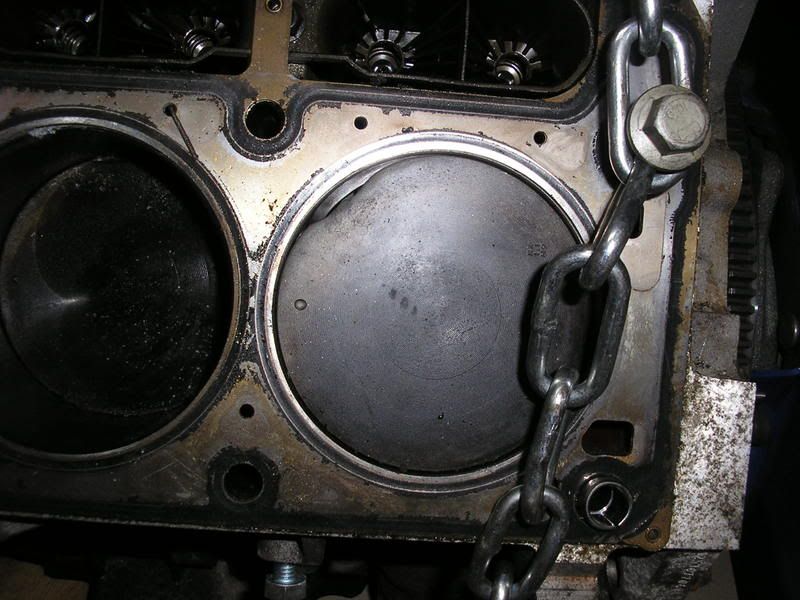 [/IMG]
[IMG]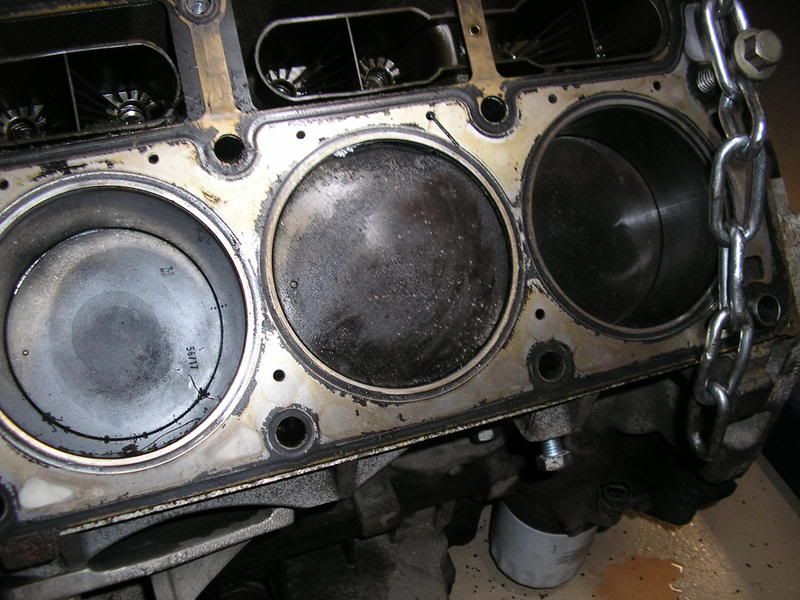 [/IMG]
Could it be from predetonation? It happened at VIR, 71*, water temps were 203* and oil temps were 255*.
Here is my last dyno sheet:
[IMG]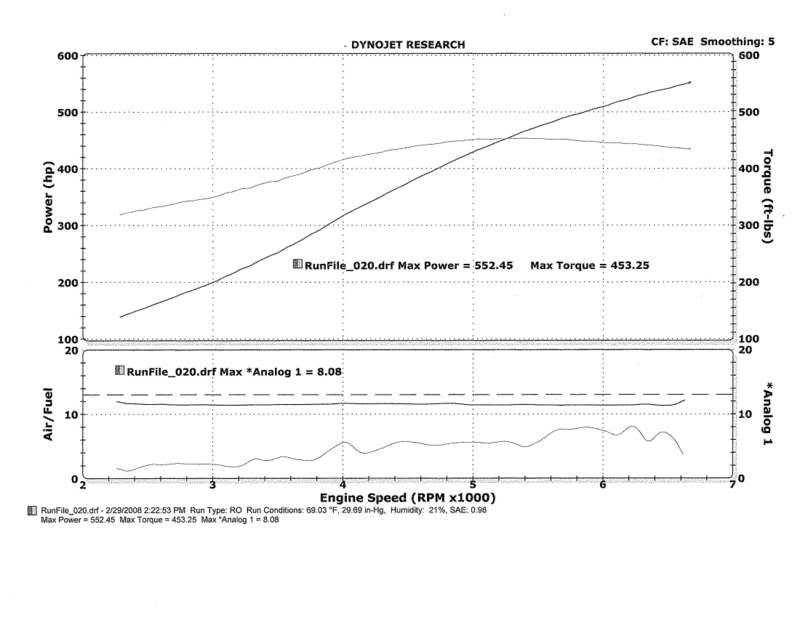 [/IMG]
I thought it was a pretty conservative tune. Could it still be cracked ring and this is the damage I did on the 3 hr ride home? Thoughts?
[IMG]
[/IMG][IMG]
[/IMG]Could it be from predetonation? It happened at VIR, 71*, water temps were 203* and oil temps were 255*.
Here is my last dyno sheet:
[IMG]
[/IMG]I thought it was a pretty conservative tune. Could it still be cracked ring and this is the damage I did on the 3 hr ride home? Thoughts?
Le Mans Master


Joined: Feb 2002
Posts: 5,970
Likes: 20
From: San Marcos Texas
I also think we see broken stock pistons from such tight top ring end gap clearances in the factory motor, when the tops of the pistons get really hot, the end top ring swells and the end gap closes to nothing and for a split second the ring locks in the bore and breaks off the top ring land. Cast pistons with tight ring end gaps don't like long, hard runs. Builds up heat in the top of the pistons...Well thats my theory anyway. 
Le Mans Master


Joined: Oct 2005
Posts: 7,088
Likes: 1,829
From: Metro Detroit Michigan
I also think we see broken stock pistons from such tight top ring end gap clearances in the factory motor, when the tops of the pistons get really hot, the end top ring swells and the end gap closes to nothing and for a split second the ring locks in the bore and breaks off the top ring land. Cast pistons with tight ring end gaps don't like long, hard runs. Builds up heat in the top of the pistons...Well thats my theory anyway.
Of course, detonation would contribute hugely to the heat load.
Is detonation always a factor?
I'm curious. Has anyone had this happen while using race gas with enough octane to make detonation highly unlikely?
Corvette Stories
The Best of Corvette for Corvette Enthusiasts

Top 10 Most Expensive Corvettes Ever Sold on Bring A Trailer
Brett Foote
10 Things Every Corvette Owner Needs (2026 Edition)
Michael S. Palmer
8 Most "Only Corvette Owners Understand" Quirks and Problems
Pouria Savadkouei
10 Reasons the C6 Z06 is Still A Performance Benchmark After 20 Years
Joe Kucinski
How Much Horsepower Every Corvette Engine "LOST" in 1972
Joe Kucinski
Top 10 DOs and DON'Ts for Protecting Your Convertible Top!
Michael S. Palmer
Top 10 Most Explosive Corvettes Ever Made: Power-to-Weight Ratio Ranked!
Joe Kucinski
150 hp to 1,250 hp: Every Corvette Generation Compared by the Specs That Matter
Joe Kucinski
8 Coolest Corvette Pace Cars (and Replicas) of All Time
Verdad Gallardo
Former Vendor
Joined: Jan 2007
Posts: 155
Likes: 0
From: Columbia City IN
That's my theory too, except that when the ring ends butt and the ring is forced hard against the cylinder wall, it could produce enough heat to melt the ring land, as well as enough force to break it. So ring end gap might be a factor in either scenario.
Of course, detonation would contribute hugely to the heat load.
Is detonation always a factor?
I'm curious. Has anyone had this happen while using race gas with enough octane to make detonation highly unlikely?
Of course, detonation would contribute hugely to the heat load.
Is detonation always a factor?
I'm curious. Has anyone had this happen while using race gas with enough octane to make detonation highly unlikely?
The heat of the chamber gets to a point and the tight end gap of a stocker is not enough.
What do the plugs say? Check the topside rod bearing? Msd coils?
There are a TON of variables when something like this happens, often its too easy to blame one little thing.

Melting Slicks

Joined: Sep 2005
Posts: 3,082
Likes: 0
From: eagle mountain utah
Preignition? or detonation?
Detonation is caused by too much timing and tends to show in the middle of the piston nearest teh spark plug. Preignition is an event that occurs before the spark plug fires and may produce pressures on one side of the comb chamber near a hot spot that exceed the strength of the piston in a weak place, such as above the ring land. My guess, from here it looks like preignition or a hot spot in the chamber.
Do you spray meth? Meth will clean teh chamber and reduce or eliminate hot spots and preignition.
Do you spray meth? Meth will clean teh chamber and reduce or eliminate hot spots and preignition.
Last edited by leojnknsC5; Sep 28, 2008 at 07:21 PM.
Thread Starter
Safety Car
Joined: May 2007
Posts: 4,812
Likes: 46
From: Taylorsville North Carolina
I am in no way blaming the tuner here. I knew I was on the edge hp wise for a stock bottom and I was pushing it really hard at the top end of 3rd and 4th gears.
"Well is the block ok? Now you will be able to forge your baby and turn up the wick"
I have a na forged 402 al block on the way. Hopefully the old block will be OK enough to get some $$s to help with the rebuild.
"Do you spray meth? Meth will clean teh chamber and reduce or eliminate hot spots and preignition."
I had a meth kit installed but not hooked up. My tuner said there was no real need for it. Timing would back down if IATs got too high. I do not know where timing was set.
My biggest concern is for the new engine and if this was a predetonation issue or an oil starvation issue. From what I gather it is a FI issue and not a road racing issue. It seems $500 for Accusump is pretty cheap insurance for a $9000 motor. Thanks for the input.
"Well is the block ok? Now you will be able to forge your baby and turn up the wick"
I have a na forged 402 al block on the way. Hopefully the old block will be OK enough to get some $$s to help with the rebuild.
"Do you spray meth? Meth will clean teh chamber and reduce or eliminate hot spots and preignition."
I had a meth kit installed but not hooked up. My tuner said there was no real need for it. Timing would back down if IATs got too high. I do not know where timing was set.
My biggest concern is for the new engine and if this was a predetonation issue or an oil starvation issue. From what I gather it is a FI issue and not a road racing issue. It seems $500 for Accusump is pretty cheap insurance for a $9000 motor. Thanks for the input.
Le Mans Master
Joined: Oct 2005
Posts: 7,088
Likes: 1,829
From: Metro Detroit Michigan
According to APS in an old thread, measuring individual cylinders showed that #5 and 7 run leaner, which would create more heat and possibly detonation. Something to do with airflow in our manifolds, and maybe the firing order I suppose.
An interesting suggestion I read was to flow the injectors, and put the richest ones on cylinders 5 and 7.
Whatever the chain of events that leads to this failure, a forged engine seems to make it much less likely, according to what I've read here. Haven't seen anyone associate it with lack of lubrication.
Edit:
The service manual puts the top ring end gap at .009 to .0149. Isn't this a little tight for FI, particularly positioned so high on the piston?

Last edited by Warp Factor; Sep 29, 2008 at 07:02 AM.

Drifting

Joined: Mar 2005
Posts: 1,737
Likes: 0
From: Northern VA
This is why people say not to run FI on a road course. A motor can live a long happy life on the street or drag strip. A couple of pulls on VIR's long straight, and voila.
My money is on high EGT.
My money is on high EGT.

Race Director

Joined: Jan 2003
Posts: 19,802
Likes: 0
From: San Antonio Texas
St. Jude Donor '05-'06-'08
I also think we see broken stock pistons from such tight top ring end gap clearances in the factory motor, when the tops of the pistons get really hot, the end top ring swells and the end gap closes to nothing and for a split second the ring locks in the bore and breaks off the top ring land. Cast pistons with tight ring end gaps don't like long, hard runs. Builds up heat in the top of the pistons...Well thats my theory anyway.


Race Director
Joined: May 2005
Posts: 15,960
Likes: 21
From: West Norriton PA
St. Jude Donor '08
It looks like either detonation problems or excessive heat problems that closed ring gap.
You'll know more when you get the pistons out and see if the top ring is broke.
Detonation can rattle a motor to pieces but I would have thought you would have heard a lot of pinging and loss power if this was the case.
You'll know more when you get the pistons out and see if the top ring is broke.
Detonation can rattle a motor to pieces but I would have thought you would have heard a lot of pinging and loss power if this was the case.
Melting Slicks
Joined: Sep 2005
Posts: 3,082
Likes: 0
From: eagle mountain utah
"Do you spray meth? Meth will clean teh chamber and reduce or eliminate hot spots and preignition."
I had a meth kit installed but not hooked up. My tuner said there was no real need for it. Timing would back down if IATs got too high. I do not know where timing was set.
Race Director
Joined: May 2005
Posts: 15,960
Likes: 21
From: West Norriton PA
St. Jude Donor '08

Detonation (also called "spark knock") is an erratic form of combustion that can cause head gasket failure as well as other engine damage. Detonation occurs when excessive heat and pressure in the combustion chamber cause the air/fuel mixture to autoignite. This produces multiple flame fronts within the combustion chamber instead of a single flame kernel. When these multiple flames collide, they do so with explosive force that produces a sudden rise in cylinder pressure accompanied by a sharp metallic pinging or knocking noise. The hammer-like shock waves created by detonation subject the head gasket, piston, rings, spark plug and rod bearings to severe overloading.
Mild or occasional detonation can occur in almost any engine and usually causes no harm. But prolonged or heavy detonation can be very damaging. So if you hear knocking or pinging when accelerating or lugging your engine, you probably have a detonation problem
CAUSES OF PRE-IGNITION
Carbon deposits form a heat barrier and can be a contributing factor to preignition. Other causes include: An overheated spark plug (too hot a heat range for the application). Glowing carbon deposits on a hot exhaust valve (which may mean the valve is running too hot because of poor seating, a weak valve spring or insufficient valve lash).
A sharp edge in the combustion chamber or on top of a piston (rounding sharp edges with a grinder can eliminate this cause).
Sharp edges on valves that were reground improperly (not enough margin left on the edges).
A lean fuel mixture.
Low coolant level, slipping fan clutch, inoperative electric cooling fan or other cooling system problem that causes the engine to run hotter than normal.
Melting Slicks
Joined: Sep 2005
Posts: 3,082
Likes: 0
From: eagle mountain utah