




Rotors101 suggestions

Thread Starter
Advanced


Joined: Nov 2006
Posts: 51
Likes: 0
From: Dallas TX
 Rotors101 suggestions
I have the stock rotors, brakes, and caliper's. I bought the brake pads from O'really's. The rotors really need to be replaced. I'm looking at all types and need to make a choice so I can just do regular driving in the city and on the highway. No drag racing.
I read some threads from 2003. I just want some up to date information for 2011--just in case there are some new parts to choose from.
I found the following:
o'reilly auto parts/282.99 Each front and back
Baer Eradispeed Plus rotors
$829.95
Do anyone have any suggestions?
What to look for?
Thanks
I read some threads from 2003. I just want some up to date information for 2011--just in case there are some new parts to choose from.
I found the following:
o'reilly auto parts/282.99 Each front and back
Baer Eradispeed Plus rotors
$829.95
Do anyone have any suggestions?
What to look for?
Thanks

Burning Brakes


Joined: Jun 2008
Posts: 940
Likes: 81
From: Lake Villa IL
Check with Gene at www.gmpartshouse.com. He a great selection and prices and is a real pleasure to deal with.

Le Mans Master

Joined: May 2007
Posts: 5,393
Likes: 17
From: Belleville Mich.
Geeze, it doesn't sound that difficult.
Why not replace with new gm rotors & pads?
You said that all you wanted was for every day driving.
Buying all new GM products would be best.
Good luck.
Why not replace with new gm rotors & pads?
You said that all you wanted was for every day driving.
Buying all new GM products would be best.
Good luck.
Thread Starter
Advanced
Joined: Nov 2006
Posts: 51
Likes: 0
From: Dallas TX
Well, I have been reading about cross drilled rotors. And the rest is in my post. I have been doing some research and wanted some opinions. If the cross drilled rotors cost the same as GM products or less. Why by GM stock rotors and waste my time installing them in my garage. If I take them apart myself, I just wanted some opinions and suggestions from some pro's. Thanks for your post.
Team Owner


Joined: Jan 2004
Posts: 23,220
Likes: 3
From: HOUSTON
St. Jude Donor '06 thru '15, '19
http://forums.corvetteforum.com/c5-g...ng-merged.html
TPS, I went with the slotted , phosphated ones and they look and work great.
TPS, I went with the slotted , phosphated ones and they look and work great.
Thread Starter
Advanced
Joined: Nov 2006
Posts: 51
Likes: 0
From: Dallas TX
Bluefire, Yes. The cross cut rotors is something I am thinking about.
Why didn't you buy them with the drilled holes?
Anyone can respond, if it is important to have the holes or not.
I just found the following:
DBA (Disc Brakes Australia) is a worldwide leader in after market brakes.
Part no. DBA4992XS. Rear ONLY.
Why didn't you buy them with the drilled holes?
Anyone can respond, if it is important to have the holes or not.
I just found the following:
DBA (Disc Brakes Australia) is a worldwide leader in after market brakes.
Part no. DBA4992XS. Rear ONLY.
"AlohaC5" Senior Member


Joined: Jun 2003
Posts: 3,562
Likes: 44
From: Madison, AL
If you only plan to have your Corvette be a 'daily driver' then drilled rotors are fine - it's cosmetic. However, if you ever plan to do high performance driving events (HPDE), then you definitely do NOT want drilled rotors because they will crack from intense use, heat and uneven cooling. Slotted rotors are good, but if you plan on wearing and changing them often, just go with the basic blank rotors for best performance and price.
Corvette Stories
The Best of Corvette for Corvette Enthusiasts

Top 10 Most Explosive Corvettes Ever Made: Power-to-Weight Ratio Ranked!
Joe Kucinski
150 hp to 1,250 hp: Every Corvette Generation Compared by the Specs That Matter
Joe Kucinski
8 Coolest Corvette Pace Cars (and Replicas) of All Time
Verdad Gallardo
Top 10 Corvette Engines RANKED by Peak Torque (70+ Years of Muscle!)
Joe Kucinski
Corvette ZR1X Will Be Pacing the Indy 500, And Could Probably Race, Too!
Verdad Gallardo
Top 10 Corvettes Coming to Mecum Indy 2026!
Brett Foote
Top 10 C9 Corvette MUST-HAVES to Fix These C8 Generation Flaws!
Michael S. Palmer
10 Revolutionary 'Corvette Firsts' Most People Don't Know
Joe Kucinski
5 Reasons to Upgrade to an LS6-Powered Corvette; 5 Reasons to Stay LT2
Michael S. Palmer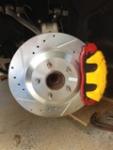
Advanced
Joined: Sep 2011
Posts: 70
Likes: 0
From: DFW Area Denton County
If you only plan to have your Corvette be a 'daily driver' then drilled rotors are fine - it's cosmetic. However, if you ever plan to do high performance driving events (HPDE), then you definitely do NOT want drilled rotors because they will crack from intense use, heat and uneven cooling. Slotted rotors are good, but if you plan on wearing and changing them often, just go with the basic blank rotors for best performance and price.

Le Mans Master


Joined: May 2006
Posts: 7,847
Likes: 228
From: Hillsboro OR
Bluefire, Yes. The cross cut rotors is something I am thinking about.
Why didn't you buy them with the drilled holes?
Anyone can respond, if it is important to have the holes or not.
I just found the following:
DBA (Disc Brakes Australia) is a worldwide leader in after market brakes.
Part no. DBA4992XS. Rear ONLY.
Why didn't you buy them with the drilled holes?
Anyone can respond, if it is important to have the holes or not.
I just found the following:
DBA (Disc Brakes Australia) is a worldwide leader in after market brakes.
Part no. DBA4992XS. Rear ONLY.


Pro

Joined: Aug 2010
Posts: 593
Likes: 9
From: San Antonio Texas
The material of choice by automotive engineers for rotors is grey iron. It is THE cheapest of all irons but it has properties that are desireable. The two that are most important is that grey iron doesn't tranfer sound much at all and doesn't transfer heat well. Prove this by suspending a piece of steel and striking it with a hammer. It will ring like a bell. Do the same with a piece of cast grey and it will just go "thud". Grey iron also dissapates heat more effeciently for exactly the same reason! Unfortunately, grey iron is easy to create, requires a small amount of capital to produce, has a low melt temperature, as it is made mostly from scrap steel, iron, and a huge conglomeration of miscellaneous junk. China, India, Brazil, and some other emerging industrial nations have the cheapest iron production costs in the world. But, China must buy scrap steel and iron on the open market as they have very little domestic scrap. Amazingly, The US is where China buys the most scrap because the US is where a huge portion of the world's scrap metal is located! China has increased the price of scrap steel over the last decade to a point where it is very difficult for the US producers to compete. The whole point is that the quality of the iron is a function of the quality of the scrap that it is made from and how well the foundry controls its process. Some foundries control their mixtures extremely well and others do not care. This is why you see such a difference in performance in the end product. My point is, that if you buy from GM, I believe that you will at least have iron that is to GM's material specification and the parts will have been machined to proper dimensional tolerance. GM will not risk putting their name on a safety related product without having control of the process of its vendor. The US legal system has seen to that! Other companies that provide rotors to the aftermarket do not have the same risk that GM does so they can afford to buy directly from China, sell a product that looks and fits like a GM product but MAY or MAY NOT have the same quality assurance program that GM has. So how is the consumer to know what he is getting? To me the brakes are a pretty important system on a car and I believe I will stick to an OEM branded product for my family's safety. The difference in cost is so small compared to having an accident caused by failed or marginal brakes. And by the way, zinc phosphate is one of the worst anti corrosion processes available, better than nothing, but it is cheap!. Go look at the results of ASTM salt spray tests. You will be amazed. Good Luck.

Instructor
Joined: Jun 2006
Posts: 107
Likes: 0
From: Siloam Springs AR
Replaced mine with ATE
A couple years ago I broke both of my front rotors by overheating them doing some spirited driving. I put hawk pads and ATE rotors back on. I have yet to break these. They have remained straight and flutter free. If you are just looking for OE stopping power my experience has been positive with this combo and they are priced competatively.
http://www.tirerack.com/brakes/resul...9&autoModClar=
http://www.tirerack.com/brakes/resul...9&autoModClar=

Drifting


Joined: Feb 2006
Posts: 1,585
Likes: 15
From: New Hartford IA
If you do hard road racing you will kill any stock size rotor very fast. You might get two to three track days from them if you really push the car hard on race pads and sticky tires, etc. Best to just stick with a quality blank rotor and stock up on extra pads and rotors for a stock brake setup.
The Centric premium rotors are a decent plain rotors with coated hats and ends. On the street most of the rotors will hold up though. I wouldn't spend more than $200-$300 on all four rotors for just street use.
The Centric premium rotors are a decent plain rotors with coated hats and ends. On the street most of the rotors will hold up though. I wouldn't spend more than $200-$300 on all four rotors for just street use.

Intermediate
Joined: Aug 2011
Posts: 33
Likes: 0