




PCV System: vent tube check valve

Thread Starter
Racer

Joined: Apr 2009
Posts: 488
Likes: 2
From: Myrtle Beach SC
 PCV System: vent tube check valve
Question: is there any harm in installing a check valve in the fresh air supply line to the valve covers? I've scoured this forum and the LS1 forum...as well as some others...and can't find an answer. 
The idea is to allow air flow ONLY from the air intake TO the valve cover, and have the crankcase vented via the LS7 valley cover, through a catch can, and back to the intake.
Thanks.
The idea is to allow air flow ONLY from the air intake TO the valve cover, and have the crankcase vented via the LS7 valley cover, through a catch can, and back to the intake.
Thanks.

Le Mans Master


Joined: Mar 2002
Posts: 5,955
Likes: 161
From: PNW
Question: is there any harm in installing a check valve in the fresh air supply line to the valve covers? I've scoured this forum and the LS1 forum...as well as some others...and can't find an answer.
The idea is to allow air flow ONLY from the air intake TO the valve cover, and have the crankcase vented via the LS7 valley cover, through a catch can, and back to the intake.
Thanks.
The idea is to allow air flow ONLY from the air intake TO the valve cover, and have the crankcase vented via the LS7 valley cover, through a catch can, and back to the intake.
Thanks.
Are you running boost?
The LS7 valley cover (as well as later LS6 valley covers) should have the fixed 1 mm dia orifice in the nipple coming off the front RH corner of the cover.
Thread Starter
Racer
Joined: Apr 2009
Posts: 488
Likes: 2
From: Myrtle Beach SC
Thanks for the replies, fellas!
To answer your questions:
1) not boosted
2) the block is an LQ9 6.0L, bored .030" over => 408 cu in
According to GM, the LS7 has a 2.5mm orifice...or so I thought. I don't suppose that it makes a difference...
I bought a "Help" brand brake booster check valve...seems to be good for this application. It allows air through with just a slight exhale and seals when you exhale hard into it.
I guess one of the things that I'd be concerned about it is proper venting during all "throttle modes" and engine loads....
So the plan is to install the check valve in the intake duct, oriented to allow flow only to the valve covers...and let the fixed orifice in the valley cover do its thing to vent the gasses back out...
Do either of you (NassyBlue or ZeeOSix) see any issues with this?
Anybody else have ideas, comments, etc.? Thanks!
To answer your questions:
1) not boosted
2) the block is an LQ9 6.0L, bored .030" over => 408 cu in
According to GM, the LS7 has a 2.5mm orifice...or so I thought. I don't suppose that it makes a difference...
I bought a "Help" brand brake booster check valve...seems to be good for this application. It allows air through with just a slight exhale and seals when you exhale hard into it.
I guess one of the things that I'd be concerned about it is proper venting during all "throttle modes" and engine loads....
So the plan is to install the check valve in the intake duct, oriented to allow flow only to the valve covers...and let the fixed orifice in the valley cover do its thing to vent the gasses back out...
Do either of you (NassyBlue or ZeeOSix) see any issues with this?
Anybody else have ideas, comments, etc.? Thanks!
Last edited by sunchaser73; Sep 7, 2012 at 12:34 PM.
Le Mans Master
Joined: Mar 2002
Posts: 5,955
Likes: 161
From: PNW
I guess one of the things that I'd be concerned about it is proper venting during all "throttle modes" and engine loads....
So the plan is to install the check valve in the intake duct, oriented to allow flow only to the valve covers...and let the fixed orifice in the valley cover do its thing to vent the gasses back out...
Do either of you (NassyBlue or ZeeOSix) see any issues with this?
Anybody else have ideas, comments, etc.? Thanks!
So the plan is to install the check valve in the intake duct, oriented to allow flow only to the valve covers...and let the fixed orifice in the valley cover do its thing to vent the gasses back out...
Do either of you (NassyBlue or ZeeOSix) see any issues with this?
Anybody else have ideas, comments, etc.? Thanks!
Guess the only way to know is to try it out, and watch for signs of excess crankcase pressure (ie, dipstick popped out or seals leaking).
So what is driving you to put a check valve in the fresh air line? Are you getting too much oil residue back up through the fresh air line and into the throttle body?
Thread Starter
Racer
Joined: Apr 2009
Posts: 488
Likes: 2
From: Myrtle Beach SC


I guess the only way to find out how well the check valve works is like you said...drive and look for signs of excess pressure.
Something else I read recently: built motors are more prone to oil consumption than an otherwise stock motor...
Also read something about harder faced piston rings can take longer to break in properly, resulting in higher oil consumption during that time period...I read that it could be a few thousand miles...not sure how accurate that is. Any ideas? Have you heard of that before?
Well...all of the work is done (installing the check valve and routing the fresh air lines) so all that is left is to take it for a spin and see what happens...

Burning Brakes


Joined: May 2007
Posts: 911
Likes: 27
From: Southern IL
Yeah, pretty much...I pulled the line from my catch can back to the intake and it had a nice oil sheen on the inside...I'm certain that I would NOT like what I saw if I removed the throttle body and shined a light into the manifold!
I guess the only way to find out how well the check valve works is like you said...drive and look for signs of excess pressure.
Something else I read recently: built motors are more prone to oil consumption than an otherwise stock motor...
Also read something about harder faced piston rings can take longer to break in properly, resulting in higher oil consumption during that time period...I read that it could be a few thousand miles...not sure how accurate that is. Any ideas? Have you heard of that before?
Well...all of the work is done (installing the check valve and routing the fresh air lines) so all that is left is to take it for a spin and see what happens...
I guess the only way to find out how well the check valve works is like you said...drive and look for signs of excess pressure.
Something else I read recently: built motors are more prone to oil consumption than an otherwise stock motor...
Also read something about harder faced piston rings can take longer to break in properly, resulting in higher oil consumption during that time period...I read that it could be a few thousand miles...not sure how accurate that is. Any ideas? Have you heard of that before?
Well...all of the work is done (installing the check valve and routing the fresh air lines) so all that is left is to take it for a spin and see what happens...
You say you are running a catch can & still getting oil in your intake? How is your all of your PCV lines routed?
Thread Starter
Racer
Joined: Apr 2009
Posts: 488
Likes: 2
From: Myrtle Beach SC
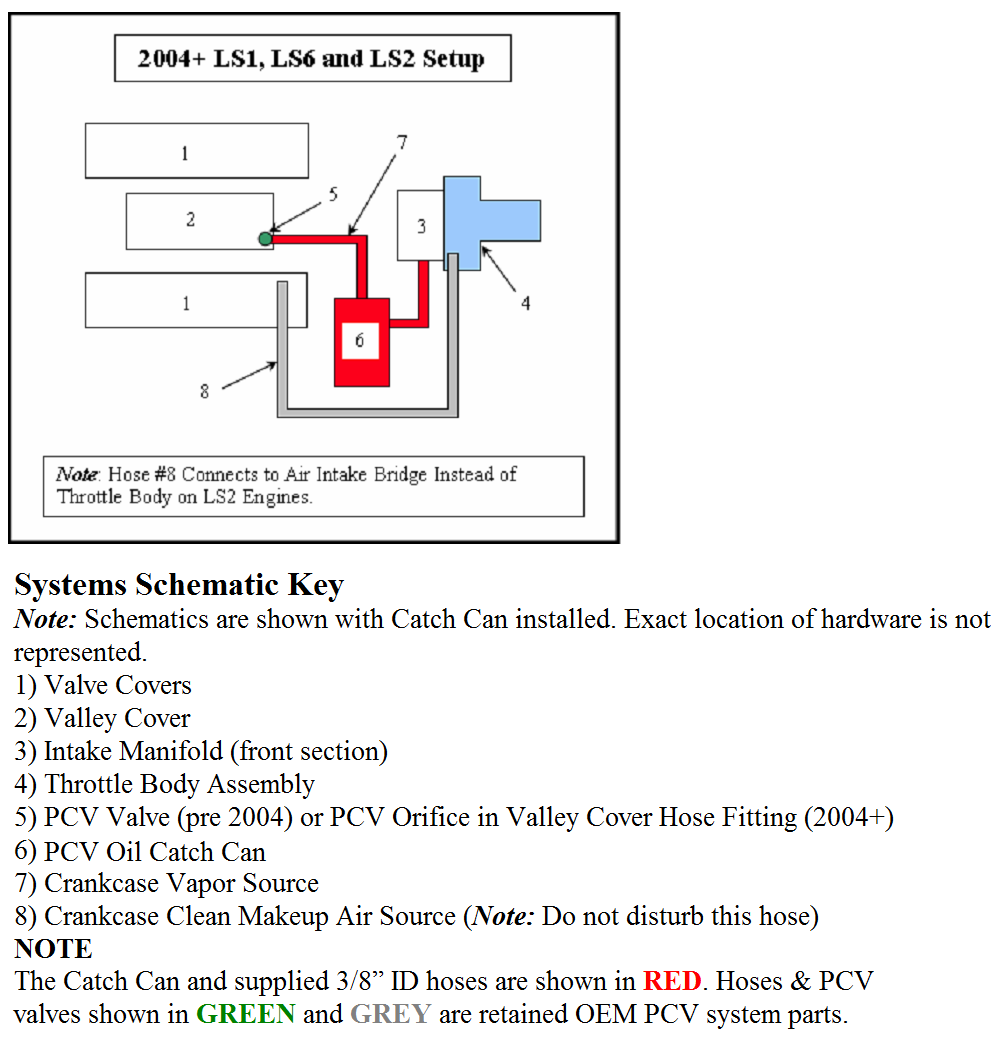
As of this afternoon, I relocated the fresh air supply to the air bridge upstream of the throttle body, with lines running to each valve cover. The catch can lines are still routed the same.
Corvette Stories
The Best of Corvette for Corvette Enthusiasts

Every 2027 Corvette Engine Explained
Joe Kucinski
Designer Imagines A Corvette That Looks More Like a Corvette Than the Corvette
Verdad Gallardo
10 Ugly Corvettes That We Still Kinda Love
Joe Kucinski
Top 10 Most Expensive Corvettes Ever Sold on Bring A Trailer
Brett Foote
10 Things Every Corvette Owner Needs (2026 Edition)
Michael S. Palmer
8 Most "Only Corvette Owners Understand" Quirks and Problems
Pouria Savadkouei
10 Reasons the C6 Z06 is Still A Performance Benchmark After 20 Years
Joe Kucinski
How Much Horsepower Every Corvette Engine "LOST" in 1972
Joe Kucinski
Top 10 DOs and DON'Ts for Protecting Your Convertible Top!
Michael S. Palmer
Thread Starter
Racer
Joined: Apr 2009
Posts: 488
Likes: 2
From: Myrtle Beach SC
Try setting it up exactly like in the diagram in this thread (minus the PCV valve)
http://forums.corvetteforum.com/c5-t...in-intake.html
http://forums.corvetteforum.com/c5-t...in-intake.html
Burning Brakes
Joined: May 2007
Posts: 911
Likes: 27
From: Southern IL

Thread Starter
Racer
Joined: Apr 2009
Posts: 488
Likes: 2
From: Myrtle Beach SC

I'll re-route my lines as you described and see how it goes. I'm also going to remove that check valve and just use a regular connector...
Thanks for you help!

Burning Brakes
Joined: May 2007
Posts: 911
Likes: 27
From: Southern IL
Make sure you also have the manifold vacuum line hooked up as well as the fresh air line...wouldn't want to blow anything up.


Safety Car


Joined: May 2007
Posts: 4,812
Likes: 46
From: Taylorsville North Carolina
You could just put 2 of the cheap breathers on each valve cover and block the inlet at the air box. That would get a lot of hoses out of the bay. As far as oil in tb, you could just put a breather on the catch can instead of running that line back into intake. Not sure how your inspections work in your area, but why take a chance on getting oil into combustion chamber. You would have to block intake port if you did this. Good luck with it.
Burning Brakes
Joined: May 2007
Posts: 911
Likes: 27
From: Southern IL
You could just put 2 of the cheap breathers on each valve cover and block the inlet at the air box. That would get a lot of hoses out of the bay. As far as oil in tb, you could just put a breather on the catch can instead of running that line back into intake. Not sure how your inspections work in your area, but why take a chance on getting oil into combustion chamber. You would have to block intake port if you did this. Good luck with it.
Le Mans Master
Joined: Mar 2002
Posts: 5,955
Likes: 161
From: PNW
Only problem IMO with running just breathers and blocking off all PCV system ports is that the crankcase will not be evacuated very well if there is no active vacuum from the intake trying to suck out the vapors. If you ran a breather(s) on the valve cover(s) instead of a fresh air tube from in front of the throttle body, as least there is still fresh air being swept through the crankcase to purge out condensation and vapors.
Burning Brakes
Joined: May 2007
Posts: 911
Likes: 27
From: Southern IL
Only problem IMO with running just breathers and blocking off all PCV system ports is that the crankcase just will not be evacuated very well if there is no active vacuum from the intake trying to suck out the vapors. If you ran a breathers on the valve cover instead of a fresh air tube from in front of the throttle body, as least there is still fresh air being swept through the crankcase to sweep out condensation and vapors.