




Lowering on Stock Bolts

Thread Starter
Instructor

Joined: Dec 2007
Posts: 237
Likes: 0
From: Monroe NC
 Lowering on Stock Bolts
I'm hoping y'all can offer some assistance. When I purchased my 99 it was lowered to the max. Considering where I live, the number of speed bumps and "valleys" in the road, I asked the shop where I bought the car to raise it as high as it would go. Now, I'm wanting to take it back down to stock height to give it a more refined look.
When I asked my local dealer about it, the "Corvette" mechanic looked a little puzzled about how to do that particular process. He mentioned something about adjusting leaf springs, etc. Needless to say, I wasn't feeling real confident about that time.
Can someone tell me, or offer a link, that shows the bolts involved and how the process of lowering is done? I'm not sure it's something I would attempt, but hopefully I can get a better understanding of what's involved.
Thanks.
When I asked my local dealer about it, the "Corvette" mechanic looked a little puzzled about how to do that particular process. He mentioned something about adjusting leaf springs, etc. Needless to say, I wasn't feeling real confident about that time.
Can someone tell me, or offer a link, that shows the bolts involved and how the process of lowering is done? I'm not sure it's something I would attempt, but hopefully I can get a better understanding of what's involved.
Thanks.

Drifting


Joined: Jan 2012
Posts: 1,341
Likes: 8
From: Hopatcong New Jersey
Drifting
Joined: Jan 2012
Posts: 1,341
Likes: 8
From: Hopatcong New Jersey
Also, when you measure your ride height, measure from point J and K (the jacking points on the frame rail).
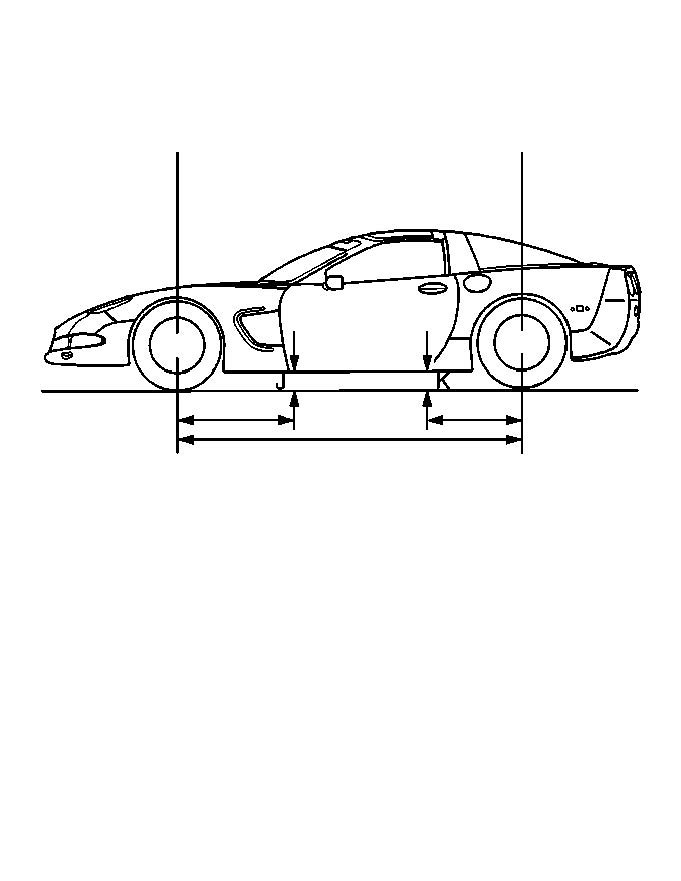
If you wan't to return to stock heights the measurements are:
Base, FE1, FE3, FE4---------J Height (Curb)-----------K Height (Curb)
Service Preferred-----------153 mm (6.02 in)---------158 mm (6.22 in)
Service Allowable-----------153 mm (6.02 in)---------158 mm (6.22 in)
Lower the car, drive it around for a day, measure heights, adjust as needed, get alignment.
If you wan't to return to stock heights the measurements are:
Base, FE1, FE3, FE4---------J Height (Curb)-----------K Height (Curb)
Service Preferred-----------153 mm (6.02 in)---------158 mm (6.22 in)
Service Allowable-----------153 mm (6.02 in)---------158 mm (6.22 in)
Lower the car, drive it around for a day, measure heights, adjust as needed, get alignment.
Thread Starter
Instructor
Joined: Dec 2007
Posts: 237
Likes: 0
From: Monroe NC
Okay Guys...this is good stuff. Since the car has been raised to its max, is there a way to determine how many threads (or how much of the bolt) should be visible on both front and rear if it is at or near the stock height? I guess what I'm getting at, if the dealer does this, I would hate to have to take the car back multiple times if it's not at the proper height the first time. Make sense?
Drifting
Joined: Jan 2012
Posts: 1,341
Likes: 8
From: Hopatcong New Jersey
Okay Guys...this is good stuff. Since the car has been raised to its max, is there a way to determine how many threads (or how much of the bolt) should be visible on both front and rear if it is at or near the stock height? I guess what I'm getting at, if the dealer does this, I would hate to have to take the car back multiple times if it's not at the proper height the first time. Make sense?
Just an FYI.. number of threads showing isn't the most accurate way to determine ride height, the ONLY way to assure correct height is to measure at the proper points.
Thread Starter
Instructor
Joined: Dec 2007
Posts: 237
Likes: 0
From: Monroe NC
dblerman, thanks for the follow-up. Candidly, I am a bit unsure whether this dealership can actually do the job based on the mechanics comments when the service advisor and I were talking to him. Unfortunately, there aren't many options in this area. Think I'll call around and see what I can find out.
Thanks again.
Thanks again.
Last edited by nmacdonald; Oct 22, 2012 at 08:02 PM.
Drifting
Joined: Jan 2012
Posts: 1,341
Likes: 8
From: Hopatcong New Jersey
dblerman, thanks for the follow-up. Candidly, I am a bit unsure whether this dealership can actually do the job based on the mechanics comments when the service advisor and I were talking to him. Unfortunately, there aren't many options in this area. Think I'll call around and see what I can find out.
Thanks again.
Thanks again.
You could also post in your regional forum and see if anyone local could help you out. All you need is a jack and a couple wrenches. It's literally a 20-30 minute job.

Burning Brakes

Joined: Jan 2009
Posts: 1,218
Likes: 70
I am not an expert, however measuring using the body, which is plastic that is hung on seems to be a logical problem. Doing so assumes that both sides are exactly the same, which they may not be.
My intent is to simply offer a thought. I certainly may be wrong.
Corvette Stories
The Best of Corvette for Corvette Enthusiasts

Top 10 Most Expensive Corvettes Ever Sold on Bring A Trailer
Brett Foote
10 Things Every Corvette Owner Needs (2026 Edition)
Michael S. Palmer
8 Most "Only Corvette Owners Understand" Quirks and Problems
Pouria Savadkouei
10 Reasons the C6 Z06 is Still A Performance Benchmark After 20 Years
Joe Kucinski
How Much Horsepower Every Corvette Engine "LOST" in 1972
Joe Kucinski
Top 10 DOs and DON'Ts for Protecting Your Convertible Top!
Michael S. Palmer
Top 10 Most Explosive Corvettes Ever Made: Power-to-Weight Ratio Ranked!
Joe Kucinski
150 hp to 1,250 hp: Every Corvette Generation Compared by the Specs That Matter
Joe Kucinski
8 Coolest Corvette Pace Cars (and Replicas) of All Time
Verdad Gallardo
Melting Slicks

Joined: Mar 2009
Posts: 2,300
Likes: 115
From: Odessa FL
St. Jude Donor '10-'12-'13-'14-'15-'16-'17

Drifting
Joined: Jan 2012
Posts: 1,341
Likes: 8
From: Hopatcong New Jersey

Thread Starter
Instructor
Joined: Dec 2007
Posts: 237
Likes: 0
From: Monroe NC
Thanks to all. I'll do a quick check in the regional forum to see if I get any replies that are helpful. As indicated, a DIY hinges on finding a level service. I have the jack and jack stands...and a neighbor who is pretty good mechanically, so I'll ponder that one.



Racer
Joined: Oct 2011
Posts: 371
Likes: 0
From: Tucker Georgia
Mine was slammed on stock bolts when I bought it. Handling was ok, but it rode like a buck board and bottomed out with little bumps on the freeway. I had it raised back up by a speed shop. We just eyeballed it until it looked like the right stance and looked like it would clear most bumps (vette size bumps). I think it ended up coming up about an inch and a quarter. Handling actually felt better and the ride was very much improved.