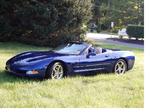
I just bought this 2000 Vette and although all 4 tires it came with are good, the two in front are a different size and brand than the rear. The rear ones are slightly larger. Is this throwing off the geometry and/or calibration of anything on this car? Do I need to do anything different with air pressure front to rear? Is the difference affecting the handling of the vehicle on the curves? I am not interested in winning straight line races, just having a fun, safe ride and I do like feeling secure pulling G's on the curves. I am still afraid to totally relax with her yet because of this difference.
I try to keep my toys OEM, and I am wondering if I should get a new set of rear tires sooner than later.
On a base C5 you should have 245-45-17's and 275-40-18's
Screw with this, and you screw with the computer.
I don't like using different tire brands/models front to rear.
OEM setup was 17" front and 18" rear wheels. Tires were 245/45x17 front, and 275/40x18 rear. Also OEM tires were run flats. In general a mix 'n match in brands front to rear is OK, as long as both tires on the same axle are the same type. Note that these tires are also handed - each of the 4 is unique to that corner of the car. Pressure - 30 all around.
On a base C5 you should have 245-45-17's and 275-40-18's
Screw with this, and you screw with the computer.
I don't like using different tire brands/models front to rear.
I just checked, I am close to what you say above, but not quite. Michelin on the front is 245-45-17. Back, I think is Bridgestone 275-45-18.
From what everyone is saying above, I am not sure the 45 on the rear is going to make a huge difference, I might be okay the way they are except I need to be sure all are evenly inflated to 30lbs.
Any thoughts on the 45's on the rear?
I am not sure how to tell if they are "run flat" or not, never had to do that before. Is it in the small print on the tires?
Your car is perfectly fine, stop worrying about it and go for a ride.
Are you learning about how to interrogate and read the DIC? Do you have and have read through any of the Owners Manual?
You will have more fun with it and feel better the more knowledge you have of the car.
And ask away with any questions here, everybody is very helpful and knowledgeable.
Your car is perfectly fine, stop worrying about it and go for a ride.
Are you learning about how to interrogate and read the DIC? Do you have and have read through any of the Owners Manual?
You will have more fun with it and feel better the more knowledge you have of the car.
And ask away with any questions here, everybody is very helpful and knowledgeable.
Well I disagree with the statement above that everything is fine.
The rear tire size of 275/45-18 has an overall diameter of 27.7" while the front tire size of 145/45-17 has an overall diameter of 25.7" or a delta of 2" which is above the 1/2" to 1 1/2" numbers I posted earlier. What that means is that TC is extremely unlikely to work if it was ever needed. If you have no concerns with TC ever being needed then go as is.
The way to determine if the tires are run flat vary slightly from manufacturer to manufacturer. For your front Michelin's there would be a ZP to indicate Zero Pressure after the Michelin brand. For your Bridgestones according to the information on TireRack they do not offer a run flat tire in the 275/45-18 size that you have. I'm going to guess that none of your tires are run flats. No big deal except remember that you have no spare tire so if you do have a flat the only choice may be to call a flat bed..... Many folk (myself included) do not run the run flat type tires. I carry tire plugs and a jack (and tire iron etc), a cigarette lighter air pump and a TPMS friendly tire sealant so that should I have a flat I MAY be able to repair it and continue on my way to a tire shop for proper repair.
Third that.
Most like to keep the factory 3 steps in width (245/275 for base model, 265/295 for Z) or maybe 4, even if they switch out wheels.
Quick but not perfect check if keeping the 3 width jump:
1" bigger rear wheel diameter, 3 widths; go one aspect ratio down. Example from factory: 245-45-17 with 275-40-18.
Same wheel diameter front and rear, 3 widths; same aspect ratio. Example: 245-40-18 with 275-40-18.
I can get much deeper and more accurate, but I'm doing this on my phone...
Mixing tire brands and types can be a problem. For sedans they say don't mix them on the axles. However, on a sports car where you may be pushing the limit a lot more than you would in a sedan you need to have equal handling tires on front and rear or if you don't have equal handling tires front and rear you damned well better have the better handling tires in the rear. Failure to do this properly can result in severe oversteer situations especially off throttle oversteer in corners. The C5 is a great handling car because it is a little tail happy in off throttle operation but making it more tail happy by putting less capable tires on the rear could be problematic.
Well I disagree with the statement above that everything is fine.
The rear tire size of 275/45-18 has an overall diameter of 27.7" while the front tire size of 245/45-17 has an overall diameter of 25.7" or a delta of 2" which is above the 1/2" to 1 1/2" numbers I posted earlier. What that means is that TC is extremely unlikely to work if it was ever needed. If you have no concerns with TC ever being needed then go as is.
If it were my car, I would put rear tires on that would ensure the TC system works as designed.
While all that is theoretically right as far as being a purist, those rear tires will work just fine until they need to be replaced because of wear. Don't scare the crap out of her unnecessarily over a 1/2" larger diameter rear tire. There is no need to panic, there is no immediate need to replace those rears, you will not spin out and die the next time you accelerate or go around a curve. They have been on the car for probably many years and many thousands of miles, the car is still intact. Use them 'till they wear out and by that time you will be replacing all 4's in a matched set. Unless you are going road racing or drive nuts in rain or snow, they should not really be any concern. If you didn't ask on this forum, you never would have known the difference. Drive the car and enjoy it, get new tires when these wear out.
Your car is perfectly fine, stop worrying about it and go for a ride.
Are you learning about how to interrogate and read the DIC? Do you have and have read through any of the Owners Manual?
You will have more fun with it and feel better the more knowledge you have of the car.
And ask away with any questions here, everybody is very helpful and knowledgeable.
And another welcome to the forum, and nice car.
I am running C6 Corvette chrome wheels 18" 245/40 front and 19" 285/35 on rear, all Continental Extreme Contacts with new Z51 sway bars There are absolutely no issues with traction control or other computer controlled functions. Speedo is dead on and it handles superbly, All tires at 30PSI. The computer does not know that you have different brand tires front and rear. It is best, even from an aesthetic viewpoint to have matched tires, but not essential. Unless you are going to track the car , enjoy it and replace the tires when you need them.
Dave
Your front tires have an overall diameter of 25.7" and your rear tires have an overall diameter of 26.7" so the rear to front stagger is right in the middle of the 1/2" to 1 1/2" range and in fact is just about exactly the stagger that came from the factory even though you are NOT running factory C5 sizes.
So there is no reason for your TC to not behave as designed.
The OP's current rear to front stagger is 2" which means that effectively TC is OFF because the tire sizes are well outside the design that is used by the TC system to decide if automatic action is needed.
The issue is not the tire sizes that are on the car. The issue is whether the stagger is within the design limits.
If the OP wants to drive the car with TC effectively OFF that should be clearly her decision. And having knowledge of the impact of her current tire sizes should be input to that decision.
As I received the above , I was researching the stagger issue, and you are correct. I was about to correct my stance on it. I stand corrected. I think it is best to insure the proper stagger specs. and ensure that the TC is operational.She should likely correct it. Based on above, I would.
Dave
As I received the above , I was researching the stagger issue, and you are correct. I was about to correct my stance on it. I stand corrected. I think it is best to insure the proper stagger specs. and ensure that the TC is operational.She should likely correct it. Based on above, I would.
Dave
Your front tires have an overall diameter of 25.7" and your rear tires have an overall diameter of 26.7" so the rear to front stagger is right in the middle of the 1/2" to 1 1/2" range and in fact is just about exactly the stagger that came from the factory even though you are NOT running factory C5 sizes.
So there is no reason for your TC to not behave as designed.
The OP's current rear to front stagger is 2" which means that effectively TC is OFF because the tire sizes are well outside the design that is used by the TC system to decide if automatic action is needed.
The issue is not the tire sizes that are on the car. The issue is whether the stagger is within the design limits.
If the OP wants to drive the car with TC effectively OFF that should be clearly her decision. And having knowledge of the impact of her current tire sizes should be input to that decision.
Thanks everyone for your input!!
It sounds like it would be best for me to at least replace the rear tires. Since I already have Michelin's on the front, I am going to try to find matching ones for the rear. I am especially big on staying OEM in my cars. It is very possible someone threw them on there to sell the car, because the tire pressure reading is not working right now and needs to be re calibrated.
I already knew going into this purchase that this car was going to need to be driven differently from anything I have had in the past so I am being extra cautious in learning and getting a feel, and I noticed I had to be very careful about applying the gas through sharp curves like entrance/exit ramps. She lost it a little once and the correction that was necessary was extremely quick and very easy to over correct. I was not going fast at the time so I handled it no problem, but the different feel was unsettling enough that I knew I had to take a step back and not push her too hard too quick.
Do you think this is maybe the scenario you were talking about with the TC and the oversized tires in the back?
It sounds like it would be best for me to at least replace the rear tires. Since I already have Michelin's on the front, I am going to try to find matching ones for the rear. I am especially big on staying OEM in my cars. It is very possible someone threw them on there to sell the car, because the tire pressure reading is not working right now and needs to be re calibrated.
I already knew going into this purchase that this car was going to need to be driven differently from anything I have had in the past so I am being extra cautious in learning and getting a feel, and I noticed I had to be very careful about applying the gas through sharp curves like entrance/exit ramps. She lost it a little once and the correction that was necessary was extremely quick and very easy to over correct. I was not going fast at the time so I handled it no problem, but the different feel was unsettling enough that I knew I had to take a step back and not push her too hard too quick.
Do you think this is maybe the scenario you were talking about with the TC and the oversized tires in the back?
Could very well be, check if tires are all run-flat or non /// mixing those can be bad also !!!
Remember that the 'Vette is designed for everything from an old guy like me who drives around on nice days, to a person who "tracks" the car- runs it on race tracks at high speeds, to a daily commuter who drives it in everything- even snow. So, GM designed the car to do all those things.
Part of the fun of a performance car (instead of an appliance like a Camry) is that as you learn, you get to make decisions that make the car more satisfactory- for YOU.
We have a LOT of bumpy roads here (snow belt). I (like many others on this forum) changed out the run-flats for a smooth ride. I bought Bridgestone RE 760's (like on the rear of your car), and I like them. I am willing to roll the dice on a flat tire (and have had two flats in 10,000 miles, since installing the regular tires!) in exchange for a less harsh ride. So, I bought a pump, a repair kit... and a membership to AAA. My decision would have been very different if I lived in LA with smooth concrete roads.
As to the roadside repair- it may not even be practical, since when a 'Vette has a flat, it is LOW- so low most jacks will not fit under. Probably you are looking at a flatbed towing job. The run-flats give you the ability to drive at "normal" (55 MPH) road speeds for say 50 miles, to a service location.
Also- look at your driver's side door jam- the proper inflation is shown there. I am pretty sure it is 35 PSI- not 30 as indicated earlier in this thread.
It sounds like it would be best for me to at least replace the rear tires. Since I already have Michelin's on the front, I am going to try to find matching ones for the rear. I am especially big on staying OEM in my cars. It is very possible someone threw them on there to sell the car, because the tire pressure reading is not working right now and needs to be re calibrated.
First of all, welcome to the Corvette Forum!
If you're seriously interested in keeping the car as close to OE as possible, you'd need to change all 4 tires to Goodyear Eagle "run-flats", as they were the OE tires for your car................AND, $$$$