When you click on links to various merchants on this site and make a purchase, this can result in this site earning a commission. Affiliate programs and affiliations include, but are not limited to, the eBay Partner Network.
Swapped pump and filter this weekend. Pump sounds normal. But the new ac Delco filter seems to be noisy while flowing. I've only driven about 2 miles to test the car since then. Could it be an air pocket in the filter assembly? Likely to go away?
I put a new WIX filter on my 95 Mustang and when I checked the feed tube one of the plastic covers had broken off and fell down in the filter. Had a hell of a time getting it out
I may have stumbled upon a fix by accident this week. I posted having the same issues in another related thread: since installing a new AC Delco fuel filter this spring, it's been much louder.
I pulled my intake on Wednesday to change my EOP sensor and install a LS6 PCV Valley cover, and the noise is since gone! I suspect there was a pocket of air trapped in the filter, and disconnecting the fuel line at the fuel rail allowed the filter to "burp" or bleed the filter while disconnected.
I may have stumbled upon a fix by accident this week. I posted having the same issues in another related thread: since installing a new AC Delco fuel filter this spring, it's been much louder.
I pulled my intake on Wednesday to change my EOP sensor and install a LS6 PCV Valley cover, and the noise is since gone! I suspect there was a pocket of air trapped in the filter, and disconnecting the fuel line at the fuel rail allowed the filter to "burp" or bleed the filter while disconnected.
I'm just amazed a post from 2017 which went untouched has garnered so much recent attention. In 2017 I wager the filter was of better quality than post-Covid production changes.
I can happily report that my issue was resolved on its own back in the day. So it seems as if an air pocket or some aspect of a fresh filter being worn in was to blame and it worked itself out quickly or I would have replaced it or sought other ideas here at the time.
I don't like working on fuel systems. But the idea of an easily serviced aftermarket filter system is attractive after installing one.
Reducing fuel pressure if possible to around 38psi baseline (32psi reference vacuum at 12"Hg intake manifold vacuum)
Will help extend fuel pump lifespan and reduce noise, reduce current draw of the pump, increase fuel pump flow rate, reduce fuel heating.
This is a 'performance' mind setup. Provided you can re-tune for the new pressure, and have enough injector to cover the spread.
Return fuel systems will help with fuel temp stability, fuel temp is a factor of fuel density which can have a significant(up to around a whole point of AFR at idle iirc) influence.
Dead-head fuel rails I successfully use at 600rwhp in LS1 intake systems for 6+ years, these are simple OEM rails which improves reliability, less fittings to leak, less hoses, less mess.
Together you can run both, e.g. on my vehicle I have a return style fuel system, simply return from the regulator to the fuel tank and feed the dead-head rail with the regulator. Recommend Aeromotive. I use 5/16" Hose clamped braided (track legal) for feeding 600rwhp gasoline E10 this way: minimum complexity rail, return fuel helps control temps, low fuel pressure benefits, these all together is how you acquire the reliability and longevity and simplicity of a performance set-up. Aeromotive Stealth In-tank is quite fuel pump capable at 5/16" fuel line for this job, 2,000 run hours, it will last 10 years. Entire fuel system is worth less than a single rear tire and feeds 600rwhp for 10 years. Good deal.
My issue is a quiet fuel pump for the first fifteen miles and then a loud howl from the fuel pump as long as I drive the car further than fifteen miles. The howl doesn't go away until after my C5 has sat in the garage over night. As long as I don't drive fifteen miles or more, the fuel pump is quiet. After that, it is annoying as hell and the howl fluctuates in sound, going up and down with the beat of the signal flasher when I switch on the turn signals. I have a new fuel pump (second one), a new WIX fuel filter, a new fuel pressure regulator and a new fuel pump relay but the darn thing still howls after fifteen miles or more of driving.
or fuel pressure is getting high over time because of a failing regulator or clogged return line, since you replace regulator technically thats ruled out, (new parts can be bad but this would be a very strange coincidence case)
thus, You can verify fuel pressure and make sure there is no other filters with debris cycling, and then check the fuel tank for debris or perhaps some other substance got in there
When the howling starts, the temperature of the wires on the fuel pump and thefuel pressureand actual fuel flow are the indicators for diagnostics.
In other words, when the howling starts, gets bad, you can remove a fuel line and see what comes out with pump powered to check if flow is there, and if pump still howls when there is no resistance to flow like into a 2-liter bottle. Just pop the fuel line and see what its doing and sounds like, if you are mechanically competent handling fuel like that and experienced etc... This is one diagnostic test.
Another of course is fuel pressure as an indicator, whih if you are lucky will show some drop or change during the incident.
Antoher indicator is pump wiring temperature, see if it spikes and rises rapidly during howling.
together this can help evaluate the fuel system components piece by piece.
Once you rule those out its just a return line left, if clogged, resistance = noisy + heat + reduced flow, not not heat + reduced flow when the line is disconnected flowing into a 2-liter bottle, see how we checkerboard the strategy
I can't add anything here other than I just had to buy a new filter/regulator as my fuel pressure was dropping 10psi@WOT. The new AC/Delco unit helped considerably, as it is only losing 5psi@WOT now. Tuner hasn't had any issues with the GM units, so thats what he ordered. Reason I'm still loosing pressure is with new mods to the LS7 the pump, even though it's an aftermarket Walbro, is having trouble keeping up with 42lb OEM LS7 injectors. Going with a boost-a-pump now.......
I can't add anything here other than I just had to buy a new filter/regulator as my fuel pressure was dropping 10psi@WOT. The new AC/Delco unit helped considerably, as it is only losing 5psi@WOT now. Tuner hasn't had any issues with the GM units, so thats what he ordered. Reason I'm still loosing pressure is with new mods to the LS7 the pump, even though it's an aftermarket Walbro, is having trouble keeping up with 42lb OEM LS7 injectors. Going with a boost-a-pump now.......
option B Is to reduce the fuel pressure to about 35 or 38psi baseline. Vacuum reference it to drop even more.
Boost-pump is added potential source of failure/complexity , unnecessary
The real problem is your fuel pressure is too high, it makes unnecessary heat, it causes voltage drop, it puts wear/tear on the fuel pump, and completely absolutely no reason for it Unless the injectors are too small. In which case its an injector size problem, not a fuel pump problem, get the right injectors. 42 is too small anyways for any V8 trying to maximize the benefits of EFI in a hobby installation, should be at least 80lb/hr for 500bhp, so it can target 280degrees btdcc start of spray, post EVC, get all the fuel into that window (300* - 230*) which improves torque, sometimes 20% more torque. So you are shooting your fuel system in the foot using such high fuel pressure and shooting your torque output in the foot using inadequate injection timing. Level up, friend
Did you see it?
35psi of fuel pressure, . 5/16" Fuel line, 600rwhp dynojet, Aeromotive stealth pump w/ 2000 run hours,
23-25mpg through a 4l80e or 30mpg through a T-56 @ 3000lbs
I'll tune yours for free if you set it up correctly
We are talking, what, ~50lph difference between 58.0psi and ~35psi (220 vs 270lph)
At worst its around 30 to 40lph more fuel flow rate.
With using ALL of the fuel flowing at 58psi (220lph)
360lb/hr gasoline E0 (100% gasoline)
360 W .50bsfc is 720bhp
360 w/ .60bsfc is 600bhp
Notice, this is 13.5v fuel pump inputs exactly.
Many 'psedo'(the corvette is a daily driver, not a race car) performance vehicles with near-stock wiring at wide open throttle generally will see maybe 12.8 to 13.2v at the fuel pump inputs.
They often need wiring upgrades (for racing... and so on) and 'racing' (daily driver "racing") tuning.
'Racing' tuning is like this
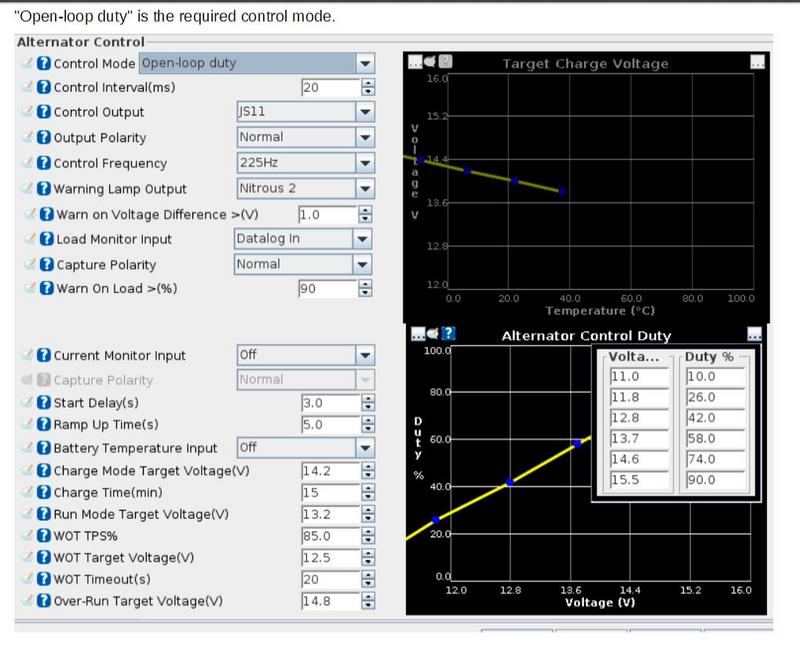
We are reducing the alternator voltage during wide open throttle to protect the engine from fatal destruction. I would elaborate but there are so many far reaching impacts this has it would be another long paragraph. Mainly, it protects the fuel system from sudden changes in fuel delivery, for a variety of reasons, allowing the vehicle to sustain numerous injury to its electrical system innumerable components while keeping the engine running perfect fine as long as the battery cable stays on.
Of course, if actually racing, we would want the most peak voltage for efficiency of electronics, best fuel delivery, and so on. Alternator and battery upgrades are integral to racing and performance. To win a race, gives sponsorships, money, fame, etc... especially at a level playing field, every ounce of juice counts somewhere. But majority of us would prefer the safety of protecting our engines over winning a race at any cost - that is your decision to make here.
Lets look at the fuel flow carefully, and go back to this now knowing what we should have always known,
With using ALL of the fuel flowing at 58psi (220lph)
360lb/hr gasoline (100% gasoline = E0)
360 W .50bsfc is 720bhp
360 w/ .60bsfc is 600bhp
Firstly, at 13.49v It is more realistic the pump is only putting about 200 to 210lph , due to many variables including the way the chart may have been made, slight variations in pump/design, the influence of heating/heated fuel after so much run-time, etc... always under estimate your fuel flow to give you headroom, just as with any pump, you don't want to be right on the edge or verge of running out. leave something on the table. In the case of fuel systems, lets figure average wot voltage of 13.0v to be safe, and some variability in fuel flow for the 99 other reasons, and say we've got around 200lph to work with under these conditions at 58psi and 13.0v. Maybe even 190lph.
It is safe to say somewhere between 190 to 220lph is available, 13.0 to 13.5v range, suboptimal conditions, at 58psi.
using gasoline E0, 0.74 kg/liter,
190lph gasoline is 310lb/hr fuel
310/0.58bsfc = 530bhp
But lets not forget E10 fuel (E12 lmao), its about 4% less (0.88*114,000BTU(gasoline)) + (0.12*76,000(etoh)) = 110,000~ btu/gal so 110/114 = 4%~
so really its,
298lb/hr fuel using gasoline BSFC of 0.58 now that we've included the etoh depreciation = 513bhp @ 58psi and 13.0v
However, if we change the fuel pressure to around 36 or 38psi , we now have around 298+58lb/hr = 356lb/hr / .58bsfc = 613bhp @ 35psi and 13.0v
613 - 513 = 100bhp = ~86rwhp
How about closer to optimal conditions, 35psi fuel pressure and 13.5v 275lph(448lb/hr) its about 25% more fuel,
445lb/hr / 0.58bsfc = 767bhp @ 13.5v and 35psi
after alcohol tax and wiggle room for bsfc its maybe 750 or 720bhp?
summary
-it seems that this '255' fuel pump under the sub-optimal conditions at 35psi supports an additional 80 to 90rwhp dynojet worth of fuel with 36 to 38psi instead of 58psi.
-optimal E10 delivery at 13.5v with 58psi is around 360lb/hr of fuel
-optimal E10 delivery at 13.5v with 37psi is around 440lb/hr of fuel
-suboptimal E10 delivery at 13.0v with 58psi is around 298lb/hr of fuel
-suboptimal E10 delivery at 13.0v with 37psi is around 356lb/hr of fuel
Using ~37psi instead of 58psi increases fuel flow ability about 20 to 25%
Does your fuel pump make noise from start of use in the day to the end of use and does it get worse the longer you drive the car. Also, where did you find an A/C Delco fuel pump? Those Delco pumps have been discontinued for quite a while now. Was it a used pump or was it new?
I discovered that in 97, there was a GM recall of the C5 related to the fuel pump noise and it was related to grounding. Apparently, there is a ground wire issue that causes the pump to gain noise during operation, the longer the car is driven. I didn't notice at first because after purchasing the car from the wife of my deceased cousin, I only drove it short distances around town. But, when I drove it an hour and a half one way and then an hour and a half back home, the noise was deafening (exaggeration of course). It was at the very least annoying. Car is in the shop now and they too feel it is a grounding issue. I have my fingers crossed that they are able to find the faulty wiring and fix the noise.
Last edited by tdoriausername; Jul 10, 2025 at 06:23 PM.
How does one go about reducing fuel pressure to 38psi? Is there an easy and safe way to do this? I mean the fuel pump is going to put out the pressure that the fuel pump is going to put out. How to you cause the fuel pump to put out less (38psi) pressure?
Replace the fuel pressure regulator with one which allows you to adjust the pressure in the line. Some C5s have it on the rail I believe. Others have it in the passenger tank which you replace with an LPE piece and the install an afpr in line somewhere else.
Fuel regulators for over-valve port injected, and usually tbi injected engines, involves a spring style regulator where sufficient pressure to push open the spring is what allows fuel to return to the tank, regulating pressure.
Returnless fuel systems for over-valve injected engines are not actually returnless, there is a return regulator inside the fuel tank. But because it is inside the tank, we say it is 'returnless' meaning there is no external return system or lines.
Since the system is set to what, ~58psi, in the tank with a regulation spring, the 58psi of fuel pressure overcomes spring force and the rest of the fuel goes back to the tank, warmer now that its been pumped by the fuel pump, 'returned' to the fuel tank supply.
Fuel lines have some friction so the pressure we measure at the rail is always slightly less than what the pump is putting out at it's outlet, the faster the fuel flows out from the regulator (m/s or meters/second fuel velocity) the more friction causes a pressure drop, the lower the fuel pressure will drop by the time it reaches the rail. Thus, high output setups approaching significant friction velocities (around 2m/s for 5/16" fuel lines approaching 600-800rwhp gasoline) will see 3 to 5psi less at the rail, than at the fuel pump, at those times, on 'returnless' systems, since regulation occurs at the tank and not based on what is in the rail. I am not mentioning this because its really a problem or important for performance; merely stating how things work.
One way to change the fuel pressure of these in-tank regulators is to change the pressure set spring or replace the entire regulator in the tank.
The set spring of return fuel regulation is just like wastegate regulation, and many kinds of oil pump pressure regulation, you can think of that way usually.
The type of regulation you want in a performance app is under-hood regulators, where they are easy to access, vacuum referenced.
These will require a return fuel line for the fuel tank supply, since regulation occurs outside the fuel tank it needs to send excess fuel back to the tank, using the same spring regulation.
Because its a spring regulator, the lowest regulator spring pressure wins(opens). In other words, if the in tank regulator is 58psi, and you install a separate second regulator under the hood with a return line, the one under the hood can be adjusted to any pressure less than 58psi. This means the original 58psi regulator in the fuel tank never opens, it is effectively invisible to the fuel system. Therefore it does not need to be removed. One may simply add an underhood regulator + return fuel line and ignore the in-tank regulator as it will simply no longer open/function. Thus external regulators can be added and reduce fuel pressure below any other regulators.
The ideal/optimized fuel pressure regulator for performance vehicle includes:
1. Fuel regulator under-hood, adjustable
2. Fuel return line hose to the fuel tank, from regulator
3. Vacuum reference to intake manifold, to the regulator under-hood.
This under-hood regulation is exemplary fuel system, all performance vehicles using over-valve injection inherently desire this type of fuel system. As performance enthusiast and engine tuning/optimization you will require fuel regulator adjustment, easy access for maintenance and inspection, and vacuum reference to relax the high flow system when it is not in full demand.
In general, under-hood vacuum referenced adjustable regulation fuel system improve performance optimization, maintainability and also longevity of any fuel system.








 Noisy fuel filter - air?