







Jet pump in right tank

Popular Reply
Oct 12, 2022, 08:20 PM

No Hostility Be Happy


Joined: Aug 2018
Posts: 10,082
Likes: 7,398
From: South Hill Wa
2022 C5 of the Year Finalist - Modified
2021 C5 of the Year Finalist - Modified

I wasn't talking about the whole jet pump assembly.
I am talking about replacing just the sending unit with a new GM sending unit. If that is all that is needed for the failure at hand. The sending unit itself just snaps into the base on both sides identically. The wiring is identical. The resistance value is identical..
if you buy this GM part right here it can be used on either side even though it is generally listed as left hand for some stupid reason. https://www.rockauto.com/en/moreinfo...sn=910&jsn=910
In the GM instructions it shows how to install it in either side IIRC. I'd double check or triple check if I hadn't thrown them out already.
I have both my original sending units in the garage from my car. They are the same. The wire rod that holds the float is slightly different left to right but the float lands in the same spot, and if one was being **** that can be swapped out if desired although the GM instructions didn't say it was needed.
I am talking about replacing just the sending unit with a new GM sending unit. If that is all that is needed for the failure at hand. The sending unit itself just snaps into the base on both sides identically. The wiring is identical. The resistance value is identical..
if you buy this GM part right here it can be used on either side even though it is generally listed as left hand for some stupid reason. https://www.rockauto.com/en/moreinfo...sn=910&jsn=910
In the GM instructions it shows how to install it in either side IIRC. I'd double check or triple check if I hadn't thrown them out already.
I have both my original sending units in the garage from my car. They are the same. The wire rod that holds the float is slightly different left to right but the float lands in the same spot, and if one was being **** that can be swapped out if desired although the GM instructions didn't say it was needed.

Melting Slicks


Joined: Sep 2011
Posts: 2,258
Likes: 544
From: Appleton WI
What symptoms are you experiencing. Are you getting the fuel gage drops to zero after about 100 miles or something? Any codes?
The tanks hold 18 gallons combined. As stated above, calculate how far you can go with half the fuel and carry a gallon of gas when close to that threshold.
The tanks hold 18 gallons combined. As stated above, calculate how far you can go with half the fuel and carry a gallon of gas when close to that threshold.

Thread Starter
Racer


Joined: Apr 2017
Posts: 425
Likes: 94
Yes been getting the gauge drops to zero and after resetting the DIC code P1431 it goes back up. When I fill up at about 200 miles and gauge only goes to 3/4 tank and takes about 7 gallons. Going to probably do the can thing and see if it’s transferring fuel or not just worried about it restarting if I run out. It’s a 2000 manual. Just very annoying. Been using the Techron and sea foam for about a year without much luck
No Hostility Be Happy
Joined: Aug 2018
Posts: 10,082
Likes: 7,398
From: South Hill Wa
2022 C5 of the Year Finalist - Modified
2021 C5 of the Year Finalist - Modified
Speaking from experience and going almost 3 years without a functional fuel gauge from multiple failures.
The solution for me was to stop procrastinating and just drain the tanks and replace the parts. In the grand scheme of things it's not nearly the scary monster that our brains want us to believe that it is.
While I never did have a clogged jet pump I did have a bad sender in the right hand tank. For the right side I bought the assembly that comes with an updated jet pump.
Left hand tank ultimately got a new sender as well. Now it goes to full and returns to empty without the half hour time out gauge drops to zero check gauges message lol.
Also if you have a good late model scan tool it may have the ability to see your fuel sender voltages real time. This will show you what is going on in the right tank real time.
I happened to us my HP Tuners Scanner channel functions for this task.
The solution for me was to stop procrastinating and just drain the tanks and replace the parts. In the grand scheme of things it's not nearly the scary monster that our brains want us to believe that it is.
While I never did have a clogged jet pump I did have a bad sender in the right hand tank. For the right side I bought the assembly that comes with an updated jet pump.
Left hand tank ultimately got a new sender as well. Now it goes to full and returns to empty without the half hour time out gauge drops to zero check gauges message lol.
Also if you have a good late model scan tool it may have the ability to see your fuel sender voltages real time. This will show you what is going on in the right tank real time.
I happened to us my HP Tuners Scanner channel functions for this task.
No Hostility Be Happy
Joined: Aug 2018
Posts: 10,082
Likes: 7,398
From: South Hill Wa
2022 C5 of the Year Finalist - Modified
2021 C5 of the Year Finalist - Modified
No, no, sorry about that if I made it confusing. I DO NOW have a fully functioning system. So nice to have accurate fuel gauge and not have to listen to the gong when check gauges pops up.
I was able to get factory GM parts from rock auto to fix everything.
I do believe the factory parts are getting harder and harder to find in stock.
Corvette Stories
The Best of Corvette for Corvette Enthusiasts

Top 10 Most Expensive Corvettes Ever Sold on Bring A Trailer
Brett Foote
10 Things Every Corvette Owner Needs (2026 Edition)
Michael S. Palmer
8 Most "Only Corvette Owners Understand" Quirks and Problems
Pouria Savadkouei
10 Reasons the C6 Z06 is Still A Performance Benchmark After 20 Years
Joe Kucinski
How Much Horsepower Every Corvette Engine "LOST" in 1972
Joe Kucinski
Top 10 DOs and DON'Ts for Protecting Your Convertible Top!
Michael S. Palmer
Top 10 Most Explosive Corvettes Ever Made: Power-to-Weight Ratio Ranked!
Joe Kucinski
150 hp to 1,250 hp: Every Corvette Generation Compared by the Specs That Matter
Joe Kucinski
8 Coolest Corvette Pace Cars (and Replicas) of All Time
Verdad Gallardo
Racer
Joined: Jun 2014
Posts: 430
Likes: 147
From: Hendersonville NC
I have been down this road. The jet pump works of a siphon if it's not transferring fuel from the right tank to the left tank then it can only be a couple of things.
1.something is breaking the siphon
2. The pump is stopped up.
3. The check valve in the siphon pump is clogged up.
This is what I done, and yes it is a pain in but. Drop the cradle and remove both fuel tanks. Once you have both tanks out remove both pumps. Inspect the lines for any cracks or anything that could break the siphon. Check the siphon pump for any clogs. If you find nothing take 2 five gallon buckets and fill each one half full set your pumps down in them and hook them to a battery you should see the siphon pump transferring fuel to the other bucket. If not and there is no hole in any of the lines breaking the siphon the Check valve is stopped up. This was the case with mine I sprayed some carburetor cleaner up in it and pecked on it a couple of times with a screwdriver put the tanks back in the buckets and hooked up the battery again. The siphon pump sputtered a couple of times and blew out some trash and has worked just fine ever since.
1.something is breaking the siphon
2. The pump is stopped up.
3. The check valve in the siphon pump is clogged up.
This is what I done, and yes it is a pain in but. Drop the cradle and remove both fuel tanks. Once you have both tanks out remove both pumps. Inspect the lines for any cracks or anything that could break the siphon. Check the siphon pump for any clogs. If you find nothing take 2 five gallon buckets and fill each one half full set your pumps down in them and hook them to a battery you should see the siphon pump transferring fuel to the other bucket. If not and there is no hole in any of the lines breaking the siphon the Check valve is stopped up. This was the case with mine I sprayed some carburetor cleaner up in it and pecked on it a couple of times with a screwdriver put the tanks back in the buckets and hooked up the battery again. The siphon pump sputtered a couple of times and blew out some trash and has worked just fine ever since.




No Hostility Be Happy
Joined: Aug 2018
Posts: 10,082
Likes: 7,398
From: South Hill Wa
2022 C5 of the Year Finalist - Modified
2021 C5 of the Year Finalist - Modified


Pro


Joined: Oct 2006
Posts: 515
Likes: 133
I have been down this road. The jet pump works of a siphon if it's not transferring fuel from the right tank to the left tank then it can only be a couple of things.
1.something is breaking the siphon
2. The pump is stopped up.
3. The check valve in the siphon pump is clogged up.
This is what I done, and yes it is a pain in but. Drop the cradle and remove both fuel tanks. Once you have both tanks out remove both pumps. Inspect the lines for any cracks or anything that could break the siphon. Check the siphon pump for any clogs. If you find nothing take 2 five gallon buckets and fill each one half full set your pumps down in them and hook them to a battery you should see the siphon pump transferring fuel to the other bucket. If not and there is no hole in any of the lines breaking the siphon the Check valve is stopped up. This was the case with mine I sprayed some carburetor cleaner up in it and pecked on it a couple of times with a screwdriver put the tanks back in the buckets and hooked up the battery again. The siphon pump sputtered a couple of times and blew out some trash and has worked just fine ever since.
1.something is breaking the siphon
2. The pump is stopped up.
3. The check valve in the siphon pump is clogged up.
This is what I done, and yes it is a pain in but. Drop the cradle and remove both fuel tanks. Once you have both tanks out remove both pumps. Inspect the lines for any cracks or anything that could break the siphon. Check the siphon pump for any clogs. If you find nothing take 2 five gallon buckets and fill each one half full set your pumps down in them and hook them to a battery you should see the siphon pump transferring fuel to the other bucket. If not and there is no hole in any of the lines breaking the siphon the Check valve is stopped up. This was the case with mine I sprayed some carburetor cleaner up in it and pecked on it a couple of times with a screwdriver put the tanks back in the buckets and hooked up the battery again. The siphon pump sputtered a couple of times and blew out some trash and has worked just fine ever since.
The jet pump does not work on a siphon principle. Here is how it works:
The incoming high pressure flow from the left pump passes through a nozzle that converts high pressure to high velocity flow through Bernoulli's principle.
The high velocity flow exiting the nozzle collides with fuel coming in through the right angle inlet from the right tank, and through the principle of momentum exchange results in higher flow lower pressure exiting the pump to go to the left tank.
Comparing energy in to energy out, the process is not very efficient, but has the advantage of no moving parts, no electricity, etc.
It is usually the small diameter nozzle that gets plugged.
Pro
Joined: Oct 2006
Posts: 515
Likes: 133
Just for grins, here is one of the jet pumps from a Cessna 750 Citation X:
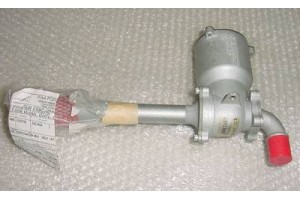
It is about a foot long. There are three jet pumps per side: one transfers fuel from center tank to wing tank (shown), one transfers fuel within wing tank to feed bay, one feeds the engine from the feed bay and also provides motive flow to the other two. The feed ejector motive flow is provided by an engine driven pump at about 300 gph at about 475 psig.
It is about a foot long. There are three jet pumps per side: one transfers fuel from center tank to wing tank (shown), one transfers fuel within wing tank to feed bay, one feeds the engine from the feed bay and also provides motive flow to the other two. The feed ejector motive flow is provided by an engine driven pump at about 300 gph at about 475 psig.

.


Joined: Apr 2013
Posts: 5,042
Likes: 1,157
From: Oregon
St. Jude Donor '14-'15-'16-'17-'18-'19-'20-'21-'22-'23

Team Owner


Joined: May 2001
Posts: 25,058
Likes: 1,265
From: Virginia
St. Jude Donor '11

Racer
Joined: Jun 2014
Posts: 430
Likes: 147
From: Hendersonville NC