When you click on links to various merchants on this site and make a purchase, this can result in this site earning a commission. Affiliate programs and affiliations include, but are not limited to, the eBay Partner Network.
Hello i currently have a bone stock 2003 c5 and recently got into modding it, i first did a differential upgrade and now im looking at doing a CAI along side a tune. Can anyone point me in a right direction when it comes to what CAI actually offer better performance? I’ve seen some CAI that simply increase flow but dont actually bring in cold air due to still pulling air from the engine bay. The two I’ve seen that actually change where the car gets air from are the Callaway Honker and the Varram intake. Any others that yall know about or would recommend??? Thank you!
Kingtalon is correct about a factory airbox being the best protection. However I live in southwest Florida and it gets really hot. I frequently see intake air temps in the 130-160 range with the factory airbox when stopped and it takes a while to drop down below 130 after I get moving. I just installed the Vram system and am seeing intake air temps around 100-105. So significantly cooler which equals more power. The Vram does get air from the bumper vents and could pull in water if you are not careful. Also, my long term fuel trims are up 15-18% from the stock air box, so the Vram has altered the way the MAF measures airflow to the engine. I have an HPtuners MPVi3 and am in the process of adjusting the MAF curve.
I know it may seem counter intuitive and this is going to be unpopular (surprise). Generally hot air is intentional by design on behalf of factory intake systems.
I don't want to write a book about this. Although I will answer any questions and perform math as needed to make the point if anybody has some confusion.
Warmer air has multiple benefits for a daily driver engine in daily driver situations. Here are the main points off the top of my head (I prob forget some others)
1. Expanding air volume which improves velocity which improves cylinder distribution and filling rate for large port (generally performance-based) engines.
2. Increased energy input (conservation of energy) which improves fuel economy (hot air makes better economy provided additional friction @ new velocity is reasonable)
3. Helps vaporize fuel, factory engines inject fuel to a closed intake valve and rely heavily on heating to vaporize before the valve opens at low speeds since there isn't much airflow momentum/kinetic energy input at low speeds
4. #3 also helps reduce carbon deposits by rapidly vaporizing fuel and mixing fuel which gives it little time to form byproducts (think oil simmering in a frying pan, interacting with itself vs flash vaporization)
5. Reduce oil contamination from liquid fuel when using performance injection end angles (if the vehicles been tuned with post EVC injection timing)
6. Improved drivability when the engine is cold started, reduced carbon buildup from cold engine behaviors, improves cold engine responses, by pre-warming incoming air
Additionally as correctly pointed out the maf sensor is extremely sensitive to position, laminar flow profile, excitement for hot-wire. Changing plumbing systems without addressing the maf sensor's sensitive nature will lead to any number of issues, from improper fueling, intermittent fouling/richness, hesitation/deadspot, misfire/backfire, etc...
its also difficult for people to tell if you've got the filter system sealed up properly, to exclude debris. Nobody is pressure testing their intake systems, they just assume.
And it actually gets even deeper than these basic points. To even more important issues...
7. The PCV system relies on a post factory air filter pressure drop of 0.8"Hg to 1.8"Hg something in that range to drive PCV at wide open throttle which scavenges the crankcase for blow-by gas. All factory engines need this and have this. This is needed to protect engine oil from deposits and protect oil quality. When installing 'high flow filters' (or removing the air filter) the crankcase pressure will rise and may even go positive at wide open throttle which causes oil leaking, oil to gradually seep out of the engine, oil contamination from blow-by, and this significant reduced oil lifespan and engine lifespan as a result.
And we keep going
8. Air filtering from factory paper air filter is provided around 1 to 3uM generally particulate rate perhaps 80 to 95% of 2uM for example captured. Aftermarket filters may not have the filtering ability that the OEM paper element does and allow larger particulate to enter the engine oil. To give you an idea of how terrible this is for piston ring interface consider the size of oil molecules is roughly 800picometers which is 0.8nm or around 0.0008uM in size, and up to perhaps 2nm in size depending on the compound.
Compare A bit of debris at 1uM to 1nM , is like a marble to a person. A grain of sand to a beach ball.
Imagine now you have this clean array of oil molecules the size of sand grains and a beach ball falls in between them. There goes the piston oil seal quality bit by bit, gradually the ring loses its clean containment features, gradually as more debris is allowed to enter the cylinder becomes scuffed/scratched/damaged, the additional pollen/fungus/debris contributes to carbon conglomerates and byproducts....
Gah. Just don't do it you have no idea what you are doing. If you want power use forced induction and a quality off-road filter + pre-filter engine will last longer than factory and produce 2x 3x the factory output. Thats the solution. Not to reduce pcv and air filtering and fuel vaporization and air distribution and engine lifespan from a cheap nickle and dimes modification. People buy cigarettes and other drugs all the time and seem fine doing it, that doesn't make it safe or smart to do that just because everybody does it. You have to look at the long term results, end point, compare end point engines. I Used to inspect imported engines from Japan and those with aftermarket filters were the worst condition, sand blasted throttle valves, pitted and debris embedded to deck and head, ruined piston oil ring seals, smoking and leaking. Trash it makes them into trash
Science don't need any opinion. What you want as an educated consumer is testing data in compliance with some standards. For example both of these popular companies provide standards, math, testing data to consumers , at least in a general sense
Companies which list their filtering and pressure drop testing procedures/practices and compliance with standards is the first step.
They must provide specific math which was used to determine filtering and pressure drop capabilities,
From: https://www.knfilters.com/efficiency..._procedure.htm
If you notice, "wheres the factory air filter testing done for comparison"??
They don't want you to have that data = not a good sign
On the merit of particulate capture alone, I would stay away from aftermarket filters unless you can perform this type of comparison against a factory filter.
The issue with the crankcase is based on pressure drop, its a different kind of curve you are interested in, something like this
Which can be based on mileage in some environment or dust in grams of various sizes... there is more than one way to test a filter pressure drop over time.
The more important initial aspect is whatever the filter flows brand new out of the box. You can size the breathing of the engine around that rate. For example my 5.3L uses about 1000CFM at 90*F intake air temp, so I need a filter that flows around 900 to 1000cfm @ 1 to 2"Hg of pressure drop, keeping up to 3"Hg to scavenge the crankcase and clean the oil up over time while producing enough vacuum to keep oil inside the engine and prevent leaking. I expect the pressure drop to increase slightly with mileage.
Be careful when comparing pressure drops, Water vs Mercury
The above test doesn't give us the data we need. The information is extremely limited. Its showing us that for identical sized filter papers, that the Pro Guard 7 can only flow about 72%~ of what the same exact filter size/description can flow when made of the best material they offer. This does not tell us which filter we need for our engine because it does not show a CFM rating @ pressure drop.
What you are looking for is something like this which shows filter part number and CFM vs Pressure drop somehow
Here is another example , see it lists CFM and the resulting pressure drop with some part number for the consumer, and is according to Testing standardize ISO 5011 otherwise its not comaprable to any other data we find with any other standard. At least not fully. Sometimes we just have to make do with what we get though.
K&N following standards, so you know when they say a filter flow 500CFM they mean 500CFM @ 1.5"H2O
So lets say our engine uses 500CFM of airflow, and we buy a filter that flows 500CFM @ 1.5"Water. At first it will not produce the required pressure drop for crankcase cleaning. However as its used the pressure drop rises, sometimes dramatically, just look at the graphs above showing particulate capture vs pressure drop change. Over time the filter will go from 500CFM @ 1.5"H2O to 500CFM @ 3"H2O and then 5" H2O and then 8"H2O etc.... And this happens rapidly within the first few hundred miles for paper filter elements like the factory uses. Notice the shape of the dust vs pressure is practically exponential for K&N and AFE while some of the paper filters produce almost linear curves as dust is collected.
Matching an intake system to an engine isn't a guessing game or has anything to do with what you like or what makes the most power. The worst possible filter will make the most power.
What matters is that it can deliver these and other performance metrics to protect your engine, dust capture ability, pressure drop over mileage. Whether the system can pass a pressure test. Lets make a list
Filter need to:
1. provide necessary particulate capture (third picture, 'filter efficiency result')
2. produce necessary pressure drop (above last few pics showing CFM vs pressure change)
3. Seal up tightly and pass pressure testing to avoid leaking (a tiny leak is very bad. )
I calculated previously: https://forums.holley.com/forum/holl...671#post396671
4. Provides conditions needed for laminar flow to maf sensor if applicable without excess friction
5. Provides pre-warmed air when required to maintain fuel economy/efficiency, improve cylinder distribution and reduce carbon byproducts (deposits and fuel contamination)
Yeah stick with the factory piece if you have anything near a factory engine. If you upgrade turbocharged/supercharged at that point start look for a filter that meets these criterion at higher CFM rates - don't just shove any off the shelf unit on it. I know everybody does that but its wrong and costs the engine lifespan as a result. I would never buy a used engine that has an aftermarket air filter or any PCV system modifications on it because there is a good chance its been trashed with debris and oil contamination.
Given the choice, I'll take the Honker best made, bigger filter, Horspepower between the Honker, Vararam and Halltech TRAP (if you can find one) are minimal. TRAP would be my next choice. All 3 run a higher chance of hydrolocking the motor.
My 2500HD with a LQ4 (Iron LS based motor) had a K&N panel filter replacing the OE filter when I bought it with 70k? miles and is over 251k now, over 150k of those with a K&N cone filter.
I would imagine there are thousands of customers running the Honker and Vararam. Maybe 10s of thousands. I'll bet less than .1% of the owners have hydrolocked their engines due to driving thru water deep enough to cause that. If Id ever be in a flash flood I'd shut the engine off immediately. It's not rocket science. If you drive thru flood water, you have nobody to blame but yourself. A constant downpour will NOT cause a hydrolock. I was caught once in a torrential rain in Florida (it doesn't rain any harder, anywhere else, than in Florida!), and had no issues at all, though I did find out where I needed new weatherstripping!!!!
Last edited by grinder11; Sep 9, 2025 at 03:19 PM.
Science don't need any opinion. What you want as an educated consumer is testing data in compliance with some standards. For example both of these popular companies provide standards, math, testing data to consumers , at least in a general sense
Companies which list their filtering and pressure drop testing procedures/practices and compliance with standards is the first step.
They must provide specific math which was used to determine filtering and pressure drop capabilities,
From: https://www.knfilters.com/efficiency..._procedure.htm
If you notice, "wheres the factory air filter testing done for comparison"??
They don't want you to have that data = not a good sign
On the merit of particulate capture alone, I would stay away from aftermarket filters unless you can perform this type of comparison against a factory filter.
The issue with the crankcase is based on pressure drop, its a different kind of curve you are interested in, something like this
Which can be based on mileage in some environment or dust in grams of various sizes... there is more than one way to test a filter pressure drop over time.
The more important initial aspect is whatever the filter flows brand new out of the box. You can size the breathing of the engine around that rate. For example my 5.3L uses about 1000CFM at 90*F intake air temp, so I need a filter that flows around 900 to 1000cfm @ 1 to 2"Hg of pressure drop, keeping up to 3"Hg to scavenge the crankcase and clean the oil up over time while producing enough vacuum to keep oil inside the engine and prevent leaking. I expect the pressure drop to increase slightly with mileage.
Be careful when comparing pressure drops, Water vs Mercury
The above test doesn't give us the data we need. The information is extremely limited. Its showing us that for identical sized filter papers, that the Pro Guard 7 can only flow about 72%~ of what the same exact filter size/description can flow when made of the best material they offer. This does not tell us which filter we need for our engine because it does not show a CFM rating @ pressure drop.
What you are looking for is something like this which shows filter part number and CFM vs Pressure drop somehow
Here is another example , see it lists CFM and the resulting pressure drop with some part number for the consumer, and is according to Testing standardize ISO 5011 otherwise its not comaprable to any other data we find with any other standard. At least not fully. Sometimes we just have to make do with what we get though.
K&N following standards, so you know when they say a filter flow 500CFM they mean 500CFM @ 1.5"H2O
So lets say our engine uses 500CFM of airflow, and we buy a filter that flows 500CFM @ 1.5"Water. At first it will not produce the required pressure drop for crankcase cleaning. However as its used the pressure drop rises, sometimes dramatically, just look at the graphs above showing particulate capture vs pressure drop change. Over time the filter will go from 500CFM @ 1.5"H2O to 500CFM @ 3"H2O and then 5" H2O and then 8"H2O etc.... And this happens rapidly within the first few hundred miles for paper filter elements like the factory uses. Notice the shape of the dust vs pressure is practically exponential for K&N and AFE while some of the paper filters produce almost linear curves as dust is collected.
Matching an intake system to an engine isn't a guessing game or has anything to do with what you like or what makes the most power. The worst possible filter will make the most power.
What matters is that it can deliver these and other performance metrics to protect your engine, dust capture ability, pressure drop over mileage. Whether the system can pass a pressure test. Lets make a list
Filter need to:
1. provide necessary particulate capture (third picture, 'filter efficiency result')
2. produce necessary pressure drop (above last few pics showing CFM vs pressure change)
3. Seal up tightly and pass pressure testing to avoid leaking (a tiny leak is very bad. )
I calculated previously: https://forums.holley.com/forum/holl...671#post396671
4. Provides conditions needed for laminar flow to maf sensor if applicable without excess friction
5. Provides pre-warmed air when required to maintain fuel economy/efficiency, improve cylinder distribution and reduce carbon byproducts (deposits and fuel contamination)
Yeah stick with the factory piece if you have anything near a factory engine. If you upgrade turbocharged/supercharged at that point start look for a filter that meets these criterion at higher CFM rates - don't just shove any off the shelf unit on it. I know everybody does that but its wrong and costs the engine lifespan as a result. I would never buy a used engine that has an aftermarket air filter or any PCV system modifications on it because there is a good chance its been trashed with debris and oil contamination.
Thoughts on this? (None of this is my own opinion)
I think most people can't get into the science...
I went with a honker because I am going to up the hp and figured if anyone was legit..it would be callaway.
My thoughts is that the ai is not an engineer, it can only read other things online and uses that as its source.
Whenever it is missing information, it calls bs
For example, My engine does use 1000CFM. I have about 750bhp its forced inducted
Notice the ai says 'its wrong' and supplies some equation from some source to 'prove' that it is 'wrong'. When really it simply lacks information that doesn't exist in its sources.
The same goes for every little 'incorrect' remark it makes. Everything from pre-warming, which all power plants in the world do to improve economy and efficiency, and something that engines have done frequently since the days of carb applications, many of which ran intake system over exhaust systems to improve vaporization of fuel. And then there is aftermarket tuning strategies of injecting fuel post EVC which requires a whole different approach to vaporization and velocity/momentum timing of an intake system. An ai does not understand the tuning application of such ideas which are largely esoteric, somewhat secretive, or sparsely distributed with respect to knowledge, e.g. the sources are few and far between and often disagree with each other, and many are specific to some ECU/vehicle/engine and do not cross over, for example Haltech injection timing numbers don't match with AEM or Holley injection timing and none of those match a gen3 chevrolet ECU injection timing map numbers either. The ai just isn't at that level to grasp such concepts. It takes a true experienced (25 years here) professional (doctorate in engineering here) to discern these minute secluded details and produce a detailed explanation with human fingers typing on a keyboard.
I could easily convince the ai of any these details if having a conversation with it. Piece by piece I could get it to 'see' and agree with me if needed. It doesn't have actual intellect it can only use the information it is handed even if that info is wrong in the first place. It doesn't know fact from fiction other than published data from time to time.
notice at the end it basically agrees with every bullet point I make. Only it lacks the information to support the 'how and why' of it. Such as how I need 1000cfm 'its impossible' it just lacks the information so it has no idea and calls bs to cover its blind spot.
most of the crap online is wrong or incomplete. At the end of the day you can take your own measurement and ignore what I said. Go ahead and measure the crankcase pressure on a corvette, skyline, supra, corolla, etc... and see what you think. Then change the air filter / pcv system and try again. the ai keeps mentioning intake suction but there isn't any at wide open throttle to speak of. It doesn't understand how the pcv system works becuase the people producing online information don't understand either.
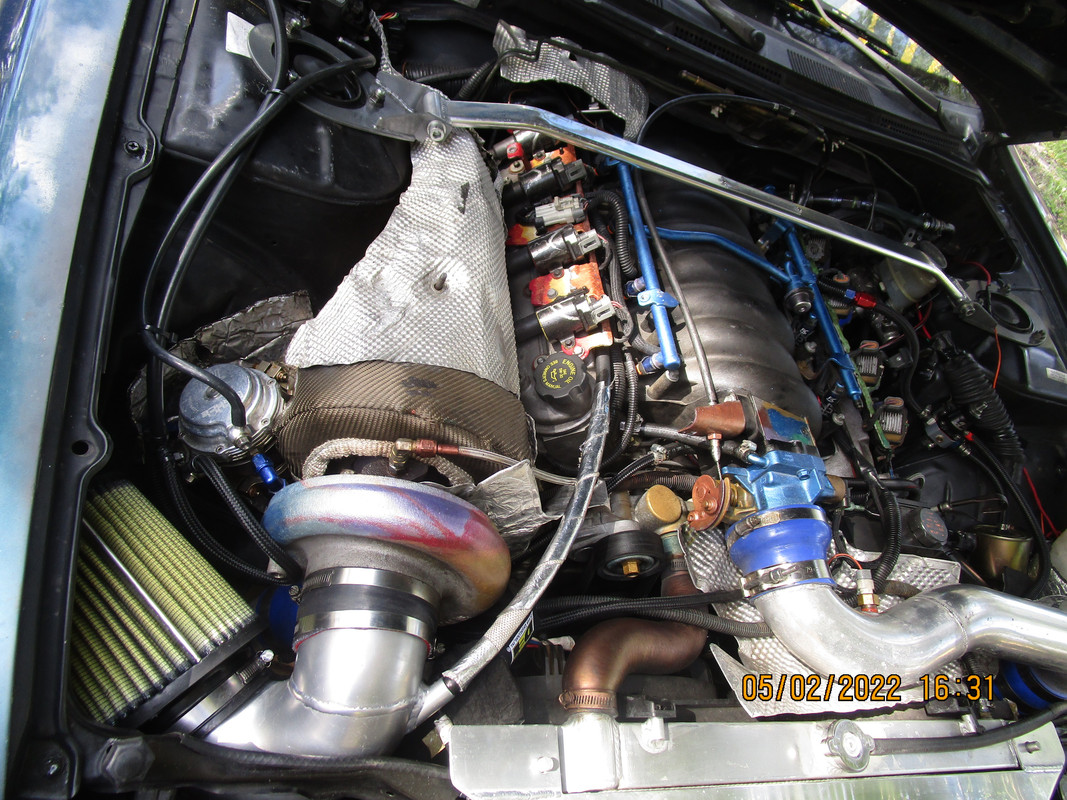
Brand new 800CFM filter at 520bhp (approx output in the video) is giving 3.98v from a 4.54v baseline = ~0.66"Hg crankcase pressure after line friction (pressure is lower behind the filter, pressure gradually climbs as a gradient towards the crankcase where blow-by is being produced, which is where we measured it)
After ~1,000miles it will be even lower perhaps 1.25 to 2"Hg which is the target
With another ~200bhp it will be even lower = more crankcase cleaning action at wide open throttle for my 240,000 miles turbo V8 engine like new inside!!
I would imagine there are thousands of customers running the Honker and Vararam. Maybe 10s of thousands. I'll bet less than .1% of the owners have hydrolocked their engines due to driving thru water deep enough to cause that. If Id ever be in a flash flood I'd shut the engine off immediately. It's not rocket science. If you drive thru flood water, you have nobody to blame but yourself. A constant downpour will NOT cause a hydrolock. I was caught once in a torrential rain in Florida (it doesn't rain any harder, anywhere else, than in Florida!), and had no issues at all, though I did find out where I needed new weatherstripping!!!!
Agreed but it is something people should be aware of. Granted the same goes for the stock design. The TRAP had likely the lowest air intake point and I dorve it in Florida and Georgia even during the remains of a passing hurricane.
The greatest threat of hydrocking a motor is from mistaking a small pond for a puddle.
Brand new 800CFM filter at 520bhp (approx output in the video) is giving 3.98v from a 4.54v baseline = ~0.66"Hg crankcase pressure after line friction (pressure is lower behind the filter, pressure gradually climbs as a gradient towards the crankcase where blow-by is being produced, which is where we measured it)
After ~1,000miles it will be even lower perhaps 1.25 to 2"Hg which is the target
With another ~200bhp it will be even lower = more crankcase cleaning action at wide open throttle for my 240,000 miles turbo V8 engine like new inside!!










 Best CAI?