When you click on links to various merchants on this site and make a purchase, this can result in this site earning a commission. Affiliate programs and affiliations include, but are not limited to, the eBay Partner Network.
Interesting topic, as I have a LS7 wet sump. From my understanding, a GZ (or any) vacuum pump is the only way to effectively remove crankcase pressure at WOT with wet sump N/A applications. Your intake will remain clean from oil mist. Not sure if a dry sump is more effective than a wet sump. You can install a double catch can, but that also adds more restriction as well. I've got a new GZ vacuum pump setup that I intend to install this summer when tuning.
Notice it had failed and started blowing out the oil seals of the engine. The major down sides of electric pumping is
1. it can fail or become weak/clogged/damaged/worn without warning and lead to excessive crankcase pressure without your knowledge
2. requires filtering of oil and maintenance as it will eventually clog or die from general use
Either way, whatever method you select for a performance or reliability application will require somekind of monitoring and careful calibration of monitoring setup. Notice after it failed the owner installed a monitoring gauge for the crankcase pressure. You should be doing this anyways no matter what kind of PCV you use to ensure the crankcase pressure stays in target range.
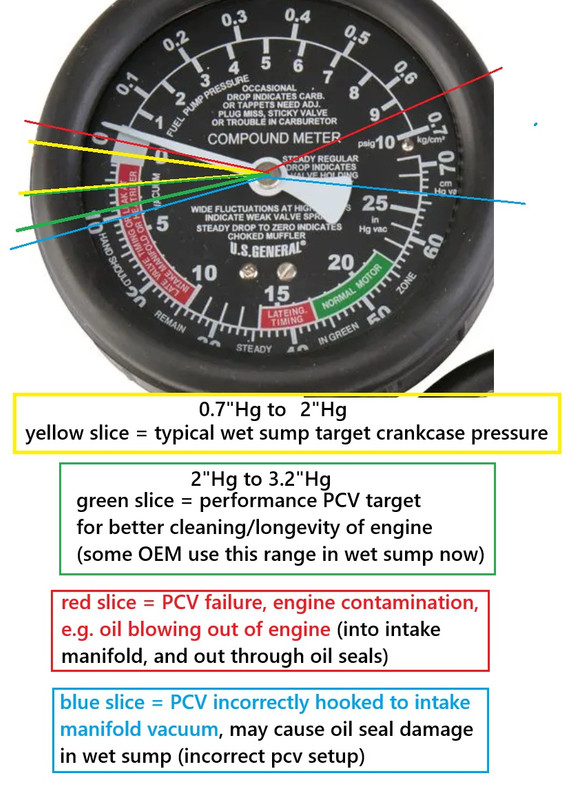
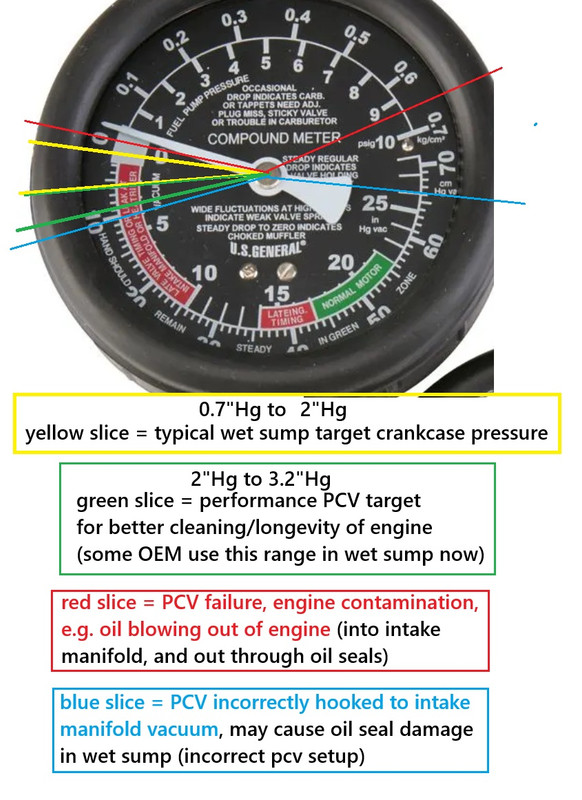
Target range for wet sump is
I recommend OEM PCV for a Supra/Skyline engine. You can monitor the setting up to get within target range and then service the PCV system like an OEM system without having to constantly monitor as long as you follow the general rules of PCV and forced induction, it can be maintenance free for many years like other OEM.
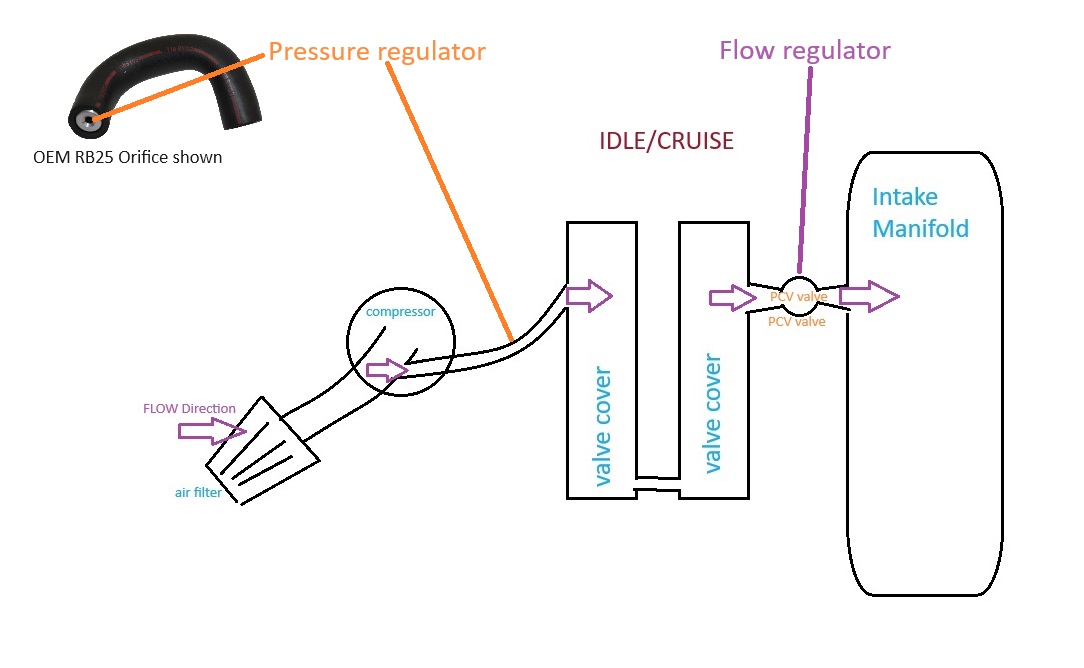
If using a catch can, it may ONLY be placed between the intake manifold and pcv valve(or in that same hose for natural aspirated engines without a pcv valve, where one would be), and it must not block flow to the pcv valve or restrictor orifice (fill up or clogged with oil, must be maintained). The PCV valve orifice flow must be set to accomodate the engine needs, not all PCV valves are the same and not all engines are same. PCV valve flow should be set to maintain a pressure below atmospheric in the crankcase for idle/cruise using a mechanical measurement gauge. This ensures there is no leaks in the crankcase system and that idle/cruise flow is adequate. There are many tools capable of performing this measurement I've seen technician use them before on this site in fact after we had this discussion.
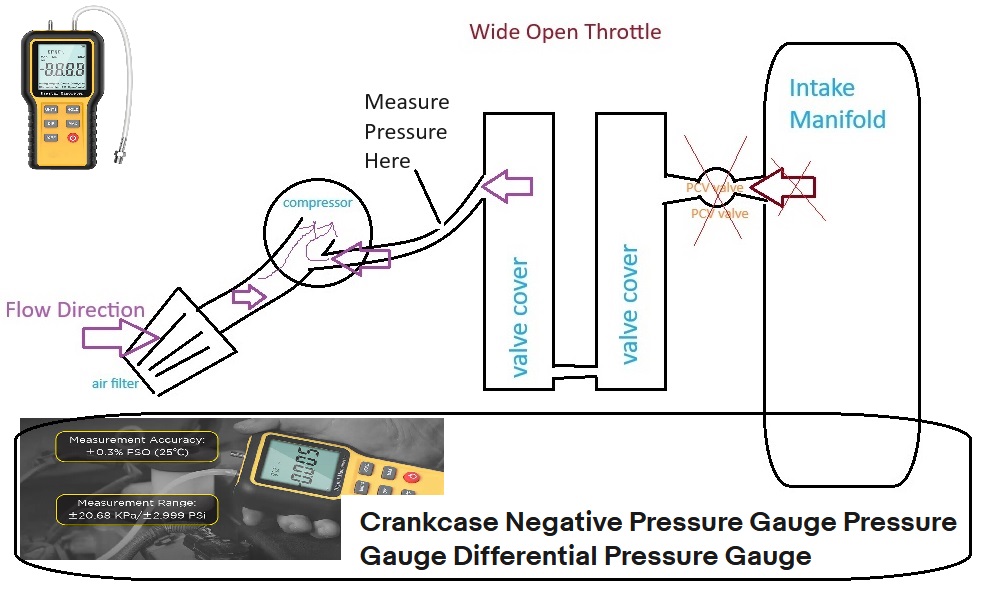
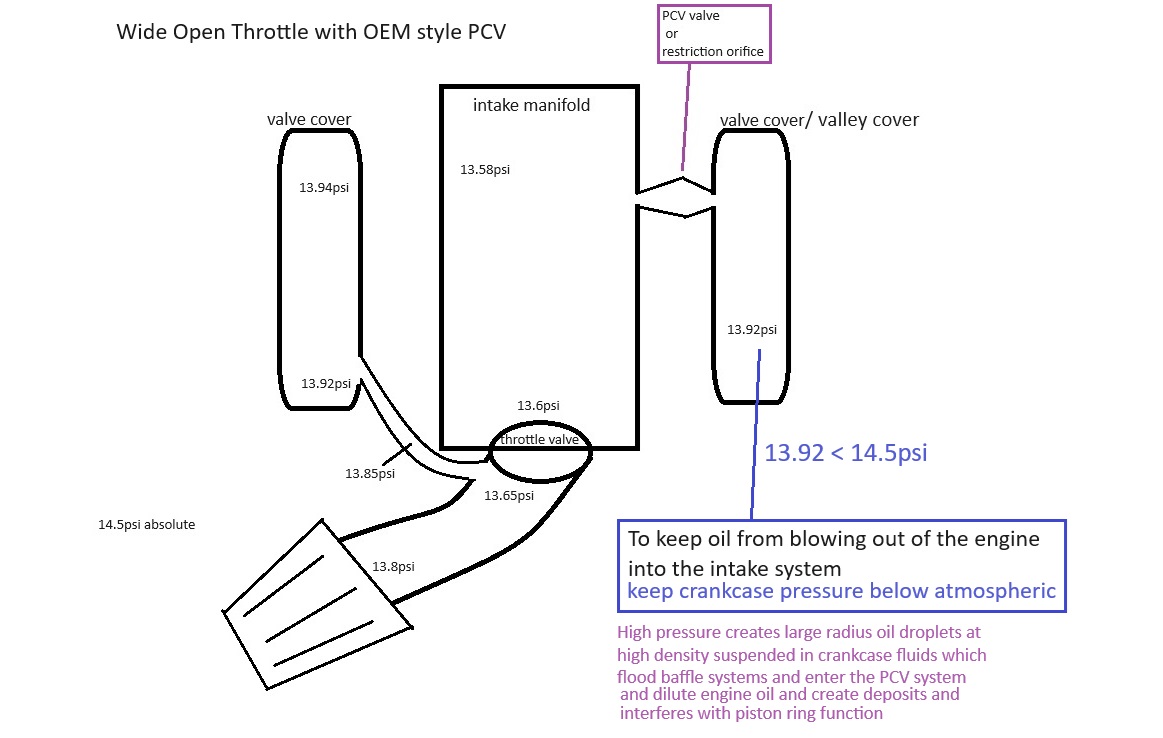
For wide open throttle the air filter produces the pressure drop of PCV, the air filter becomes the pcv system at wot. It is important not to over-size the air filter otherwise it will not produce a pressure drop at wot and the crankcase pressure will rise above atmospheric and defeat/disable PCV which allows oil to blow out of the engine and form large oil droplets which invade the pcv system gradually filling it with oil including piston rings which accumulate oil sticky tar like conglomerates that seizes piston rings over thousands of miles resulting with smoking engine cylinder wear eventual failure. Crankcase pressure at wot needs to be maintained below atmospheric in target range shown above to keep the ring packs drained properly from accumulating carbon deposits.
[QUOTE=Kingtal0n; Crankcase pressure at wot needs to be maintained below atmospheric in target range shown above to keep the ring packs drained properly from accumulating carbon deposits.[/QUOTE]
Appreciate the info. With N/A applications, at WOT it's impossible to achieve vacuum and the reason why catch cans are installed. They help, but still do not cure the problem. A belt driven vacuum pump (like a GZ pump) can be regulated and set to produce the proper vacuum as RPM's increase. They actually work well with idle/cruise and WOT.
Appreciate the info. With N/A applications, at WOT it's impossible to achieve vacuum and the reason why catch cans are installed. They help, but still do not cure the problem. A belt driven vacuum pump (like a GZ pump) can be regulated and set to produce the proper vacuum as RPM's increase. They actually work well with idle/cruise and WOT.
All Factory Natural aspirated engines have a vacuum inside their crankcase at all times. Even if very small there is flow still present which is a scalar pressure gradient. All OEM engines do this every single one of them no matter what induction. You should measure it on many factory engines before making your claim without evidence and I am happy to have corrected this misconception on your part.
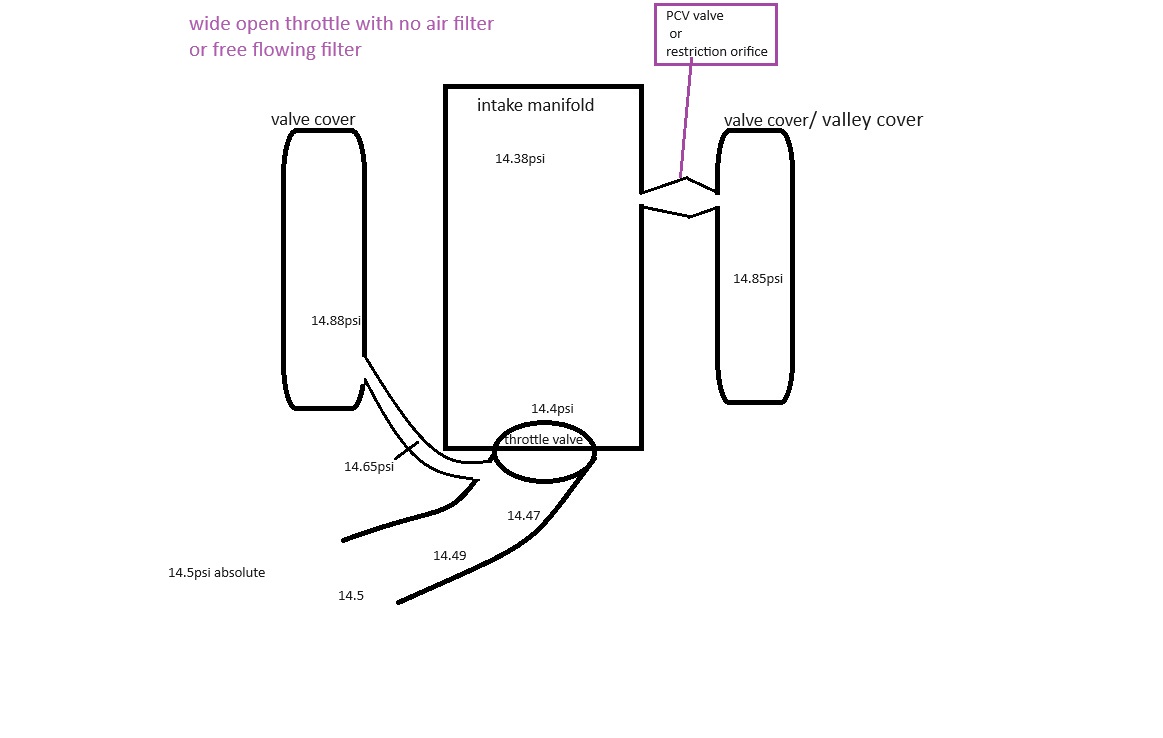
Here is a factory engine natural aspirated example for wide open throttle with negative pressure inside the crankcase. So you can see I placed numbers inside the intake tract for your viewing directly to make sure its actually negative.
Natural aspirated PCV
Belt drive Vacuum pumps require maintenance and add complexity. They need rebuilt and cleaned routinely. They are not recommended for normal daily drivers or street/strip applications due to these reasons. Even if they are more ideal than OEM pcv in operational theory, the OEM pcv systems are trouble free and nearly maintenance free (replace the hoses and pcv valve every 10 years or whatever).
If you place a breather on any engine it will eventually lead to ruined cylinder walls over high mileage and smoking leaking engine and other problems.
If you place a catch can on any engine without measuring the impact on crankcase pressure and adjusting the hoses, pcv valve, orifice flow rates, air filter aspects to correct for the catch can's friction and volume additional impact, the same thing will happen, smoking leaking, oil contamination, eventual failure. There is also additional risk based on catch can heating/placement that it may collect water (combustion is 1 gallon of water for 1 gallon of fuel burnt, so...) and chemically react heating/cooling water in the presence of myriad substrates which forms particularly long-term problematic corrosive products such as carbonic acid.
I agree with what you're saying, but a stock LS1/ LS6/ LS3, etc., still has oil coming into the intake, that's been well documented. Maintaining vacuum at WOT is the issue.
Idle or light cruising the PCV system works as you described, but not at WOT.
I have never encountered this before. Or maybe I have but only as a PCV topic.
If I have a large displacement engine with no windows between cylinders and am pushing 6500 rpm what is the benefit of a vac pump?
Also, how and where does one install this?
Buddy came off valve cover. On a hot rod, you mount a vacuum pump in the engine bay (like the firewall) or even the trunk, away from heat, connecting its inlet to the brake booster line or valve covers and its outlet to the booster/system, using a reservoir if needed for consistent power assist on engines with big cams that lack natural vacuum. The pump provides vacuum for power brakes (and other accessories like HVAC) that a big cam engine can't generate on its own, ensuring a firm pedal every time.
I agree with what you're saying, but a stock LS1/ LS6/ LS3, etc., still has oil coming into the intake, that's been well documented. Maintaining vacuum at WOT is the issue.
Idle or light cruising the PCV system works as you described, but not at WOT.
Because people change their air filters and neglect to measure and set the PCV system accordingly
YOU set the crankcase pressure as low as you want on ANY engine, by understanding how PCV works. If i want to have -5PSI inside the crankcase on a natural aspirated engine at Wide open throttle I can do it because I know how to do it properly.
There is nothing documented properly. Nobody is documenting their crankcase pressure or it would be obvious the issue is people improperly modifying their engines and then complaining about oil inside the intake manifold.
No oil would go into the intake manifold if the crankcase pressure was correct and the crankcase pressure would be correct if people actually measured and set it correctly.
'as I describe' is simply how physics and engines work, its reality. If you cover the throttle body with your hand the crankcase pressure drops accordingly at wide open throttle because there is a little PCV tube attached to the crankcase 'as I described' as all engines exist on the planet from the factory. I can blindfold myself and point to any engine on the planet from the OEM and it works like this and produces a pressure below atmospheric inside the crankcase at wide open throttle to keep oil out of the intake system as long as there is a properly sized factory air filter without any leaking.
To put it another way. The space between the air filter and turbocharger is naturally aspirated just like the space between the air filter and a natural aspirated engine.
Its the same exact thing, same PCV system design overall, same consequences with improper modification.
Turbo = Supercharger = Natural aspirated PCV design, for wide open throttle.
Identical feature and function, the PCV system feeds from the post air filter tract no matter what type of induction is in place. Clearly there is some misconception here that they are different when they are absolutely 100% identical for the PCV system at wide open throttle.
If you understand one, understand all.
I would actually have to spend more time on the coupe to know what is what. The original owner had installed a homemade catch can system some twenty years ago. That does not imply poor quality. He was a machinist and everything he touched on the car continues to impress me. Yet I cannot say that the catch can is set up correctly or that it still works. I just presume it is for now.
I did some reading and apparently the C5-R block DOES have windows in the crankcase.
I am trying my hand at developing my own cam for the first time and quite enjoying the learning curve as I go. I geek for these things. Far from going for "more" cam, I am aiming at one with a dead calm idle, great vacuum and street manners for this previously SC'd insane 427 while compensating for lower compression ratio.
How does one determine the correct PCV vacuum for a car, or an LS specifically?
Crankcase pressure is measured like tire pressure, boost pressure, coolant pressure, oil pressure, transmission pressure, MAP, etc....
With appropriate gauge
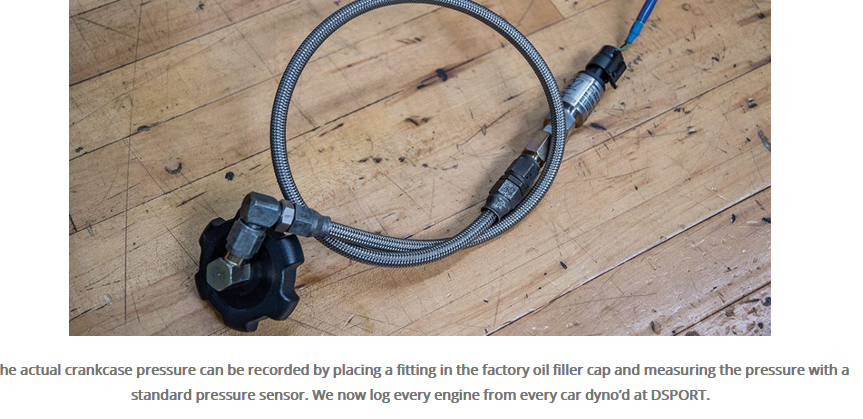
These are all GAUGES for measuring crankcase pressure
1-bar MAP SENSOR
This is an actual crankcase measurement electronic tool gauge
this is a standard automotive mechanical gauge like a boost gauge
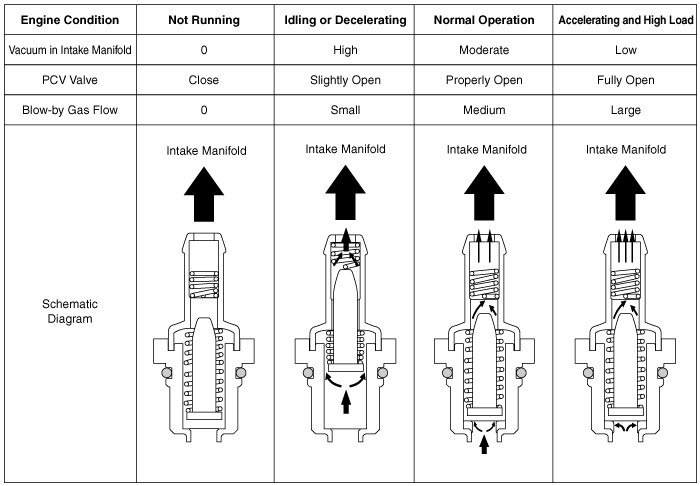
To adjust crankcase FLOW at idle cruise the PCV valve orifice(or restriction orifice for natural aspirated certain engines) controls flow rate. A PCV valve adjusts flow based on pressure an orifice does not automatically do that but is less complex and cheaper to maintain.
On the other side of the crankcase is the fresh air inlet which contains a restrictor to control crankcasePRESSURE at idle/cruise.
So you see PRESSURE and FLOW regulation taking place on either end of the crankcase.
Modern engines contain computer controlled solenoid or spring/diaphragm that control the PRESSURE regulation side.
here is example https://static.nhtsa.gov/odi/tsbs/20...45282-9999.pdf
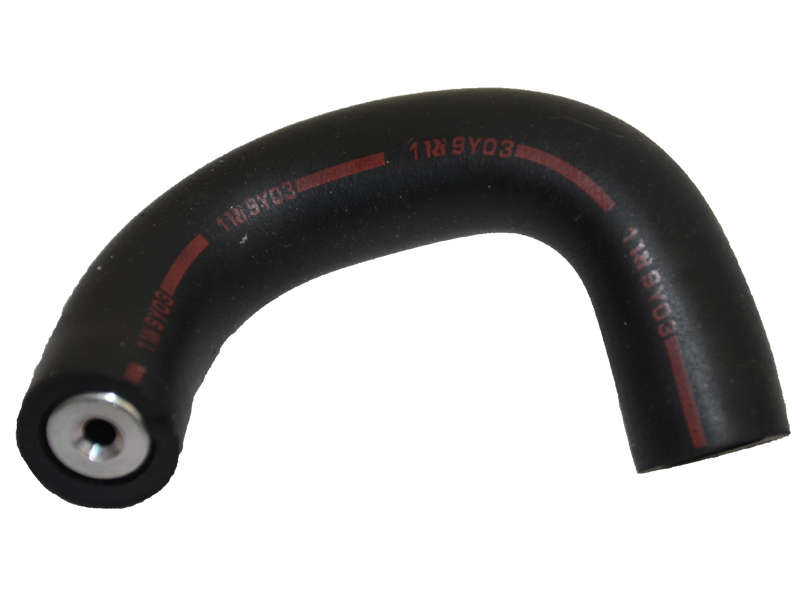
Here is an example of a pre-computer controlled crankcase pressure era restrictor to control PRESSURE of the crankcase in Skyline 1995 RB25DET and Silvia SR20DET Engines
The restrictor orifice needed depends on the flow rate set by the PCV valve(s) or restriction orifice where the PCV valve would be, which controls FLOW rate
--------------- End of Idle / Cruise PCV section -----------
<<Begin wide open throttle PCV section>>
For wide open throttle you still measure the crankcase pressure the same way as above. The only difference is how you SET the crankcase pressure.
For wide open throttle you want the PCV valve (or restrictor orifice where the pcv valve would normally be) To have NO FLOW or MINIMAL FLOW. This is why oil goes inside the intake manifold, people allow flow through the pcv valve into the intake manifold at wide open throttle which should not happen. They have no clue it is happening. If there is oil inside the intake, then the PCV system has been disabled/damaged/leaking and there is flow into the intake manifold at wide open throttle that should not be there.
During boost a quality PCV valve is 99.9% CLOSED , Chevrolet PCV valves are notoriously leaky and must be replaced by a higher quality PCV valve for boost such as a Toyota Supra 1995 Twin Turbo PCV valve(s). For performance engines I recommend two PCV valves to double idle/cruise flow for extra crankcase cleaning action to keep oil quality higher than OEM. The more flow through the crankcase the cleaner the oil will stay the better quality oil washing the rings and engine parts will be which enables higher mileage capability of the engine.
How do you set wide open throttle PCV crankcase pressure for natural aspirated and turbo and supercharger applications? ALL THE SAME WAY
The pressure at wide open throttle is set by theAIR FILTER.
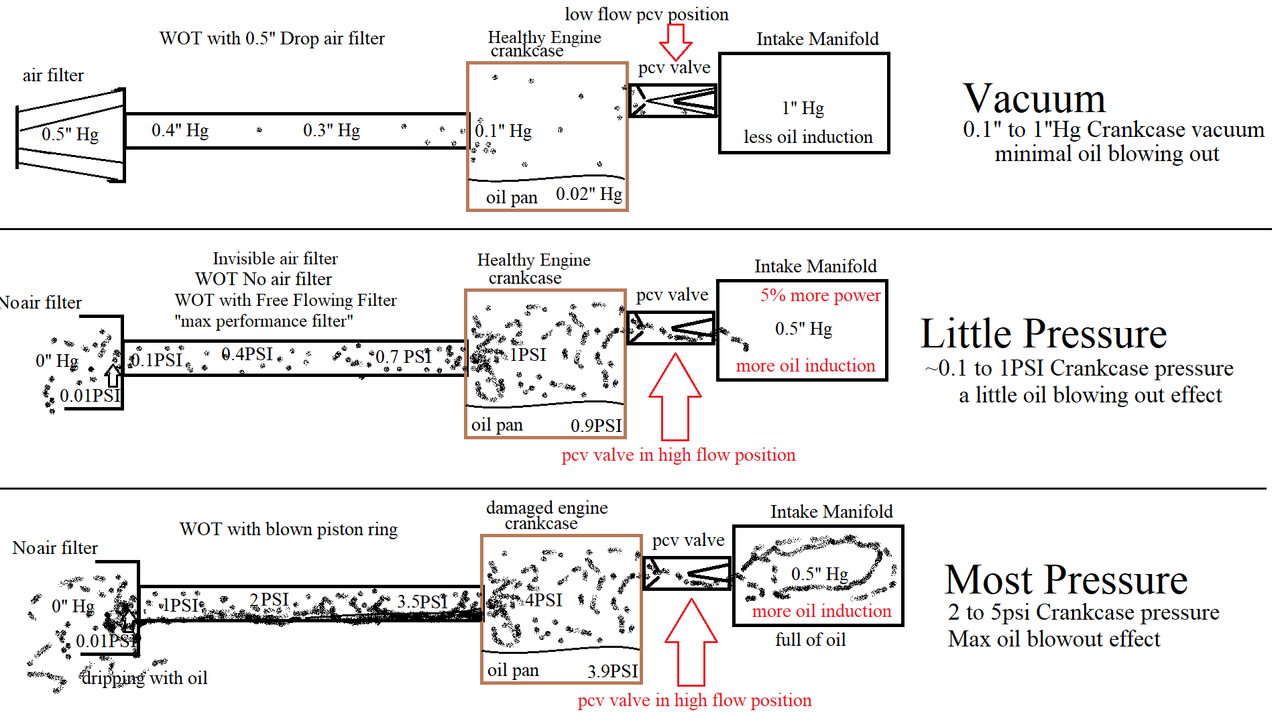
WITH air filter:
WITHOUT air filter:
Here is some examples showing how to fill the intake manifold with oil by removing the air filter or installing too free flowing of an air filter
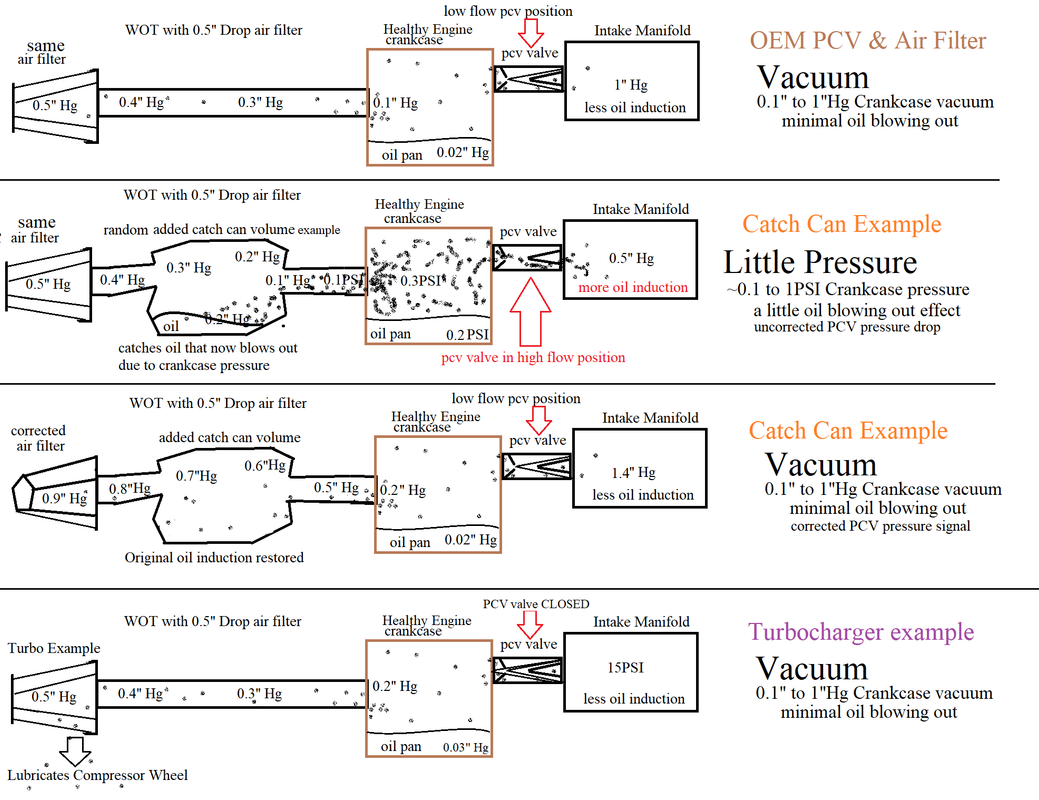
Here is some examples showing how adding a catch can and not correcting the air filter pressure drop leads to oil blowing out of the engine
If this is your first time realizing the air filter role in PCV, simply think of placing your hand over the mouth of the engine. What happens when you put your hand over the throttle valve? There is a vacuum which developed behind your hand. This is the vacuum that drives PCV action at wide open throttle. Your "hand" is the air filter. If you remove the air filter, you remove that vacuum, and if you remove that vacuum you remove PCV and now crankcase pressure rises into a high pressure state which blows oil into every oil seal and out of the engine and fills the ring pack with oil accumulating carbon which eventually ruins the engine.
This is why all ALL EVERY OEM manufacturer use a Factory air filter slightly too small for their engine, and designs the Air filter duct work so that even if a higher flow filter is installed there should still always be some pressure drop(vacuum) in the air filter tract. This is why replacing the air filter and or air filter tract leads to oil blowing out of the engine and ruining the engine over time.
Well I have one thing going for me then by being cheap and using an oem LS7 air intake and blade maf when I get to that point.
Interesting education on the air filter restriction to keep the pressures under one atmosphere. I will have to read for content again later as I need to kick my butt into gear for the day having not slept. Too busy tweaking cam specs. I started over
I don't know off hand how powerful the OEM AIR pump is. It is possible that it could be used to pull a vacuum. But I'm not aware of how many Hg it is capable of pulling. It may be that it isn't powerful enough, IDK....
Been running a GZ pump on mine for the last 8 years. Works well, but you need to pay attention to the setup of it so you don't suck the valve area dry and overfill your can. I have gone through COUNTLESS renditions of mine. The way it is setup now though is perfect.
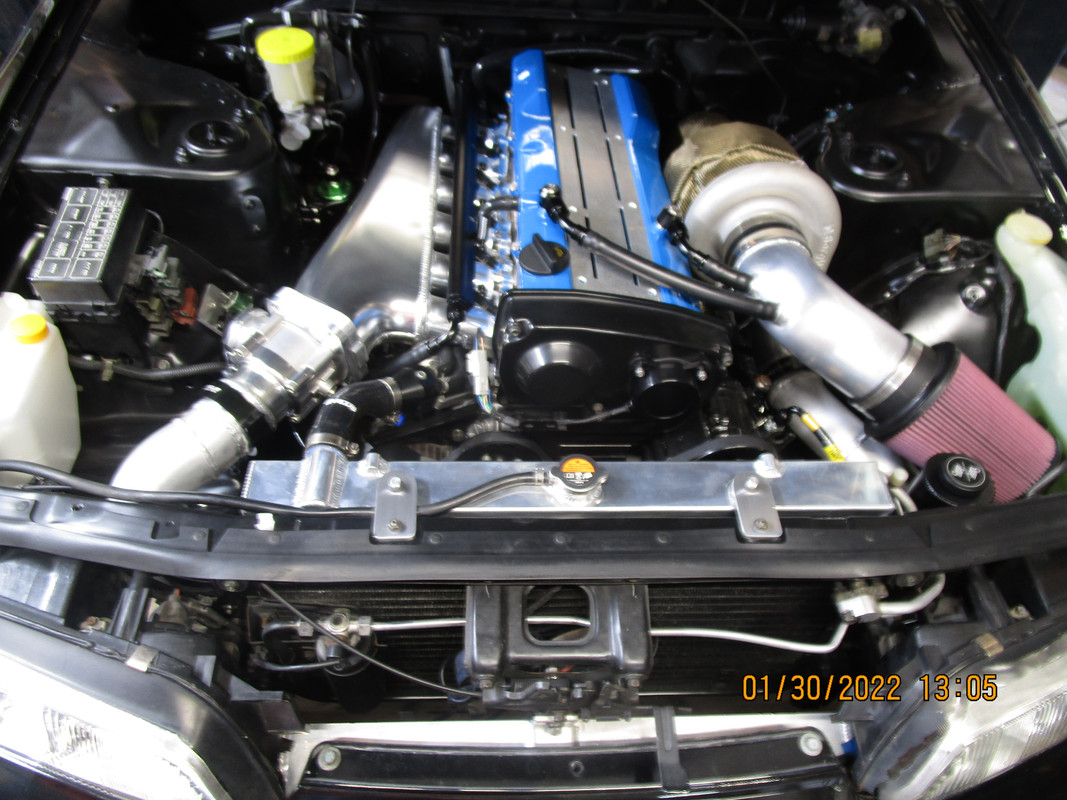
That engine bay always looks so good it excites me.
Trial and error or test and verify sound like the way to get it set it seems.
I still do not see the expense for such a setup. It astounds me. We have a tensioner with a second pulley face on it.... standard. And a vac pump with a basic mount. I see 300 worth of kit, not 1200+. I am also surprised that a stronger electric variant doesn't exist and this makes me wonder if something akin to an electric power steering unit could not be hooked up with the right check valves and reservoir tank somewhere to make this happen "affordably."
Designer Imagines A Corvette That Looks More Like a Corvette Than the Corvette
Slideshow: A Jaguar designer's personal project imagines what a modern front-engined Corvette might look like if Chevrolet revisited the golden age of the Stingray.





 Vacuum Pump?