




A/F Gauge Hookup: Which Wire

Thread Starter
Le Mans Master


Joined: Aug 2002
Posts: 8,472
Likes: 38
From: Houston TX
St. Jude Donor '11
 A/F Gauge Hookup: Which Wire
I think Bank 2 sensor 1 is the preferred O2 to monitor because #7 is supposed to show the first signs of leaning out. Please no "monitoring narrow band O2 sensors is a waste of time" comments.
I was looking through my Helms last night looking at the pinouts on the PCM for which wire to tap into for the Bank 2 Sensor 1 O2 sensor for an A/F gague. There are two wires listed. One says HO2 "Bank 2 Sensor 1 High" and the other says "...Low". What is the difference and which do you tap into to read the O2 voltage?
TIA
I was looking through my Helms last night looking at the pinouts on the PCM for which wire to tap into for the Bank 2 Sensor 1 O2 sensor for an A/F gague. There are two wires listed. One says HO2 "Bank 2 Sensor 1 High" and the other says "...Low". What is the difference and which do you tap into to read the O2 voltage?
TIA

Le Mans Master


Joined: Jun 2001
Posts: 7,331
Likes: 518
From: Admit Nothing, Deny Everything, Make Counter Accusations.
Re: A/F Gauge Hookup: Which Wire (5 Liter Eater)
If you insist on reading the stock O2 sensors why not just use a good ODBII scan tool like EFILive?
Thread Starter
Le Mans Master
Joined: Aug 2002
Posts: 8,472
Likes: 38
From: Houston TX
St. Jude Donor '11
Re: A/F Gauge Hookup: Which Wire (rbartick)
Because I don't feel like parting with the hundreds of dollars for EFI Live, AutoTap, laptop, Predator, Etc. when all I need to do is hook up a multimeter.
Granted I won't have LTFT, KR or other data but I really just want to see if -2 is enough on my MAFT. Also I am thinking seriously about a dry N2O kit and I want to make sure I'm not leaning out the first time I spray it.
Granted I won't have LTFT, KR or other data but I really just want to see if -2 is enough on my MAFT. Also I am thinking seriously about a dry N2O kit and I want to make sure I'm not leaning out the first time I spray it.

Racer

Joined: Oct 2001
Posts: 294
Likes: 15
From: South Orange Co. CA
Re: A/F Gauge Hookup: Which Wire (5 Liter Eater)
You need to connect the two leads of the voltmeter to both the low and high signals. Be sure to use a high input impedance meter (DVM). Don't use something like one of the old Simpson meters since the loading may affect the reading.
Le Mans Master
Joined: Jun 2001
Posts: 7,331
Likes: 518
From: Admit Nothing, Deny Everything, Make Counter Accusations.
Re: A/F Gauge Hookup: Which Wire (5 Liter Eater)
Because I don't feel like parting with the hundreds of dollars for EFI Live, AutoTap, laptop, Predator, Etc. when all I need to do is hook up a multimeter.
Granted I won't have LTFT, KR or other data but I really just want to see if -2 is enough on my MAFT. Also I am thinking seriously about a dry N2O kit and I want to make sure I'm not leaning out the first time I spray it.
Granted I won't have LTFT, KR or other data but I really just want to see if -2 is enough on my MAFT. Also I am thinking seriously about a dry N2O kit and I want to make sure I'm not leaning out the first time I spray it.
The only time you will fall out of stoich is if your trims are maxxed out and you would get a check engine light in that situation. This gauge will also be fairly useless at WOT because the stock sensor is not really designed for that A/F range, you are not logging data for analysis, and you will not be able to watch the gauge and determine what is going on without killing someone. No offense intended, but this sounds like an exercise in futility.
Thread Starter
Le Mans Master
Joined: Aug 2002
Posts: 8,472
Likes: 38
From: Houston TX
St. Jude Donor '11
Re: A/F Gauge Hookup: Which Wire (sunvet)
You need to connect the two leads of the voltmeter to both the low and high signals. Be sure to use a high input impedance meter (DVM). Don't use something like one of the old Simpson meters since the loading may affect the reading.
rbartick, I'm fully aware that the A/F gauge will flip back and forth during closed loop operation. What I'm trying to find out is my WOT O2 voltage to give me a good idea of my A/F ratio. Obviously if this reading is too rich (>~.875 mv) I won't know if it's because of positive LTFT's or what.
I knew it would be impossible to bring this up without some narrow band O2 sensor bashing. :rolleyes:
[Modified by 5 Liter Eater, 3:21 PM 2/12/2004]
Melting Slicks


Joined: Jan 2000
Posts: 3,029
Likes: 1
From: Wichita KS
Cruise-In I Veteran
Cruise-In II Veteran
Cruise-In III Veteran
Cruise-In IV Veteran
Re: A/F Gauge Hookup: Which Wire (rbartick)
You will not learn anything about your MAFT setting because the PCM will always maintain stoich during closed loop operation based on O2 sensor feedback and fuel trims. So I can tell you right now that the gauge is gonna indicate 14.7:1 while cruising around, unless you have a check engine light.
The only time you will fall out of stoich is if your trims are maxxed out and you would get a check engine light in that situation. This gauge will also be fairly useless at WOT because the stock sensor is not really designed for that A/F range, you are not logging data for analysis, and you will not be able to watch the gauge and determine what is going on without killing someone. No offense intended, but this sounds like an exercise in futility.
The only time you will fall out of stoich is if your trims are maxxed out and you would get a check engine light in that situation. This gauge will also be fairly useless at WOT because the stock sensor is not really designed for that A/F range, you are not logging data for analysis, and you will not be able to watch the gauge and determine what is going on without killing someone. No offense intended, but this sounds like an exercise in futility.
:iagree: Since it was already brought up I will just agree with it
sorry, but you did expect it :lol:
Melting Slicks
Joined: Feb 2002
Posts: 2,613
Likes: 0
From: Winston Salem NC
Re: A/F Gauge Hookup: Which Wire (5 Liter Eater)
You call it bashing? He gave you sound advice, especially if you are going to spray. My 02's read about .860 at 13.1 AFR. I've seen them over .900 at 13.1.
Hope it works out.
Hope it works out.
Corvette Stories
The Best of Corvette for Corvette Enthusiasts

Top 10 Most Expensive Corvettes Ever Sold on Bring A Trailer
Brett Foote
10 Things Every Corvette Owner Needs (2026 Edition)
Michael S. Palmer
8 Most "Only Corvette Owners Understand" Quirks and Problems
Pouria Savadkouei
10 Reasons the C6 Z06 is Still A Performance Benchmark After 20 Years
Joe Kucinski
How Much Horsepower Every Corvette Engine "LOST" in 1972
Joe Kucinski
Top 10 DOs and DON'Ts for Protecting Your Convertible Top!
Michael S. Palmer
Top 10 Most Explosive Corvettes Ever Made: Power-to-Weight Ratio Ranked!
Joe Kucinski
150 hp to 1,250 hp: Every Corvette Generation Compared by the Specs That Matter
Joe Kucinski
8 Coolest Corvette Pace Cars (and Replicas) of All Time
Verdad Gallardo
Le Mans Master
Joined: Jun 2001
Posts: 7,331
Likes: 518
From: Admit Nothing, Deny Everything, Make Counter Accusations.
Re: A/F Gauge Hookup: Which Wire (5 Liter Eater)
I knew it would be impossible to bring this up without some narrow band O2 sensor bashing. :rolleyes:
That DVM is going to be all over the place when you try to do a WOT reading and the results from one run to the next will be unpredictable even if you change nothing. Have you ever seen the readings that come from the stock O2 sensors at WOT? In addition, without data logging your readout will be absolutely worthless.
How can I fly to the moon in my C5? Please do not reply by saying that attempting to fly to the moon in my C5 is a waste of time.
Thread Starter
Le Mans Master
Joined: Aug 2002
Posts: 8,472
Likes: 38
From: Houston TX
St. Jude Donor '11
Re: A/F Gauge Hookup: Which Wire (rbartick)
Yes, I've monitored other O2 sensors under WOT pulls and they are fairly static albeit nowhere near wideband accurate.
Didn't want to start a flame war fallas, just wanted to find out what wires to tap into. :grouphug:
Didn't want to start a flame war fallas, just wanted to find out what wires to tap into. :grouphug:
Le Mans Master
Joined: Jun 2001
Posts: 7,331
Likes: 518
From: Admit Nothing, Deny Everything, Make Counter Accusations.
Re: A/F Gauge Hookup: Which Wire (5 Liter Eater)
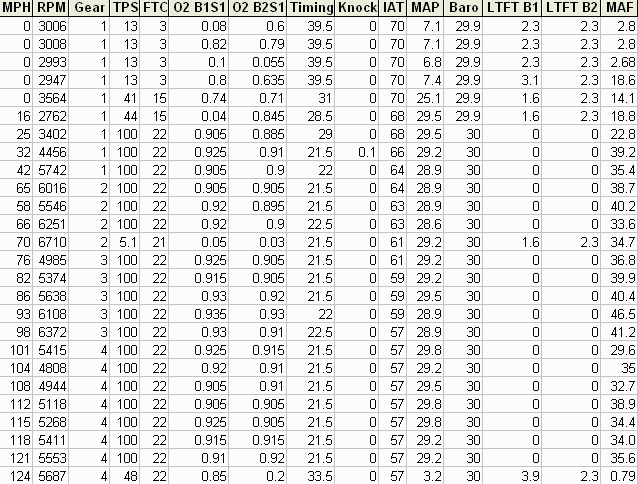
Here are some stock O2 reading taken from a 1/4 mile blast:
Click image for a larger view
I usually get different readings on every pass even if PCM learning is long completed and I do not change a thing. I should add that monitoring knock is just as important as monitoring the A/F ratio. Knock retard can easily occur if your mixture is off and that will really kill power.
[Modified by rbartick, 5:15 PM 2/12/2004]
Click image for a larger view
I usually get different readings on every pass even if PCM learning is long completed and I do not change a thing. I should add that monitoring knock is just as important as monitoring the A/F ratio. Knock retard can easily occur if your mixture is off and that will really kill power.
[Modified by rbartick, 5:15 PM 2/12/2004]
Thread Starter
Le Mans Master
Joined: Aug 2002
Posts: 8,472
Likes: 38
From: Houston TX
St. Jude Donor '11
Re: A/F Gauge Hookup: Which Wire (rbartick)
OK, granted there is ~.025 variance but from that I would say you're running rich seeing as how you are in the .900 mv's. What was your other run like? Were the O2's in the high 800's, low 900's again or totally different? A long 4th gear pull should show even less variance.
Granted you probably want to run rich seeing as how it looks like you're blown, by which I mean supercharged, if you're trapping @ 124.
[Modified by 5 Liter Eater, 4:22 PM 2/12/2004]
[Modified by 5 Liter Eater, 4:25 PM 2/12/2004]
Granted you probably want to run rich seeing as how it looks like you're blown, by which I mean supercharged, if you're trapping @ 124.
[Modified by 5 Liter Eater, 4:22 PM 2/12/2004]
[Modified by 5 Liter Eater, 4:25 PM 2/12/2004]
Thread Starter
Le Mans Master
Joined: Aug 2002
Posts: 8,472
Likes: 38
From: Houston TX
St. Jude Donor '11
Re: A/F Gauge Hookup: Which Wire (5 Liter Eater)
Or maybe you're spraying seeing as how the IAT drops, I've never seen a spraying autotap but I would think the IAT would go real low. That and the timing doesn't look as high as it should which points me back to FI. Hey all this data is neat, you must have a lot of multimeters. :lolg: Just kidding, I couldn't resist. Meant to be harmless. :cheers:
Le Mans Master
Joined: Jun 2001
Posts: 7,331
Likes: 518
From: Admit Nothing, Deny Everything, Make Counter Accusations.
Re: A/F Gauge Hookup: Which Wire (5 Liter Eater)
The car is stock. I just kept into the gas for a few seconds after I passed the lights. The run can be seen here:
http://www.rbartick.com/race_z06.htm
The VR airbox I have is responsible for the drop in IATs. You can also see my MAP climbing a bit at speed. In that run was car was running pretty good but I am not sure what my actual A/F was. I can upload an even leaner tune and the stock O2 sensors may still report the same thing as this run. If I go leaner I start to knock even though I run the stock timing.
Also on my car the A/F starts lean, gets rich around the TQ peak, and then leans out again up towards the redline. This is not indicated at all by the stock O2 sensors. Over the summer I spent some time tuning my car on the road with the stock O2 sensors. I went to the dyno with what I thought was a good tune and I found out that my A/F curve looked like a Motor-Cross track with a huge lean dip right before the Tq peak. This was not indicated at all with the stock O2 sensors.
Bottom line, I cannot depend on the stock O2 sensors at WOT.
http://www.rbartick.com/race_z06.htm
The VR airbox I have is responsible for the drop in IATs. You can also see my MAP climbing a bit at speed. In that run was car was running pretty good but I am not sure what my actual A/F was. I can upload an even leaner tune and the stock O2 sensors may still report the same thing as this run. If I go leaner I start to knock even though I run the stock timing.
Also on my car the A/F starts lean, gets rich around the TQ peak, and then leans out again up towards the redline. This is not indicated at all by the stock O2 sensors. Over the summer I spent some time tuning my car on the road with the stock O2 sensors. I went to the dyno with what I thought was a good tune and I found out that my A/F curve looked like a Motor-Cross track with a huge lean dip right before the Tq peak. This was not indicated at all with the stock O2 sensors.
Bottom line, I cannot depend on the stock O2 sensors at WOT.
Thread Starter
Le Mans Master
Joined: Aug 2002
Posts: 8,472
Likes: 38
From: Houston TX
St. Jude Donor '11
Re: A/F Gauge Hookup: Which Wire (rbartick)
Point taken. Perhaps the stock O2's are not good for telling me if I should go another 2% lean on my MAFT.
But they will be good in telling me if something is wrong with my future nitrous setup. I'm going to be trying different ways to plumb a dry nitrous kit into my Vortex and am afraid that I may freeze the MAF since it's so close to the filter. Dyno Tune has a module that will shut off the N2O if it detects an overly lean condition http://www.speedshop.org/store/scrip...p?idproduct=67 and I will still need to know the wires to tap into for this or a multimeter.
Now I know the wires and have a different perception of narrow band O2 tuning. So it's a win-win. Rbattick, you work on getting those LTFT's negative. :p:
:cheers:
But they will be good in telling me if something is wrong with my future nitrous setup. I'm going to be trying different ways to plumb a dry nitrous kit into my Vortex and am afraid that I may freeze the MAF since it's so close to the filter. Dyno Tune has a module that will shut off the N2O if it detects an overly lean condition http://www.speedshop.org/store/scrip...p?idproduct=67 and I will still need to know the wires to tap into for this or a multimeter.
Now I know the wires and have a different perception of narrow band O2 tuning. So it's a win-win. Rbattick, you work on getting those LTFT's negative. :p:
:cheers:

Intermediate
Joined: Feb 2004
Posts: 34
Likes: 0
From: Sterling VA
Airfuel gauges are pointless...!!....
airfuel gauges= poor mans EGT gauge....
Like autometers... = "light show"
the onle way a airfuel gauge is right... is if you have a wide band 02.
Do it right just get a EGT gauge...
Like autometers... = "light show"
the onle way a airfuel gauge is right... is if you have a wide band 02.
Do it right just get a EGT gauge...
