






Dynamic Alignment Question
Thread Starter
Drifting


Joined: May 2005
Posts: 1,419
Likes: 2
From: "Cedar Valley" (Northeastern) Iowa
 Dynamic Alignment Question
Looking at the geometry of the rear suspension, it looks like there will be more toe-in at weight is added....either from driver and passenger or dynamic compression of the spring.
- Is this a correct Toe-in observation?
- Also looks like Camber will be lost with loading of the
suspension...correct?
If I have it figured out, the front suspension should do the same.....
- Correct?
- Toe-in?
- Camber?
Thanks in advance for your knowledgeable response.
- Is this a correct Toe-in observation?
- Also looks like Camber will be lost with loading of the
suspension...correct?
If I have it figured out, the front suspension should do the same.....
- Correct?
- Toe-in?
- Camber?
Thanks in advance for your knowledgeable response.

Racer

Joined: Apr 2008
Posts: 373
Likes: 2
From: White Plains NY
Looking at the geometry of the rear suspension, it looks like there will be more toe-in at weight is added....either from driver and passenger or dynamic compression of the spring.
- Is this a correct Toe-in observation?
- Also looks like Camber will be lost with loading of the
suspension...correct?
If I have it figured out, the front suspension should do the same.....
- Correct?
- Toe-in?
- Camber?
Thanks in advance for your knowledgeable response.
- Is this a correct Toe-in observation?
- Also looks like Camber will be lost with loading of the
suspension...correct?
If I have it figured out, the front suspension should do the same.....
- Correct?
- Toe-in?
- Camber?
Thanks in advance for your knowledgeable response.
Mike
Pro

Joined: Aug 2004
Posts: 534
Likes: 0
From: Ann Arbor MI
I have data from an 05 C6 that shows how the following settings change with jounce, assuming you start from curb height:
Rear toe: IN
Rear Camber: More negative
Front toe: OUT
Front Camber: More negative
This is only data from one car though, so YMMV. Are you looking at a drawing or photo, or your own car? If you send me the picture, maybe I can provide some insight.
Rear toe: IN
Rear Camber: More negative
Front toe: OUT
Front Camber: More negative
This is only data from one car though, so YMMV. Are you looking at a drawing or photo, or your own car? If you send me the picture, maybe I can provide some insight.
Pro
Joined: Aug 2004
Posts: 534
Likes: 0
From: Ann Arbor MI

Safety Car


Joined: Feb 2007
Posts: 4,939
Likes: 448
From: CHOCOWINITY NC
 Most independently suspended cars go through changes as the suspension loads and unloads. All cars and geometries are somewhat different but as a general rule, as rear suspension compresses the wheels camber in and toe in. The geometry responsible for this is based on the relationship of the locating arms, length of those arms, pivot point placement, bushing stiffness/compliance and design, etc. The Corvette uses a relativly conventional double A arm arrangement to arrive at the desired motions. Changes in alignment aid in handling for one, stabilize the car under cornering loads and suspension loading/unloading. On the front the change is generally less, both Toe and camber, but still changes nonetheless....The suspension engineers have worked this all out..Some manufacturers use very exotic combinations to achieve the desired changes based on their engineering design.
You'll find some interesting information here:
http://www.carbibles.com/suspension_bible.html
Last edited by Modshack; Oct 28, 2008 at 11:24 PM.
Racer
Joined: Apr 2008
Posts: 373
Likes: 2
From: White Plains NY
Most independently suspended cars go through changes as the suspension loads and unloads. All cars and geometries are somewhat different but as a general rule, as rear suspension compresses the wheels camber in and toe in. The geometry responsible for this is based on the relationship of the locating arms, length of those arms, pivot point placement, bushing stiffness/compliance and design, etc. The Corvette uses a relativly conventional double A arm arrangement to arrive at the desired motions. Changes in alignment aid in handling for one, stabilize the car under cornering loads and suspension loading/unloading. On the front the change is generally less, both Toe and camber, but still changes nonetheless....The suspension engineers have worked this all out..Some manufacturers use very exotic combinations to achieve the desired changes based on their engineering design.You'll find some interesting information here:
http://www.carbibles.com/suspension_bible.html
they seem to talk more of deflection of the bushings that causes the toe change. all things being equal the harder the bushing the less toe change. never the the less I stand corrected
Mike

Le Mans Master

Joined: Dec 2005
Posts: 6,993
Likes: 1
From: Vail, Arizona
Corvette Stories
The Best of Corvette for Corvette Enthusiasts

Corvette & Porsche 911: How Two Icons Conquered the Last 25 Years
Joe Kucinski
2027 Chevrolet Silverado 1500 First Look: Everything You NEED to Know!
Michael S. Palmer
5 Best & 5 Worst Corvette Daily Drivers
Joe Kucinski
The Headlights of Every Corvette Generation Explained
Joe Kucinski
5 Best & 5 Most Overrated Corvette Track Packages of All Time!
Joe Kucinski
Every 2027 Corvette Engine Explained
Joe Kucinski
Designer Imagines A Corvette That Looks More Like a Corvette Than the Corvette
Verdad Gallardo
10 Ugly Corvettes That We Still Kinda Love
Joe Kucinski
Top 10 Most Expensive Corvettes Ever Sold on Bring A Trailer
Brett Foote
Safety Car
Joined: Feb 2007
Posts: 4,939
Likes: 448
From: CHOCOWINITY NC
after reading some other articles on suspension http://www.ozebiz.com.au/racetech/theory/align.html
they seem to talk more of deflection of the bushings that causes the toe change. all things being equal the harder the bushing the less toe change. never the the less I stand corrected
Mike
they seem to talk more of deflection of the bushings that causes the toe change. all things being equal the harder the bushing the less toe change. never the the less I stand corrected
Mike
Last edited by Modshack; Oct 29, 2008 at 09:53 AM.

Team Owner


Joined: Jun 2005
Posts: 46,295
Likes: 2,596
From: Northern, VA
St. Jude Donor '15
"In honor of jpee"
Steve, I thought the early TT crashes in Germany were due to rear end lift? And that the resultant change was to add that spoiler on the rear of the cars, no? A bit more explanation plz. 

Racer
Joined: Mar 2002
Posts: 356
Likes: 0
From: Flagler Beach Florida
What vette are these spec used on? C5 or C6?
Racer
Joined: Apr 2008
Posts: 373
Likes: 2
From: White Plains NY
Hey Steve,
leaving deflection aside. why would the toe change as the suspension loads and unloads? the only movement of the a-arms is up and down right? that's if the points of contact of the wheel hub assembly to the a-arms are perpendicular to the ground. to change the toe the a-arms would have move laterally or the tie-rods would have to compress or expand. right?
Mike
leaving deflection aside. why would the toe change as the suspension loads and unloads? the only movement of the a-arms is up and down right? that's if the points of contact of the wheel hub assembly to the a-arms are perpendicular to the ground. to change the toe the a-arms would have move laterally or the tie-rods would have to compress or expand. right?
Mike
Last edited by mikeci; Oct 29, 2008 at 10:46 AM.
Safety Car
Joined: Feb 2007
Posts: 4,939
Likes: 448
From: CHOCOWINITY NC
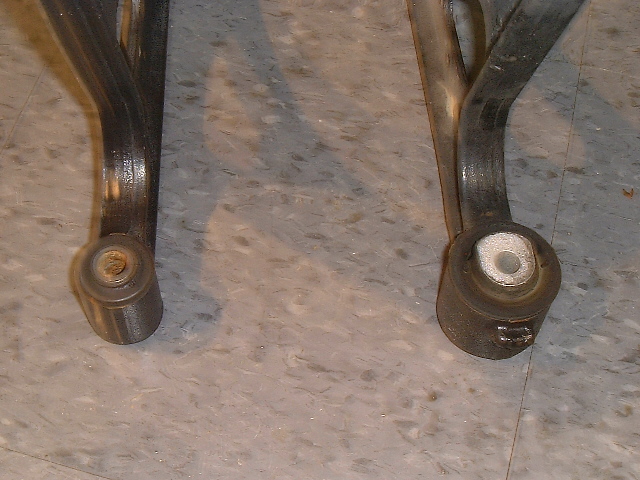
Hi Bill..It was a combination of several things (including lift). In addition to adding the Spoiler, they changed the sway bar rates, front shocks, and front lower control arms as shown above. Most early cars were recalled and had this kit installed in late 2000, early 2001 along with the option to add Electronic Stability control.. It is rare to find an unmolested early example now and they are fairly desirable among the TT enthusiasts.. I actually sell a bushing adapter that allows the late arms to be able to accept the early style bushing. Gets back some of the feel they dialed out...
Safety Car
Joined: Feb 2007
Posts: 4,939
Likes: 448
From: CHOCOWINITY NC
leaving deflection aside. why would the toe change as the suspension loads and unloads? the only movement of the a-arms is up and down right? that's if the points of contact of the wheel hub assembly to the a-arms are perpendicular to the ground. to change the toe the a-arms would have move laterally or the tie-rods would have to compress or expand. right?
Mike
Mike
On the front, what you describe is called bump steer. Geometry is designed so Toe change from the arms is kept to a minimum when articulating and is largely controlled by the bushing deflection as discussed. Bump steer is when Tie rods are not perfectly level from Rack to wheel and as the wheel moves up and down an arc is scribed from the end of the steering rack to the wheel..The subtle movement in and out of the wheel at the tie rod end, and consequent toe change is called bump steer. This is why lowering a car may result in some handling changes you did not anticipate....The closer that arc is scribed up and down from the parallel plane of the tie rods and the longer the rod, the less potential "steering" input from suspension articulation..
Last edited by Modshack; Oct 29, 2008 at 11:40 AM.
Racer
Joined: Apr 2008
Posts: 373
Likes: 2
From: White Plains NY

I thought the reason for unequal length a-arms was to allow the increase or decrease in camber as the suspension moves. I'm going to have to read up more on the subject before I jam my foot deeper into my mouth.
Safety Car
Joined: Feb 2007
Posts: 4,939
Likes: 448
From: CHOCOWINITY NC
Ha ha! No problem. Unequal A arms are just one of a dozen ways to do that. As long as you're in the learning mode, here's another excellent read which discusses and illustrates the stuff we've been talking about...

http://www.mgf.ultimatemg.com/group2...n/tracking.htm

Last edited by Modshack; Oct 29, 2008 at 11:39 AM.
Racer
Joined: Apr 2008
Posts: 373
Likes: 2
From: White Plains NY
Steve has always been a good source for me in the past when I did my suspension over. btw I went w/ the pfadt shocks instead of the bilsteins. I can't wait to pick his brain when I'm ready to do the engine over. thanks again Steve!
Last edited by mikeci; Oct 29, 2008 at 03:26 PM.
Pro
Joined: Aug 2004
Posts: 534
Likes: 0
From: Ann Arbor MI
The location and angle of the tie rod also affects toe change . . . the difference between how the tie rod pivots and how the control arm pivots will cause the wheel to be pushed or pulled slightly in or out.
While it may not be obvious at first, these changes in toe or camber can be a good thing if the engineers design and tune them properly . . . they can help increase stability or make the car respond slower or faster, or change the oversteer/understeer balance.
Suspension geometry is a very complex thing. There are MANY attributes to consider, and they are all dependant on eachother. Roll center height and migration, anti dive, anti squat, camber and toe curves, how the alignment changes with cornering and braking loads . . . it's NOT as simple as most enthusaists think. These design attributes lay the foundation upon which the engineers tune the springs, shocks, steering, and tires. If the geometry isn't right, the rest of the car won't be very good either.
While it may not be obvious at first, these changes in toe or camber can be a good thing if the engineers design and tune them properly . . . they can help increase stability or make the car respond slower or faster, or change the oversteer/understeer balance.
Suspension geometry is a very complex thing. There are MANY attributes to consider, and they are all dependant on eachother. Roll center height and migration, anti dive, anti squat, camber and toe curves, how the alignment changes with cornering and braking loads . . . it's NOT as simple as most enthusaists think. These design attributes lay the foundation upon which the engineers tune the springs, shocks, steering, and tires. If the geometry isn't right, the rest of the car won't be very good either.