






NPP Question

Thread Starter
Racer


Joined: Feb 2009
Posts: 282
Likes: 1
 NPP Question
I have one question and I'm hoping someone here can help me out. I just bought a used 2008 with NPP. Is there ever a time when you can see the butterfly valve in each of the inside tail pipes in a closed position? I'm trying to figure out if the prior owner disabled the open/close feature. The corresponding fuse has not been removed, but both valves remain in the un-blocking position when the motor is idling & when it is shut off. I'm not certain if that indicates it has been modified or if that's the way it operates normally. Thanks for your help!


Former Vendor
Joined: Sep 2008
Posts: 2,695
Likes: 0
From: Brightwaters NY
St. Jude Donor '09
Should be closed on starup and stay closed at idle
is this fuse in place? If not just install a 10A fuse or our wireless controller Mild2Wild and get it back in operation
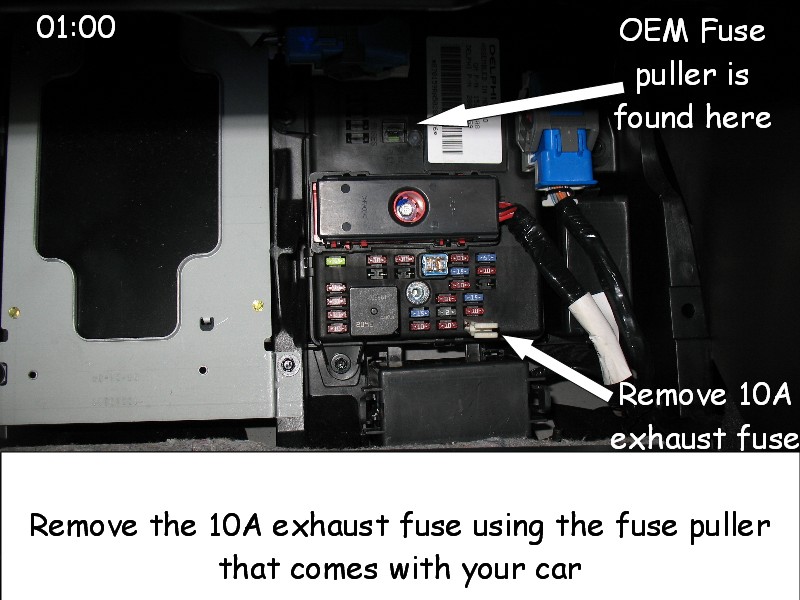
is this fuse in place? If not just install a 10A fuse or our wireless controller Mild2Wild and get it back in operation

Team Owner


Joined: Aug 2002
Posts: 35,617
Likes: 167
Tech Contributor
Cruise-In 11 Veteran
NCM Ambassador
St. Jude Donor '05-'06-'07-'10
Something sounds wrong and it does sound like the previous owner may have done something to limit or disable the operation. Are there any additional wires added to the fuse box? It sounds as if the owner could have added a switch to keep them open. Also, if they had pulled the fuse the butterfly actuator may be stuck open. With the car off and the exhaust cool, can you manually move the armature on the valve to see the butterfly valves move inside the tailpipe?
The valves will be open for the first two seconds that the car is started. It requires time for the vacuum pressure to build to close the valves. After that The operation of the NPP is normally closed, open on demand. Have someone stand behind the car and bring up the RPM to 3,500 and you should see the valves open. The butterfly operation is tied to the throttle position sensor and the RPM. It uses the throttle position to determine driver intent. Under normal operation the valves work as follows.
Below 30% throttle and 3,500 rpm the valves are closed.
Above 30% throttle and 3,500 rpm the valves will open.
Between 30% throttle and 80% throttle and above 3,500 rpm the valves are open.
Above 80% throttle and above 2,800 rpm the valves are open.
The valves will be open for the first two seconds that the car is started. It requires time for the vacuum pressure to build to close the valves. After that The operation of the NPP is normally closed, open on demand. Have someone stand behind the car and bring up the RPM to 3,500 and you should see the valves open. The butterfly operation is tied to the throttle position sensor and the RPM. It uses the throttle position to determine driver intent. Under normal operation the valves work as follows.
Below 30% throttle and 3,500 rpm the valves are closed.
Above 30% throttle and 3,500 rpm the valves will open.
Between 30% throttle and 80% throttle and above 3,500 rpm the valves are open.
Above 80% throttle and above 2,800 rpm the valves are open.
Last edited by talon90; Feb 25, 2009 at 03:36 PM. Reason: corrected second paragraph logic error.
Thread Starter
Racer
Joined: Feb 2009
Posts: 282
Likes: 1
The fuse is in place and I didn't see any additional wiring around the fuse panel. Maybe the fuse actually blew? I talked to two people in the local dealer's service department and neither seemed too knowledgeable about how the NPP option actually works. The car is currently in that same garage for a water pump leak. (Rats!) I'm thinking that if it isn't something that was done with the electronics, may be a vacuum connection was removed, or as suggested above, the valves are stuck. The car was repo'd by GMAC from its San Diego owner in December and I bought it last week.
Talon90: I think that what you meant to say in your 2nd paragraph, 3rd sentence, is that I should have someone stand behind the car and bring the engine up to 3500 RPM and at that point they should see the valves open - rather than close. Right? So far I haven't seen the valves closed, even when idling. My impression is that the car is louder than it normally would be.
Thanks for the responses! You've confirmed my suspicion and I'll follow up with the shop today.
Talon90: I think that what you meant to say in your 2nd paragraph, 3rd sentence, is that I should have someone stand behind the car and bring the engine up to 3500 RPM and at that point they should see the valves open - rather than close. Right? So far I haven't seen the valves closed, even when idling. My impression is that the car is louder than it normally would be.
Thanks for the responses! You've confirmed my suspicion and I'll follow up with the shop today.

Team Owner


Joined: Jun 2005
Posts: 46,295
Likes: 2,596
From: Northern, VA
St. Jude Donor '15
"In honor of jpee"
I think all the advice you need is above. But, could it be the system needs to be reset? Since it's in the shop, have them just disconnect and then reconnect the battery cables. Altho it's vacuum/mechanical, there has to be something telling it to open with that fuse in there. just a thought; I'm probably wrong but it's worth a shot.
Leaking water pump? hmmm...
Leaking water pump? hmmm...
Thread Starter
Racer
Joined: Feb 2009
Posts: 282
Likes: 1
Yeah, my sentiments exactly. The car was delivered on a transport on Saturday and I noticed a small pink puddle on my garage floor on Monday. I hope this is just a fluke and not the tip of an iceberg.
Regarding a smart fuse mod: I haven't heard of that before but in my quick research found something called a Smart LED Fuse that Fastcar may be referring to. I looked at the exhaust fuse and it isn't a Smart LED Fuse - it's just a plain 10A fuse like the others in the panel. I will have it replaced though, just in case it is blown.
Thanks again! I really do appreciate the suggestions!
Regarding a smart fuse mod: I haven't heard of that before but in my quick research found something called a Smart LED Fuse that Fastcar may be referring to. I looked at the exhaust fuse and it isn't a Smart LED Fuse - it's just a plain 10A fuse like the others in the panel. I will have it replaced though, just in case it is blown.
Thanks again! I really do appreciate the suggestions!
Corvette Stories
The Best of Corvette for Corvette Enthusiasts

Corvette & Porsche 911: How Two Icons Conquered the Last 25 Years
Joe Kucinski
2027 Chevrolet Silverado 1500 First Look: Everything You NEED to Know!
Michael S. Palmer
5 Best & 5 Worst Corvette Daily Drivers
Joe Kucinski
The Headlights of Every Corvette Generation Explained
Joe Kucinski
5 Best & 5 Most Overrated Corvette Track Packages of All Time!
Joe Kucinski
Every 2027 Corvette Engine Explained
Joe Kucinski
Designer Imagines A Corvette That Looks More Like a Corvette Than the Corvette
Verdad Gallardo
10 Ugly Corvettes That We Still Kinda Love
Joe Kucinski
Top 10 Most Expensive Corvettes Ever Sold on Bring A Trailer
Brett Foote
Racer
Joined: Apr 2008
Posts: 347
Likes: 0
From: Chantilly VA
Open at start up and closes. The NPP closes until 3500 rpm then it opens to give more breathing thus getting the cool sound, horsepower etc. Get the Wild to mild switch from Pipedreams and you can manipulate as you like, keeping opened or closed whichever you like. Awesome mod and was my first! Works like a dream. Also get the 1-4 shift eliminator or use the smart fuse for this application and you will not have the 1-4 be mandatory. The light will stay on but you can shift 1-2
Thread Starter
Racer
Joined: Feb 2009
Posts: 282
Likes: 1
I got the Exhaust Tail Pipe Flow Control System Description and Operation sheet, Document ID: 1661283
Normal Mode
When the vehicle is stationary with the engine running the exhaust flow control module (EFCM) commands the vacuum solenoid On, which supplies engine vacuum to both exhaust flow control valves. This causes the valves to close, diverting exhaust flow through a baffled path inside the mufflers. As vehicle speed increases, throttle position reaches 25% or greater and engine speed reaches 3500 RPM, the EFCM commands the vacuum solenoid off. This causes the valves to open, diverting exhaust flow through an un-baffled path inside the mufflers, thus enhancing engine performance.
Competition Mode
When traction control is driver disabled, vehicle speed increases, throttle position reaches 25% or greater and engine speed reaches 3000 RPM, the EFCM commands the vacuum solenoid off. This causes the valves to open; [sic] diverting exhaust flow through an un-baffled path inside the mufflers more frequently and at lower engine speeds.
The system also delays exhaust valve activity during wide-open throttle acceleration to inhibit exhaust valve actuation when the accelerator pedal is released and reapplied while shifting gears.
The ERCM has the ability to detect electrical malfunctions within the system. Any electrical malfunction detected will cause the system to be disabled and increase exhaust audibility.
The system uses the engine control module (ECM), body control module (BCM), electronic brake control module (EBCM), EFCM, exhaust flow control valve vacuum solenoid, vacuum reservoir, vacuum lines, 2 exhaust flow control valves and the serial data circuit to perform the system functions.
If I correctly understand what I read here, the butterfly valves are closed at idle and remain closed until certain parameters are reached.
When the vehicle is stationary with the engine running the exhaust flow control module (EFCM) commands the vacuum solenoid On, which supplies engine vacuum to both exhaust flow control valves. This causes the valves to close, diverting exhaust flow through a baffled path inside the mufflers. As vehicle speed increases, throttle position reaches 25% or greater and engine speed reaches 3500 RPM, the EFCM commands the vacuum solenoid off. This causes the valves to open, diverting exhaust flow through an un-baffled path inside the mufflers, thus enhancing engine performance.
Competition Mode
When traction control is driver disabled, vehicle speed increases, throttle position reaches 25% or greater and engine speed reaches 3000 RPM, the EFCM commands the vacuum solenoid off. This causes the valves to open; [sic] diverting exhaust flow through an un-baffled path inside the mufflers more frequently and at lower engine speeds.
The system also delays exhaust valve activity during wide-open throttle acceleration to inhibit exhaust valve actuation when the accelerator pedal is released and reapplied while shifting gears.
The ERCM has the ability to detect electrical malfunctions within the system. Any electrical malfunction detected will cause the system to be disabled and increase exhaust audibility.
The system uses the engine control module (ECM), body control module (BCM), electronic brake control module (EBCM), EFCM, exhaust flow control valve vacuum solenoid, vacuum reservoir, vacuum lines, 2 exhaust flow control valves and the serial data circuit to perform the system functions.



Thread Starter
Racer
Joined: Feb 2009
Posts: 282
Likes: 1
For anybody who is interested, the problem was diagnosed as a restriciton in the tail pipe exhaust valve vacuum line. It is repaired now and the car is much quieter... except when I want to make some noise.
Thanks for all your help!
Thanks for all your help!