











Still checking

Le Mans Master

Joined: Dec 2012
Posts: 7,750
Likes: 172
2015 C6 of the Year Finalist

Race Director


Joined: Jan 2011
Posts: 11,973
Likes: 463
From: Tonawanda New York

Found this.....
RRIM and SMC both can be considered fiberglass, just not in the conventional sense.
RRIM
Quote:
Reinforced Reaction Injection Molding (RRIM) describes a method often seen in automotive applications. This method differs from conventional injection molding in that polymerization, via a chemical reaction, occurs in the mold as opposed to melting and cooling to form a solid polymer. RRIM is further characterized by inclusion of reinforcement additives to provide improved physical properties
one of the primary "reinforcement" methods is milled glass fibers.
SMC
Quote:
Sheet Molding Compound (SMC)
Description: A fiberglass reinforced thermosetting compound manufactured by dispersing long stands (>1”) of chopped glass fibers on a bath of polyester resin. The longer glass fibers in SMC result in better strength properties than standard BMC products. Typical applications include demanding electrical applications, corrosion resistant needs, structural components at low cost, automotive, and transit.
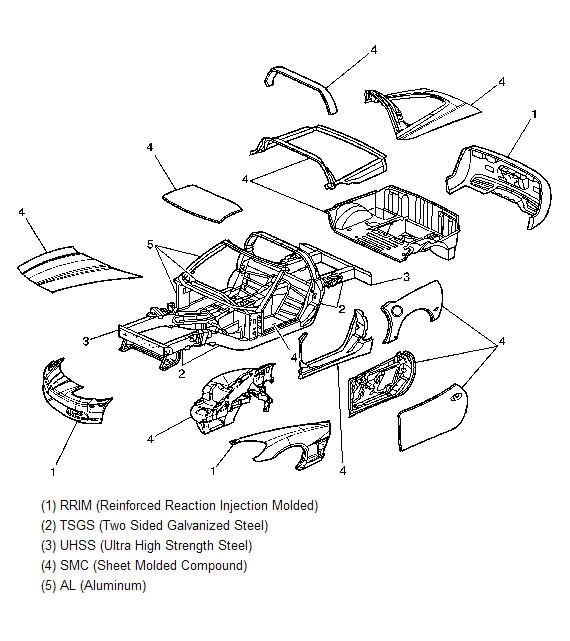
For the Z06 take #2 above and replace two sided galvanized steel with aluminum and for the front fenders (part of #1) replace RRIM with carbon fiber.
For the ZR1 take #2 above and again replace the steel with aluminum, replace the front fenders (part of #1), hood, roof panel and B pillar halo (all part of #4) with carbon fiber.
RRIM and SMC both can be considered fiberglass, just not in the conventional sense.
RRIM
Quote:
Reinforced Reaction Injection Molding (RRIM) describes a method often seen in automotive applications. This method differs from conventional injection molding in that polymerization, via a chemical reaction, occurs in the mold as opposed to melting and cooling to form a solid polymer. RRIM is further characterized by inclusion of reinforcement additives to provide improved physical properties
one of the primary "reinforcement" methods is milled glass fibers.
SMC
Quote:
Sheet Molding Compound (SMC)
Description: A fiberglass reinforced thermosetting compound manufactured by dispersing long stands (>1”) of chopped glass fibers on a bath of polyester resin. The longer glass fibers in SMC result in better strength properties than standard BMC products. Typical applications include demanding electrical applications, corrosion resistant needs, structural components at low cost, automotive, and transit.
For the Z06 take #2 above and replace two sided galvanized steel with aluminum and for the front fenders (part of #1) replace RRIM with carbon fiber.
For the ZR1 take #2 above and again replace the steel with aluminum, replace the front fenders (part of #1), hood, roof panel and B pillar halo (all part of #4) with carbon fiber.

Safety Car


Joined: Sep 2011
Posts: 3,913
Likes: 395
From: Cary NC
The C5 and C6 use essentially the same SMC material. Roughly 40% resins, 33% calcium carbonate, 20% chopped fiberglass, and 7% hardeners, special resins for finish, etc.
This allowed the C5 body panels to be thinner, lighter, and less brittle than the pre-1997 Corvettes. The composition didn't change significantly in the C6. It appears the C7 is using the same SMC panels.
Corvette Stories
The Best of Corvette for Corvette Enthusiasts

Top 10 Most Explosive Corvettes Ever Made: Power-to-Weight Ratio Ranked!
Joe Kucinski
150 hp to 1,250 hp: Every Corvette Generation Compared by the Specs That Matter
Joe Kucinski
8 Coolest Corvette Pace Cars (and Replicas) of All Time
Verdad Gallardo
Top 10 Corvette Engines RANKED by Peak Torque (70+ Years of Muscle!)
Joe Kucinski
Corvette ZR1X Will Be Pacing the Indy 500, And Could Probably Race, Too!
Verdad Gallardo
Top 10 Corvettes Coming to Mecum Indy 2026!
Brett Foote
Top 10 C9 Corvette MUST-HAVES to Fix These C8 Generation Flaws!
Michael S. Palmer
10 Revolutionary 'Corvette Firsts' Most People Don't Know
Joe Kucinski