When you click on links to various merchants on this site and make a purchase, this can result in this site earning a commission. Affiliate programs and affiliations include, but are not limited to, the eBay Partner Network.
I have a 2005 with a 6 litre engine. When I'm driving the temperature guage hovers between 210 degrees and 215 degrees which is about the midpoint on the guage. I keep thinking it's going to boil over. The owners manual says that the overheating warning wont come on till 255 degrees. Is it normal to run this hot or should I install a 180 degree thermostat?
That sounds like an okay temp to me. I think the stat is a 195. You could try a 180 stat but you shouldn't need too worry about it. I don't think I'd worry until you started seeing 230 and up temps.
I have a 2005 m6 and my temp stays at 192 with the A/C on, on a 90 degree day at 85 mph. When I get off the highway or traffic builds up and I am in stop and go the temps will climb to 215 or a bit more.
Fans come on and it will slowly cool down. Personally I would check for obstructions like debris or leaves blocking the radiator. While those temps won't hurt anything I believe it should run cooler if all is
well with the cooling system. Has the coolant been changed, is the correct coolant in the system? I am in no way an expert on this, I'm just letting you know how my car runs.
Let's look at it this way:
Here is the stock fan table
The fan starts ramping up at 199F. At highway speeds of say 60 mph, there should be sufficient airflow such that you don't need the fan. If you're seeing 210F at highway speeds, I'd say you're running about 12 degrees or more hotter than you should. Also, that means the fan is running 39% when it should be off. These cars like to clog the lower part of the AC condensor and the rad with bugs, dirt, grass, you name it. Periodically, they should be carefully cleaned rom the back with compressed air or a low pressure water stream, taking care not to bend the fins. Low coolant levels or an air bubble in the coolant system can also raise temps. Rags or plastic bags can also get sucked in between the condensor and rad, so you could check for that also.
Living in the Valley of the Sun, summer time air temps can range from 105 to 115........(but it's a dry heat!).......and my 7.0 liter runs about 220-225.....again, not unusual for the extreme heat in Phoenix in the summer. At times in heavy traffic during the middle of the day engine temp can be 230. Also, I must add that I have an A & A S/C with an air to air intercooler. I am told that this is not harmful.......if the engine temp begins to move above 230, I'll shut off the A/C for a few minutes and the temp will drop back down to 220ish.......I have no idea what this would be like in an area with high humidity (IE: Houston, Dallas, Atlanta, Miami, S.C, N.C. etc etc.) Our humidity today was 9% with 102 degrees air temp.......car stayed at 220 with the A/C running in city traffic.
As someone mentioned the OP did not state the driving condition for those temps. I have an '06 and my temps only get in that range if in town driving during the summer. If that was my car and it was running in that range on the highway it would cause me concern and I would start looking for the issue.
i have an '09 with brand new LS3 crate engine ( 2500 miles ). with current temps around 80-85°f, on the freeway ( 70 - 75mph ) it runs about 196° - 198°f, around town it'll be around 203°f.
when the summer heat is here ( 95° - 110° ) with the A/C on sitting at a stoplight, it'll see around 220°-225°f. my record though, is 260°f. this was on the first motor ( some shoddy repair work, as in installing the head gaskets wrong ),
caused a bit of an overheating issue.
I have a 2005 with a 6 litre engine. When I'm driving the temperature guage hovers between 210 degrees and 215 degrees which is about the midpoint on the guage. I keep thinking it's going to boil over. The owners manual says that the overheating warning wont come on till 255 degrees. Is it normal to run this hot or should I install a 180 degree thermostat?
The 180 stat won't help if you are stuck in traffic, or something else is causing you to run hot, like a rad obstruction, or air bubble. Once the stat is fully open, it becomes a balancing act between engine load, airflow, ambient temps, and water pump speed. The only time the 180 stat will lower your temps compared to the OEM stat is at highway speeds, in which case you might see temps in the 190 - 192 range. All that putting a lower temp stat in does for you is to delay the inevitable once your are stuck in traffic, and not by much. Temps are still going to climb until the fan ramps up enough to provide sufficient airflow to balance the required amount of heat exchange. I"ve got a Dewitts rad that gives me 50% more cooling capacity, but if I get stuck in traffic on a stinking hot day, temps will still rise to the 221 - 223F range. I've seen it numerous times. What the extra cooling capacity does for me is to lessen the fan duty cycle because the fan doesn't have to run at 90% as long as it would otherwise, because the rad is exchanging that much more heat for the same airflow. That's a good thing, considering the number of times you read about the fan connector melting.
The 180 stat won't help if you are stuck in traffic, or something else is causing you to run hot, like a rad obstruction, or air bubble. Once the stat is fully open, it becomes a balancing act between engine load, airflow, ambient temps, and water pump speed. The only time the 180 stat will lower your temps compared to the OEM stat is at highway speeds, in which case you might see temps in the 190 - 192 range. All that putting a lower temp stat in does for you is to delay the inevitable once your are stuck in traffic, and not by much. Temps are still going to climb until the fan ramps up enough to provide sufficient airflow to balance the required amount of heat exchange. I"ve got a Dewitts rad that gives me 50% more cooling capacity, but if I get stuck in traffic on a stinking hot day, temps will still rise to the 221 - 223F range. I've seen it numerous times. What the extra cooling capacity does for me is to lessen the fan duty cycle because the fan doesn't have to run at 90% as long as it would otherwise, because the rad is exchanging that much more heat for the same airflow. That's a good thing, considering the number of times you read about the fan connector melting.
include me on the list for a fan failure, or as you mentioned, melted connector. this happened just after my first engine replacement. ran fine for a week, then lost the fan connection.
it's been about 40k miles so far, fan still going.
when doing the first engine replacement, the mechanic also replaced the stock radiator with Z06 version. not such how larger ( or even if it is larger ) but, with the previously mentioned head gasket issue, i didn't have that version
of engine & radiator long enough to notice a difference.
I have a 2005 with a 6 litre engine. When I'm driving the temperature guage hovers between 210 degrees and 215 degrees which is about the midpoint on the guage. I keep thinking it's going to boil over. The owners manual says that the overheating warning wont come on till 255 degrees. Is it normal to run this hot or should I install a 180 degree thermostat?
Others have covered typical temps and potential problems, but nobody has directly mentioned the apparent concern of the OP about boiling over. True, the boiling point of water at atmospheric pressure is 212, and many of the temps mentioned, as well as the temperature warning light set point, are well above 212. But your radiator cap is a 15 psi cap, so when hot, the radiator is under pressure. At 15 psi, the boiling point of water is 257, and the boiling point of the car’s 50/50 mix of water and antifreeze is 268.
As a sidelight, that’s why you should never loosen the radiator cap until the coolant is safely below 212. If the coolant temperature is above 212 and you release the 15 psi pressure of the radiator cap, the coolant will start boiling, and there’s some chance you’ll get scalded as it boils over. As long as the cap stays in place and the coolant temp remains below the 268 boiling point of 50/50 water/antifreeze at 15 psi, the coolant will remain totally liquid with no boiling.
I'm in Los Angeles so we don't have winters and temps average 60-90 all year round, today was a high of 92. My Corvette would get to those 210+ water temps which is around where the computer pulls timing. I replaced with new coolant and water wetter, 170 thermostat, and changed the fans to come on sooner, now my water temps stays around 180 - 190.
My car (06, stock LS2, 6MT) is behaving similar to some others in this thread.
I recently replaced the water pump after it started leaking with a new Gates part. I replaced the pump gaskets to the engine, the thermostat (187 deg F) and housing, and the upper and lower radiator hoses at the same time. I filled the system with just water (pouring into the tank) to flush and make sure nothing was leaking. When I drove the car, I noticed that the temperature rose above 187 on the highway (6th, 1500 RPM), to the 205-210 range. At higher engine speeds (>2000), the temperature dropped to the 195-200 range. From reading posts, it sounded like air was trapped in the system somewhere. Before the work on the car, the temp stayed around 190 unless sitting in traffic, going up to as high as 220 in traffic, then back down to 190 when I started moving. It took about 9 quarts of water.
I drained and refilled the system with water again, to flush out the old coolant some more, being careful to not let the tank level get too low after starting the engine and letting it warm up, thinking maybe I let it suck air in the first time. As far as I can tell, both times I was following the Static Fill method in my shop manual. Same result. I drove it for about a week with the second filling of water. This fill was also about 9 quarts.
When I saw it still not acting right, I order a vacuum filling kit. When it arrived, I drained the system (it was almost clear, just a hint of orange), and filled it with the vacuum kit (50% Napa Orange Dex-compatible concentrate, 50% distilled water). It took two vacuum fill cycles (1st time to 0 on the gauge, 2nd time to almost 0). At that point, the tank was almost full, about where it had been before the work on the car. The tool was able to get to the 19-24 in H2O level in the instructions. The cooling hoses did partially collapse as I had heard from others' experience during the operation. It also took roughly 9 quarts.
When it was done, I put the cap on tight, started the engine, and let it come up to temperature. The level did not go down. I then took the car for a fairly long drive, and it's still doing the same thing! The only thing I can think of causing air to trap this time was the hose into the coolant bucket did initially have air in it before the valve was opened to suck the coolant into the tank.
Not really sure what to do at this point. As some have pointed out, the engine temps are in a safe range, but not where they should be under normal conditions. Could I have a bad thermostat that just stays partially closed all the time? Maybe that would cause the cooling to be only a function of engine load and water pump speed?
Based on my own experience I’d say you’ve still got an air bubble. The only way I’ve been able to get that last bit of air out of the system was first to get things up to temp by a half hour run on the highway, and then get engine rpm’s up to 4K or so briefly. This dropped the level in the reservoir after it cooled down and I filled it to the line. Once it took two attempts doing this. It’s a PITA bleeding these systems.
I have a 2005 with a 6 litre engine. When I'm driving the temperature guage hovers between 210 degrees and 215 degrees which is about the midpoint on the guage. I keep thinking it's going to boil over. The owners manual says that the overheating warning wont come on till 255 degrees. Is it normal to run this hot or should I install a 180 degree thermostat?
I have an 05 and in stop and go traffic with 90/100 temps it runs between 210 and 225. I recall seeing 230/235 a few times but never caused an issue.
I agree with FatsWaller that you still have air in the system.
I did a coolant flush on mine and realized the temp was not right. I left the cap off the tank and held 2000 rpm for a minute or so like 3 times trying to get it to burp with no success.
What I ended up doing was pulling the return line on the tank reservoir and hooking up a vacuum pump. It did pull air from the radiator and coolant from the tank. This fixed my problem and like 5 minutes.
I had a 160 thermostat in my car. I had the water pump replaced and I didn't know it came with a stock GM thermostat. My car runs consistently 17-19 degrees hotter than before.... that's coolant and oil temps.
Last edited by sallen619; Jul 4, 2022 at 01:00 AM.
The only time the 180 stat will lower your temps compared to the OEM stat is at highway speeds, in which case you might see temps in the 190 - 192 range. All that putting a lower temp stat in does for you is to delay the inevitable once your are stuck in traffic, and not by much. Temps are still going to climb until the fan ramps up enough to provide sufficient airflow to balance the required amount of heat exchange.
wanted to chime in, because when I was getting my cam swap done in late May, I was trying to decide if I should do the 160 thermostat; and I read a lot of posts saying exactly what was stated above - that it only makes a difference on the highway. I can say for certain, this is definitely not the case on my car. I consistently see my temps 10-15deg cooler than before, in all situations, not just highway. Granted I don't sit in much stop and go traffic where I live, I'm usually cruising 35-50, and I hover in the 185-195 range, despite having significantly more horsepower now than when I had the stock 186 thermostat (470whp/440wtq). With the stock thermostat I typically hovered around 195-205. On a cooler summer day I've seen it sit at 180deg while cruising around 45mph - that was definitely never possible before.
Just wanted to leave this here for anyone researching a 160 thermostat in the future. YMMV, but on my car and my situations, it definitely makes a consistent difference.
I need some enlightenment. Why do you want your car to run cooler than the temperature it was designed to run at?
If your car is running hotter than the design specs there is an issue with the cooling system. My 2005, with no mods
runs at the design temperatures all the time and I regularly drive the car in 90 degree heat with the A/C on at 80 mph.
So why do you need to run at 185 to 195 which is not much lower than the temps I run at with OEM thermostat?
I am not being snarkey, just curious.
Designer Imagines A Corvette That Looks More Like a Corvette Than the Corvette
Slideshow: A Jaguar designer's personal project imagines what a modern front-engined Corvette might look like if Chevrolet revisited the golden age of the Stingray.




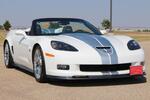


 Engine operating temperature