



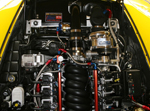


 show us pics man




Boost ad headunits
Pro


Joined: Feb 2002
Posts: 593
Likes: 0
From: Pleasanton CA

To simplify all of the above: A bigger head unit will push a larger volumn of air. Kinda like 500 cfpm @ 10 psi, or 1000 cfpm @ 10 psi. The larger volumn at the same pressure will make more horsepower. Of course, the tune, injector size, etc., must also consider the increase in volumn.
A given engine will consume the same volume of air if you pressurize the intake to 10 psi with the smallest Vortech or the largest Procharger. Obviously, the larger head unit will be able to deliver more boost to a given engine than the smaller head unit if you let it. And the larger blower can pressurize a much larger engine to 10 psi than a small blower.
Another thing to remember is that boost comes from restriction of flow. The blower is trying to move more air than the engine can consume. Suppose you bolt a blower kit on the mildest truck motor out there, one designed for maximum torque at trailer towing engine speeds. Suppose you pulley the blower to deliver a max boost of 10 psi. Now you improve the engine's ability to breathe by swapping on big valve ported heads, installing a bigger cam, and free flowing intake and exhaust systems. When you bolt your blower on with the same pulleys as before, you are almost certainly going to see less boost than you had before. Your engine is less of a restriction than it was before, and can consume more of the blower's output without an increase in intake manifold pressure.
This is how one engine can make 450 hp at 10 psi while another engine of the same displacement can make 650 hp at 6 psi. It's all in the breathing!

Melting Slicks


Joined: Nov 2005
Posts: 2,166
Likes: 26
From: Odenton MD
I hear ya, I have done years of research on FI and I still am learning of new techniques of engine building, cam designs and so on.
There are so many things that can influence this, such as the cam duration and lift. The higher and longer the valve stays open the more it will allow air to flow in, just like the added headers will allow gases to flow out easiler and droping the psi because there is less "left over air if you will" left in the combution chamber. There is know way to easily explain it, but just know that a bigger blower with less boost, more belt wrap because you are using a larger pulley which will eliminate belt slip, and high compression is the way to go IMHO. (Don't forget the meth)
There are so many things that can influence this, such as the cam duration and lift. The higher and longer the valve stays open the more it will allow air to flow in, just like the added headers will allow gases to flow out easiler and droping the psi because there is less "left over air if you will" left in the combution chamber. There is know way to easily explain it, but just know that a bigger blower with less boost, more belt wrap because you are using a larger pulley which will eliminate belt slip, and high compression is the way to go IMHO. (Don't forget the meth)
Exactly what I've been doing.

Melting Slicks
Joined: Nov 2005
Posts: 2,166
Likes: 26
From: Odenton MD
All centifugal compressors heat the air as they compress it. Less efficient compressors have a higher discharge temp than more efficient compressors. And the efficiency of any given compressor is not a constant across its map of pressure ratio versus flow rate. You want to pick a head unit that will operate efficiently given your planned boost and your engine's air flow capability.
Sure wish I had a Procharger compressor map. Hard to pick a head unit without one. With the low boost pressure ratio I am operating on, I am certain I am not operating my D1SC in the most efficient islands. I see IATs in the 130s to 150s, but it still makes 680 rwhp, however (5.7 psi).
Guest
Posts: n/a
A bigger head unit has the capability to push a larger volume of air at the same pressure. But please remember that the engine you're bolting the head unit to is itself an air pump! It can only move a fixed amount of air per revolution unless you pressurize the intake! It does not matter what head unit pressurizes the intake if you pulley it to a max of 10 psi.
A given engine will consume the same volume of air if you pressurize the intake to 10 psi with the smallest Vortech or the largest Procharger. Obviously, the larger head unit will be able to deliver more boost to a given engine than the smaller head unit if you let it. And the larger blower can pressurize a much larger engine to 10 psi than a small blower.
Another thing to remember is that boost comes from restriction of flow. The blower is trying to move more air than the engine can consume. Suppose you bolt a blower kit on the mildest truck motor out there, one designed for maximum torque at trailer towing engine speeds. Suppose you pulley the blower to deliver a max boost of 10 psi. Now you improve the engine's ability to breathe by swapping on big valve ported heads, installing a bigger cam, and free flowing intake and exhaust systems. When you bolt your blower on with the same pulleys as before, you are almost certainly going to see less boost than you had before. Your engine is less of a restriction than it was before, and can consume more of the blower's output without an increase in intake manifold pressure.
This is how one engine can make 450 hp at 10 psi while another engine of the same displacement can make 650 hp at 6 psi. It's all in the breathing!
A given engine will consume the same volume of air if you pressurize the intake to 10 psi with the smallest Vortech or the largest Procharger. Obviously, the larger head unit will be able to deliver more boost to a given engine than the smaller head unit if you let it. And the larger blower can pressurize a much larger engine to 10 psi than a small blower.
Another thing to remember is that boost comes from restriction of flow. The blower is trying to move more air than the engine can consume. Suppose you bolt a blower kit on the mildest truck motor out there, one designed for maximum torque at trailer towing engine speeds. Suppose you pulley the blower to deliver a max boost of 10 psi. Now you improve the engine's ability to breathe by swapping on big valve ported heads, installing a bigger cam, and free flowing intake and exhaust systems. When you bolt your blower on with the same pulleys as before, you are almost certainly going to see less boost than you had before. Your engine is less of a restriction than it was before, and can consume more of the blower's output without an increase in intake manifold pressure.
This is how one engine can make 450 hp at 10 psi while another engine of the same displacement can make 650 hp at 6 psi. It's all in the breathing!
Corvette Stories
The Best of Corvette for Corvette Enthusiasts

10 Reasons the C6 Z06 is Still A Performance Benchmark After 20 Years
Joe Kucinski
How Much Horsepower Every Corvette Engine "LOST" in 1972
Joe Kucinski
Top 10 DOs and DON'Ts for Protecting Your Convertible Top!
Michael S. Palmer
Top 10 Most Explosive Corvettes Ever Made: Power-to-Weight Ratio Ranked!
Joe Kucinski
150 hp to 1,250 hp: Every Corvette Generation Compared by the Specs That Matter
Joe Kucinski
8 Coolest Corvette Pace Cars (and Replicas) of All Time
Verdad Gallardo
Top 10 Corvette Engines RANKED by Peak Torque (70+ Years of Muscle!)
Joe Kucinski
Corvette ZR1X Will Be Pacing the Indy 500, And Could Probably Race, Too!
Verdad Gallardo
