



Contemplating on NOS....Need recomendation.

Thread Starter
Burning Brakes


Joined: Aug 2005
Posts: 821
Likes: 0
From: Orlando FL.
 Contemplating on NOS....Need recomendation.
Thinking of doing a 50 shot maybe 75 shot. NO 100 shot.
Now, I have a A4/LS2 with LS3 Heads and Fuel Injectors, car is in perfect condition but just got this itch about trying NOS been very conservative. Plus I really like keeping the look of the engine bay stock so the wet systems I seen are a no-no. Dont want a bunch or relays, lines,switches,etc,etc,etc...
Seems to me that a Dry shot can be easly be installed and hidden pretty well with a single nossle.
I looked at Harris Speed and seem they got real good deals for the system I am looking for but, need your opinion on this since we are talking NOS and I am no expert on this but not dumb either.
What other necesary parts are needed for a dry system if ANY?
is this enough ? --> http://www.harrisspeedworks.com/shop...cat=365&page=1
Is the progressive relay NOS recommended?
any other brands anyone recomends? NOS? ZEX? TNT? Other?
thanx brothers!
Now, I have a A4/LS2 with LS3 Heads and Fuel Injectors, car is in perfect condition but just got this itch about trying NOS been very conservative. Plus I really like keeping the look of the engine bay stock so the wet systems I seen are a no-no. Dont want a bunch or relays, lines,switches,etc,etc,etc...
Seems to me that a Dry shot can be easly be installed and hidden pretty well with a single nossle.
I looked at Harris Speed and seem they got real good deals for the system I am looking for but, need your opinion on this since we are talking NOS and I am no expert on this but not dumb either.
What other necesary parts are needed for a dry system if ANY?
is this enough ? --> http://www.harrisspeedworks.com/shop...cat=365&page=1
Is the progressive relay NOS recommended?
any other brands anyone recomends? NOS? ZEX? TNT? Other?
thanx brothers!
Melting Slicks

Joined: May 2005
Posts: 2,231
Likes: 0
From: Brownsville Tx
HSW's kits have always been high quality and well priced. The only thing missing from that kit is a window switch. Not everyone runs one, but it is a necessity in my book. It will keep the nitrous from activating too low in the rpm band, and will shut it off at an upper rpm limit, keeping you from spraying into redline. You also have to make sure your injectors have the capacity to support the nitrous shot. The dry kits are very safe and let you use almost all the nitrous in the bottle since your A/F isn't dependant on bottle pressure. The only problem is finding a tuner who knows how to tune them. If you have one near you then go for it!
The other brands you mentioned are all good. Wet kits tend to kick harder, but at a 50-75 shot the difference between wet and dry cant be felt much. I was running a TNT kit that worked great. A wet kit can also be made VERY stealthy, but any good wet kit usually costs more than a dry kit. They are also easier to tune, just about anyone can do it right. If money is no object, look into the "money maker" wet kit by Nitrous Outlet. You basically send them your intake manifold and they send it back to you nitrous ready, yet when mounted, it looks no different than stock....AT ALL. VERY VERY sneaky but expensive.
As far as a progressive controller, I dont think its necessary at all for the size of shot you're planning on. Plus progressive controllers wear your solenoids a lot faster.
Either way you go, im telling you, you are gonna love the gas!!
The other brands you mentioned are all good. Wet kits tend to kick harder, but at a 50-75 shot the difference between wet and dry cant be felt much. I was running a TNT kit that worked great. A wet kit can also be made VERY stealthy, but any good wet kit usually costs more than a dry kit. They are also easier to tune, just about anyone can do it right. If money is no object, look into the "money maker" wet kit by Nitrous Outlet. You basically send them your intake manifold and they send it back to you nitrous ready, yet when mounted, it looks no different than stock....AT ALL. VERY VERY sneaky but expensive.
As far as a progressive controller, I dont think its necessary at all for the size of shot you're planning on. Plus progressive controllers wear your solenoids a lot faster.
Either way you go, im telling you, you are gonna love the gas!!
Last edited by jogar80; Mar 4, 2008 at 01:30 AM.

Race Director

Joined: Mar 2007
Posts: 11,331
Likes: 18
From: Missouri City Texas
My first NITROUS (NOS is a brand) kit on my firebird was a HSW kit and it worked great. You wont even feel a 50 shot on the corvette though...atleast run a 75 or 100 shot.
Dry kits are great (I dont buy into the wet kit being a better setup thinking...both will produce LOTS of power)...get yourself the kit, FPSS, window switch, bottle heater and you'll be good to go.
Dry kits are great (I dont buy into the wet kit being a better setup thinking...both will produce LOTS of power)...get yourself the kit, FPSS, window switch, bottle heater and you'll be good to go.
Drifting

Joined: Dec 2002
Posts: 1,613
Likes: 0
Well with N20 you have to deal with all the wires relays etc.
For a 50 shot it is not worth the hassle IMO due a cam
A 75 shot wakes the ls2 up and when you go to a 100 or 125 you will really feel it LOL
My prefrance is wet:
Can you spot the wires or relays? rest of the lines?
Its funny in person people I tell people I have spray open the hood and they look around for a few mins before they spot the plate, most look up front LOL
Wet Nitrous Outlet Plate Kit.
Best ET / MPH so far 125 shot: 11.1 / 125 at 2800 feet
This is by no means the least expensive kit but I like the 6 fuel and 6 N20 ports for there atomization or better distribution of fuel and N20 IMO.
650 Base Nitrous Outlet 90mm Plate kit
129 Window / WOT via tps switch
I also run 100 unleaded every time I spray, I run the tank 20 miles past the low fuel warning and add 5+ gallons of 100 octane unleaded.
IMO one should get a N20 tune and verify AFR at the very least.
I use HP tuners and a Inovative WB to monitor my AFR and Knock Retard.
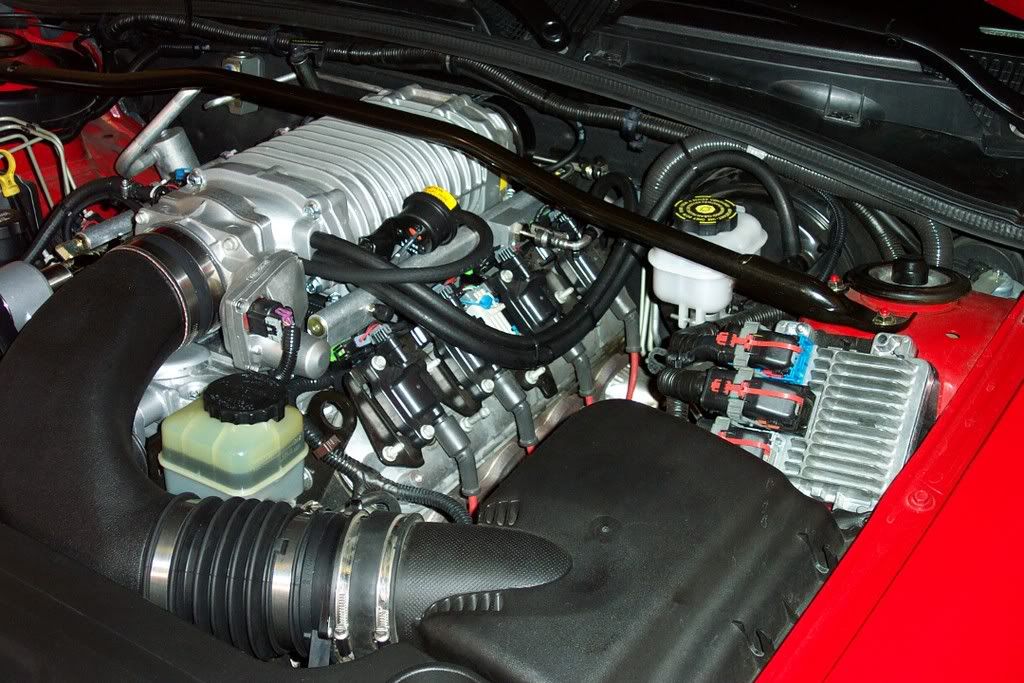
Plate installed just like a TB spacer (Black lines are HSW).
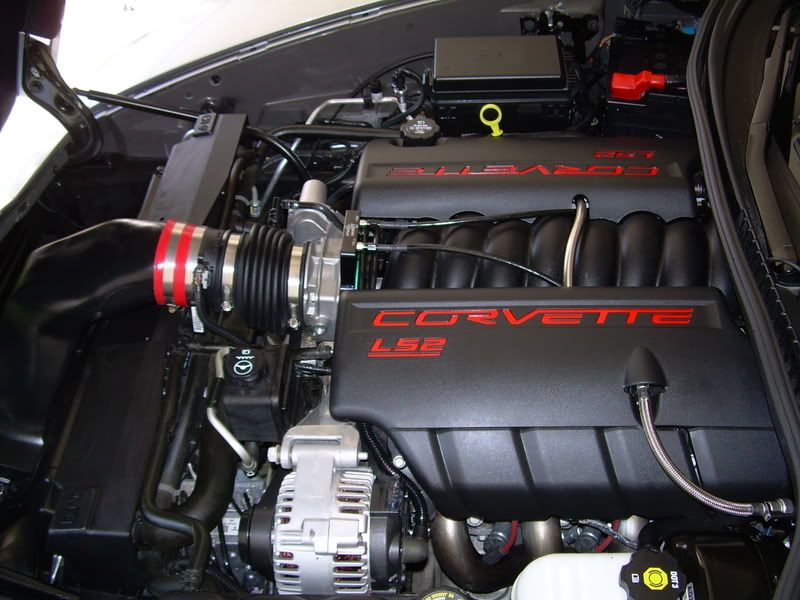
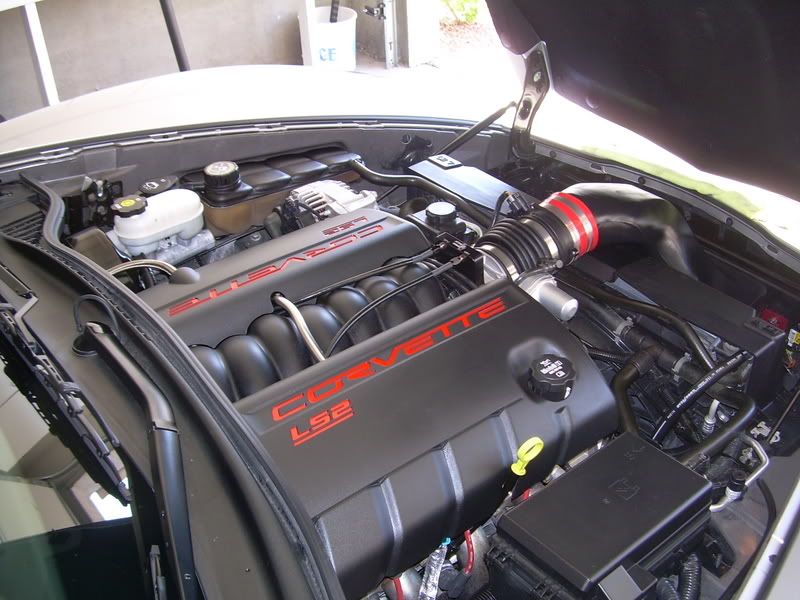

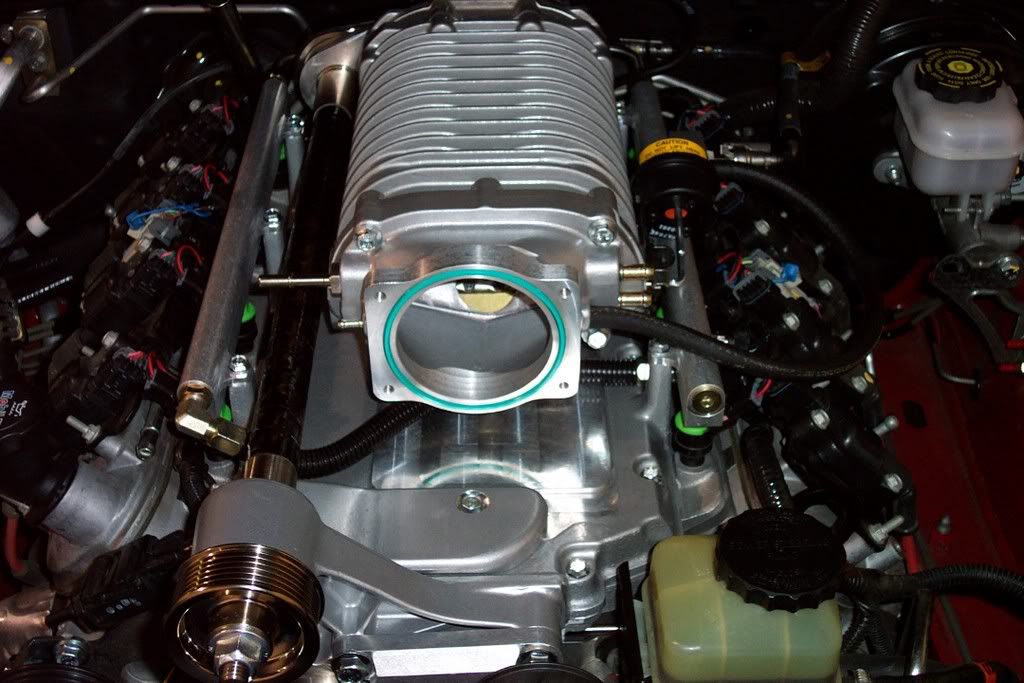
Close up of the plate (they come black but this pic shows the ports well).

Plate kit http://www.nitrousoutlet.com/catalog...del=37&dept=11
Window / WOT Switch http://www.nitrousoutlet.com/catalog...del=86&dept=11
Dave, Chis and Ray from Nitrous Outlet have been great.
http://www.nitrousoutlet.com/index.asp
Lots of good N20 info at LS1-LS2-LS6-LS7 PERFORMANCE Nitrous Oxide section
http://www.ls1tech.com/forums/forumd...aysprune=&f=10
For a 50 shot it is not worth the hassle IMO due a cam
A 75 shot wakes the ls2 up and when you go to a 100 or 125 you will really feel it LOL
My prefrance is wet:
Can you spot the wires or relays? rest of the lines?
Its funny in person people I tell people I have spray open the hood and they look around for a few mins before they spot the plate, most look up front LOL
Wet Nitrous Outlet Plate Kit.
Best ET / MPH so far 125 shot: 11.1 / 125 at 2800 feet
This is by no means the least expensive kit but I like the 6 fuel and 6 N20 ports for there atomization or better distribution of fuel and N20 IMO.
650 Base Nitrous Outlet 90mm Plate kit
129 Window / WOT via tps switch
I also run 100 unleaded every time I spray, I run the tank 20 miles past the low fuel warning and add 5+ gallons of 100 octane unleaded.
IMO one should get a N20 tune and verify AFR at the very least.
I use HP tuners and a Inovative WB to monitor my AFR and Knock Retard.
Plate installed just like a TB spacer (Black lines are HSW).
Close up of the plate (they come black but this pic shows the ports well).
Plate kit http://www.nitrousoutlet.com/catalog...del=37&dept=11
Window / WOT Switch http://www.nitrousoutlet.com/catalog...del=86&dept=11
Dave, Chis and Ray from Nitrous Outlet have been great.
http://www.nitrousoutlet.com/index.asp
Lots of good N20 info at LS1-LS2-LS6-LS7 PERFORMANCE Nitrous Oxide section
http://www.ls1tech.com/forums/forumd...aysprune=&f=10
Last edited by SoldSyclone; Mar 4, 2008 at 11:40 PM.
Instructor

Joined: Feb 2008
Posts: 247
Likes: 0
From: NY
SoldSyclone, wow, that looks great! Even though it's pretty obvious that you're running spray, it has a stock look to it and blends in with the engine. Excellent 
I'm hoping to do a completely stealth dry setup, but I also have no idea how to get the bottle hidden...any suggestions?

I'm hoping to do a completely stealth dry setup, but I also have no idea how to get the bottle hidden...any suggestions?
Drifting
Joined: Dec 2002
Posts: 1,613
Likes: 0
I have a Black bottle (Nitrous Outlet - the sticker)
Black heated bracket(heated 860) and black straps
And dark tint, in the winter I keep a jacket around it to keep the heat in.
It is hard to hide a 10# bottle
1 you can remove the carpet liner and fit it in the back corner IE a stealth box would hide the top 3rd.
2 remove the carpet liner if you lay the bottle on its side all the way in the back modify a bracket over half the bottle will tuck in, new carpet or a ake speaker box or amp rack would hide it.
3 A smaller bottle could hide in one of the compartments, or under the dash on the pas side, just buy or keep a 10 15 20 or 50lb bottle at home to top the small one off.
4 If you wanted to get real tricky you could mount the bottle under the car or behind one of the bumpers then buy the Money Maker hidden system.
This is what I due its simple and way cheaper than driving around and paying $4 a lb.
Simply pop your smaller bottle in the freezer for 15min to an hour (depends on amount in bottles and temp of the larger bottle)
Hook up a short line between bottles open them and the n20 will transfer to the colder bottle dont overfill it.
Black heated bracket(heated 860) and black straps
And dark tint, in the winter I keep a jacket around it to keep the heat in.
It is hard to hide a 10# bottle
1 you can remove the carpet liner and fit it in the back corner IE a stealth box would hide the top 3rd.
2 remove the carpet liner if you lay the bottle on its side all the way in the back modify a bracket over half the bottle will tuck in, new carpet or a ake speaker box or amp rack would hide it.
3 A smaller bottle could hide in one of the compartments, or under the dash on the pas side, just buy or keep a 10 15 20 or 50lb bottle at home to top the small one off.
4 If you wanted to get real tricky you could mount the bottle under the car or behind one of the bumpers then buy the Money Maker hidden system.
This is what I due its simple and way cheaper than driving around and paying $4 a lb.
Simply pop your smaller bottle in the freezer for 15min to an hour (depends on amount in bottles and temp of the larger bottle)
Hook up a short line between bottles open them and the n20 will transfer to the colder bottle dont overfill it.
Corvette Stories
The Best of Corvette for Corvette Enthusiasts

Every 2027 Corvette Engine Explained
Joe Kucinski
Designer Imagines A Corvette That Looks More Like a Corvette Than the Corvette
Verdad Gallardo
10 Ugly Corvettes That We Still Kinda Love
Joe Kucinski
Top 10 Most Expensive Corvettes Ever Sold on Bring A Trailer
Brett Foote
10 Things Every Corvette Owner Needs (2026 Edition)
Michael S. Palmer
8 Most "Only Corvette Owners Understand" Quirks and Problems
Pouria Savadkouei
10 Reasons the C6 Z06 is Still A Performance Benchmark After 20 Years
Joe Kucinski
How Much Horsepower Every Corvette Engine "LOST" in 1972
Joe Kucinski
Top 10 DOs and DON'Ts for Protecting Your Convertible Top!
Michael S. Palmer
Tech Contributor


Joined: Mar 2003
Posts: 12,094
Likes: 197
From: Colorado Springs, CO
St. Jude Donor '08-'09-'10-'11
Wow what different ends of the spectrum we are. My car has the bottle proudly displayed between the seats just in front of where the top stores.
My preference is a dry shot and the reasons will surprise most people. My dry shot set-up is a bit more advanced than most and I will share the trade secrets.
The biggest complaint about the dry shot is tuning it. The biggest complaint about a wet shot are the variables of bottle pressure, fuel solenoid reliability and what happens during a failure. If a fuel solenoid fails which I have seen quite a few times, you get a lean condition. If it leaks you get a backfire. If the nitrous solenoid doesnt fire its a rich stumble you get.
My system didnt install the way other dry systems do. The tuning for a dry shot is to use one dry nozzle pointing toward the MAF to get a concentrated shot of air on the MAF making it think the incomming air is filling the entire volume of the MAF unit and the PCM commands more fuel to be dumped. I dont like the freezing of the MAF element and you also had a hard time adjusting it a little richer or a little leaner. Another variable is if the nozzle's aiming gets changed and it shoots over the MAF element you get a very lean condition. A second nozzle has been used by some to tune but again its all about where the N2O is pointing as it comes out. Timing is adjusted with a timing tricker box and you never know if its working because they intercept the signal from the crank and the scan always shows the commanded timing even if the timing is being pulled.
Harris speed works has an active circiut to adjust fuel and timing curves to suit the fuel and spark retard of any application and it goes inline with the MAF. Its advantage is that it can be adjusted to any amount of fuel or timing. It is an active circuit and it can fail. Its tuning is another matter.
My final methodology for tuning was to make a passive circiut with parts from radio shack and have the dry nozzles pointing away (thats right, I said AWAY) from the MAF on my dry shot. The N2O would mix evenly prior to getting to the MAF and the even flow of air keeps the PE exactly at the commanded PE which is 13:1. To maximize the car's N/A operation, I wanted the circiut to pull timing and dump additional fuel only while my thumb is pushing the trigger button on my T-handle and not when the system is armed. Off the button my car runs the hottest max effort tune I could do to my car. OK, for those keeping score my car is now going to run at 13:1 on a nitrous shot as commanded (no we arent leaving it there). It is even and it is predictable. No nozzles to come loose and change where they shoot and no pointing the nozzles with a try and guess and hope reiteration to get 11.8:1 which is my target.
Nozzle location: sorry the install isnt stealth which I just dont understand. It not a curse to have a bottle. Its a legit power adder with drag race classes.

I intercepted the signal at the MAF and installed a relay to to change resistence to the MAF's IAT sensor. For those not familiar the IAT is a themal resistor and varies its resistance with the temps it is subjected to. The IAT or intake air temp sensor does exactly what it says; it measures the temperature of the incomming stream of air. In the case of my firing the nitrous the resistance is changed to make the car think that the incomming air charge is 199 degrees. Now unless you live and drive on the surface of Venus, the IAT's will never hit 199. The amount of timing is one degree more in the summer. I pull 1.5 degrees per 50HP. A nitrous shot is variable from 0-150 on a single nozzles and somewhat higher on a dual nozzle. Now for the cool part of the tuning. The IAT not only controls the timing curve from the IAT base spark table but on the fuel tab there is an IAT vs. Injector flow rate table (this is on the general fuel tab for C6's and the PE tab for C5's...in the C5's case its an adder for the commanded PE). In this table IFR is changed according to IAT temps. In the following screen shots of my HPtuners editor, the IAT base spark and IAT vs injector flow rate are pictured. In this first you can se where I typed in -4 degrees in the high end of the table. When I first did this mod I used the lower end of the table so the IAT could be in series with the new resistor and they both contribute to the amount of timing pulled. For example if it is 95 degrees out the car is going to pull one more degree than lower temps. On actual hotter days the IAT would vary the resistence and pull the extra degree by accessing the next hotter verticle line on the IAT spark table but my ever knowledgeable brother, whom I believe at times is supernatural, spoke some words of wisdom. A teacher by discipline, he led me to my faulty thinking by asking questions and facilitating the absorbtion of knowledge. He asked why I wanted different values for the IAT temps. I responded with the, "Duh, cause on hotter days it needs to pull more timing." "Why would you do that?" he asked. I said, "because of the hot air comming in." He then said,"Well, nitrous is so cold when its shot that it cools the air intake temps by 70 degrees doesnt it? It dawned on me that the hot air charge would always be under the 95 degree line and therefore not need anymore timing pulled so it isnt an issue. Frady cats can pull another degree if they want in the summer but it really isnt needed.

Now I have to take a second to dispell 2 myths: first the IAT needs to have its resistence tricked with a resitor. The nitrous comming in wont cool the IAT fast enough to think you can have it pull the timing with cold temps listing the timing as -3 or -4 in the colder areas. After a few seconds on a hit the Iat never moves on my scans more than 1 defree. Second for the guys that say the cylinder airmass on the shot is so much higher than N/A that you can just command 3 or 4 degrees less in those areas. BS. The scans I took of my car hitting the shot always hits cells in the mid to high parts of the N/A affected timing cells so that doesnt work either unless you are going to tune for N2O and done care about maxxed out N/A operation.
In this next table the IAT vs injector flow rate adjusts the fuel to where I want it. Smaller values richen the shot. The IFR is lowered making the PCM think it has smaller injectors so it makes them dump more fuel:

In my case the 199 degree input instructs my car to dump 8% more fuel than normal. If I want 1% less I type that change in If I want 2% more I type that in. The best part is that it all shows up in the scans. Wet shots need to have constant bottle pressure to maintan a a/f ratio (which it never is) and the only way to richen it up is to change the fuel jet. I just type in what I want and it works flawlessly.
Initially, I scanned the car safely in my driveway (later in use with a 22 shot then 50 then 75 then 100...)and bypassed my WOT switch to allow the IAT circiut to adjust the timing -4 degrees and add 8% fuel while sitting safely in my driveway and simply revving to 3500 where my shot pops in to make me go retarded fast. The scan showed 42 degrees at that load and rpm and without moving up or down on the gas pedal and triggering the circiut, the timing fell to 38 and the long term fuel trends jumped down 8%. I wish I had saved the scans to show some screen shots but the system workd flawlessly and ends the debate in my mind of wet vs. dry.
Now some safety issues. The relay in the IAT tricker needs to be operating to supply the ground for the relay that triggers the solenoid so if the tricker doesnt function, the N2O doesnt fire. The nozzles point away from the MAF so it doesnt freeze and potentially damage the element. I dont have to worry about a dry hit heading over the MAF and leaning out. I have consistency and a degree of control no wet system has. In the case of my speed density tuned 2005 I dont need the MAF to even be there and the MAP/VE would calculate the fueling and still compensate to the commanded PE. I have a permanantly mounted XD-16 Lc-1 wideband to monitor fuel. The fuel curve never spikes lean on the shot engagment. The N2O is pointed away and takes time to hit the MAF and then the motor and the IAT commands the IFR to dump more fuel instantly. When you come off the pedal the car isnt under load anymore and doesnt need a sustained rich state. I couldnt get the car to spike lean before or after the shot even staying on the pedal. I didnt invent the IAT resistor trick first but I invented it to myself and later checking on the internet found that I wasnt the only guy to do it.
Now with all this safety and simplicity I want to see a guy make an argument for a wet shot over this. You can keep the fuel solenoid and the fuel in the intake manifold idea. By the way, dry shots hold hold the record in that drag class. If you are going to do this you need to get the MAF patch to extend the frequency limits for the MAF or you can potentially max out the MAF. I believe I saw 9800hz on the 100 shot so the guys thinking the MAF is maxxed out must have been thinking it prior to the MAF frequency patch. For those that dont know what it is, on the editor click the operating system button in the upper left corner. It has the add on licenses for speed density where available and the TCS and MAF patches. A write-entire must be done to enact these changes. If anyone has questions about this system or is close by and needs a hand with its install, shoot me a PM. All my work is shareware and I share secrets. (I guess that means they arent secrets)
I have run a 35 shot and a 50 shot. Those who say its not worth it to run such a small shot is a very narrow vision. On the street even with a great tire (mine are r-compound) as I run there are limits. First gear cant have any shot. On drag radials, a 22 shot 2nd gear can break the tires loose. It actually does it N/A unless the tires are really warm. 3rd gear has a 50 shot limit. In the summer I would have better traction so a 35 shot in 2nd and 75 shot in 3rd will likely stick the ground. Now I can understand when a car is stock or near stock that you would be wasting your efforts for a small shot but the jet or jets are easy enough to change. A max effort H/C car on the street is going to be slower with a 100 shot if he isnt running an R-compound tire. It will be a spectacular burnout at 50mph though. My car is never going to be able to be floored in 1st gear on any size shot. What shot you run is entirely up to your rear tires and the power level you have N/A. A guy running near 500rwhp on the street isnt going to run a 175 shot. Another issue is that a 50 shot is 85+rwtq. Most H/C cars wont be able to use it on street tires. A 50 shot isnt insignificant unless you have no power N/A in which you lean your car (and ego) off the bottle. 50 shot guys will have plenty of shots per 10lb bottle so its a good situation. Keep in mind that the fuel injectors need to be big enough to supply the needed fuel for the additional requirement. If you have 90% duty cycle with a H/C car and you add a 125 shot you are over the line. Think 40lb'ers for a 500rwhp car which is likely more than 550rwtq on a 50 shot H/C car. Go bigger for silly numbers. Also remember that the fuel pump isnt going to support 600/700 without a boost-a-pump. 600HP from a supercharger isnt like the 600rwhp from the bottle. The TQ is 500 for a 600rwhp S/C car and close to 700rwtq for a 475 rwhp H/C car on a 125shot. They call it TQ in a bottle.
My preference is a dry shot and the reasons will surprise most people. My dry shot set-up is a bit more advanced than most and I will share the trade secrets.
The biggest complaint about the dry shot is tuning it. The biggest complaint about a wet shot are the variables of bottle pressure, fuel solenoid reliability and what happens during a failure. If a fuel solenoid fails which I have seen quite a few times, you get a lean condition. If it leaks you get a backfire. If the nitrous solenoid doesnt fire its a rich stumble you get.
My system didnt install the way other dry systems do. The tuning for a dry shot is to use one dry nozzle pointing toward the MAF to get a concentrated shot of air on the MAF making it think the incomming air is filling the entire volume of the MAF unit and the PCM commands more fuel to be dumped. I dont like the freezing of the MAF element and you also had a hard time adjusting it a little richer or a little leaner. Another variable is if the nozzle's aiming gets changed and it shoots over the MAF element you get a very lean condition. A second nozzle has been used by some to tune but again its all about where the N2O is pointing as it comes out. Timing is adjusted with a timing tricker box and you never know if its working because they intercept the signal from the crank and the scan always shows the commanded timing even if the timing is being pulled.
Harris speed works has an active circiut to adjust fuel and timing curves to suit the fuel and spark retard of any application and it goes inline with the MAF. Its advantage is that it can be adjusted to any amount of fuel or timing. It is an active circuit and it can fail. Its tuning is another matter.
My final methodology for tuning was to make a passive circiut with parts from radio shack and have the dry nozzles pointing away (thats right, I said AWAY) from the MAF on my dry shot. The N2O would mix evenly prior to getting to the MAF and the even flow of air keeps the PE exactly at the commanded PE which is 13:1. To maximize the car's N/A operation, I wanted the circiut to pull timing and dump additional fuel only while my thumb is pushing the trigger button on my T-handle and not when the system is armed. Off the button my car runs the hottest max effort tune I could do to my car. OK, for those keeping score my car is now going to run at 13:1 on a nitrous shot as commanded (no we arent leaving it there). It is even and it is predictable. No nozzles to come loose and change where they shoot and no pointing the nozzles with a try and guess and hope reiteration to get 11.8:1 which is my target.
Nozzle location: sorry the install isnt stealth which I just dont understand. It not a curse to have a bottle. Its a legit power adder with drag race classes.
I intercepted the signal at the MAF and installed a relay to to change resistence to the MAF's IAT sensor. For those not familiar the IAT is a themal resistor and varies its resistance with the temps it is subjected to. The IAT or intake air temp sensor does exactly what it says; it measures the temperature of the incomming stream of air. In the case of my firing the nitrous the resistance is changed to make the car think that the incomming air charge is 199 degrees. Now unless you live and drive on the surface of Venus, the IAT's will never hit 199. The amount of timing is one degree more in the summer. I pull 1.5 degrees per 50HP. A nitrous shot is variable from 0-150 on a single nozzles and somewhat higher on a dual nozzle. Now for the cool part of the tuning. The IAT not only controls the timing curve from the IAT base spark table but on the fuel tab there is an IAT vs. Injector flow rate table (this is on the general fuel tab for C6's and the PE tab for C5's...in the C5's case its an adder for the commanded PE). In this table IFR is changed according to IAT temps. In the following screen shots of my HPtuners editor, the IAT base spark and IAT vs injector flow rate are pictured. In this first you can se where I typed in -4 degrees in the high end of the table. When I first did this mod I used the lower end of the table so the IAT could be in series with the new resistor and they both contribute to the amount of timing pulled. For example if it is 95 degrees out the car is going to pull one more degree than lower temps. On actual hotter days the IAT would vary the resistence and pull the extra degree by accessing the next hotter verticle line on the IAT spark table but my ever knowledgeable brother, whom I believe at times is supernatural, spoke some words of wisdom. A teacher by discipline, he led me to my faulty thinking by asking questions and facilitating the absorbtion of knowledge. He asked why I wanted different values for the IAT temps. I responded with the, "Duh, cause on hotter days it needs to pull more timing." "Why would you do that?" he asked. I said, "because of the hot air comming in." He then said,"Well, nitrous is so cold when its shot that it cools the air intake temps by 70 degrees doesnt it? It dawned on me that the hot air charge would always be under the 95 degree line and therefore not need anymore timing pulled so it isnt an issue. Frady cats can pull another degree if they want in the summer but it really isnt needed.
Now I have to take a second to dispell 2 myths: first the IAT needs to have its resistence tricked with a resitor. The nitrous comming in wont cool the IAT fast enough to think you can have it pull the timing with cold temps listing the timing as -3 or -4 in the colder areas. After a few seconds on a hit the Iat never moves on my scans more than 1 defree. Second for the guys that say the cylinder airmass on the shot is so much higher than N/A that you can just command 3 or 4 degrees less in those areas. BS. The scans I took of my car hitting the shot always hits cells in the mid to high parts of the N/A affected timing cells so that doesnt work either unless you are going to tune for N2O and done care about maxxed out N/A operation.
In this next table the IAT vs injector flow rate adjusts the fuel to where I want it. Smaller values richen the shot. The IFR is lowered making the PCM think it has smaller injectors so it makes them dump more fuel:
In my case the 199 degree input instructs my car to dump 8% more fuel than normal. If I want 1% less I type that change in If I want 2% more I type that in. The best part is that it all shows up in the scans. Wet shots need to have constant bottle pressure to maintan a a/f ratio (which it never is) and the only way to richen it up is to change the fuel jet. I just type in what I want and it works flawlessly.
Initially, I scanned the car safely in my driveway (later in use with a 22 shot then 50 then 75 then 100...)and bypassed my WOT switch to allow the IAT circiut to adjust the timing -4 degrees and add 8% fuel while sitting safely in my driveway and simply revving to 3500 where my shot pops in to make me go retarded fast. The scan showed 42 degrees at that load and rpm and without moving up or down on the gas pedal and triggering the circiut, the timing fell to 38 and the long term fuel trends jumped down 8%. I wish I had saved the scans to show some screen shots but the system workd flawlessly and ends the debate in my mind of wet vs. dry.
Now some safety issues. The relay in the IAT tricker needs to be operating to supply the ground for the relay that triggers the solenoid so if the tricker doesnt function, the N2O doesnt fire. The nozzles point away from the MAF so it doesnt freeze and potentially damage the element. I dont have to worry about a dry hit heading over the MAF and leaning out. I have consistency and a degree of control no wet system has. In the case of my speed density tuned 2005 I dont need the MAF to even be there and the MAP/VE would calculate the fueling and still compensate to the commanded PE. I have a permanantly mounted XD-16 Lc-1 wideband to monitor fuel. The fuel curve never spikes lean on the shot engagment. The N2O is pointed away and takes time to hit the MAF and then the motor and the IAT commands the IFR to dump more fuel instantly. When you come off the pedal the car isnt under load anymore and doesnt need a sustained rich state. I couldnt get the car to spike lean before or after the shot even staying on the pedal. I didnt invent the IAT resistor trick first but I invented it to myself and later checking on the internet found that I wasnt the only guy to do it.
Now with all this safety and simplicity I want to see a guy make an argument for a wet shot over this. You can keep the fuel solenoid and the fuel in the intake manifold idea. By the way, dry shots hold hold the record in that drag class. If you are going to do this you need to get the MAF patch to extend the frequency limits for the MAF or you can potentially max out the MAF. I believe I saw 9800hz on the 100 shot so the guys thinking the MAF is maxxed out must have been thinking it prior to the MAF frequency patch. For those that dont know what it is, on the editor click the operating system button in the upper left corner. It has the add on licenses for speed density where available and the TCS and MAF patches. A write-entire must be done to enact these changes. If anyone has questions about this system or is close by and needs a hand with its install, shoot me a PM. All my work is shareware and I share secrets. (I guess that means they arent secrets)
I have run a 35 shot and a 50 shot. Those who say its not worth it to run such a small shot is a very narrow vision. On the street even with a great tire (mine are r-compound) as I run there are limits. First gear cant have any shot. On drag radials, a 22 shot 2nd gear can break the tires loose. It actually does it N/A unless the tires are really warm. 3rd gear has a 50 shot limit. In the summer I would have better traction so a 35 shot in 2nd and 75 shot in 3rd will likely stick the ground. Now I can understand when a car is stock or near stock that you would be wasting your efforts for a small shot but the jet or jets are easy enough to change. A max effort H/C car on the street is going to be slower with a 100 shot if he isnt running an R-compound tire. It will be a spectacular burnout at 50mph though. My car is never going to be able to be floored in 1st gear on any size shot. What shot you run is entirely up to your rear tires and the power level you have N/A. A guy running near 500rwhp on the street isnt going to run a 175 shot. Another issue is that a 50 shot is 85+rwtq. Most H/C cars wont be able to use it on street tires. A 50 shot isnt insignificant unless you have no power N/A in which you lean your car (and ego) off the bottle. 50 shot guys will have plenty of shots per 10lb bottle so its a good situation. Keep in mind that the fuel injectors need to be big enough to supply the needed fuel for the additional requirement. If you have 90% duty cycle with a H/C car and you add a 125 shot you are over the line. Think 40lb'ers for a 500rwhp car which is likely more than 550rwtq on a 50 shot H/C car. Go bigger for silly numbers. Also remember that the fuel pump isnt going to support 600/700 without a boost-a-pump. 600HP from a supercharger isnt like the 600rwhp from the bottle. The TQ is 500 for a 600rwhp S/C car and close to 700rwtq for a 475 rwhp H/C car on a 125shot. They call it TQ in a bottle.
Last edited by SpinMonster; Mar 16, 2008 at 04:56 AM.
Drifting
Joined: Dec 2002
Posts: 1,613
Likes: 0
Great post and nice setup spin
And I agree the small hits are worth it
One thing I noticed with my setup:
50 shot hooked well even in 1st high 1.8's
75 shot was hit and miss in first great in 2nd mid 1.8's
so I didnt want the go up thinking it would get worse but I did
100 shot was more miss but still great in 2nd high 1.7's when it hooked
so now I was really like what do I do get a progressive controller?
But to my surprise the 125 shot planted the rear end and got me consistant 1.70-1.73 60's and hooks well on the street ask the AWD's.
It seems the sooner I hit it the better it hooks, I stall it to 1600 roll out a bit then hit the button (dont try this with a M6)
06 1lt A6: VR - Kooks 1 7/8 - N.O. plate kit
stock suspension with Dennis tweeks
295/35/18" BFG's 24-30psi depending on conditions
Best ET/MPH/60 11.1/125/1.70 at 3000 feet
And I agree the small hits are worth it
One thing I noticed with my setup:
50 shot hooked well even in 1st high 1.8's
75 shot was hit and miss in first great in 2nd mid 1.8's
so I didnt want the go up thinking it would get worse but I did
100 shot was more miss but still great in 2nd high 1.7's when it hooked
so now I was really like what do I do get a progressive controller?
But to my surprise the 125 shot planted the rear end and got me consistant 1.70-1.73 60's and hooks well on the street ask the AWD's.
It seems the sooner I hit it the better it hooks, I stall it to 1600 roll out a bit then hit the button (dont try this with a M6)
06 1lt A6: VR - Kooks 1 7/8 - N.O. plate kit
stock suspension with Dennis tweeks
295/35/18" BFG's 24-30psi depending on conditions
Best ET/MPH/60 11.1/125/1.70 at 3000 feet
Tech Contributor
Joined: Mar 2003
Posts: 12,094
Likes: 197
From: Colorado Springs, CO
St. Jude Donor '08-'09-'10-'11
Great post and nice setup spin
And I agree the small hits are worth it
One thing I noticed with my setup:
50 shot hooked well even in 1st high 1.8's
75 shot was hit and miss in first great in 2nd mid 1.8's
so I didnt want the go up thinking it would get worse but I did
100 shot was more miss but still great in 2nd high 1.7's when it hooked
so now I was really like what do I do get a progressive controller?
But to my surprise the 125 shot planted the rear end and got me consistant 1.70-1.73 60's and hooks well on the street ask the AWD's.
It seems the sooner I hit it the better it hooks, I stall it to 1600 roll out a bit then hit the button (dont try this with a M6)
06 1lt A6: VR - Kooks 1 7/8 - N.O. plate kit
stock suspension with Dennis tweeks
295/35/18" BFG's 24-30psi depending on conditions
Best ET/MPH/60 11.1/125/1.70 at 3000 feet
And I agree the small hits are worth it
One thing I noticed with my setup:
50 shot hooked well even in 1st high 1.8's
75 shot was hit and miss in first great in 2nd mid 1.8's
so I didnt want the go up thinking it would get worse but I did
100 shot was more miss but still great in 2nd high 1.7's when it hooked
so now I was really like what do I do get a progressive controller?
But to my surprise the 125 shot planted the rear end and got me consistant 1.70-1.73 60's and hooks well on the street ask the AWD's.
It seems the sooner I hit it the better it hooks, I stall it to 1600 roll out a bit then hit the button (dont try this with a M6)
06 1lt A6: VR - Kooks 1 7/8 - N.O. plate kit
stock suspension with Dennis tweeks
295/35/18" BFG's 24-30psi depending on conditions
Best ET/MPH/60 11.1/125/1.70 at 3000 feet
Its still 2 solenoids. I can send you a scan of it in real use on the street. Watch how there is no lean spike. My scan also have a wideband reading too so you can see how fast the system reacts.
I can help with the suspension and set-up too so you can hit 10's the next itme out. I will be planning a Vegas trip and maybe we can do the install together.




Drifting
Joined: Dec 2002
Posts: 1,613
Likes: 0