When you click on links to various merchants on this site and make a purchase, this can result in this site earning a commission. Affiliate programs and affiliations include, but are not limited to, the eBay Partner Network.
I am looking for someone to help me understand the attributes, good or bad, optimum or detrimental of this cam for my car.
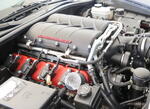
2010 LS3, V-3 Si with a 3.6" pulley, M1 meth, 1 7/8th" headers, 3" crossover pipes, Borla S-Type exhaust, stock throttle body and intake manifold, valve springs and trunnions done.
There is no 'one cam fits all' ... The specs of that cam are pretty normal for a modified LS engine.
Just my opinion, but having an overlap of +3° means that it won't have the best of street manners. When I say 'street manners', I am talking about idle quality and low rpm driveability.
Just for comparison, the LS3 OEM cam has an overlap of -26° (Big difference going from -26° overlap to +3° overlap). That's a difference of 29 degrees!
Just my opinion, but I certainly would not recommend using this cam in an automatic trans car that has a stock stall torque converter ... would be more suited for a C6 with a M6 trans or a C6 with an A6 trans and a 3,400 rpm stall converter.
It does not have particularly good 'street manners'. The idle is pretty rough. Low RPM driveability is certainly not 'refined' LOL but as long as that buys me performance I am good with the trade. I like the idle. 3,200 stall torque converter. Trans is an RPM Level VII 4L65e.
I bought the car built as it is so I don't know some of the specific parts but appropriate springs and pushrods were installed with the cam.
You ever get your tune looked at? 3 degrees of overlap isn't much in the grand scheme of things, so while your idle might be a bit bumpy, if its tuned appropriately your low speed drive ability shouldn't be that bad. My cam is a touch rowdier than yours and I really don't have any issues unless I try to punch it below 1400rpm.
Let me save you thousands of dollars in maintenance and bullshit
With forced induction, if the car is just a street/strip (daily driver with occasional trips to a 1/4 strip),
ALWAYS use the slowest ramp, the lowest lift, the lightest spring pressure possible. This will enhance the durability and longevity of your valvetrain.
WHY? Because with forced induction, we prefer to use boost make the power, not the cam.
For example, a "TINY" camshaft TFS30602001 , has VERY low lift, VERY slow ramps, and can use a single weak spring PAC1218.
This cam will support 800 900rwhp. And it will last 100,000 miles or more (the valve springs, valvetrain, etc...)
If you start using a stronger spring, they will only last 20k to 30k miles instead of 100,000. Call the cam manufacturer and start asking how many miles you can get out of this spring, that spring, do some research. I always start with the spring and work backwards because that is where 99% of the screw ups happen. Meaning, if you can make 900hp with a light spring, why go heavier?? there is no gain, no reason, no purpose to using a larger cam and more spring if your goals are short of 900hp.
Let me save you thousands of dollars in maintenance and bullshit
With forced induction, if the car is just a street/strip (daily driver with occasional trips to a 1/4 strip),
ALWAYS use the slowest ramp, the lowest lift, the lightest spring pressure possible. This will enhance the durability and longevity of your valvetrain.
WHY? Because with forced induction, we prefer to use boost make the power, not the cam.
For example, a "TINY" camshaft TFS30602001 , has VERY low lift, VERY slow ramps, and can use a single weak spring PAC1218.
This cam will support 800 900rwhp. And it will last 100,000 miles or more (the valve springs, valvetrain, etc...)
If you start using a stronger spring, they will only last 20k to 30k miles instead of 100,000. Call the cam manufacturer and start asking how many miles you can get out of this spring, that spring, do some research. I always start with the spring and work backwards because that is where 99% of the screw ups happen. Meaning, if you can make 900hp with a light spring, why go heavier?? there is no gain, no reason, no purpose to using a larger cam and more spring if your goals are short of 900hp.
Couple of things first. My car is already built and I am pleased with the performance and at a minimum, accepting of the roughness and not particularly looking to change the cam or valves and springs. It is a hot rod not a CTS-V and it sounds and runs like one. If I had reason to believe the present setup presents a risk to the continuing health and stable operation of the engine I would make changes but it is not on my radar. The purpose of this thread was to help me understand the dynamics and interactions of cams and performance in general and my cam in specific.
As far as an HP goal, I am pretty much there. It made 677 WHP\633 TQ although I am considering a 3.4" pulley.
Now to your assertion, I had not thought of it that way but yes, I can see where it is possible that by depending on the blower you could fill the cylinder without increasing the lift and due to preserving operating characteristics and reducing wear and tear would be a smart way to go. The other side of the equation I am not so sure about. With boost you would have significantly more waste gas to eliminate during the exhaust cycle than you did NA but no helper to get it out. Wouldn't you need more lift during exhaust to accommodate the volume of gasses as it would not have a machine propelling it.
In a PD blower car I had previously the exhaust valves were held open longer, to the point where the intake valves were beginning to open, to allow the blower to push the last of the exhaust product out of the cylinder. You lose a little boost but you get all the exhaust gasses out and lower the cylinder temps by a not insignificant amount. In this setup the point was to be able to run a PD blower without an aftercooler.
I very much appreciate the contributions to this thread!!!
Last edited by SteveJewels; Aug 8, 2020 at 11:06 AM.
In this setup the point was to be able to run a PD blower without an aftercooler.
When your talking about a PD blower for the LS engine, you are either going to have a Edelbrock EForce, a Magnuson Heartbeat, a GM LS9 or a Whipple blower.
All of these have there coolant cooled by use of a Front Mounted Coolant Heat Exchanger ... What are you talking about when you mention an "aftercooler" ?
If the "aftercooler" your talking about is indeed the front mounted coolant heat exchanger, you would be making a very big mistake by removing it.
If that's not what your talking about, please explain what you mean by an "aftercooler".
When your talking about a PD blower for the LS engine, you are either going to have a Edelbrock EForce, a Magnuson Heartbeat, a GM LS9 or a Whipple blower.
All of these have there coolant cooled by use of a Front Mounted Coolant Heat Exchanger ... What are you talking about when you mention an "aftercooler" ?
If the "aftercooler" your talking about is indeed the front mounted coolant heat exchanger, you would be making a very big mistake by removing it.
If that's not what your talking about, please explain what you mean by an "aftercooler".
aftercooler aka heat exchanger... i think he is confused but to remove any type of intercooler is not a good idea.
Aftercooler is (perhaps) an archaic term, used during the WWII era when there were airplanes that had both a turbocharger (Then called a Turbosupercharger.) and a Supercharger. There was an air - to - air heat exchanger between the turbocharger and supercharger that was referred to as an "intercooler" because it was in between the two boost devices as contrasted with airplanes of that time that had only a turbocharger and so the heat exchanger was 'after' the boost device and was referred to as an "aftercooler". That is the configuration I have with my A&A V-3 Si kit so I referred to it as an aftercooler. N
Last edited by SteveJewels; Aug 8, 2020 at 06:27 PM.
The other side of the equation I am not so sure about. With boost you would have significantly more waste gas to eliminate during the exhaust cycle than you did NA but no helper to get it out. Wouldn't you need more lift during exhaust to accommodate the volume of gasses as it would not have a machine propelling it.
Actually a high exhaust gas pressure on the exhaust stroke is desirable as it provides a cushion for the piston approaching TDC. Engines which use turbochargers and high exhaust gas pressure preserve their connecting rods, rod caps, and rod bearings. The connecting rod is held down to the crankshaft allowing the use of factory rod bolts at very high rpm.
Keep in mind the pressure ratio through an engine is not the key to having potential for flow. In other words, there are many engines out there with very 'high' exhaust gas pressure which still produce 1000, 2000hp or whatever. The reason is, intake pressure (say 20 to 50psi) and exhaust pressure (say, 20 to 80psi) are both negligible when compared to combustion pressure (1000psi) which drives the piston to produce torque. In other words, it doesn't matter if you need 20psi or 40psi of boost as long as the IAT is similar at that flow rate the combustion pressure isn't going to be adversely affected because it's based on mass input (mass rate) not intake or exhaust pressure.







 Cam school







 but it is not on my radar. The purpose of this thread was to help me understand the dynamics and interactions of cams and performance in general and my cam in specific.









