






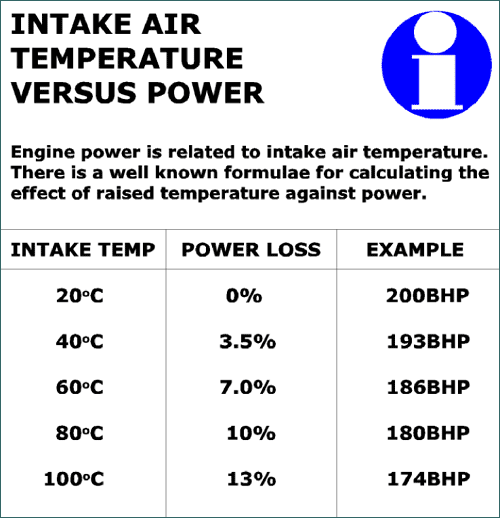



Why it slower when hotter?????

Thread Starter
Intermediate

Joined: Dec 2006
Posts: 46
Likes: 0
From: Phoenix AZ
 Why it slower when hotter?????
I have noticed that after my car warms up in the morning and I get on it it is REALLY FAST. I have also noticed that when driving it for an exteded period of time it get slower . I guess I have heard this is called "heat soak." Is there anything I can do to combat this problem or make it not so dramatic, granted I live in Phoenix AZ. Any help would be appreciated

Le Mans Master


Joined: Aug 1999
Posts: 5,411
Likes: 2
From: N Carolina 08 Z51 Coupe
I have noticed that after my car warms up in the morning and I get on it it is REALLY FAST. I have also noticed that when driving it for an exteded period of time it get slower . I guess I have heard this is called "heat soak." Is there anything I can do to combat this problem or make it not so dramatic, granted I live in Phoenix AZ. Any help would be appreciated

Safety Car


Joined: Dec 2005
Posts: 4,157
Likes: 37
From: North Carolina
St. Jude Donor '07-'08-'09-'11-'12
Correct, and as intake air temps increase, after a certain point the computer will pull timing which will also rob you of power.
The best thing you can do to help is install a 160 thermostat and get the engine tuned. Part of the tuning process will turn the fans on sooner and keep your engine running cooler...which in turn keeps your power up.
Actually, if you want to take a short ride, Chuck CoW in in Phoenix this weekend doing tunes, he could help you out. Here is his itinerary:
DATE: Friday October 26, Saturday 27 and Sunday 28th
PLACE: Arizona DynoChip in Chandler
513 54th St. Suite 5
Chandler Arizona 85226
Contact Person: Keith
You can also get Chuck on his cell at 914-332-0049 if you want to, if you cant make it and want to road trip for some fun, he and a bunch of us will be at SEMA in Vegas this week. Chuck will be doing tunes there as well.
The best thing you can do to help is install a 160 thermostat and get the engine tuned. Part of the tuning process will turn the fans on sooner and keep your engine running cooler...which in turn keeps your power up.
Actually, if you want to take a short ride, Chuck CoW in in Phoenix this weekend doing tunes, he could help you out. Here is his itinerary:
DATE: Friday October 26, Saturday 27 and Sunday 28th
PLACE: Arizona DynoChip in Chandler
513 54th St. Suite 5
Chandler Arizona 85226
Contact Person: Keith
You can also get Chuck on his cell at 914-332-0049 if you want to, if you cant make it and want to road trip for some fun, he and a bunch of us will be at SEMA in Vegas this week. Chuck will be doing tunes there as well.

Intermediate

Joined: Apr 2005
Posts: 48
Likes: 0
From: cincinnati ohio
I was out for a morning drive and the temperature was in the low 40's. The vette was screaming. If I understand horsepower numbers from a dyno, they are adjusted for temperature, Humidity and barometric pressure. Does anyone know how much more actual horse power you have at say 40 degrees vs 80 degrees outside temperature?

Melting Slicks

Joined: Sep 2007
Posts: 2,597
Likes: 3
From: READING PA
St. Jude Donor '08-'09-'10
The difference between 80 deg and 40 deg is very substantial and if i was to guess it would be about 25rwhp. Just ask the guys what happens to their mph and et's at the drag strip with those differences in temp.

Le Mans Master


Joined: Nov 2004
Posts: 6,566
Likes: 2
From: Goleta CA
Cruise-In VIII Veteran
Corvette Stories
The Best of Corvette for Corvette Enthusiasts

Top 10 Most Expensive Corvettes Ever Sold on Bring A Trailer
Brett Foote
10 Things Every Corvette Owner Needs (2026 Edition)
Michael S. Palmer
8 Most "Only Corvette Owners Understand" Quirks and Problems
Pouria Savadkouei
10 Reasons the C6 Z06 is Still A Performance Benchmark After 20 Years
Joe Kucinski
How Much Horsepower Every Corvette Engine "LOST" in 1972
Joe Kucinski
Top 10 DOs and DON'Ts for Protecting Your Convertible Top!
Michael S. Palmer
Top 10 Most Explosive Corvettes Ever Made: Power-to-Weight Ratio Ranked!
Joe Kucinski
150 hp to 1,250 hp: Every Corvette Generation Compared by the Specs That Matter
Joe Kucinski
8 Coolest Corvette Pace Cars (and Replicas) of All Time
Verdad Gallardo

 meltdown, anyone?
Racer
Joined: May 2005
Posts: 341
Likes: 3
From: Albuquerque New Mexico


Former Vendor
Joined: Nov 2005
Posts: 11,792
Likes: 255
From: Ossining New York
St. Jude Donor '07-'08-'09-'10-'12-'13-'14
Very Good Info!
VERY GOOD INFO...THANKS FOR POSTING THIS...
This is what I've been preaching for years... This week in Arizona, I had a tuner ask me why I was insisting on low temp stats before tuning the cars...
I said..."you don't know....It's soooo damn hot here...Why wouldn't you????"
Anyone who was part of the Latest "Chuck CoW TRAVAL n- TUNE in ARIZONA" could sure tell em why!
KEEP IT COOL!
Chuck CoW

Safety Car
Joined: Jun 1999
Posts: 3,570
Likes: 3
From: Austin, Singapore, Kuala Lumpur, Houston, Dallas, Hong Kong, Elgin, etc.. Texas
The solution is to get the ECM tuned. A 160 degree thermostat also helps a little but not nearly as much as a tune.