







Clearing up misconceptions with the PCV system

Thread Starter
Le Mans Master

Joined: Aug 2001
Posts: 8,145
Likes: 1
From: Bradenton FLORIDA
 Clearing up misconceptions with the PCV system
This is a copy of a reply to a customers questions regarding his C6 after a known tuner (one with no shop of his own) modified his PCV system & the potential damage this mod will do to the car. This is informational ONLY, and tuner does not matter, only the issues of modifying the crankcase ventilation system:
Understanding the C5, C6 crankcase ventilation system & clearing up as much of the wrong info being given on the forums & in person by one known tuner that is eliminating it & the damage caused over time by this as well as the need for a proper catch can to prevent the oil mist from entering the intake manifold. Please note, there are several very good catch cans on the market that do an excellent job of preventing this problem, here are a couple that are popular on the Corvette Forum:


I’m referring to the capping off of the OEM system & running open hoses down to the ground from each valve cover.
OK, On the crankcase evac system: In the 30's/40's/50's cars had the crankcase ventilation system that this tuner uses. But it had one feature better...the intake of air was at the oil fill tube you see at the front of the old cars engine and it had an oiled steel wool filter & the down tube was one single tube that the venturi effect at speed would cause a suction (negative pressure) from this tube at the rear of the motor so the harmful vapors, caustic gasses, moisture, unburnt fuel, etc. would be evacuated or "flushed" from the crankcase where the heat from the motor at operating temperature would "flash off) these to a vapor. If they are not flushed out with filtered fresh air the vapors would re-condense inside the engine after cool-down & the droplets formed would drip back down into the oil & the damage done is slow, but over time irreversible. Remember, these motors rarely made it to 50k miles before needing rebuilt...part of the reason was less effective oil & other filters).
Now in the late 60's, the fresh air source evolved to include a filter & fitting in the air cleaner assembly (a small foam type that was to be replaced w/every oil change) and the vacuum (suction needed to flush the fresh air through the system) was sourced from the intake manifold vacuum (much more steady & effective because the old way would only pull air through while moving) and a PCV valve
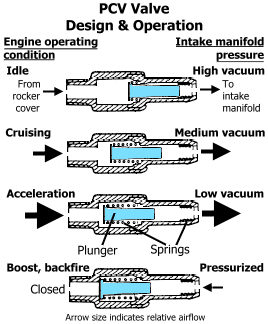
to control the amount of vacuum & to act as a checkvalve to prevent back-flow from excess crankcase pressure or backfire from forcing oil mist into the intake where it contaminates the air charge & causes knock , lost power, and carbon build up on the pistons. Now look back & re-read.....the advancements of just adding filtered fresh air & steady vacuum had these motors going as much as 100,000 miles before needing rebuilds.
Now on to today’s where it is a system that is closed for emissions. The gasses that are drawn through the crankcase into the intake manifold are burnt through the combustion process & then the catalytic converters. Filtered fresh air is drawn from the throttle body front where it is filtered by the main air filter so no need for a secondary filter to get ignored & clogged. Then the fresh air enters the passenger side valve cover is pulled through the rockers, down the push rod valleys, through the heart of the crankcase where it flushes out all the harmful stuff mentioned earlier) , up the drivers side push rod valleys, through the drivers side rockers, out the rear of the drivers side valve cover, through the foam covered plastic hose around the rear of the motor, back up along the passenger side valve cover, to the PCV valve to the intake manifold & through the combustion process the amount of vacuum is regulated by the PCV valve. And a motor only pulls vacuum at an idle or low speed....at high RPM's the blow-by (yes, even the best motor has some) would push oil back into the intake if not for the checkvalve action of the PCV. This is where the catch can comes into play…..add the catch can to trap & condense the oil mist & vapor to prevent it from entering your intake. And with a FI application, adding a breather to allow for better filtered fresh air flow from the breather (which has a capacity of several times the OEM inlet) and it you have excessive crankcase pressure it would vent out the breather instead of into your throttle body & entering the intake from that passage.
Now on to an un-named tuners set-up: They eliminate all the PCV system & run 2 open hoses to hang near the ground. This does 2 things well, it prevents ANY oil from entering the intake, and it vents excess crankcase pressure down & away from the top of the motor where it makes a mess. But this is hardly worth a slow death to the motor as a result. As mentioned in the early days, a down tube provided the negative pressure to evac the gasses while at speed. This is called the "Venturi" effect. (swing a short hose around your head and hold your thumb over the end in your hand & feel the suction) With their set-up there is a hose run from each valve cover fitting to near the ground. At speed (even though they may be ending in the same place) one will pull more than the other, and the one with the least amount of pull will suck up dust, dirt, water, gravel, and who knows what DIRECTLY into your motor!!! And all the way through it! Just as pouring a cup of sand in the oil fill would do the same thing, but much slower. Following me here? They are doing this on theory & half thought only. The other harm is at idle or low speeds there is no vacuum pulling air through to flush out the harmful vapors & gasses!!! So when you shut your motor off, after it has cooled, you have all that crap re-condensing back into the motor. Just what all is in the crankcase while running? Water vapor #1 and unburnt fuel that dilutes the oil, and caustic gasses from the blow by....of which sulfuric acid is one main ingredient. So have you followed the science of this?
Hope this opened your eyes up a bit. Remember, I have been building performance & race motors since the early 70's, am a graduate of Reher Morrison Pro Stock engine building school, have run one of the winningest big$ bracket drag teams in the Eastern US for the past 7 years, have a shop of nothing but champion drag racers at the local, divisional, National, & World level. We race every single weekend somewhere in the country & we build & repair the motors that do this ourselves. These are motors costing $20k plus & making 1,000 hp NA. On our first C5 that currently has 176,000 miles on it, we started drag racing the vette when it had 25k miles on it & did not need to rebuild it until a nitrous "event" (screw-up) broke my #7 piston. This is a car raced every weekend at 2-3 events & many times doubled up w/2 drivers sharing. It has many times been driven 1,000 miles to a race, won or runnered up at many, and driven back. Do a Google search on RevXtreme drag race (spell rev xtreme several ways) and read the media coverage. It's easy to be convinced by some so and so who claims to know everything, but my whole team can back it up with knowledge, experience, qualification, accomplishments, and racing & testing & perfecting everything we do on a weekly basis.
Understanding the C5, C6 crankcase ventilation system & clearing up as much of the wrong info being given on the forums & in person by one known tuner that is eliminating it & the damage caused over time by this as well as the need for a proper catch can to prevent the oil mist from entering the intake manifold. Please note, there are several very good catch cans on the market that do an excellent job of preventing this problem, here are a couple that are popular on the Corvette Forum:
I’m referring to the capping off of the OEM system & running open hoses down to the ground from each valve cover.
OK, On the crankcase evac system: In the 30's/40's/50's cars had the crankcase ventilation system that this tuner uses. But it had one feature better...the intake of air was at the oil fill tube you see at the front of the old cars engine and it had an oiled steel wool filter & the down tube was one single tube that the venturi effect at speed would cause a suction (negative pressure) from this tube at the rear of the motor so the harmful vapors, caustic gasses, moisture, unburnt fuel, etc. would be evacuated or "flushed" from the crankcase where the heat from the motor at operating temperature would "flash off) these to a vapor. If they are not flushed out with filtered fresh air the vapors would re-condense inside the engine after cool-down & the droplets formed would drip back down into the oil & the damage done is slow, but over time irreversible. Remember, these motors rarely made it to 50k miles before needing rebuilt...part of the reason was less effective oil & other filters).
Now in the late 60's, the fresh air source evolved to include a filter & fitting in the air cleaner assembly (a small foam type that was to be replaced w/every oil change) and the vacuum (suction needed to flush the fresh air through the system) was sourced from the intake manifold vacuum (much more steady & effective because the old way would only pull air through while moving) and a PCV valve
to control the amount of vacuum & to act as a checkvalve to prevent back-flow from excess crankcase pressure or backfire from forcing oil mist into the intake where it contaminates the air charge & causes knock , lost power, and carbon build up on the pistons. Now look back & re-read.....the advancements of just adding filtered fresh air & steady vacuum had these motors going as much as 100,000 miles before needing rebuilds.
Now on to today’s where it is a system that is closed for emissions. The gasses that are drawn through the crankcase into the intake manifold are burnt through the combustion process & then the catalytic converters. Filtered fresh air is drawn from the throttle body front where it is filtered by the main air filter so no need for a secondary filter to get ignored & clogged. Then the fresh air enters the passenger side valve cover is pulled through the rockers, down the push rod valleys, through the heart of the crankcase where it flushes out all the harmful stuff mentioned earlier) , up the drivers side push rod valleys, through the drivers side rockers, out the rear of the drivers side valve cover, through the foam covered plastic hose around the rear of the motor, back up along the passenger side valve cover, to the PCV valve to the intake manifold & through the combustion process the amount of vacuum is regulated by the PCV valve. And a motor only pulls vacuum at an idle or low speed....at high RPM's the blow-by (yes, even the best motor has some) would push oil back into the intake if not for the checkvalve action of the PCV. This is where the catch can comes into play…..add the catch can to trap & condense the oil mist & vapor to prevent it from entering your intake. And with a FI application, adding a breather to allow for better filtered fresh air flow from the breather (which has a capacity of several times the OEM inlet) and it you have excessive crankcase pressure it would vent out the breather instead of into your throttle body & entering the intake from that passage.
Now on to an un-named tuners set-up: They eliminate all the PCV system & run 2 open hoses to hang near the ground. This does 2 things well, it prevents ANY oil from entering the intake, and it vents excess crankcase pressure down & away from the top of the motor where it makes a mess. But this is hardly worth a slow death to the motor as a result. As mentioned in the early days, a down tube provided the negative pressure to evac the gasses while at speed. This is called the "Venturi" effect. (swing a short hose around your head and hold your thumb over the end in your hand & feel the suction) With their set-up there is a hose run from each valve cover fitting to near the ground. At speed (even though they may be ending in the same place) one will pull more than the other, and the one with the least amount of pull will suck up dust, dirt, water, gravel, and who knows what DIRECTLY into your motor!!! And all the way through it! Just as pouring a cup of sand in the oil fill would do the same thing, but much slower. Following me here? They are doing this on theory & half thought only. The other harm is at idle or low speeds there is no vacuum pulling air through to flush out the harmful vapors & gasses!!! So when you shut your motor off, after it has cooled, you have all that crap re-condensing back into the motor. Just what all is in the crankcase while running? Water vapor #1 and unburnt fuel that dilutes the oil, and caustic gasses from the blow by....of which sulfuric acid is one main ingredient. So have you followed the science of this?
Hope this opened your eyes up a bit. Remember, I have been building performance & race motors since the early 70's, am a graduate of Reher Morrison Pro Stock engine building school, have run one of the winningest big$ bracket drag teams in the Eastern US for the past 7 years, have a shop of nothing but champion drag racers at the local, divisional, National, & World level. We race every single weekend somewhere in the country & we build & repair the motors that do this ourselves. These are motors costing $20k plus & making 1,000 hp NA. On our first C5 that currently has 176,000 miles on it, we started drag racing the vette when it had 25k miles on it & did not need to rebuild it until a nitrous "event" (screw-up) broke my #7 piston. This is a car raced every weekend at 2-3 events & many times doubled up w/2 drivers sharing. It has many times been driven 1,000 miles to a race, won or runnered up at many, and driven back. Do a Google search on RevXtreme drag race (spell rev xtreme several ways) and read the media coverage. It's easy to be convinced by some so and so who claims to know everything, but my whole team can back it up with knowledge, experience, qualification, accomplishments, and racing & testing & perfecting everything we do on a weekly basis.

Burning Brakes


Joined: Nov 2004
Posts: 988
Likes: 4
From: Livermore CA
Tracy, What you explain is very informative and a good basis for discussion. After doing many valve spring swaps on LS series engines I am still amused by how much ring blow by there is with 110 psi shop air in the cylinder of a fresh LS engine with fully seated rings. I have used the vent to atmosphere hose method you described with the only difference being that I tied them together with a tee to a single common vent. At any engine speed including idle I have a fair amount of blow by air flowing from the 5/8th hose, I just don't see a dirt ingestion problem with this set up. Run two short independent vents and maybe an ingestion problem could crop up, I still think you would feel out flow from both hoses. Now on to the catch cans, I have tried Elite Engineering's can, and a larger Moroso catch can and while they catch a little oil the intake manifold is still wet with oil. The oil is in a vapor and while the current catch can grab some, most will still get by and condenses once it is in the large volume of the intake manifold. I think a large volume coalescing fitter is necessary. The spun steel wool or abrasive sponge type coalescing elements currently in use in the catch cans being sold are really not oil mist coalescing elements. I think the the catch cans are heading the right direction but just are not yet fully refined to coalesce and trap the majority of the lost engine oil.
John
John
Thread Starter
Le Mans Master
Joined: Aug 2001
Posts: 8,145
Likes: 1
From: Bradenton FLORIDA
Tracy, What you explain is very informative and a good basis for discussion. After doing many valve spring swaps on LS series engines I am still amused by how much ring blow by there is with 110 psi shop air in the cylinder of a fresh LS engine with fully seated rings. I have used the vent to atmosphere hose method you described with the only difference being that I tied them together with a tee to a single common vent. At any engine speed including idle I have a fair amount of blow by air flowing from the 5/8th hose, I just don't see a dirt ingestion problem with this set up. Run two short independent vents and maybe an ingestion problem could crop up, I still think you would feel out flow from both hoses. Now on to the catch cans, I have tried Elite Engineering's can, and a larger Moroso catch can and while they catch a little oil the intake manifold is still wet with oil. The oil is in a vapor and while the current catch can grab some, most will still get by and condenses once it is in the large volume of the intake manifold. I think a large volume coalescing fitter is necessary. The spun steel wool or abrasive sponge type coalescing elements currently in use in the catch cans being sold are really not oil mist coalescing elements. I think the the catch cans are heading the right direction but just are not yet fully refined to coalesce and trap the majority of the lost engine oil.
John
John
Hi John,
You are correct on the T into 1 will not allow the hose to suck anything up, but you are disabeling a critical function of the PCV system, and that is flushing out the vapors & gasses with filtered fresh air. Doing what you describe vents excess crankcase pressure, but without a path of fresh air through the crankcase & a suction source to draw it, long term damage will result as covered in the first post. On our drag-only builds we run a belt driven vacuum pump with a vacuum relief valve that regulates the amount of vac, allows for the fresh air to pass through the crankcase, and since we change oil every few races, only run a 1/4 mile at a time, & rebuild the motors every season, the lack of filtered air is not an issue on enngine life....but it is critical on a street application.


Drifting


Joined: Apr 2008
Posts: 1,955
Likes: 22
From: Lehigh Valley Pennsylvania
I've seen this topic debated 100 times with many different opinions and theories. The bottom line is that during idle and low rpms your engine is creating very little blow by and your PCV is drawing maximum vacuum. When you need vacuum the most, when you are creating MAXIMUM BB, at WOT there is ZERO, I repeat ZERO vacuum. So how does your vehicle vent these vapors? Under pressure, through the oil ports, and through the valley nipple into your TB. It is a horrible system and is for emission purposes only. The downtubes used by said tuner create no Venturi Effect during idle and low rpms, only at speed. The reason for the down tubes is primarily to vent the noxious unspent fuel and oil vapors away from the cabin. Catch cans are a bandaid and I have done tests to prove they do not eliminate all the oil from the intake stream. I ran two in conjunction and had exactly half the oil in the second can as I did the first. There is only one true method to venting your CC vapors at WOT and this is with a Vacuum Pump, but they are expensive and not really needed for stock applications.
Corvette Stories
The Best of Corvette for Corvette Enthusiasts

Corvette ZR1X Will Be Pacing the Indy 500, And Could Probably Race, Too!
Verdad Gallardo
Top 10 Corvettes Coming to Mecum Indy 2026!
Brett Foote
Top 10 C9 Corvette MUST-HAVES to Fix These C8 Generation Flaws!
Michael S. Palmer
10 Revolutionary 'Corvette Firsts' Most People Don't Know
Joe Kucinski
5 Reasons to Upgrade to an LS6-Powered Corvette; 5 Reasons to Stay LT2
Michael S. Palmer
2027 Corvette vs The World: Every C8 vs Its Closest Competitor
Joe Kucinski
10 Most Common Corvette Problems of the Last 20 Years!
Joe Kucinski
5 MOST and 5 LEAST Popular Corvette Model Years in History!
Joe Kucinski
2027 Corvette Buyer's Guide: Everything You Need to Know!
Joe Kucinski
Thread Starter
Le Mans Master
Joined: Aug 2001
Posts: 8,145
Likes: 1
From: Bradenton FLORIDA
I've seen this topic debated 100 times with many different opinions and theories. The bottom line is that during idle and low rpms your engine is creating very little blow by and your PCV is drawing maximum vacuum. When you need vacuum the most, when you are creating MAXIMUM BB, at WOT there is ZERO, I repeat ZERO vacuum. So how does your vehicle vent these vapors? Under pressure, through the oil ports, and through the valley nipple into your TB. It is a horrible system and is for emission purposes only. The downtubes used by said tuner create no Venturi Effect during idle and low rpms, only at speed. The reason for the down tubes is primarily to vent the noxious unspent fuel and oil vapors away from the cabin. Catch cans are a bandaid and I have done tests to prove they do not eliminate all the oil from the intake stream. I ran two in conjunction and had exactly half the oil in the second can as I did the first. There is only one true method to venting your CC vapors at WOT and this is with a Vacuum Pump, but they are expensive and not really needed for stock applications.


Melting Slicks

Joined: Sep 2007
Posts: 2,597
Likes: 3
From: READING PA
St. Jude Donor '08-'09-'10
Direct vent or catch can ?
If one was to convert the "two hoses down to bottom" to a catch can assy what would they need to do ? Not sure what the catch can offers
but the thaughts of oil vapor going into the intake does not seem like GM had the correct answer to PCV issued. I seen in another thread there was a diagram of a catch can assy. I would appreciate if someone would help me a little on that.
but the thaughts of oil vapor going into the intake does not seem like GM had the correct answer to PCV issued. I seen in another thread there was a diagram of a catch can assy. I would appreciate if someone would help me a little on that.
Thread Starter
Le Mans Master
Joined: Aug 2001
Posts: 8,145
Likes: 1
From: Bradenton FLORIDA
If one was to convert the "two hoses down to bottom" to a catch can assy what would they need to do ? Not sure what the catch can offers
but the thaughts of oil vapor going into the intake does not seem like GM had the correct answer to PCV issued. I seen in another thread there was a diagram of a catch can assy. I would appreciate if someone would help me a little on that.
but the thaughts of oil vapor going into the intake does not seem like GM had the correct answer to PCV issued. I seen in another thread there was a diagram of a catch can assy. I would appreciate if someone would help me a little on that.
The catch can has to a proper design...and all are not created equal. The right can will take care of 95%, if not 100% of the oil in the manifold. You do understand theat with the 2 hoses hanging down at speed one will be sucking up dirt,sand,dust,water, directly into your engine, right? You would want to go to the drivers side rear, and the grommet is the perfect size to put a 90 degree PCV valve in. Then run 3/8" emmissions rated hose (fuel/emmissions is fine) so it is rigid enough to not colapse under vacuum. Run this around the back of the intake to the pass side front where the can is located to the inlet, on ours it is the top fitting due to the perforated down-tube used to disperse the vapor evenly for maximum condensation effect so the oil mist & vapors are condensed to droplets that puddle in the can bottom. Ours is also 1 full quart as the surface area is critical to be effective on the cars with the issues, (althought there are several other very good cans out there...I like Mike Norris's as far as looks & functionality). We also build in a PCV valve into our cans so there is not guessing on having one in the right place (and it is fine to have your OEM one as well) Then go from the outlet of the can, to your vac fitting on the pass side lower snout of the intake. Then you need a fresh air source that is filtered....and that should feed to the front fitting on the pass side valve cover. Even better is to locate it on a modified oil fill cap as high as possible. The fresh air source can be the OEM fitting that is stock. or a mini breather that may be located anywhere you run a hose to as long as it is not going to get water splashed on it.
Hope this helps, if not ask for more clarification because that is what these threads were started for.
Drifting
Joined: Apr 2008
Posts: 1,955
Likes: 22
From: Lehigh Valley Pennsylvania
You are only half correct, we have our cans on hundreds of cars & run them on each of our drag cars & unless there is excessive cylinder bore/ring wear they prevent almost ALL oil from entering, This is with our design....I can't tell you on all the others but with some we tested we saw the same thing you did. As far as the hoses running down, read the first post over carefully.....I address them in detail....but at the cost of eating the engine up over time it is not worth it. I suspect though as you are a juniour member, and do not list your location you work with said tuner and are defending this. Just drive your car as is with the open tubes running down and DON'T encourage those that value their engine to be drawn into this destructive mod.

Race Director

Joined: Jan 2000
Posts: 12,375
Likes: 406
From: Florida
Interesting thread and informative. My comment in reading this is that while most catch cans out there may be very effective in trapping oil on drag cars, they may be less effective on road racing. The reason being that the engines in RR spend a lot more time around WOT, where the mess occurs, and because as the oil heats and thins, it's mist becomes finer and the hotter air charge allows more of the oil to remain suspended. I wonder if adding condensing circuit (say a mocal oil cooler with a drain), would help. It would also result in colder PCV air into the intake, reducing IAT.

Team Owner


Joined: May 2004
Posts: 26,345
Likes: 231
From: SoCal
Interesting thread and informative. My comment in reading this is that while most catch cans out there may be very effective in trapping oil on drag cars, they may be less effective on road racing. The reason being that the engines in RR spend a lot more time around WOT, where the mess occurs, and because as the oil heats and thins, it's mist becomes finer and the hotter air charge allows more of the oil to remain suspended. I wonder if adding condensing circuit (say a mocal oil cooler with a drain), would help. It would also result in colder PCV air into the intake, reducing IAT.
Couple of things I know from years of messing with this issue on my C5:
1. Coalescing filters will catch oil missed by all the other can manufacturers
2. Running the fresh air line to the top of the oil cap and using a 5/8" line will prevent a lot of oil backflowing thru the fresh air line. The oil is forced directly into the valve cover nipple instead of having to work its way up the filler cap neck
DH

Tech Contributor


Joined: Mar 2003
Posts: 12,094
Likes: 197
From: Colorado Springs, CO
St. Jude Donor '08-'09-'10-'11
Another variation with keeping the system intact and not sucking up oil is to move the passenger side valve cover hose to a fitting put on the oil filler car and run the hose to the same location on the coupler in front of the TB. Oil isnt that high up and isnt caugth up in the hose. Andy at A&A has posted this info on another thread and it has proven to be a good mod.
Thread Starter
Le Mans Master
Joined: Aug 2001
Posts: 8,145
Likes: 1
From: Bradenton FLORIDA
We can debate this to death and you will never convince me that the factory PCV system on the LS2 serves any purpose other than to satisfy smog. I do not run the downtubes BTW but did run the PCV delete on my GTO from 1k, 30K miles with zero issues and oil clean on the dipstick from oil change to oil change. I had my C6 three days before pulling the PCV. I think I can deduce however which tuner you are referring to and he has one of the best reputations anywhere in the LSX community.
Thread Starter
Le Mans Master
Joined: Aug 2001
Posts: 8,145
Likes: 1
From: Bradenton FLORIDA
Interesting thread and informative. My comment in reading this is that while most catch cans out there may be very effective in trapping oil on drag cars, they may be less effective on road racing. The reason being that the engines in RR spend a lot more time around WOT, where the mess occurs, and because as the oil heats and thins, it's mist becomes finer and the hotter air charge allows more of the oil to remain suspended. I wonder if adding condensing circuit (say a mocal oil cooler with a drain), would help. It would also result in colder PCV air into the intake, reducing IAT.
Thread Starter
Le Mans Master
Joined: Aug 2001
Posts: 8,145
Likes: 1
From: Bradenton FLORIDA
Not to mention lateral G forces and deceleration which we also see on road courses but no straight line drag racing. These tend to force oil up to the valve cover and cause oil to flow backwards thru the fresh air line!!!! I ran two catch cans in this line as well to keep oil from getting into the intake.
Couple of things I know from years of messing with this issue on my C5:
1. Coalescing filters will catch oil missed by all the other can manufacturers
2. Running the fresh air line to the top of the oil cap and using a 5/8" line will prevent a lot of oil backflowing thru the fresh air line. The oil is forced directly into the valve cover nipple instead of having to work its way up the filler cap neck
DH
Couple of things I know from years of messing with this issue on my C5:
1. Coalescing filters will catch oil missed by all the other can manufacturers
2. Running the fresh air line to the top of the oil cap and using a 5/8" line will prevent a lot of oil backflowing thru the fresh air line. The oil is forced directly into the valve cover nipple instead of having to work its way up the filler cap neck
DH
Another variation with keeping the system intact and not sucking up oil is to move the passenger side valve cover hose to a fitting put on the oil filler car and run the hose to the same location on the coupler in front of the TB. Oil isnt that high up and isnt caugth up in the hose. Andy at A&A has posted this info on another thread and it has proven to be a good mod.
If you do a search on Google you should be able to find a few suppliers, it is designed to remove any liguid flowing through.
Almost all great discussion here, as is the purpose of the thread with only one choosing to be ignorant & ignore the science of this subject. Keep the good tips flowing here!

Tech Contributor
Joined: Jul 2002
Posts: 14,949
Likes: 263
From: St. Louis, MO
St. Jude Donor '08
Thanks for the thread Tracy. I've been on a few with you on this topic and appreciate your reasoned and informative responses.
I've finally decided to bite the bullet and buy a catch can and would like to buy from you. Do I remember that have developed your own for $50 or so?
I've finally decided to bite the bullet and buy a catch can and would like to buy from you. Do I remember that have developed your own for $50 or so?