



PCV Question

Thread Starter
Burning Brakes


Joined: Mar 2008
Posts: 1,073
Likes: 8
From: Houston TX
 PCV Question
Is the PCV "valve" on the LS2 / LS3 an actual valve in the traditional sense? I am trying to determine if one is working properly.
Most systems utilize a ball-type check valve and are functioning properly if you can suck air through but not blow air out of the attached rubber line.
Does one check the LS2 / LS3 PCV's mounted on the valley cover in the same fashion? If not, how can you determine if it is functioning correctly?
Most systems utilize a ball-type check valve and are functioning properly if you can suck air through but not blow air out of the attached rubber line.
Does one check the LS2 / LS3 PCV's mounted on the valley cover in the same fashion? If not, how can you determine if it is functioning correctly?
Last edited by techvette; Jun 17, 2010 at 07:04 PM.
Race Director


Joined: Mar 2005
Posts: 10,399
Likes: 26
From: Austin Texas
No valve, it's a fixed orifice. The Positive Crankcase Ventilation system on the C6 uses one line from the valley cover to behind the throttle body to remove positive pressure (blowby) from the crankcase and another line to the passenger side valve cover from in front of the throttle body to allow fresh, filtered air into the crankcase.
Thread Starter
Burning Brakes
Joined: Mar 2008
Posts: 1,073
Likes: 8
From: Houston TX
The reason I ask is that I am trying to figure out an oil consumption issue and there is a lot coming through the PCV into the intake manifold.
With most systems, you can tell if they are working correctly by being able to suck air through them, but not be able to blow air through them. I suppose that won't work with a fixed orifice.
So being a fixed orifice, there are no moving parts in there to stop working or break, which means it really can't fail...Right?
So I guess my search for the cause continues...
With most systems, you can tell if they are working correctly by being able to suck air through them, but not be able to blow air through them. I suppose that won't work with a fixed orifice.
So being a fixed orifice, there are no moving parts in there to stop working or break, which means it really can't fail...Right?
So I guess my search for the cause continues...
Last edited by techvette; Jun 18, 2010 at 10:11 AM.
Race Director
Joined: Mar 2005
Posts: 10,399
Likes: 26
From: Austin Texas
What do you consider and "oil consumption issue"? If the oil ends up in the intake it's blowby (bad rings?).
My '05 used 1/2 quart of oil in 13,000 miles (4 oil changes) but when I pulled the intake to swap to a ported intake the stock intake was covered in oil. Very minimal oil use but lots of oil on the intake.
My '05 used 1/2 quart of oil in 13,000 miles (4 oil changes) but when I pulled the intake to swap to a ported intake the stock intake was covered in oil. Very minimal oil use but lots of oil on the intake.
Corvette Stories
The Best of Corvette for Corvette Enthusiasts

Top 10 Most Expensive Corvettes Ever Sold on Bring A Trailer
Brett Foote
10 Things Every Corvette Owner Needs (2026 Edition)
Michael S. Palmer
8 Most "Only Corvette Owners Understand" Quirks and Problems
Pouria Savadkouei
10 Reasons the C6 Z06 is Still A Performance Benchmark After 20 Years
Joe Kucinski
How Much Horsepower Every Corvette Engine "LOST" in 1972
Joe Kucinski
Top 10 DOs and DON'Ts for Protecting Your Convertible Top!
Michael S. Palmer
Top 10 Most Explosive Corvettes Ever Made: Power-to-Weight Ratio Ranked!
Joe Kucinski
150 hp to 1,250 hp: Every Corvette Generation Compared by the Specs That Matter
Joe Kucinski
8 Coolest Corvette Pace Cars (and Replicas) of All Time
Verdad Gallardo
Thread Starter
Burning Brakes
Joined: Mar 2008
Posts: 1,073
Likes: 8
From: Houston TX
What do you consider and "oil consumption issue"? If the oil ends up in the intake it's blowby (bad rings?).
My '05 used 1/2 quart of oil in 13,000 miles (4 oil changes) but when I pulled the intake to swap to a ported intake the stock intake was covered in oil. Very minimal oil use but lots of oil on the intake.
My '05 used 1/2 quart of oil in 13,000 miles (4 oil changes) but when I pulled the intake to swap to a ported intake the stock intake was covered in oil. Very minimal oil use but lots of oil on the intake.

Retired & lovin' it!


Joined: Mar 2005
Posts: 4,475
Likes: 549
From: Jackson NJ
If you're using a quart of oil in say 400 miles (tank of gas), you've got a bigger problem than the PCV circuit. That much oil consumption has got to be due to bad rings or bad valve seals....not sure how you can say you've got good compression, but leak down test is good next step.

Racer


Joined: Sep 2006
Posts: 309
Likes: 0
From: Houston TX
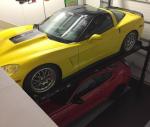
Since this is my car you guys are talkin about, let me clear the air: IT IS NOT consuming one quart of oil per tank of fuel. The oil consumption is high, no doubt, but it's not at the level it's being made out to be. Also take into considertaion that it's a stroked LSX455 with no oil cooler. Engine heat also plays a part in viscosity breakdown. And since I live in Houston, TX the climate here is not condusive to larger cubic inch motors with no cooling modifications whatsoever.
Instructor
Joined: May 2007
Posts: 234
Likes: 3
From: Wexford, PA
Pull any LS intake after 10K or so miles, and you will see oil. Do not be suprised, there is no in getting around this. This will look like a significant amount if you havent seen it before, but it is not that bad.
The best judgement is to keep track of how much oil your car is burning. According to GM, 1qt every oil change is acceptable, but I have never seen mine burn that much.
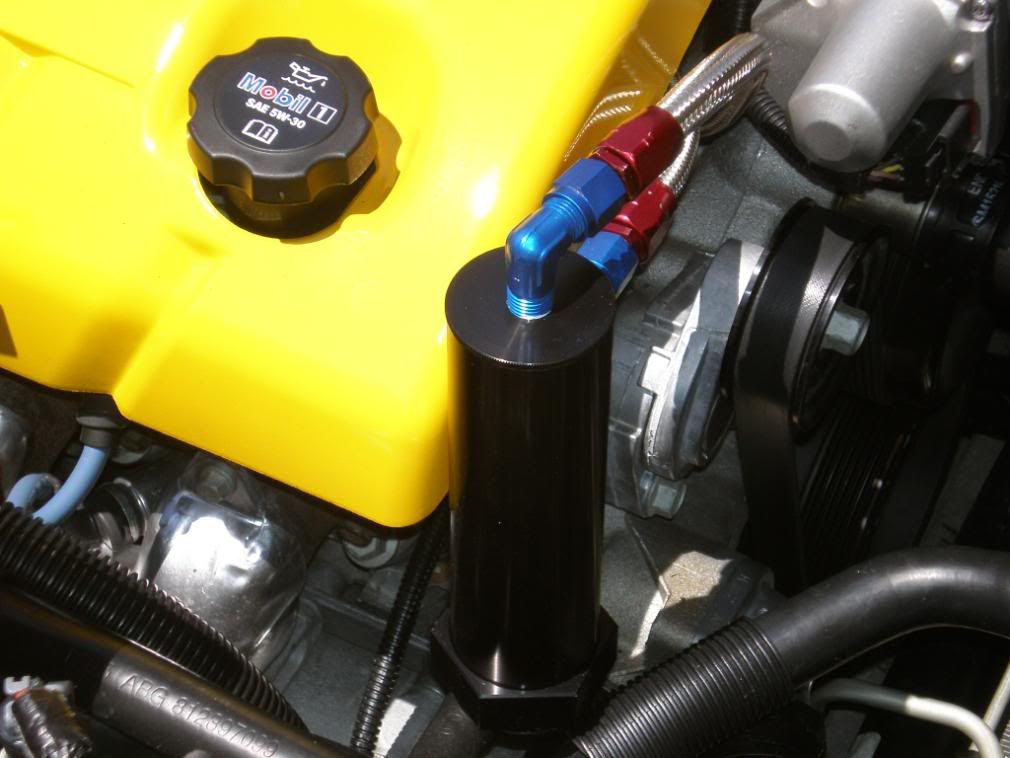
I personall do not like oil in my intake, espcially after all of my extensive modifications so I have install a catch can system to catch as much oil as I can.
The best judgement is to keep track of how much oil your car is burning. According to GM, 1qt every oil change is acceptable, but I have never seen mine burn that much.
I personall do not like oil in my intake, espcially after all of my extensive modifications so I have install a catch can system to catch as much oil as I can.
Thread Starter
Burning Brakes
Joined: Mar 2008
Posts: 1,073
Likes: 8
From: Houston TX
I was misinformed about how many miles the car had been driven since the oil was topped off. Now it looks like a more reasonable consumption number of 1 quart every 5-600 miles is the reality of it.
A leak down test will be performed shortly, followed by the addition of a catch can and an oil cooler.
A leak down test will be performed shortly, followed by the addition of a catch can and an oil cooler.