

CAI performance comparison
Burning Brakes

Joined: Nov 2012
Posts: 968
Likes: 8

I'd suspect that any manuf is going to know the 'about' CFM flow of the filter they use. As long as that exceeds the intake, or the physical dynamics/CFM flow of the gadget you are putting on, the filter should not be a problem.
Knowing how much CFM change an new intake is adding, it should add if you want more power, is part of the info I'd like. Knowing the base/stock CFM setup, you'd want to always increase CFM flow.
Typically, for free flow filters, you may get a bit more fine material in your engine/oil. Some folks that is important, some not.
Talking just increasing power, means increasing CFM flow for an engine. With the CAI setups, I'd like to see how much is really from 'cold air' change and how much from increased CFM charge. This is sort of an experimental/academic and real life application question. That would be an important factor in who's CAI really has 'cold air' helping the most - accounting for CFM change/additions. The first/most help, I suspect again, is CFM.
In the end, for many folks the question is not important. It's just what setup provides the best overall gains, i.e. HP, TQ, TTD. I just like to know the details.
Knowing how much CFM change an new intake is adding, it should add if you want more power, is part of the info I'd like. Knowing the base/stock CFM setup, you'd want to always increase CFM flow.
Typically, for free flow filters, you may get a bit more fine material in your engine/oil. Some folks that is important, some not.
Talking just increasing power, means increasing CFM flow for an engine. With the CAI setups, I'd like to see how much is really from 'cold air' change and how much from increased CFM charge. This is sort of an experimental/academic and real life application question. That would be an important factor in who's CAI really has 'cold air' helping the most - accounting for CFM change/additions. The first/most help, I suspect again, is CFM.
In the end, for many folks the question is not important. It's just what setup provides the best overall gains, i.e. HP, TQ, TTD. I just like to know the details.
Last edited by J Christensen; Nov 29, 2013 at 01:18 PM.

Safety Car


Joined: May 2011
Posts: 3,807
Likes: 508
From: Oshawa, Ontario
blown fuse
For me, rather than using "Cold' air and or ram air as the determinant, I'd like to see the CFM the setups flow. I'd guess that will be the bigger addition to any gains in real life or the dyno.
Maybe different, but I did some extensive testing with motorcycles cold air intakes -vs- OEM and free flow/ram air intakes (not advertised as cold air), and there was negligible gain with any setup claiming cold air/ram made and no notable extra power (ok, ok any power is better power, yes, but I'm here discussing where the bulk of the power change comes from), however, on the less restricted intake design/improved CFM, the increased CFM did consistently show extra gains, meaning increased CFM (with a tune for the change), typically made the bulk of the extra power, whether the air was same temp as engine, or closer to ambient, or ambient, made less difference, sometimes much less. Also, after a maximizing custom tune, the form of the intake setup could be changed and raise the HP or TQ, generally moving HP direction and TQ the other (further fine tuning required), by lengthening or shortening the intake form (tube/velocity stack). That type of change alone can effect how the power shows on the dyno and street.
That power, translated from the dyno to the road, in my opinion, is either folks chasing HP higher numbers, I think the wrong way to go generally, as often higher HP numbers will produce lower TTD, but not always. Sometimes higher TQ will result in better TTD = getting out of the hole quicker and sustaining faster acceleration to (shorter) distance. So for me, with a setup for a faster vehicle, you need to figure do you want faster (as in acceleration to a distance), say 1/4 miles, or a higher top end speed. Higher HP does not necessarily make for faster TTD in a 1/4 mile, though obviously larger gains in HP sure ought to help better TTD. I'm talking about cold air/ram -vs- CFM changes and which of those is really providing the most/best of any gain for that setup.
Give me the CFM. Yes, math, PCM setup and theory should show improved power due to 'cold air' intake, MAF/IAT and AF adjustments by the PCM = less timing pulled, etc, better AFR and all, but I think in comparison to higher CFM, those cold air gains cold air notably lower just based upon a CAI addition. Ideally you'd want higher CFM first, and cold air second, until you get to the point of CFM for the engine is maxed or about maxed out. As you reach the upper realm of the CFM efficiency/max of the engine, the gains from CFM become less notable. Each engine has an about 'golden' spot for it's max efficiency (HP/TQ, of shifting those numbers up or down, to achieve the users desired outcome.
In my opinion, after maxing out the intake/exhaust, the cold air will still only result in about negligible gains, very small. Yes, I know, what is small to some is large to others, any gain is good - but again in comparison to the gains from increased CFM, which is what my post/question is about.
That would be an interesting comparison. Not "cold air" setup, but the CFM differences between these "CAI" setups, providing a tune to the mod was done afterwards to maximize the intake.
Show me the $$$ (CFM).
Maybe different, but I did some extensive testing with motorcycles cold air intakes -vs- OEM and free flow/ram air intakes (not advertised as cold air), and there was negligible gain with any setup claiming cold air/ram made and no notable extra power (ok, ok any power is better power, yes, but I'm here discussing where the bulk of the power change comes from), however, on the less restricted intake design/improved CFM, the increased CFM did consistently show extra gains, meaning increased CFM (with a tune for the change), typically made the bulk of the extra power, whether the air was same temp as engine, or closer to ambient, or ambient, made less difference, sometimes much less. Also, after a maximizing custom tune, the form of the intake setup could be changed and raise the HP or TQ, generally moving HP direction and TQ the other (further fine tuning required), by lengthening or shortening the intake form (tube/velocity stack). That type of change alone can effect how the power shows on the dyno and street.
That power, translated from the dyno to the road, in my opinion, is either folks chasing HP higher numbers, I think the wrong way to go generally, as often higher HP numbers will produce lower TTD, but not always. Sometimes higher TQ will result in better TTD = getting out of the hole quicker and sustaining faster acceleration to (shorter) distance. So for me, with a setup for a faster vehicle, you need to figure do you want faster (as in acceleration to a distance), say 1/4 miles, or a higher top end speed. Higher HP does not necessarily make for faster TTD in a 1/4 mile, though obviously larger gains in HP sure ought to help better TTD. I'm talking about cold air/ram -vs- CFM changes and which of those is really providing the most/best of any gain for that setup.
Give me the CFM. Yes, math, PCM setup and theory should show improved power due to 'cold air' intake, MAF/IAT and AF adjustments by the PCM = less timing pulled, etc, better AFR and all, but I think in comparison to higher CFM, those cold air gains cold air notably lower just based upon a CAI addition. Ideally you'd want higher CFM first, and cold air second, until you get to the point of CFM for the engine is maxed or about maxed out. As you reach the upper realm of the CFM efficiency/max of the engine, the gains from CFM become less notable. Each engine has an about 'golden' spot for it's max efficiency (HP/TQ, of shifting those numbers up or down, to achieve the users desired outcome.
In my opinion, after maxing out the intake/exhaust, the cold air will still only result in about negligible gains, very small. Yes, I know, what is small to some is large to others, any gain is good - but again in comparison to the gains from increased CFM, which is what my post/question is about.
That would be an interesting comparison. Not "cold air" setup, but the CFM differences between these "CAI" setups, providing a tune to the mod was done afterwards to maximize the intake.
Show me the $$$ (CFM).

Race Director

Joined: Mar 2005
Posts: 11,549
Likes: 27
From: Southampton NJ


Thread Starter
Race Director


Joined: Sep 2007
Posts: 16,557
Likes: 2,106
From: Peoria/Phoenix AZ
C6 of Year Finalist (performance mods) 2019
HOXXOH,
I agree with you, the highest intake restriction sets the max CFM. Many intakes on a vehicle are not maxed out to the possible CFM for the intake. Changing length, shape, polishing, and the like can and does change the dynamics of the power curves, etc.
As with bikes, or cars, internal combustion engines, you can mess about with changing intakes, etc, which will change things. When considering singularly changing to a 'CAI', my question is what of the two are really making the bulk of the power increase, cold air or increased CFM?
I agree with you, the highest intake restriction sets the max CFM. Many intakes on a vehicle are not maxed out to the possible CFM for the intake. Changing length, shape, polishing, and the like can and does change the dynamics of the power curves, etc.
As with bikes, or cars, internal combustion engines, you can mess about with changing intakes, etc, which will change things. When considering singularly changing to a 'CAI', my question is what of the two are really making the bulk of the power increase, cold air or increased CFM?
As a quick example: An LS3 with the stock airbox and filter may run the 1/4 mile in 12.50 seconds. However, if you prop the shroud open to allow ambient air to enter the filter, the very same car will run 12.30 seconds. There is no CFM change (unless you consider the density differential), since nothing but the air temperature is different.
Tech Contributor


Joined: Jul 2002
Posts: 14,950
Likes: 264
From: St. Louis, MO
St. Jude Donor '08
It's only the introduction of colder air that makes any difference. If you look at it more technically, there is no power increase. The engine never gains power, it just has power diminished as the amount of oxygen is decreased due to hotter underhood air being less dense.
As a quick example: An LS3 with the stock airbox and filter may run the 1/4 mile in 12.50 seconds. However, if you prop the shroud open to allow ambient air to enter the filter, the very same car will run 12.30 seconds. There is no CFM change (unless you consider the density differential), since nothing but the air temperature is different.
As a quick example: An LS3 with the stock airbox and filter may run the 1/4 mile in 12.50 seconds. However, if you prop the shroud open to allow ambient air to enter the filter, the very same car will run 12.30 seconds. There is no CFM change (unless you consider the density differential), since nothing but the air temperature is different.
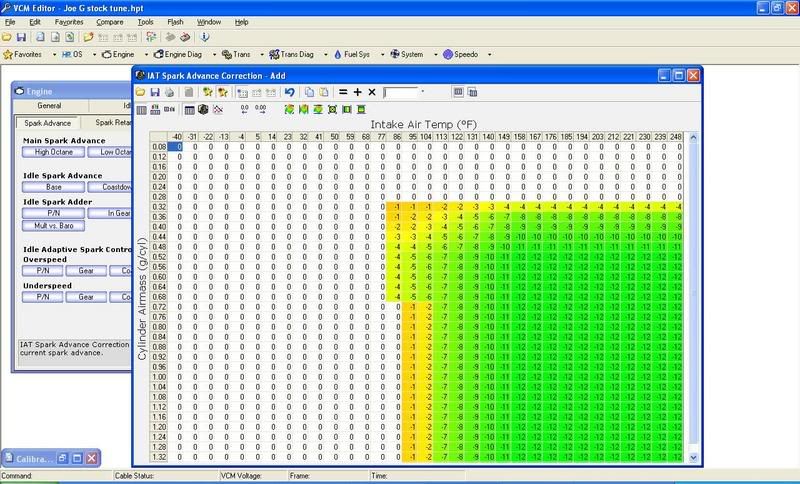
The benefit to a CAI, particularly in a stock tune, is because the stock tune pulls 12 degrees of timing at 158 degrees IAT (that's about ½ of commanded timing and is a major reduction in horsepower). On 70 degree days I've scanned 150+ IAT's in the staging lanes on a stock Z06 and it didn't get down to near ambient until after the ⅛ mile. It takes some time, this case about 7 seconds.
Here is a stock IAT timing table - look how much timing is pulled at relatively low IAT's starting at 100 degrees.

If you scan your cars you can tell if you have a restriction by monitoring your MAP value. When the engine is off you should see MAP of 1 as there is obviously no vacuum. As vacuum goes up the MAP reading goes down, my car idles at .60 or so. Stock would be lower as my cam reduces my vacuum. Any reading lower than .99 or 1.0 at WOT indicates a restriction in the intake tract. With my Vararam at WOT I typically see MAP of .99 to 1.01 when making pass. I use a K&N filter, I switched to a more dense filter and saw .94-.95 MAP's, meaning the engine was pulling some vacuum at WOT and I had a restriction and I noticed slightly slower ET's.
I've had my car up to 185 mph a few times at the Miami Mile event. I did NOT see my map go over 1.01 even at 185 mph, so I do not think there is any real "ram air" effect at any speed the car is capable of.
The benefit of the CAI is due to the cooler IAT as the timing table above shows.
Race Director
Joined: Mar 2005
Posts: 11,549
Likes: 27
From: Southampton NJ
This is accurate.
The benefit to a CAI, particularly in a stock tune, is because the stock tune pulls 12 degrees of timing at 158 degrees IAT (that's about ½ of commanded timing and is a major reduction in horsepower). On 70 degree days I've scanned 150+ IAT's in the staging lanes on a stock Z06 and it didn't get down to near ambient until after the ⅛ mile. It takes some time, this case about 7 seconds.
Here is a stock IAT timing table - look how much timing is pulled at relatively low IAT's starting at 100 degrees.
If you scan your cars you can tell if you have a restriction by monitoring your MAP value. When the engine is off you should see MAP of 1 as there is obviously no vacuum. As vacuum goes up the MAP reading goes down, my car idles at .60 or so. Stock would be lower as my cam reduces my vacuum. Any reading lower than .99 or 1.0 at WOT indicates a restriction in the intake tract. With my Vararam at WOT I typically see MAP of .99 to 1.01 when making pass. I use a K&N filter, I switched to a more dense filter and saw .94-.95 MAP's, meaning the engine was pulling some vacuum at WOT and I had a restriction and I noticed slightly slower ET's.
I've had my car up to 185 mph a few times at the Miami Mile event. I did NOT see my map go over 1.01 even at 185 mph, so I do not think there is any real "ram air" effect at any speed the car is capable of.
The benefit of the CAI is due to the cooler IAT as the timing table above shows.
The benefit to a CAI, particularly in a stock tune, is because the stock tune pulls 12 degrees of timing at 158 degrees IAT (that's about ½ of commanded timing and is a major reduction in horsepower). On 70 degree days I've scanned 150+ IAT's in the staging lanes on a stock Z06 and it didn't get down to near ambient until after the ⅛ mile. It takes some time, this case about 7 seconds.
Here is a stock IAT timing table - look how much timing is pulled at relatively low IAT's starting at 100 degrees.
If you scan your cars you can tell if you have a restriction by monitoring your MAP value. When the engine is off you should see MAP of 1 as there is obviously no vacuum. As vacuum goes up the MAP reading goes down, my car idles at .60 or so. Stock would be lower as my cam reduces my vacuum. Any reading lower than .99 or 1.0 at WOT indicates a restriction in the intake tract. With my Vararam at WOT I typically see MAP of .99 to 1.01 when making pass. I use a K&N filter, I switched to a more dense filter and saw .94-.95 MAP's, meaning the engine was pulling some vacuum at WOT and I had a restriction and I noticed slightly slower ET's.
I've had my car up to 185 mph a few times at the Miami Mile event. I did NOT see my map go over 1.01 even at 185 mph, so I do not think there is any real "ram air" effect at any speed the car is capable of.
The benefit of the CAI is due to the cooler IAT as the timing table above shows.
Tech Contributor
Joined: Jul 2002
Posts: 14,950
Likes: 264
From: St. Louis, MO
St. Jude Donor '08
You bet. Here's a little secret - if you reduce the timing pulled on that table you can get a quick 25 rwhp or more on the dyno or on the track, particularly on a hot day, just by adding back the 12 degrees of timing the car is pulling. 2 minutes tuning and you look like a hero!
Corvette Stories
The Best of Corvette for Corvette Enthusiasts

150 hp to 1,250 hp: Every Corvette Generation Compared by the Specs That Matter
Joe Kucinski
8 Coolest Corvette Pace Cars (and Replicas) of All Time
Verdad Gallardo
Top 10 Corvette Engines RANKED by Peak Torque (70+ Years of Muscle!)
Joe Kucinski
Corvette ZR1X Will Be Pacing the Indy 500, And Could Probably Race, Too!
Verdad Gallardo
Top 10 Corvettes Coming to Mecum Indy 2026!
Brett Foote
Top 10 C9 Corvette MUST-HAVES to Fix These C8 Generation Flaws!
Michael S. Palmer
10 Revolutionary 'Corvette Firsts' Most People Don't Know
Joe Kucinski
5 Reasons to Upgrade to an LS6-Powered Corvette; 5 Reasons to Stay LT2
Michael S. Palmer
2027 Corvette vs The World: Every C8 vs Its Closest Competitor
Joe Kucinski

Burning Brakes
Joined: Nov 2012
Posts: 968
Likes: 8
i would think if most cars were tuned the tuner should have changed the timing to iat temps i would think that would help some, so all the power isn't from the colder charge, like i have said many times, if it was then the 5/10 5 mph gains that i seen would be just from the first 100 ft, because after moving 100 ft off the starting line the temps are going down to ambient, and no gain on the dyno, so the cfm must get a boost from speed and air being forced into the vararam at least that's what it looks like. no other way i can explain it
Enough cars have sufficient material in front of the intake to both raise IAT's as well as provide restriction to CFM. Unless a person has already increased CFMM, nearing, this is just a wild guess/approximation, I'd have to do some math, but let's say 80-90%, then CFM changes, I think will still be the main power gain on an intake setup... unless the intake setup is not meant to gain power from CFM increase, and more specifically go towards 'cold air'. The easier and more direct power gains are increased CFM. Cod air will add some benefit. When you do get closer to maxing out CFM abilities of the engine, cold air - it it is a new addition to the engine, and a good system, should/may/will likely then start to exceed the gains from any additional CFM increases (like the power it takes as you approach light speed, to get the least little bit, becomes incrementally less.
For folks going from an OEM intake setup on these cars, to after market 'cold air', 'ram air', or ?.... it is my thoughts that the main gains are from increased CFM. Yes colder air will help some, and the more you approach the max CFM of an engine, while not utilizing cold air, then cold air will have a more significant impact, and eventually 'pass' the power gains over that of any CFM left possible.
Now, if you were a 'cold air' manuf, you can certainly discuss the gains your setup makes over the OEM HP of the car. Usually that is a base car (what-ever) setup, compared to a ram air/cold air install, with a tune usually, but not always.
If, scientifically and more accurate data/production wise one wants to consider the benefits of any system, I think you have to start off with the following general process, I hope to not forget a step or two:
1. Custom tune the base car. You will then have the optimum power of that car, given the environmental circumstances. That is usually a bit higher HP/TQ than the manuf reports for that vehicle. That becomes your base power number.
2. Take any intake gadget and test the CFM flow of that gadget, say ram air, or cold air or ?.... install it and custom tune, with about same/similar environmental conditions. Nothing is going to be perfect, and we are looking to get some generally approx numbers. If it is just a new intake, not changing to 'cold air' or ram air, then you can compare those two differences. The gains, or loss, will be attributed to the CFM increase/decrease of the new intake.
3. For 'cold air' and the like, take the rough average IAT off an OEM setup, duplicate that temp/range and input that temp air into the 'cold air' intake. Custom tune. You then have the CFM equivalent flow of that unit, minus 'cold air'.
Now remove the induction of average inlet temps air, now using the 'pure' ambient or what-ever it pulls in, intake of the cold air setup, and re-tune, and you should be reasonably close, never perfect as a days temps change, but reasonably close to what gains come from 'cold air', minus the HP/TQ gains from step 3.
You now have 'cold air' power from the gadget.
A tuner can certainly adjust timing, etc, on a tune, and that should be done/is done when adjusting for increased CFM, so increase the fuel, decreased IAT's so if the PCM can not self adjust sufficiently, and many PCM's do not have sufficient sensitivity and range to self adjust from intake setups, and perhaps cold air setups, then the tuner must.
I hope I am not leaving things out.
This discussion is academic, I suppose. I use to test a good number of claims on air intake setups, after market filters, custom exhausts, etc. Most of the claims of gains made were made from an untuned base vehicle. This is deceptive as there is HP left on the table by the OEM tune, until a custom tune has been done, even without any mods.
None of the manuf then did sufficient testing to support much of those claims of increased power.. etc. from their product, though they did make claims. Most of them claimed power over the OEM setup, which is typically easy to do when you open up the intake CFM flow, exhaust side as well. Some claimed cold air was the main benefit, some ram air, some it was just a more 'free flow' filter. Providing they first custom tuned the OEM setup, then their numbers would be relatively accurate considering CFM changes. None ever ruled out CFM additions with cold air or ram air.
Some of the more aggressive manufs were claiming 16 HP gain when changing to their exhaust. Well, the truth of the matter was that if you tuned the base first, and installed the exhaust and retuned, you discover that the actual HP gains from the exhaust were more like 5-7/8 HJP gains. A few actually lost power. Same went for the intake setup/col air, ram air, 'free flow'.
I know I nit-picking, but that is part of my job.

Last edited by J Christensen; Nov 30, 2013 at 03:38 AM.
Burning Brakes
Joined: Nov 2012
Posts: 968
Likes: 8
You bet. Here's a little secret - if you reduce the timing pulled on that table you can get a quick 25 rwhp or more on the dyno or on the track, particularly on a hot day, just by adding back the 12 degrees of timing the car is pulling. 2 minutes tuning and you look like a hero!
Burning Brakes
Joined: Nov 2012
Posts: 968
Likes: 8
This is accurate.
The benefit to a CAI, particularly in a stock tune, is because the stock tune pulls 12 degrees of timing at 158 degrees IAT (that's about ½ of commanded timing and is a major reduction in horsepower). On 70 degree days I've scanned 150+ IAT's in the staging lanes on a stock Z06 and it didn't get down to near ambient until after the ⅛ mile. It takes some time, this case about 7 seconds.
Here is a stock IAT timing table - look how much timing is pulled at relatively low IAT's starting at 100 degrees.
If you scan your cars you can tell if you have a restriction by monitoring your MAP value. When the engine is off you should see MAP of 1 as there is obviously no vacuum. As vacuum goes up the MAP reading goes down, my car idles at .60 or so. Stock would be lower as my cam reduces my vacuum. Any reading lower than .99 or 1.0 at WOT indicates a restriction in the intake tract. With my Vararam at WOT I typically see MAP of .99 to 1.01 when making pass. I use a K&N filter, I switched to a more dense filter and saw .94-.95 MAP's, meaning the engine was pulling some vacuum at WOT and I had a restriction and I noticed slightly slower ET's.
I've had my car up to 185 mph a few times at the Miami Mile event. I did NOT see my map go over 1.01 even at 185 mph, so I do not think there is any real "ram air" effect at any speed the car is capable of.
The benefit of the CAI is due to the cooler IAT as the timing table above shows.
The benefit to a CAI, particularly in a stock tune, is because the stock tune pulls 12 degrees of timing at 158 degrees IAT (that's about ½ of commanded timing and is a major reduction in horsepower). On 70 degree days I've scanned 150+ IAT's in the staging lanes on a stock Z06 and it didn't get down to near ambient until after the ⅛ mile. It takes some time, this case about 7 seconds.
Here is a stock IAT timing table - look how much timing is pulled at relatively low IAT's starting at 100 degrees.
If you scan your cars you can tell if you have a restriction by monitoring your MAP value. When the engine is off you should see MAP of 1 as there is obviously no vacuum. As vacuum goes up the MAP reading goes down, my car idles at .60 or so. Stock would be lower as my cam reduces my vacuum. Any reading lower than .99 or 1.0 at WOT indicates a restriction in the intake tract. With my Vararam at WOT I typically see MAP of .99 to 1.01 when making pass. I use a K&N filter, I switched to a more dense filter and saw .94-.95 MAP's, meaning the engine was pulling some vacuum at WOT and I had a restriction and I noticed slightly slower ET's.
I've had my car up to 185 mph a few times at the Miami Mile event. I did NOT see my map go over 1.01 even at 185 mph, so I do not think there is any real "ram air" effect at any speed the car is capable of.
The benefit of the CAI is due to the cooler IAT as the timing table above shows.