








Catch Can

Thread Starter
Instructor

Joined: May 2013
Posts: 184
Likes: 2
 Catch Can
I have a c6 corvette that I plan on adding an YSI supercharger to get 800rwhp. My last A&A Si trim constantly oiled up my air filter and I was wondering if I purchased an catch can that would help out with all the oil that keeps gumming up my air filter. With the Si trim it was pretty bad, I'm really worried about the YSI version as it will be moving more air thus creating even an bigger mess. I spoke with a rep from A&A and he basically said instead of 10qts of oil only put in 8qts because of the blow by on the sc. This puts me on the edge a little as I'm worried about the car not being oiled properly under hard acceleration. my big question is do these oil catch cans really work.

Race Director


Joined: Dec 2013
Posts: 12,502
Likes: 3,629
With S/C, under boost pressure, the dirty side has a back ckeck vavle so you not dumping pressure out the intake manifold port, and all the blow by boost past the pistons is coming through the clean side isntead. Hence blow by boost out of the valve covers, to the oil tank, and out of the front tank port into the air filter system.
So catch can is installed between the oil take vent, and the air intake port.
The mighty mouse has a filtered one way vavle on it to help dump some of that pressure out if mounted on the dirty side (into the engine bay area that can create a mess over time), but your still seeing pressure on the oil catch can on a dry sump system as well.
So due to such, like to run a dual can set up on both clean and dirty sides, and on the valley port line to the dirtily catch can, a blow off valve with line that I can route down and out the bottom of engine bay to dump the excess pressure under boost, instead of the excess dump boost into the engine bay area isntead.
As for dual catch cans, like the dual radium can set, since it has dip sticks on each can to see if its time to dump the oil out of the cans, pulls the bottom of the can screws off to make dumping the cans a snap as well.


So catch can is installed between the oil take vent, and the air intake port.
The mighty mouse has a filtered one way vavle on it to help dump some of that pressure out if mounted on the dirty side (into the engine bay area that can create a mess over time), but your still seeing pressure on the oil catch can on a dry sump system as well.
So due to such, like to run a dual can set up on both clean and dirty sides, and on the valley port line to the dirtily catch can, a blow off valve with line that I can route down and out the bottom of engine bay to dump the excess pressure under boost, instead of the excess dump boost into the engine bay area isntead.
As for dual catch cans, like the dual radium can set, since it has dip sticks on each can to see if its time to dump the oil out of the cans, pulls the bottom of the can screws off to make dumping the cans a snap as well.
Race Director
Joined: Dec 2013
Posts: 12,502
Likes: 3,629
Installed on the clean or dirty side.
Again, with S/C, you have to install a one way valve on the intake manifold port so your not blowing boost pressure out the intake port, that shuts down the dirty side oil can during boost. Hence this means that all the boost blow-by/oil blow-by from the blower past the pistons is going to go out the valve cover ports (clean side), through the oil tank vent system and into the air cleaner system unchecked isntead.
As for the elite clean side oil separator that goes on the tank, works well with N/A motors, but not so well for high boost dry sump motors with the amount of pressure that your going to be pushing into the tank from the valve ports isntead.

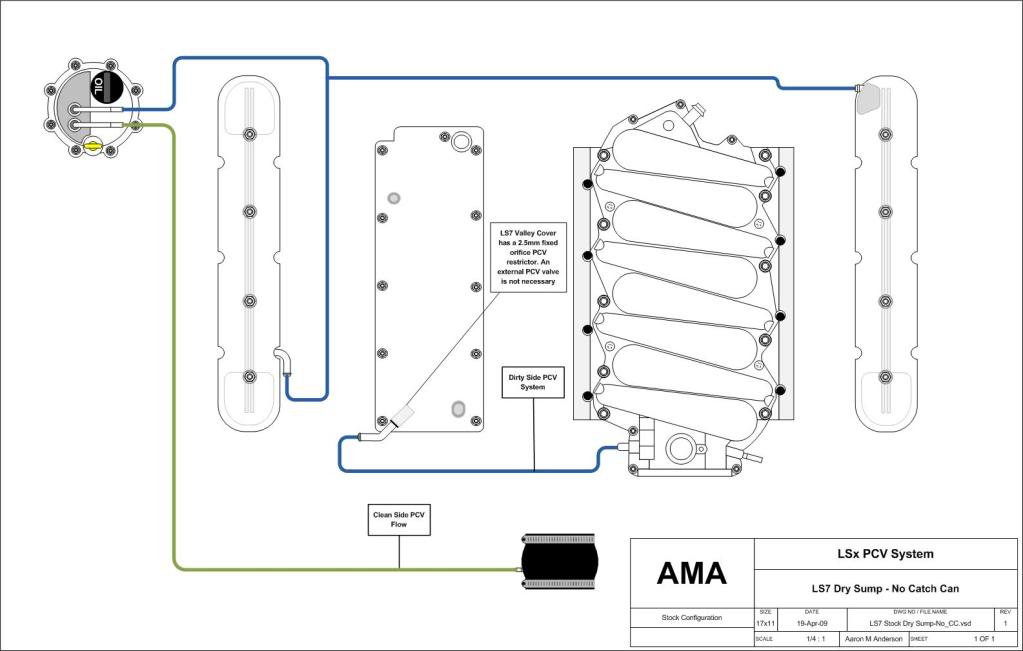
Again, with S/C, you have to install a one way valve on the intake manifold port so your not blowing boost pressure out the intake port, that shuts down the dirty side oil can during boost. Hence this means that all the boost blow-by/oil blow-by from the blower past the pistons is going to go out the valve cover ports (clean side), through the oil tank vent system and into the air cleaner system unchecked isntead.
As for the elite clean side oil separator that goes on the tank, works well with N/A motors, but not so well for high boost dry sump motors with the amount of pressure that your going to be pushing into the tank from the valve ports isntead.
Last edited by Dano523; Oct 20, 2018 at 08:05 PM.

Supporting Vendor


Joined: Aug 2013
Posts: 1,369
Likes: 294
From: Virginia
clean side separators and dual cans are hype and a band aid over a bullet hole.
oil is not the problem, it is the air. get control of the air and you will get control of the oil.
trying to catch the oil out of a line having an air flow problem, will only make the air flow problem worse.
i mean heck why don't we just cap all of these ports off then, and we wont have any oil leaving right, all better (no, not really).
__________________
Solutions for the common gearhead #made in USA
mightymousesolutions.com
facebok.com/mightymousesolutions
#mmsolutions
Six time NMCA True Street Champions
Home of the first Twin Turbo C7Z 7.81 @ 176
3470# Stock bottom end and heads Corvette Stock Bottom End Record Holder
Solutions for the common gearhead #made in USA
mightymousesolutions.com
facebok.com/mightymousesolutions
#mmsolutions
Six time NMCA True Street Champions
Home of the first Twin Turbo C7Z 7.81 @ 176
3470# Stock bottom end and heads Corvette Stock Bottom End Record Holder
Corvette Stories
The Best of Corvette for Corvette Enthusiasts

150 hp to 1,250 hp: Every Corvette Generation Compared by the Specs That Matter
Joe Kucinski
8 Coolest Corvette Pace Cars (and Replicas) of All Time
Verdad Gallardo
Top 10 Corvette Engines RANKED by Peak Torque (70+ Years of Muscle!)
Joe Kucinski
Corvette ZR1X Will Be Pacing the Indy 500, And Could Probably Race, Too!
Verdad Gallardo
Top 10 Corvettes Coming to Mecum Indy 2026!
Brett Foote
Top 10 C9 Corvette MUST-HAVES to Fix These C8 Generation Flaws!
Michael S. Palmer
10 Revolutionary 'Corvette Firsts' Most People Don't Know
Joe Kucinski
5 Reasons to Upgrade to an LS6-Powered Corvette; 5 Reasons to Stay LT2
Michael S. Palmer
2027 Corvette vs The World: Every C8 vs Its Closest Competitor
Joe Kucinski
Le Mans Master


Joined: Apr 2011
Posts: 7,820
Likes: 410
From: Montreal
St. Jude Donor '13
David is 100% right. There is absolutely no mess or fumes with his cans. I had an elite can before his and its crap. Just couldn't do the job properly.
Its great that everyone wants to help but too often things are said when the author has no real experience with the product. Lots of assumptions made, based on hearsay, or bad experience with other products.
Its great that everyone wants to help but too often things are said when the author has no real experience with the product. Lots of assumptions made, based on hearsay, or bad experience with other products.
Race Director
Joined: Dec 2013
Posts: 12,502
Likes: 3,629
Dave, the only problem I see with a single catch can, if during boost, the dirty side back into the intake is closed off (one way valve so your not losing pressure out the intake, which means that you have pressure from the oil tank to the intake manifold that is not being addressed.
So at boost, you have pressure on both the valve covers and the valley covers from the blow by getting past the pistons, and without a catch can/oil separator on the oil can side to air filter side port, your still pushing oil/vapor to the intake.
Hence if I take this diagram with single can set up, then under boost when all the pressure is out of the motor from pressure blow by on both the valley cover and both vavle covers , your actually dumping the dirty side of the system from the valley cover, directly into the air filter side unchecked from what pressure has not blow through the can blow filter valve isntead.
https://doc-00-3c-docs.googleusercon...lptSk9ZVndYSnc
Hell, I'm easy and if you have diagrams for the dry sump motors with super charger that shows the pressure flow under non boost condition when the can should be under a vacuum with one way valve, and then during boost with the correct pressure flows arrows out of the motor on all the valley and valve cover ports, maybe then could understand how your design works to catch all the excess oil with a single can/keeps the system EPA legal by no venting excess vapors into the atmosphere isntead.
Again, can blow off valve (with filter in your case) should only be to control excess pressure that can no be directed into the intake filter port during boost that may burst something in the PVC system, and not to just have the system under boost just blowing all the piston blow-by pressure/vapors out of the motor block into the atmosphere, like back in 60's with just a breather filter on the oil fill cap; that is currently only allowed for off road use vehicles only.
So at boost, you have pressure on both the valve covers and the valley covers from the blow by getting past the pistons, and without a catch can/oil separator on the oil can side to air filter side port, your still pushing oil/vapor to the intake.
Hence if I take this diagram with single can set up, then under boost when all the pressure is out of the motor from pressure blow by on both the valley cover and both vavle covers , your actually dumping the dirty side of the system from the valley cover, directly into the air filter side unchecked from what pressure has not blow through the can blow filter valve isntead.
https://doc-00-3c-docs.googleusercon...lptSk9ZVndYSnc
Hell, I'm easy and if you have diagrams for the dry sump motors with super charger that shows the pressure flow under non boost condition when the can should be under a vacuum with one way valve, and then during boost with the correct pressure flows arrows out of the motor on all the valley and valve cover ports, maybe then could understand how your design works to catch all the excess oil with a single can/keeps the system EPA legal by no venting excess vapors into the atmosphere isntead.
Again, can blow off valve (with filter in your case) should only be to control excess pressure that can no be directed into the intake filter port during boost that may burst something in the PVC system, and not to just have the system under boost just blowing all the piston blow-by pressure/vapors out of the motor block into the atmosphere, like back in 60's with just a breather filter on the oil fill cap; that is currently only allowed for off road use vehicles only.
Last edited by Dano523; Oct 24, 2018 at 02:43 AM.
Supporting Vendor
Joined: Aug 2013
Posts: 1,369
Likes: 294
From: Virginia
dave, the only problem i see with a single catch can, if during boost, the dirty side back into the intake is closed off (one way valve so your not losing pressure out the intake, which means that you have pressure from the oil tank to the intake manifold that is not being addressed.
i think you meant 'pressure from the oil tank to the cold air intake that is not being addressed'
-that flow comes from the engine, through the tank, and it is the design of the oem pcv system for this to happen, either direct out of the valve cover for wet sump, or routed through the tank on dry sump
so at boost, you have pressure on both the valve covers and the valley covers from the blow by getting past the pistons, and without a catch can/oil separator on the oil can side to air filter side port, your still pushing oil/vapor to the intake.
-every gasoline car on the road today has a vent pipe like this, and almost none have clean side fouling, only those with mechanical issue, or that have surpassed the factory layouts vent capability with increased power or other mechanical changes that increase cylinder leakage
hence if i take this diagram with single can set up, then under boost when all the pressure is out of the motor from pressure blow by on both the valley cover and both vavle covers , your actually dumping the dirty side of the system from the valley cover, directly into the air filter side unchecked from what pressure has not blow through the can blow filter valve isntead.
-a catch can system like my pcv can or as it comes in many of the 'wild' systems, this flow can be reduced or eliminated per the owners desire. My personal opinion is that if it ain't broke (oil) then don't fix it.
https://doc-00-3c-docs.googleusercon...lptsk9zvndysnc
your link is private
hell, i'm easy and if you have diagrams for the dry sump motors with super charger that shows the pressure flow under non boost condition when the can should be under a vacuum with one way valve, and then during boost with the correct pressure flows arrows out of the motor on all the valley and valve cover ports, maybe then could understand how your design works to catch all the excess oil with a single can/keeps the system epa legal by no venting excess vapors into the atmosphere isntead.
i think i know what you are getting at here. My cans have two top options, one is the filter top, to equalize the crankcase directly to atmosphere (most popular, to avoid more fumes consumption vs. Cool oxygen rich air for maximum power), and a fitting top that can be sent out of the engine bay for sensitive noses or road racing, or sent to the airbox / main air filter for visual inspection (not that any emissions modification is legal anyway)
likely to do more confusion than clarification but since you asked, here is the ls7 diagram from my high power boost friendly pcv catch can system. This can be set up for 1200hp of control as shipped or up to 1500 as a dual inlet.

again, can blow off valve (with filter in your case) should only be to control excess pressure that can no be directed into the intake filter port during boost that may burst something in the pvc system, and not to just have the system under boost just blowing all the piston blow-by pressure/vapors out of the motor block into the atmosphere, like back in 60's with just a breather filter on the oil fill cap; that is currently only allowed for off road use vehicles only.
how you assume my catch cans should be used, and how thousands of satisfied customers actually use them can be different, and i am ok with that , again no emissions modification is technically legal, and i believe the first scenario is not far off of how i describe my aggressive pcv build.
last anyone that assumes the valley plate plays a role in crankcase pressure control, please do yourself a favor, push a hose onto it, and try blowing into / sucking out of it before you post again.
i think you meant 'pressure from the oil tank to the cold air intake that is not being addressed'
-that flow comes from the engine, through the tank, and it is the design of the oem pcv system for this to happen, either direct out of the valve cover for wet sump, or routed through the tank on dry sump
so at boost, you have pressure on both the valve covers and the valley covers from the blow by getting past the pistons, and without a catch can/oil separator on the oil can side to air filter side port, your still pushing oil/vapor to the intake.
-every gasoline car on the road today has a vent pipe like this, and almost none have clean side fouling, only those with mechanical issue, or that have surpassed the factory layouts vent capability with increased power or other mechanical changes that increase cylinder leakage
hence if i take this diagram with single can set up, then under boost when all the pressure is out of the motor from pressure blow by on both the valley cover and both vavle covers , your actually dumping the dirty side of the system from the valley cover, directly into the air filter side unchecked from what pressure has not blow through the can blow filter valve isntead.
-a catch can system like my pcv can or as it comes in many of the 'wild' systems, this flow can be reduced or eliminated per the owners desire. My personal opinion is that if it ain't broke (oil) then don't fix it.
https://doc-00-3c-docs.googleusercon...lptsk9zvndysnc
your link is private
hell, i'm easy and if you have diagrams for the dry sump motors with super charger that shows the pressure flow under non boost condition when the can should be under a vacuum with one way valve, and then during boost with the correct pressure flows arrows out of the motor on all the valley and valve cover ports, maybe then could understand how your design works to catch all the excess oil with a single can/keeps the system epa legal by no venting excess vapors into the atmosphere isntead.
i think i know what you are getting at here. My cans have two top options, one is the filter top, to equalize the crankcase directly to atmosphere (most popular, to avoid more fumes consumption vs. Cool oxygen rich air for maximum power), and a fitting top that can be sent out of the engine bay for sensitive noses or road racing, or sent to the airbox / main air filter for visual inspection (not that any emissions modification is legal anyway)
likely to do more confusion than clarification but since you asked, here is the ls7 diagram from my high power boost friendly pcv catch can system. This can be set up for 1200hp of control as shipped or up to 1500 as a dual inlet.
again, can blow off valve (with filter in your case) should only be to control excess pressure that can no be directed into the intake filter port during boost that may burst something in the pvc system, and not to just have the system under boost just blowing all the piston blow-by pressure/vapors out of the motor block into the atmosphere, like back in 60's with just a breather filter on the oil fill cap; that is currently only allowed for off road use vehicles only.
how you assume my catch cans should be used, and how thousands of satisfied customers actually use them can be different, and i am ok with that
, again no emissions modification is technically legal, and i believe the first scenario is not far off of how i describe my aggressive pcv build.last anyone that assumes the valley plate plays a role in crankcase pressure control, please do yourself a favor, push a hose onto it, and try blowing into / sucking out of it before you post again.
Last edited by David@MMS; Oct 24, 2018 at 10:13 AM.



Cruising
Joined: Mar 2018
Posts: 12
Likes: 4
From: Glencoe California
Why not "do it right the first time", and put a vacuum pump system on it? https://www.gzmotorsports.com/SPVPK-...-pump-kit.html

Supporting Vendor
Joined: Aug 2013
Posts: 1,369
Likes: 294
From: Virginia
Why not "do it right the first time", and put a vacuum pump system on it? https://www.gzmotorsports.com/SPVPK-...-pump-kit.html
and don't forget the vac pump needs to discharge to... a catch can!

Le Mans Master
Joined: Apr 2013
Posts: 5,376
Likes: 1,118
I would love it if someone would “do it right” and build an electric vacuum pump that could actually create sufficient vacuum in the crankcase of an FI car. But I suspect that would be a very expensive kit, judging by the price of, say, a Mezeire electric WP for these cars. Because Unreal is right, there’s nowhere to mount a belt driven vacuum pump on a blower car, and these cars already have too much **** being driven by the belt now as it is, and there no friggin way you can fit a mandrel on the front of a C6 balancer to drive the pump like on a conventional race car setup. And, as David says, you still need a catch can. And, IMV, the whole world knows that MMS sells the best (as in tested and proven) kits for these cars, and David actually takes the time to give advice on here, to boot. So that’s what I’m going with myself - a MMS PVC setup.
Supporting Vendor
Joined: Aug 2013
Posts: 1,369
Likes: 294
From: Virginia
I experimented / tested electric crank pumps a long time ago, something like 15 years as you can tell how long ago by the video quality!
aside from expected complications, there is the reliability issue, much like an electric water pump giving you a quick overheat when it failed, an electric scavenge pump would give you an instant crank pressure spike and possible seal blow out.
most notably i also found no improvement in daily driving or drag race results with the aux. pump. to back that up even the best mechanical pumps claim around 5% power increase (feel free to do an independent search and math here), so all things considering IMO it just ain't worth it.
aside from expected complications, there is the reliability issue, much like an electric water pump giving you a quick overheat when it failed, an electric scavenge pump would give you an instant crank pressure spike and possible seal blow out.
most notably i also found no improvement in daily driving or drag race results with the aux. pump. to back that up even the best mechanical pumps claim around 5% power increase (feel free to do an independent search and math here), so all things considering IMO it just ain't worth it.
Le Mans Master
Joined: Apr 2013
Posts: 5,376
Likes: 1,118
I experimented / tested electric crank pumps a long time ago, something like 15 years as you can tell how long ago by the video quality!
https://www.youtube.com/watch?v=v_ChdA_AjL0
aside from expected complications, there is the reliability issue, much like an electric water pump giving you a quick overheat when it failed, an electric scavenge pump would give you an instant crank pressure spike and possible seal blow out.
most notably i also found no improvement in daily driving or drag race results with the aux. pump. to back that up even the best mechanical pumps claim around 5% power increase (feel free to do an independent search and math here), so all things considering IMO it just ain't worth it.
https://www.youtube.com/watch?v=v_ChdA_AjL0
aside from expected complications, there is the reliability issue, much like an electric water pump giving you a quick overheat when it failed, an electric scavenge pump would give you an instant crank pressure spike and possible seal blow out.
most notably i also found no improvement in daily driving or drag race results with the aux. pump. to back that up even the best mechanical pumps claim around 5% power increase (feel free to do an independent search and math here), so all things considering IMO it just ain't worth it.
Cruising
Joined: Mar 2018
Posts: 12
Likes: 4
From: Glencoe California
We have hundreds of LS street kits in use, and very few complaints or failures. If you want about 15-20 HP, cleaner oil, no leaks, and no oil in your combustion chambers, a vacuum pump is far from "sort of ridiculous". you do need to drain the catch can occasionally, and there can be some odor. I personally have one on my hot rod shop truck and my race cars, but not on the Camaro family car.