



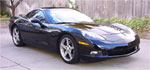


Install Ram Air Kit Now Engine Light On.

Melting Slicks


Joined: Aug 2000
Posts: 2,568
Likes: 0
From: Miami Fl

Originally Posted by lwilliams1950
Yeah I have some good pics. How do I insert them so you can see them online here?
I did it through the upload pictures option on the site, dont know how to put pix on posts..

Race Director

Joined: May 2000
Posts: 12,712
Likes: 2,271
Originally Posted by mlongo99
Having less restriction in your intake is not the only thing that affects power. It's also important to have laminar (smooth) flow for as long as possible until the fuel is mixed in. Having nothing before the throttle body probably causes the flow to be more turbulent. Turbulence is a form of restriction. It causes more pressure drop which means less flow. Thats why a polished manifold makes more power. Another point to consider is that the air at the throttle body is likely to be significantly warmer than the air by the intake, especially if the hood is closed.
I'd guess that the temperature difference is the main culprit of no power gain with turbulent flow making a smaller but significant contribution.
I'd guess that the temperature difference is the main culprit of no power gain with turbulent flow making a smaller but significant contribution.
Duke

Le Mans Master


Joined: Nov 1999
Posts: 7,695
Likes: 51
From: Imperial Beach CA
Originally Posted by SWCDuke
For all you experts out there who don't have the benefit of an education in fluid mechanics you will find that if you compute the Reynolds number for the air bridge and throttle body, the flow is fully turbulent at any WOT setting much above idle speed.
Duke
Duke

Melting Slicks
Joined: Mar 1999
Posts: 2,324
Likes: 0
From: Fort Lauderdale Fl
We do try to keep the cars at a consistent temp when running on the dyno. When we test our cars we run 3 runs stock let her cool 20 min, run 3 more with mods let her cool 20 min, go back to stock for 3 more then another 20min then back to mods. As for the power gains we not only did them on the dyno but backed them up at the track. We did gain about 5 to 6 tenths on an auto car with our Airbox and Headers. That gain was with only 3 mods, Vortex Ram Induction, BPP long tube step headers and our X-pipe. As you see we do not just sit back and give you dyno numbers we are the only manufacture that not only attends Corvette race events but also participate. If our systems did not perform we would not be there. When we go to the shows that have drag events we install our products onsite and guarantee a performance gain or we will replace it back to stock. In the years of doing business we have called out other manufactures to do the same but got no response.
Our customers are our best salesmen. All who have had the Vortex Ram Induction have been pleased with its performance gains of 2 to 4 tenths. We also stand behind them that if you do not feel a seat in the pants gain we will refund your money.
The Vortex Ram Induction System is the first ram induction for the C6.
We plan on going to the track again next Wed if anyone would like to come watch. As for all the products we manufacture the Vortex Ram Induction is the biggest bang for the buck.
Ernie
www.BreathlessPerformance.com
Our customers are our best salesmen. All who have had the Vortex Ram Induction have been pleased with its performance gains of 2 to 4 tenths. We also stand behind them that if you do not feel a seat in the pants gain we will refund your money.
The Vortex Ram Induction System is the first ram induction for the C6.
We plan on going to the track again next Wed if anyone would like to come watch. As for all the products we manufacture the Vortex Ram Induction is the biggest bang for the buck.
Ernie
www.BreathlessPerformance.com

Drifting

Joined: Nov 2004
Posts: 1,489
Likes: 29
From: Georgia
Everyone in the South Florida area COME TO MOROSO on the 24th of Nov!
$10 to watch $15 to race. Bring a Helmut if you are going to race and pants.
Go here for directions and more info.
http://www.morosomotorsportspark.com/
$10 to watch $15 to race. Bring a Helmut if you are going to race and pants.
Go here for directions and more info.
http://www.morosomotorsportspark.com/

Drifting
Joined: Nov 2004
Posts: 1,417
Likes: 0
Originally Posted by lwilliams1950
Any way to just post the pics on this site without having to link them somewhere. I would be glad to do so.
Email is torysimmers@gmail.com

Corvette Stories
The Best of Corvette for Corvette Enthusiasts

Top 10 Most Expensive Corvettes Ever Sold on Bring A Trailer
Brett Foote
10 Things Every Corvette Owner Needs (2026 Edition)
Michael S. Palmer
8 Most "Only Corvette Owners Understand" Quirks and Problems
Pouria Savadkouei
10 Reasons the C6 Z06 is Still A Performance Benchmark After 20 Years
Joe Kucinski
How Much Horsepower Every Corvette Engine "LOST" in 1972
Joe Kucinski
Top 10 DOs and DON'Ts for Protecting Your Convertible Top!
Michael S. Palmer
Top 10 Most Explosive Corvettes Ever Made: Power-to-Weight Ratio Ranked!
Joe Kucinski
150 hp to 1,250 hp: Every Corvette Generation Compared by the Specs That Matter
Joe Kucinski
8 Coolest Corvette Pace Cars (and Replicas) of All Time
Verdad Gallardo

Le Mans Master

Joined: Mar 1999
Posts: 6,744
Likes: 1
From: delmont pa
Cruise-In I Veteran
Cruise-In II Veteran
Originally Posted by jimman
Almost agree with most, a little iffy on the polish thing. When you have a polished surface you actually increase the surface resistance over a ruff finish do to no air pocket to form a surface. The temp thing is beat to death. I measured the temp under the hood and outside with a digital thermometer while driving, 78 degrees outside 80 degrees inside the hood at 50 mph. I always get in trouble on this forum when I raise these issues especially with headers. Someone is claiming a 44 ftlb increase with what I called and got creamed on a boogus base line that wasn't tested for repeatability.
Melting Slicks
Joined: Mar 1999
Posts: 2,324
Likes: 0
From: Fort Lauderdale Fl
I beg to differ on the temp issue.Next time hook up an autotap or tech 2 and look at the IAT sensor for the temp differance. Much greater then 5 to 10.
Ernie
www.BreathlessPerformance.com
Ernie
www.BreathlessPerformance.com

Le Mans Master
Joined: Mar 1999
Posts: 6,744
Likes: 1
From: delmont pa
Cruise-In I Veteran
Cruise-In II Veteran
Originally Posted by bpproducts
I beg to differ on the temp issue.Next time hook up an autotap or tech 2 and look at the IAT sensor for the temp differance. Much greater then 5 to 10.
Ernie
www.BreathlessPerformance.com
Ernie
www.BreathlessPerformance.com
Melting Slicks
Joined: Mar 1999
Posts: 2,324
Likes: 0
From: Fort Lauderdale Fl
The air passing over the thermister is what counts. That is what the computer uses to dial in the spark and fuel tables.
Ernie
www.BreathlessPerformance.com
Ernie
www.BreathlessPerformance.com
Le Mans Master
Joined: Mar 1999
Posts: 6,744
Likes: 1
From: delmont pa
Cruise-In I Veteran
Cruise-In II Veteran
Originally Posted by bpproducts
The air passing over the thermister is what counts. That is what the computer uses to dial in the spark and fuel tables.
Ernie
www.BreathlessPerformance.com
Ernie
www.BreathlessPerformance.com
Le Mans Master
Joined: Nov 1999
Posts: 7,695
Likes: 51
From: Imperial Beach CA
Originally Posted by bpproducts
I beg to differ on the temp issue.Next time hook up an autotap or tech 2 and look at the IAT sensor for the temp differance. Much greater then 5 to 10.
Ernie
www.BreathlessPerformance.com
Ernie
www.BreathlessPerformance.com
Team Owner


Joined: Jul 2002
Posts: 37,049
Likes: 69
From: This city NEVER sleeps! Frank's back yard!
Originally Posted by clem zahrobsky
the computer allows for this cooling factor. anytime air is pulled thru a restriction it is cooled until it expands again that is why you have icing in carbs venturies if there is no heat added and that is why there is hot water to the TB on the vette. the A/C in your corvette works the same way, the gas,freon 134 is passed thru a restriction that causes it to lower it temp.


Le Mans Master

Joined: Oct 2001
Posts: 6,798
Likes: 25
From: Pine Bluff Arkansas
St. Jude Donor '08-'09-'10-'11-'12-'13-'14-'15-'16-'17-'18-‘19-'20-'21
It seems, that if your going a good speed that the temps would not be too much different, but at the drags your sucking hot air for 3/4 of the track without a true CAI.
Larry
Larry