



C7 construction?

Racer


Joined: Jun 2006
Posts: 285
Likes: 8

Ok what about the suspension? Transverse leaf springs or coilovers?
Corvette is the only sports car I know of that still uses leaf springs. Now if that was the best way to go then others would be using them also. I just would like GM to make great improvements to the Corvette. I have loved these cars for the past 30 years (I'm 40) and even though I could not swing a new C7 if GM makes a big leap with it maybe it will drive down the price of used C5 and C6s even more for me.
Corvette is the only sports car I know of that still uses leaf springs. Now if that was the best way to go then others would be using them also. I just would like GM to make great improvements to the Corvette. I have loved these cars for the past 30 years (I'm 40) and even though I could not swing a new C7 if GM makes a big leap with it maybe it will drive down the price of used C5 and C6s even more for me.
The leaf spring is a great source of confusion for many but really that has a lot to do with people not understanding what they are looking at and hearing "leaf" and thinking "hotchkiss with multi-layer leaf". I've said this many times but the problems that people associate with leaf spring suspension simply do not exist with the Corvette.
Leaf springs don't do a good job of locating an axle. Well that's not a problem for the Corvette. Leaf spring suspension has high unsprung weight. Well really it's the large rigid axle that's the problem. It's not so much that the leaf spring is heavy as compared to say a full set of suspension arms + springs. Nope, it's the rigid axle... which the Corvette hasn't had since '63. Leaf springs have stiction between the multiple layers of the spring. In really early cars that was used as a kind of damper. With the C3's a switch to the fiberglass spring is often accompanied by stiffer dampers to make up for the lost damping of the spring. Anyway, that again is not a problem with the fiberglass springs.
Why don't other cars use them? That's easy. Cost. They are expensive and really in most cases have little going for them. They in no way hurt performance vs a coil but they aren't radically better either. That means they aren't a very cost effective solution in may cases. If you read All Corvettes are Red you will see that GM wasn't planning on sticking with the leaf springs when doing the C5. The problem they ran into was packaging. They said they couldn't get coils in where they wanted them. It was raise the hood line or go with bell cranks or leaf springs. I'm sure the accountants would have been happy to dump them. Anyway, they were picked because they package very nicely.
No I'm sure you are thinking if the aftermarket can get coils in there why can't GM. I can only offer speculation. It's possible that GM doesn't think coils will last long enough. To get a stiff, high strength spring into a tight package you really have to stress the metal. Look at the size of a coil on the Honda Civic. It's a lot bigger than what you put on a Corvette yet the Civic weighs less. This ultimately means the aftermarket springs are running closer to the fatigue limit of the metal. So either they must use more expensive wire (or likely wire that is less corrosion resistant) or run the risk that the coils won't last the life of the car. Not cool. The leaf, assuming it's not exposed to chemicals or exhaust heat will last the life of the car.
BTW, others have used the leaf springs like the Corvette. GM pushed to get the fiberglass springs on cars but they didn't invent the material nor the way it's used on the Corvette. Fiat used a dual mount leaf spring before GM (though it was steel). The fiberglass spring was developed out of archery bows. It's also worth noting that the amount of spring energy you can store in a fiberglass spring is MUCH greater per lb vs steel. This, in a way, is a measure of how efficient a spring is. GM's use of these springs is out side the box thinking and a good thing.

Team Owner


Joined: Feb 2001
Posts: 27,254
Likes: 136
From: Short Hills, NJ
The leaf spring is a great source of confusion for many but really that has a lot to do with people not understanding what they are looking at and hearing "leaf" and thinking "hotchkiss with multi-layer leaf". I've said this many times but the problems that people associate with leaf spring suspension simply do not exist with the Corvette.
Leaf springs don't do a good job of locating an axle. Well that's not a problem for the Corvette. Leaf spring suspension has high unsprung weight. Well really it's the large rigid axle that's the problem. It's not so much that the leaf spring is heavy as compared to say a full set of suspension arms + springs. Nope, it's the rigid axle... which the Corvette hasn't had since '63. Leaf springs have stiction between the multiple layers of the spring. In really early cars that was used as a kind of damper. With the C3's a switch to the fiberglass spring is often accompanied by stiffer dampers to make up for the lost damping of the spring. Anyway, that again is not a problem with the fiberglass springs.
Why don't other cars use them? That's easy. Cost. They are expensive and really in most cases have little going for them. They in no way hurt performance vs a coil but they aren't radically better either. That means they aren't a very cost effective solution in may cases. If you read All Corvettes are Red you will see that GM wasn't planning on sticking with the leaf springs when doing the C5. The problem they ran into was packaging. They said they couldn't get coils in where they wanted them. It was raise the hood line or go with bell cranks or leaf springs. I'm sure the accountants would have been happy to dump them. Anyway, they were picked because they package very nicely.
No I'm sure you are thinking if the aftermarket can get coils in there why can't GM. I can only offer speculation. It's possible that GM doesn't think coils will last long enough. To get a stiff, high strength spring into a tight package you really have to stress the metal. Look at the size of a coil on the Honda Civic. It's a lot bigger than what you put on a Corvette yet the Civic weighs less. This ultimately means the aftermarket springs are running closer to the fatigue limit of the metal. So either they must use more expensive wire (or likely wire that is less corrosion resistant) or run the risk that the coils won't last the life of the car. Not cool. The leaf, assuming it's not exposed to chemicals or exhaust heat will last the life of the car.
BTW, others have used the leaf springs like the Corvette. GM pushed to get the fiberglass springs on cars but they didn't invent the material nor the way it's used on the Corvette. Fiat used a dual mount leaf spring before GM (though it was steel). The fiberglass spring was developed out of archery bows. It's also worth noting that the amount of spring energy you can store in a fiberglass spring is MUCH greater per lb vs steel. This, in a way, is a measure of how efficient a spring is. GM's use of these springs is out side the box thinking and a good thing.
Leaf springs don't do a good job of locating an axle. Well that's not a problem for the Corvette. Leaf spring suspension has high unsprung weight. Well really it's the large rigid axle that's the problem. It's not so much that the leaf spring is heavy as compared to say a full set of suspension arms + springs. Nope, it's the rigid axle... which the Corvette hasn't had since '63. Leaf springs have stiction between the multiple layers of the spring. In really early cars that was used as a kind of damper. With the C3's a switch to the fiberglass spring is often accompanied by stiffer dampers to make up for the lost damping of the spring. Anyway, that again is not a problem with the fiberglass springs.
Why don't other cars use them? That's easy. Cost. They are expensive and really in most cases have little going for them. They in no way hurt performance vs a coil but they aren't radically better either. That means they aren't a very cost effective solution in may cases. If you read All Corvettes are Red you will see that GM wasn't planning on sticking with the leaf springs when doing the C5. The problem they ran into was packaging. They said they couldn't get coils in where they wanted them. It was raise the hood line or go with bell cranks or leaf springs. I'm sure the accountants would have been happy to dump them. Anyway, they were picked because they package very nicely.
No I'm sure you are thinking if the aftermarket can get coils in there why can't GM. I can only offer speculation. It's possible that GM doesn't think coils will last long enough. To get a stiff, high strength spring into a tight package you really have to stress the metal. Look at the size of a coil on the Honda Civic. It's a lot bigger than what you put on a Corvette yet the Civic weighs less. This ultimately means the aftermarket springs are running closer to the fatigue limit of the metal. So either they must use more expensive wire (or likely wire that is less corrosion resistant) or run the risk that the coils won't last the life of the car. Not cool. The leaf, assuming it's not exposed to chemicals or exhaust heat will last the life of the car.
BTW, others have used the leaf springs like the Corvette. GM pushed to get the fiberglass springs on cars but they didn't invent the material nor the way it's used on the Corvette. Fiat used a dual mount leaf spring before GM (though it was steel). The fiberglass spring was developed out of archery bows. It's also worth noting that the amount of spring energy you can store in a fiberglass spring is MUCH greater per lb vs steel. This, in a way, is a measure of how efficient a spring is. GM's use of these springs is out side the box thinking and a good thing.
 Some people often give the Corvette a hard time for the leaf springs but they're not being utilized out of cheapness or for cost cutting reasons or even out of 'tradition' or 'resistance to change', they're there by choice.
 They're lightweight and they allow the car to remain low, sleek and aerodynamic while also maintaining awesome handling/braking characteristics WITH relatively smooth/comfortable ride quality all in one.
They're not antiquated at all, quite genius and innovative actually.


Safety Car


Joined: Nov 2002
Posts: 4,168
Likes: 1,336
From: FLL Florida
Ok what about the suspension? Transverse leaf springs or coilovers?
Corvette is the only sports car I know of that still uses leaf springs. Now if that was the best way to go then others would be using them also. I just would like GM to make great improvements to the Corvette. I have loved these cars for the past 30 years (I'm 40) and even though I could not swing a new C7 if GM makes a big leap with it maybe it will drive down the price of used C5 and C6s even more for me.
Corvette is the only sports car I know of that still uses leaf springs. Now if that was the best way to go then others would be using them also. I just would like GM to make great improvements to the Corvette. I have loved these cars for the past 30 years (I'm 40) and even though I could not swing a new C7 if GM makes a big leap with it maybe it will drive down the price of used C5 and C6s even more for me.
Corvette always improves the car from year to year. It evolves. The C7 will be an improved C6. Why mess with success? It will be the best value of any sports car once again. Dave Hill's C5 chassis and leaf spring is a stroke of pure genius. It was McClelland's idea. The C7 has evolved from the C4. Even the in house LS engine design exposed the useless Limey F1 engineers who designed the LT5 boat anchor. McClelland left under a cloud because of some dumb management rulings that Hill eventually overcame including the tight budget. Because of this, ingenuity prevailed which forced engineers to think out the box. Not that box, you filthy swine.
Some amazing design solutions occurred and an unusual chassis manifested itself which many Euro engineers are looking toward for inspiration. Every major sports car company has a few Corvettes around because this is their yardstick. I know, because I've seen them at Ferrari , Porsche and BMW. Hill looked toward other divisions including the trucks to create the C5. We have become so Europeanized that anything we do is automatically inferior. Look at the numbers, for God's sake. Corvette chassis is a combination of sound engineering solutions achieved under impossible budget constraints. Nothing about it falls into any traditional category. You can't successfully categorize the chassis type. Corvette is unique in everyway. It's Yankee ingenuity at it's height including the leaf springs and the pushrod engines which are cost effective and efficient and light. If you don't like what a Corvette stands for, there is always the Euro trash to turn to. None of them have the durability that Corvette requires in their punishing production requirements. Nothing is going to find it's way into a Corvette unless it is very strong. Show me a car that can take the thrashing of a Vette?
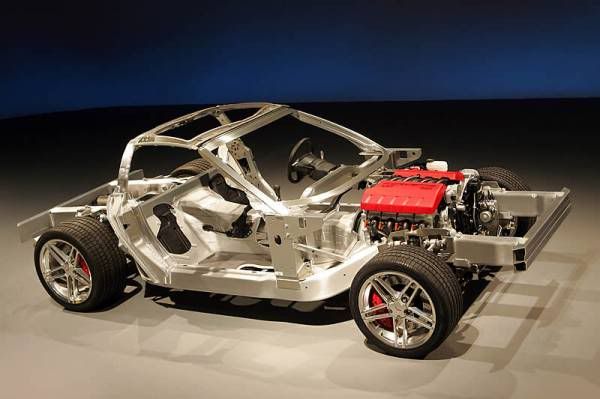 Some lunatic wants to see a big change in this chassis. Pray tell. What?
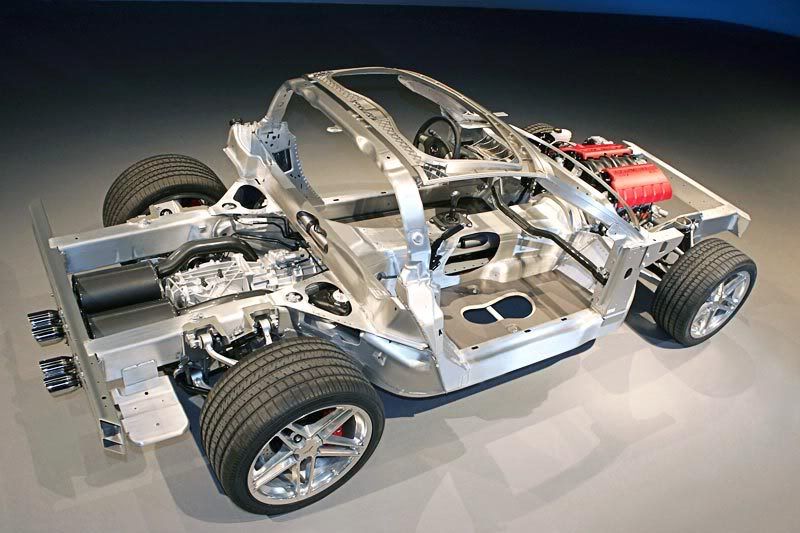 Put a label on this chassis. I dare you.
There is some serious BS on this thread with few exceptions. I laughed at the description of the various auto chassis and how Corvette needs to change theirs and their leaf springs,etc, etc. Some good reading material for those who don't enjoy things that are made up from minds that are unschooled in the sciences.
The Multibody Systems Approach to Vehicle Dynamics – Mike Blundell and Damian Harty
Race Car Vehicle Dynamics – William F. and Douglas L. Milliken Prepare to Win – Carroll Smith
Engineer to Win – Carroll Smith
'The Multibody Systems Approach to Vehicle Dynamics' by Blundell and Harty.
If you attend a university or tech college, join the Formula SAE group.
Anyway, back to Corvette's leaf springs: "If I were involved in the design of a new passenger vehicle, however, I would give serious consideration to the use of a transverse composite single leaf spring of unidirectional glass or carbon filament in an epoxy matrix. This would be the lightest practical spring configuration and, although space constraints would seem to limit its use in racing, it should be perfectly feasible on road-going vehicles, from large trucks to small commuter cars. (Since I wrote this paragraph the new-generation Corvette has come out with just such a spring to control its independent suspension systems-at both end of the car.)" In Carroll Smith's book, 'Engineer to Win'
Dave Hill, "We planned to use a massive front [roll] bar to achieve the roll stiffness we were after. We found, however, that by spreading the body attachment of the front suspension fiberglass spring into two separate attachments 18 inches apart, we could achieve a major portion of the roll stiffness contribution of the front roll bar for free. We still used a massive front bar, but it would have been even bigger."
FEA models of the Vette leaf spring under load show that the initial, unbent shape of the spring has an upward deflection on the right side of the spring resulting in a smaller upward movement on the left side so that a smaller ARBs can be implemented.
Other benefits are less unsprung weight and a lower CG. Coil springs contribute to unsprung weight that require heavier shocks for higher damping rates.
Avoids heavier hard point locators for coil/overs in the chassis which also lowers CG.
Loads are taken in the center of the chassis which translates into lower torsional loads on the frame.
Reduced size of ARBs or sway bars.
No Corvette composite spring has ever been replaced because of rate variation over its lifetime.
Ride height can be adjusted by changing the length of the end links with minimal effects on the spring rate.
OK, so there are some drawbacks: They cost more than twice as much as coils and they can influence drive train design because of their Xverse nature. Corvette is way ahead in this technology.
They are inherently more expensive to design and manufacture, particularly in performance applications. Corvette has persevered and there are amazing things coming in future Vettes. Cost of modification. As a result of specialized design and packaging, changing spring rates often requires a custom unit. Coil springs in various sizes and rates are available inexpensively.
Watch for Corvette competition solutions for the C7 leaf springs that will make coils obsolete. There are companies like VBP who have variations of Xverse leaf spring kits that allow independent adjustment of spring rate and ride height at all four corners of the car. With new patented mounts, the roll control with a single composite leaf can be adjusted without effecting spring rate.Composite springs are banned in most forms of racing including F1. Ever see those flex A arms and links?
Susceptibility to damage. Engine fluids and exhaust heat require attention to design detail.
.
Perception. Due to its association with spring-located solid axles, the leaf spring has a stigma attached to it. Remember that when you go to school to become an engineer, the stuff that you learn is 350 years old. There is little new except for materials and electronics.
So no more of this nonsense about Corvette's prehistoric chassis, leaf springs, wooden floorboards and pushrod technology already. This not only Corvette, this is American.

Le Mans Master


Joined: Jul 2010
Posts: 6,592
Likes: 2,649
From: Lancaster, PA
Re: Shaka
Very convincing. Almost made me a believer.
A few things.
You credit Dave Hill with the composite spring design. Is that really the case or is it Dave McLellan? The composite spring came with the C4.
Your reference to Dave McClelland is incorrect. I believe he was the voice of NHRA.
The LT5 you call a boat anchor was the best there was in its time. Period.
I could start a debate on the springs, but that would never end.
Very convincing. Almost made me a believer.
A few things.
You credit Dave Hill with the composite spring design. Is that really the case or is it Dave McLellan? The composite spring came with the C4.
Your reference to Dave McClelland is incorrect. I believe he was the voice of NHRA.
The LT5 you call a boat anchor was the best there was in its time. Period.
I could start a debate on the springs, but that would never end.
Team Owner
Joined: Feb 2001
Posts: 27,254
Likes: 136
From: Short Hills, NJ
I believe that the composite spring actually debuted in the 1980 or 1981 Corvette (rear spring only of course as the C2s/C3s only had them in the rear).
Le Mans Master
Joined: Jul 2010
Posts: 6,592
Likes: 2,649
From: Lancaster, PA
Corvette Stories
The Best of Corvette for Corvette Enthusiasts

Every 2027 Corvette Engine Explained
Joe Kucinski
Designer Imagines A Corvette That Looks More Like a Corvette Than the Corvette
Verdad Gallardo
10 Ugly Corvettes That We Still Kinda Love
Joe Kucinski
Top 10 Most Expensive Corvettes Ever Sold on Bring A Trailer
Brett Foote
10 Things Every Corvette Owner Needs (2026 Edition)
Michael S. Palmer
8 Most "Only Corvette Owners Understand" Quirks and Problems
Pouria Savadkouei
10 Reasons the C6 Z06 is Still A Performance Benchmark After 20 Years
Joe Kucinski
How Much Horsepower Every Corvette Engine "LOST" in 1972
Joe Kucinski
Top 10 DOs and DON'Ts for Protecting Your Convertible Top!
Michael S. Palmer
Le Mans Master
Joined: Jul 2010
Posts: 6,592
Likes: 2,649
From: Lancaster, PA
As I understand it was an option back then and it became standard on the front and rear on the C4. All under Dave McLellan.

Safety Car
Joined: Jun 2006
Posts: 3,787
Likes: 2
From: Wildomar CA
Wow you know your stuff, very impressive and informative!!! 
So how does GM fix the forever & embarassing problem they have with creaking? I know all cars flex a little but I have never seen a modern car with as much creaking (especially over angled driveways) as the Corvette?
Hope they fix this once and for all in the C7....the CREAKING has to go!!
So how does GM fix the forever & embarassing problem they have with creaking? I know all cars flex a little but I have never seen a modern car with as much creaking (especially over angled driveways) as the Corvette?
Hope they fix this once and for all in the C7....the CREAKING has to go!!
Team Owner
Joined: Feb 2001
Posts: 27,254
Likes: 136
From: Short Hills, NJ
My convertible has 110k miles. It creaks less than any other car AI have ever owned minus our Buick Rainier. My Acura CL made way more noise so I think this is not something of a huge concern. If they could make it like our Rainier was that would be amazing but sometimes that car was TOO quite.
Based on my positive experiences with the numerous C6s that I have driven/spent time in, I would imagine that a brand new updated vehicle built on a similar platform but now using all the benefits of more recent modern technology/building techniques could only be even more stellar in that department. 


Successful Plumber


Joined: Feb 2001
Posts: 43,830
Likes: 14
From: Top of the hill, 3rd mailbox on the right. Texas
CF NCM Ambassador
CI 6-7-9-10 Veteran
St. Jude Donor '06-'07-'08-'09-'10
NCM Member '09
My convertible has 110k miles. It creaks less than any other car AI have ever owned minus our Buick Rainier. My Acura CL made way more noise so I think this is not something of a huge concern. If they could make it like our Rainier was that would be amazing but sometimes that car was TOO quite.
That was taken care of with GM's hydroforming innovation and the reduction in the number of individual pieces in the frame.
My C4 squeaked and rattled. My C5 was 10x more sturdy, and my C6 is like a vault.
Le Mans Master

Joined: Oct 2009
Posts: 5,000
Likes: 2,261
Wow you know your stuff, very impressive and informative!!!
So how does GM fix the forever & embarassing problem they have with creaking? I know all cars flex a little but I have never seen a modern car with as much creaking (especially over angled driveways) as the Corvette?
Hope they fix this once and for all in the C7....the CREAKING has to go!!
So how does GM fix the forever & embarassing problem they have with creaking? I know all cars flex a little but I have never seen a modern car with as much creaking (especially over angled driveways) as the Corvette?
Hope they fix this once and for all in the C7....the CREAKING has to go!!
Team Owner
Joined: Feb 2001
Posts: 27,254
Likes: 136
From: Short Hills, NJ
The C4 creaked because the frame was made out of sections welded together. It was next to impossible to manufacture identical frame rails.
That was taken care of with GM's hydroforming innovation and the reduction in the number of individual pieces in the frame.
My C4 squeaked and rattled. My C5 was 10x more sturdy, and my C6 is like a vault.
That was taken care of with GM's hydroforming innovation and the reduction in the number of individual pieces in the frame.
My C4 squeaked and rattled. My C5 was 10x more sturdy, and my C6 is like a vault.
My C6 is also drum tight and completely free of creaks/squeaks/rattles.

Le Mans Master
Joined: Oct 2000
Posts: 6,509
Likes: 726
From: Sausalito CA
For what its worth.
I have a Elite tunnel plate on my '05 C6 Vert for rigidity, not heat.
On my C5 Vert a tunnel plate and upper chassis tie bar were added and reduced flex/ creaking.
This could be seen when jacking the car up.
The upper chassis tie mounted at the shoulder seat belts and down to the rear seat mounting bolts with a vertical bat then connect the two sides at a height equal to the tonneou (sp) cover....I really liked that product.
Look to AMG where they add a front strut tower brace (over the engine side to side) and rear strut tower brace (side to side through the trunk).
Then there are Camaros with front sub frame bracing (welded or bolt on).
I recall C4 verts had a bolt on "X" brace under the trans where C4 coupes did not.
Yes roll cage may be the ultimate answer.
I did not really answer the OP question, yet good luck.
I have a Elite tunnel plate on my '05 C6 Vert for rigidity, not heat.
On my C5 Vert a tunnel plate and upper chassis tie bar were added and reduced flex/ creaking.
This could be seen when jacking the car up.
The upper chassis tie mounted at the shoulder seat belts and down to the rear seat mounting bolts with a vertical bat then connect the two sides at a height equal to the tonneou (sp) cover....I really liked that product.
Look to AMG where they add a front strut tower brace (over the engine side to side) and rear strut tower brace (side to side through the trunk).
Then there are Camaros with front sub frame bracing (welded or bolt on).
I recall C4 verts had a bolt on "X" brace under the trans where C4 coupes did not.
Yes roll cage may be the ultimate answer.
I did not really answer the OP question, yet good luck.


Race Director

Joined: Oct 2011
Posts: 15,061
Likes: 1,613
From: Holly Springs NC
St. Jude Donor '16-'17,'22,'24


