





C7 Frame Stiffness

Thread Starter
Melting Slicks


Joined: Mar 2005
Posts: 2,338
Likes: 2
From: Snohomish WA
 C7 Frame Stiffness
Somewhere in the myriad of video and text I recall someone stating the comparative stiffness of the C7 compared to the C6Z06. :
I've looked and looked but just haven't found the quote and who made the statement.....I think it was Tad
I'll keep looking, but if someone recalls or can point me in the right direction I'd appreciate it.
PS this is NOT any dis to the C6Z. I'd still have mine if I hadn't been run over by a tractor trailer.....and btw the frame was the only thing that was still intact.
I've looked and looked but just haven't found the quote and who made the statement.....I think it was Tad
I'll keep looking, but if someone recalls or can point me in the right direction I'd appreciate it.
PS this is NOT any dis to the C6Z. I'd still have mine if I hadn't been run over by a tractor trailer.....and btw the frame was the only thing that was still intact.

Race Director


Joined: May 2008
Posts: 10,742
Likes: 629
From: Manheim Pennsylvania
At the GM presentation, Carlisle, the statement was made; "you will immediately notice the difference when you drive this car". Now I'm rethinking the $4,600.00 suspension option package. The C7 base suspension outperforms my C6 with magnetic ride.
Safety Car


Joined: Nov 2002
Posts: 4,168
Likes: 1,336
From: FLL Florida
Somewhere in the myriad of video and text I recall someone stating the comparative stiffness of the C7 compared to the C6Z06. :
I've looked and looked but just haven't found the quote and who made the statement.....I think it was Tad
I'll keep looking, but if someone recalls or can point me in the right direction I'd appreciate it.
PS this is NOT any dis to the C6Z. I'd still have mine if I hadn't been run over by a tractor trailer.....and btw the frame was the only thing that was still intact.
I've looked and looked but just haven't found the quote and who made the statement.....I think it was Tad
I'll keep looking, but if someone recalls or can point me in the right direction I'd appreciate it.
PS this is NOT any dis to the C6Z. I'd still have mine if I hadn't been run over by a tractor trailer.....and btw the frame was the only thing that was still intact.
I measured the C6 Z06 chassis without a roll cage by simply replacing the shocks with a solid rod and tying down 3 hubs at a time and loading the untied hub individually. The C6 Z06 twists like a pretzel and the steel frame is even worse. Bending on both is terrible. A 60% claimed improvement would be very noticeable as Tadge alluded to.
One should not read too much into this value from a comparison point of view because other manufactures have much stiffer chassis and publishing this info could make a C6 or a C7 the laughing stock to the low information crowd which frequent this forum.
Corvettes have never had a stiff chassis including the C7 who's wheel base is even longer than the C6. They get the performance numbers and that's what counts.
The science of optimizing the contact patch of the tire is much more important. Like tuning a suspensionless go cart for individual tracks, an art form in itself.
The ediff and tires count for a lot also but they don't get the numbers by themselves.
So, if I may ask, how will the chassis stiffness information help you and or how will you make use of it? A roll cage changes the equation drastically.
Last edited by Shaka; Aug 26, 2013 at 02:18 PM.

Team Owner


Joined: Sep 2000
Posts: 25,009
Likes: 2,707
From: Far NW 'burbs of Chicago
St. Jude Donor '13
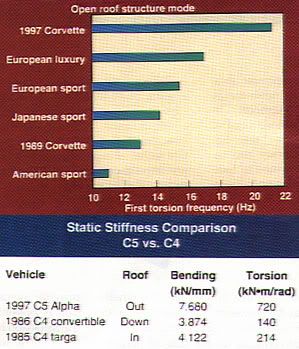
The values of the C6 chassis stiffness was not forthcoming officially so 60% stiffer doesn't mean much. There was a Htz number for the C4 which would not apply to a hybrid or aluminum chassis and also wouldn't tell you much anyway. I would like to know the value and where and how it is measured simply as a reference. Reference for what purpose, you may ask? I would like road test magazines to have a standardized measurement for sports cars. This coupled with weight, will give me insight into chassis construction and suspension advancements.
I measured the C6 Z06 chassis without a roll cage by simply replacing the shocks with a solid rod and tying down 3 hubs at a time and loading the untied hub individually. The C6 Z06 twists like a pretzel and the steel frame is even worse. Bending on both is terrible. A 60% claimed improvement would be very noticeable as Tadge alluded to.
One should not read too much into this value from a comparison point of view because other manufactures have much stiffer chassis and publishing this info could make a C6 or a C7 the laughing stock to the low information crowd which frequent this forum.
Corvettes have never had a stiff chassis including the C7 who's wheel base is even longer than the C6. They get the performance numbers and that's what counts.
The science of optimizing the contact patch of the tire is much more important. Like tuning a suspensionless go cart for individual tracks, an art form in itself.
The ediff and tires count for a lot also but they don't get the numbers by themselves.
So, if I may ask, how will the chassis stiffness information help you and or how will you make use of it? A roll cage changes the equation drastically.
I measured the C6 Z06 chassis without a roll cage by simply replacing the shocks with a solid rod and tying down 3 hubs at a time and loading the untied hub individually. The C6 Z06 twists like a pretzel and the steel frame is even worse. Bending on both is terrible. A 60% claimed improvement would be very noticeable as Tadge alluded to.
One should not read too much into this value from a comparison point of view because other manufactures have much stiffer chassis and publishing this info could make a C6 or a C7 the laughing stock to the low information crowd which frequent this forum.
Corvettes have never had a stiff chassis including the C7 who's wheel base is even longer than the C6. They get the performance numbers and that's what counts.
The science of optimizing the contact patch of the tire is much more important. Like tuning a suspensionless go cart for individual tracks, an art form in itself.
The ediff and tires count for a lot also but they don't get the numbers by themselves.
So, if I may ask, how will the chassis stiffness information help you and or how will you make use of it? A roll cage changes the equation drastically.
Safety Car
Joined: Nov 2002
Posts: 4,168
Likes: 1,336
From: FLL Florida
It was a way of measuring steel chassis stiffness a long time ago when chassis and uni body steel was common in the industry .
A new Silverado is an all steel chassis but it is made up of several different steel alloys even in the hydroformed sections. You have to bend it and twist it to measure stiffness but modern auto cad programs can tell you that also during the design phase..
Corvette Stories
The Best of Corvette for Corvette Enthusiasts

10 Reasons the C6 Z06 is Still A Performance Benchmark After 20 Years
Joe Kucinski
How Much Horsepower Every Corvette Engine "LOST" in 1972
Joe Kucinski
Top 10 DOs and DON'Ts for Protecting Your Convertible Top!
Michael S. Palmer
Top 10 Most Explosive Corvettes Ever Made: Power-to-Weight Ratio Ranked!
Joe Kucinski
150 hp to 1,250 hp: Every Corvette Generation Compared by the Specs That Matter
Joe Kucinski
8 Coolest Corvette Pace Cars (and Replicas) of All Time
Verdad Gallardo
Top 10 Corvette Engines RANKED by Peak Torque (70+ Years of Muscle!)
Joe Kucinski
Corvette ZR1X Will Be Pacing the Indy 500, And Could Probably Race, Too!
Verdad Gallardo
Top 10 Corvettes Coming to Mecum Indy 2026!
Brett Foote


Team Owner

Joined: Aug 2002
Posts: 35,617
Likes: 167
Tech Contributor
Cruise-In 11 Veteran
NCM Ambassador
St. Jude Donor '05-'06-'07-'10
Additionally, In FEA The C6 Z06 aluminum space frame global modal frequencies are 22.9 HZ in bending and 28.3 HZ in torsion. You can reference these in SAE 2005-01-0466
Safety Car
Joined: Nov 2002
Posts: 4,168
Likes: 1,336
From: FLL Florida
Team Owner
Joined: Aug 2002
Posts: 35,617
Likes: 167
Tech Contributor
Cruise-In 11 Veteran
NCM Ambassador
St. Jude Donor '05-'06-'07-'10
Unfortunately not my area of expertise. What I can tell you is that In driving the car, the redesign translates immediately to a seat of the pants improvement. Tighter in turns, firmer in transitions and a more "planted" feel in acceleration. It's very noticeable in every aspect of driver interaction with the car. I wish that I could speak more intelligently on the topic with you and I wish I had more information to share.
In terms of my basis for comparison, I've owned a 1984 coupe, a 1997 coupe and a 2005 coupe. Additionally, I've driven everything in the C6 lineup from base coupe to ZR1.
In terms of my basis for comparison, I've owned a 1984 coupe, a 1997 coupe and a 2005 coupe. Additionally, I've driven everything in the C6 lineup from base coupe to ZR1.

Pro

Joined: Nov 2007
Posts: 547
Likes: 3
From: Silicon Valley California
St. Jude Donor '09-'11
Tired of the C7 chassis is "57% stiffer" quote? Here's something closer to a real number.
"Vette/Motor Trend presents Corvette Stingray" issue on the newstands now reports the C7 stiffness target as 14500 Nm/deg, and further says they came "within 5 percent of what the CAD system indicated".
They also quote the C6 figure as 9000 Nm/deg.
The only list on the internet I can find is at the-list-torsional-rigidity and shows figures on a lot of cars no longer in production.
Alfa 159 - 31.400Nm/degree
Aston Martin DB9 Coupe 27,000 Nm/deg
Aston Martin DB9 Convertible 15,500 Nm/deg
Aston Martin Vanquish 28,500 Nm/deg
Audi TT Coupe 19,000 Nm/deg
Bugatti EB110 - 19,000 Nm/degree
BMW E36 Touring 10,900 Nm/deg
BMW E36 Z3 5,600 Nm/deg
BMW E46 Sedan (w/o folding seats) 18,000 Nm/deg
BMW E46 Sedan (w/folding seats) 13,000 Nm/deg
BMW E46 Wagon (w/folding seats) 14,000 Nm/deg
BMW E46 Coupe (w/folding seats) 12,500 Nm/deg
BMW E46 Convertible 10,500 Nm/deg
BMW X5 (2004) - 23,100 Nm/degree
BMW E90: 22,500 Nm/deg
BMW Z4 Coupe, 32,000Nm/degree
BMW Z4 Roadster: 14,500 Nm/deg
Bugatti Veyron - 60,000 Nm/degree
Chrysler Crossfire 20,140 Nm/deg
Chrysler Durango 6,800 Nm/deg
Chevrolet Corvette C5 9,100 Nm/deg
Dodge Viper Coupe 7,600 Nm/deg
Ferrari 360 Spider 8,500 Nm/deg
Ford GT: 27,100 Nm/deg
Ford GT40 MkI 17,000 Nm/deg
Ford Mustang 2003 16,000 Nm/deg
Ford Mustang 2005 21,000 Nm/deg
Ford Mustang Convertible (2003) 4,800 Nm/deg
Ford Mustang Convertible (2005) 9,500 Nm/deg
Jaguar X-Type Sedan 22,000 Nm/deg
Jaguar X-Type Estate 16,319 Nm/deg
Koenigsegg - 28.100 Nm/degree
Lambo Murcielago 20,000 Nm/deg
Lotus Elan 7,900 Nm/deg
Lotus Elan GRP body 8,900 Nm/deg
Lotus Elise 10,000 Nm/deg
Lotus Elise 111s 11,000 Nm/deg
Lotus Esprit SE Turbo 5,850 Nm/deg
Maserati QP - 18.000 nm/degree
McLaren F1 13,500 Nm/deg
Mercedes SL - With top down 17,000 Nm/deg, with top up 21,000 Nm/deg
Mini (2003) 24,500 Nm/deg
Pagani Zonda C12 S 26,300 Nm/deg
Pagani Zonda F - 27,000 Nm/degree
Porsche 911 Turbo (2000) 13,500 Nm/deg
Porsche 959 12,900 Nm/deg
Porsche Carrera GT - 26,000Nm/degree
Rolls-Royce Phantom - 40,500 Nm/degree
Volvo S60 20,000 Nm/deg
Audi A2: 11,900 Nm/deg
Audi A8: 25,000 Nm/deg
Audi TT: 10,000 Nm/deg (22Hz)
Golf V GTI: 25,000 Nm/deg
Chevrolet Cobalt: 28 Hz
Ferrari 360: 1,474 kgm/degree (bending: 1,032 kg/mm)
Ferrari 355: 1,024 kgm/degree (bending: 727 kg/mm)
Ferrari 430: supposedly 20% higher than 360
Renault Sport Spider: 10,000 Nm/degree
Volvo S80: 18,600 Nm/deg
Koenigsegg CC-8: 28,100 Nm/deg
Porsche 911 Turbo 996: 27,000 Nm/deg
Porsche 911 Turbo 996 Convertible: 11,600 Nm/deg
Porsche 911 Carrera Type 997: 33,000 Nm/deg
Lotus Elise S2 Exige (2004): 10,500 Nm/deg
Volkswagen Fox: 17,941 Nm/deg
VW Phaeton - 37,000 Nm/degree
VW Passat (2006) - 32,400 Nm/degree
Ferrari F50: 34,600 Nm/deg
Lambo Gallardo: 23000 Nm/deg
Mazda Rx-8: 30,000 Nm/deg
Mazda Rx-7: ~15,000 Nm/deg
Mazda RX8 - 30,000 Nm/degree
Saab 9-3 Sportcombi - 21,000 Nm/degree
Opel Astra - 12,000 Nm/degree
Land rover Freelander 2 - 28,000 Nm/degree
Lamborghini Countach 2,600 Nm/deg
Ford Focus 3d 19.600 Nm/deg
Ford Focus 5d 17.900 Nm/deg
"Vette/Motor Trend presents Corvette Stingray" issue on the newstands now reports the C7 stiffness target as 14500 Nm/deg, and further says they came "within 5 percent of what the CAD system indicated".
They also quote the C6 figure as 9000 Nm/deg.
The only list on the internet I can find is at the-list-torsional-rigidity and shows figures on a lot of cars no longer in production.
Alfa 159 - 31.400Nm/degree
Aston Martin DB9 Coupe 27,000 Nm/deg
Aston Martin DB9 Convertible 15,500 Nm/deg
Aston Martin Vanquish 28,500 Nm/deg
Audi TT Coupe 19,000 Nm/deg
Bugatti EB110 - 19,000 Nm/degree
BMW E36 Touring 10,900 Nm/deg
BMW E36 Z3 5,600 Nm/deg
BMW E46 Sedan (w/o folding seats) 18,000 Nm/deg
BMW E46 Sedan (w/folding seats) 13,000 Nm/deg
BMW E46 Wagon (w/folding seats) 14,000 Nm/deg
BMW E46 Coupe (w/folding seats) 12,500 Nm/deg
BMW E46 Convertible 10,500 Nm/deg
BMW X5 (2004) - 23,100 Nm/degree
BMW E90: 22,500 Nm/deg
BMW Z4 Coupe, 32,000Nm/degree
BMW Z4 Roadster: 14,500 Nm/deg
Bugatti Veyron - 60,000 Nm/degree
Chrysler Crossfire 20,140 Nm/deg
Chrysler Durango 6,800 Nm/deg
Chevrolet Corvette C5 9,100 Nm/deg
Dodge Viper Coupe 7,600 Nm/deg
Ferrari 360 Spider 8,500 Nm/deg
Ford GT: 27,100 Nm/deg
Ford GT40 MkI 17,000 Nm/deg
Ford Mustang 2003 16,000 Nm/deg
Ford Mustang 2005 21,000 Nm/deg
Ford Mustang Convertible (2003) 4,800 Nm/deg
Ford Mustang Convertible (2005) 9,500 Nm/deg
Jaguar X-Type Sedan 22,000 Nm/deg
Jaguar X-Type Estate 16,319 Nm/deg
Koenigsegg - 28.100 Nm/degree
Lambo Murcielago 20,000 Nm/deg
Lotus Elan 7,900 Nm/deg
Lotus Elan GRP body 8,900 Nm/deg
Lotus Elise 10,000 Nm/deg
Lotus Elise 111s 11,000 Nm/deg
Lotus Esprit SE Turbo 5,850 Nm/deg
Maserati QP - 18.000 nm/degree
McLaren F1 13,500 Nm/deg
Mercedes SL - With top down 17,000 Nm/deg, with top up 21,000 Nm/deg
Mini (2003) 24,500 Nm/deg
Pagani Zonda C12 S 26,300 Nm/deg
Pagani Zonda F - 27,000 Nm/degree
Porsche 911 Turbo (2000) 13,500 Nm/deg
Porsche 959 12,900 Nm/deg
Porsche Carrera GT - 26,000Nm/degree
Rolls-Royce Phantom - 40,500 Nm/degree
Volvo S60 20,000 Nm/deg
Audi A2: 11,900 Nm/deg
Audi A8: 25,000 Nm/deg
Audi TT: 10,000 Nm/deg (22Hz)
Golf V GTI: 25,000 Nm/deg
Chevrolet Cobalt: 28 Hz
Ferrari 360: 1,474 kgm/degree (bending: 1,032 kg/mm)
Ferrari 355: 1,024 kgm/degree (bending: 727 kg/mm)
Ferrari 430: supposedly 20% higher than 360
Renault Sport Spider: 10,000 Nm/degree
Volvo S80: 18,600 Nm/deg
Koenigsegg CC-8: 28,100 Nm/deg
Porsche 911 Turbo 996: 27,000 Nm/deg
Porsche 911 Turbo 996 Convertible: 11,600 Nm/deg
Porsche 911 Carrera Type 997: 33,000 Nm/deg
Lotus Elise S2 Exige (2004): 10,500 Nm/deg
Volkswagen Fox: 17,941 Nm/deg
VW Phaeton - 37,000 Nm/degree
VW Passat (2006) - 32,400 Nm/degree
Ferrari F50: 34,600 Nm/deg
Lambo Gallardo: 23000 Nm/deg
Mazda Rx-8: 30,000 Nm/deg
Mazda Rx-7: ~15,000 Nm/deg
Mazda RX8 - 30,000 Nm/degree
Saab 9-3 Sportcombi - 21,000 Nm/degree
Opel Astra - 12,000 Nm/degree
Land rover Freelander 2 - 28,000 Nm/degree
Lamborghini Countach 2,600 Nm/deg
Ford Focus 3d 19.600 Nm/deg
Ford Focus 5d 17.900 Nm/deg