



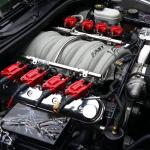

Lifetime rev counter

Thread Starter
8th Gear

Joined: Apr 2014
Posts: 8
Likes: 0
 Lifetime rev counter
I have a 6month old C7 Z51. my lifetime rev counter shows 769 on the 10,000. What does this mean as to how hard the car has been driven and if I don't get down on it over time will this number then go down. What does the rev counter show you or mean to your car? please let me know.

Team Owner

Joined: Aug 2007
Posts: 136,140
Likes: 2,432
From: I live my life by 2 rules. 1) Never share everything you know. 2)
St. Jude Donor '11-'12-'13, '16-'17-'18
"revs" refers to the number of revolutions your engine has completed.
In other words, how many times the crankshaft has gone around 360 degrees.
"How hard" has nothing to do with it - they could be revolutions at idle or at WOT. It doesn't matter
In other words, how many times the crankshaft has gone around 360 degrees.
"How hard" has nothing to do with it - they could be revolutions at idle or at WOT. It doesn't matter
Thread Starter
8th Gear
Joined: Apr 2014
Posts: 8
Likes: 0
Yes, understood, what would be normal count and what would indicate a high number ???? thanks.
Thread Starter
8th Gear
Joined: Apr 2014
Posts: 8
Likes: 0
I understand this lifetime rev counter is meant to tell a future buyer how hard a car has been driven. just trying to find out what would show normal driving vs. hard driving as per number displayed in this function.

Le Mans Master


Joined: Jun 2000
Posts: 5,555
Likes: 9
From: Indiana

Racer


Joined: Sep 2012
Posts: 342
Likes: 52
Seems a fair question. There must be some baseline reference for the number to mean something. Perhaps it can be related to odometer miles. (You can drive X miles at 6,500 rpm in first gear, or the same X miles at 1,300 rpm in 7th). Point is, there would be a rev/mile number for grandpa who never gets on it vs. hotrod who red lines it all the time. Same miles, big difference in revs. Not sure who/how an individual could come up with the data, but GM sure could...over a period of time...through a survey perhaps, or a dealer service data entry system/demographic/average.

Team Owner

Joined: Sep 2005
Posts: 20,352
Likes: 568
From: Ventura County, Calif
So, you have 7,690,000 revs in 6 months and, HOW MANY MILES?
From the very few I've read about it seems that about 4,000,000 revs in 2,000 miles might be close to something normal. If you do accept that as at least a hypothetical "normal", then at 6,000 miles you would expect to see near 12,000,000 revs.
So someone going to look at buying a used C7 with 6,000 miles looks at the rev counter and sees, what?......50,000,000 revs? One might conclude that was a bit excessive and the car had been driven in a manner well beyond " a normal way". Why? Racing? Probably? Might decide to move on to a different car.
Make sense?
From the very few I've read about it seems that about 4,000,000 revs in 2,000 miles might be close to something normal. If you do accept that as at least a hypothetical "normal", then at 6,000 miles you would expect to see near 12,000,000 revs.
So someone going to look at buying a used C7 with 6,000 miles looks at the rev counter and sees, what?......50,000,000 revs? One might conclude that was a bit excessive and the car had been driven in a manner well beyond " a normal way". Why? Racing? Probably? Might decide to move on to a different car.
Make sense?

Racer

Joined: Jul 2007
Posts: 335
Likes: 28
Let's say you're going to travel 1 mile in first gear. It doesn't matter if you do it at 6500 rpm and are done a minute, or do it at 1000 rpm and take 6 minutes ... the engine will have made the exact same number of revolutions to cover that mile.
So this number might, at best, point to a car that's done a lot of city miles (i.e. in lower gears) vs. highway miles.
Corvette Stories
The Best of Corvette for Corvette Enthusiasts

Top 10 Most Expensive Corvettes Ever Sold on Bring A Trailer
Brett Foote
10 Things Every Corvette Owner Needs (2026 Edition)
Michael S. Palmer
8 Most "Only Corvette Owners Understand" Quirks and Problems
Pouria Savadkouei
10 Reasons the C6 Z06 is Still A Performance Benchmark After 20 Years
Joe Kucinski
How Much Horsepower Every Corvette Engine "LOST" in 1972
Joe Kucinski
Top 10 DOs and DON'Ts for Protecting Your Convertible Top!
Michael S. Palmer
Top 10 Most Explosive Corvettes Ever Made: Power-to-Weight Ratio Ranked!
Joe Kucinski
150 hp to 1,250 hp: Every Corvette Generation Compared by the Specs That Matter
Joe Kucinski
8 Coolest Corvette Pace Cars (and Replicas) of All Time
Verdad Gallardo
Le Mans Master
Joined: Jun 2000
Posts: 5,555
Likes: 9
From: Indiana
To try to make sense out of the number you're forced to make guesses. Makes the number kind of useless. Perhaps I don't like to use 6th or 7th gear .. so I cruise around in 5th at 60MPH .. Someone else cruises in 7th. So my car has a higher rev count than his in the same number of miles. Doesn't mean my car has been abused, just driven differently. In general, you could probably say that a car with 100 million revs has more wear than one with 50 million .. but that also requires guessing that all other factors are equal (oil changes, etc). It's data, but I'm not sure it's information.


Team Owner
Joined: Sep 2005
Posts: 20,352
Likes: 568
From: Ventura County, Calif
To try to make sense out of the number you're forced to make guesses. Makes the number kind of useless. Perhaps I don't like to use 6th or 7th gear .. so I cruise around in 5th at 60MPH .. Someone else cruises in 7th. So my car has a higher rev count than his in the same number of miles. Doesn't mean my car has been abused, just driven differently. In general, you could probably say that a car with 100 million revs has more wear than one with 50 million .. but that also requires guessing that all other factors are equal (oil changes, etc). It's data, but I'm not sure it's information.
Maybe when C7's start showing up in the For Sale Section, buyers should demand that, along with the description and price, the sellers show a picture of the Rev Counter. Then in time there would be some basis for comparison.

I don't know the purpose of having it. Maybe GM has a secret agenda.
Race Director


Joined: Jun 2001
Posts: 10,084
Likes: 3,056
From: CA
I think it's useful. If a car is driven mostly on the highway in top gear, the revolutions will be low for the mileage. I would rather have that car, than one that was driven in the city, with more revolutions. Highway driven cars have less overall wear and tear on engine, transmission, brakes, axle, etc. Even seat wear will be lower, because there were more miles driven per hour driven.
Michael
Michael
Melting Slicks

Joined: May 2001
Posts: 2,596
Likes: 120
From: East Tennessee
Not exactly. The RPM doesn't factor into this at all, it's just the gear you're in for how many miles.
Let's say you're going to travel 1 mile in first gear. It doesn't matter if you do it at 6500 rpm and are done a minute, or do it at 1000 rpm and take 6 minutes ... the engine will have made the exact same number of revolutions to cover that mile.
So this number might, at best, point to a car that's done a lot of city miles (i.e. in lower gears) vs. highway miles.
Let's say you're going to travel 1 mile in first gear. It doesn't matter if you do it at 6500 rpm and are done a minute, or do it at 1000 rpm and take 6 minutes ... the engine will have made the exact same number of revolutions to cover that mile.
So this number might, at best, point to a car that's done a lot of city miles (i.e. in lower gears) vs. highway miles.
If you have say a 4:1 first gear ration the engine will turn 4x more revolutions than in 4th with a 1:1 ratio for a given distance..
The more revolutions the more wear. If a guy is driving in 4th on the highway for 20,000 miles just because how it sounds the engine will have more wear than if it did it at 1500rpm.
Between that and the hour meter you can figure how the car was driven, if it has a ton of hours and no miles you know it was idled and/or used in slow speed city driving. If it has no hours and a lot of miles then ti was driven fast on the highway more often.
Nothing really 'means' anything unless you start comparing it to other cars, mileage will be the automotive standard for quite some time.

Racer
Joined: Jul 2007
Posts: 335
Likes: 28
Melting Slicks
Joined: May 2001
Posts: 2,596
Likes: 120
From: East Tennessee
I think it's useful. If a car is driven mostly on the highway in top gear, the revolutions will be low for the mileage. I would rather have that car, than one that was driven in the city, with more revolutions. Highway driven cars have less overall wear and tear on engine, transmission, brakes, axle, etc. Even seat wear will be lower, because there were more miles driven per hour driven.
Michael
Michael
Take your revs and divide it by miles. Back when mine had 2600 miles it had 591x10000, or 5,910,000 revs divided br 2600 miles = 2273 revs per mile traveled.
Doesnt really mean much by itself, but with an auto is in the highest reasonable gear most of the time and I do around 50/50 driving I would consider what I have to be 'normal' I seldom manual shift it to keep the RPM up just cruising but i do play once in a while.
So the before mentioned 4,000,000 for 2000 miles means little to no aggressive driving. 8,000,000 for 2000 miles may be getting up there.
Melting Slicks
Joined: May 2001
Posts: 2,596
Likes: 120
From: East Tennessee
Stationary engines are measure in hours, so are boats, But a staionary engine runs at one RPM/load most of the time, where a boat can idle around or be at 4500RPM WOT all day. If you go into a boat ECM you can see how much time was spent at 1000rpm intervals. Unfortunately thats not user-available date so boats are judged on hours only, with no odometer its a fairly useless umber.
Point is having a total rev counter, an hour meter and an odometer one can judge how a car was driven.
Be interesting for for someone at one of the driving schools to take a pic of the revs/hour meter plus odometer of a C7 thats been tracked all its life to compare
Thread Starter
8th Gear
Joined: Apr 2014
Posts: 8
Likes: 0
So, you have 7,690,000 revs in 6 months and, HOW MANY MILES?
From the very few I've read about it seems that about 4,000,000 revs in 2,000 miles might be close to something normal. If you do accept that as at least a hypothetical "normal", then at 6,000 miles you would expect to see near 12,000,000 revs.
So someone going to look at buying a used C7 with 6,000 miles looks at the rev counter and sees, what?......50,000,000 revs? One might conclude that was a bit excessive and the car had been driven in a manner well beyond " a normal way". Why? Racing? Probably? Might decide to move on to a different car.
Make sense?
From the very few I've read about it seems that about 4,000,000 revs in 2,000 miles might be close to something normal. If you do accept that as at least a hypothetical "normal", then at 6,000 miles you would expect to see near 12,000,000 revs.
So someone going to look at buying a used C7 with 6,000 miles looks at the rev counter and sees, what?......50,000,000 revs? One might conclude that was a bit excessive and the car had been driven in a manner well beyond " a normal way". Why? Racing? Probably? Might decide to move on to a different car.
Make sense?
Le Mans Master
Joined: Jun 2000
Posts: 5,555
Likes: 9
From: Indiana
But it's still all based on assumption and guesswork. I can drive like an old lady 6 days a week and on Sunday beat the crap out of it on the dragstrip. That few minutes of 'abuse' will barely affect hours or revs or any other measure ... but could mean a lot in terms of real-world wear and tear.
As I said before .. it's data, but not information. You can interpret it different ways depending on the assumptions you make.
I think someone just decided it would be cool. They already had that info available since they need to count revs to make the tachometer work .. so a programmer just decided to add a line of code
revs = revs + 1
each time the sensor counted another rev.
As I said before .. it's data, but not information. You can interpret it different ways depending on the assumptions you make.
I think someone just decided it would be cool. They already had that info available since they need to count revs to make the tachometer work .. so a programmer just decided to add a line of code
revs = revs + 1
each time the sensor counted another rev.
Melting Slicks
Joined: May 2001
Posts: 2,596
Likes: 120
From: East Tennessee
But it's still all based on assumption and guesswork. I can drive like an old lady 6 days a week and on Sunday beat the crap out of it on the dragstrip. That few minutes of 'abuse' will barely affect hours or revs or any other measure ... but could mean a lot in terms of real-world wear and tear.
As I said before .. it's data, but not information. You can interpret it different ways depending on the assumptions you make.
I think someone just decided it would be cool. They already had that info available since they need to count revs to make the tachometer work .. so a programmer just decided to add a line of code
revs = revs + 1
each time the sensor counted another rev.
As I said before .. it's data, but not information. You can interpret it different ways depending on the assumptions you make.
I think someone just decided it would be cool. They already had that info available since they need to count revs to make the tachometer work .. so a programmer just decided to add a line of code
revs = revs + 1
each time the sensor counted another rev.
But
Say someone sat there at a dealer and held it to the floor it in neutral for 10 minutes and it had 3 miles, the total revs per mile would be huge
Or some guy bought it to mostly track it for a year and then trade it in..My pickup truck has it too lol, no doubt its just something they put on there for an extra screen but I think if the total revs were way out of line you could spot a car that was tracked/raced its whole life. Granted that same car could be driven like a little old lady after it was done being abused for a couple years and it would average back down.

Drifting

Joined: Dec 2013
Posts: 1,787
Likes: 646
From: Retired to Mississsippi.
I think it's useful. If a car is driven mostly on the highway in top gear, the revolutions will be low for the mileage. I would rather have that car, than one that was driven in the city, with more revolutions. Highway driven cars have less overall wear and tear on engine, transmission, brakes, axle, etc. Even seat wear will be lower, because there were more miles driven per hour driven.
Michael
Michael
High Miles, Low Hours = Highway Miles.
Low Miles, High Hours = City, Heavy Traffic Commuter Miles.