








Wrong size front tires
Thread Starter
Instructor


Joined: Dec 2013
Posts: 243
Likes: 59
From: Benicia CA
 Wrong size front tires
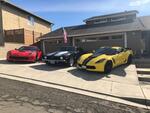
I recently bought a used 2019 Z06 A8. Yellow, 3LZ. It has brand new Michelin Pilot Sports. Sweet! Just discovered the front tires are incorrect. They are 285/35x19 instead of 285/30x19. They are about an inch taller than original. They look and drive great. But of course, now that I know, the front tires look too tall.
. My question is whether the taller front tire would have any impact on the anti-lock or traction control systems. So far I haven't seen any effects but it's alway good to check.
Thanks
Joe
. My question is whether the taller front tire would have any impact on the anti-lock or traction control systems. So far I haven't seen any effects but it's alway good to check.
Thanks
Joe

Race Director


Joined: Mar 2001
Posts: 19,997
Likes: 6,805
From: Bonneville Salt Flats
I would suspect they are tolerable, otherwise you'd already have some indication. But, on the plus side, you have a little more side-wall to help protect your flimsy OEM wheels!!! 

E N J O Y !!!
E N J O Y !!!
Drifting


Joined: Sep 2019
Posts: 1,355
Likes: 635
From: St. Louis
Your front / rear brake balance is going to be off a pretty significant amount. That means ABS will kick in when the rear tires start to lock up before the front tires are able to reach their maximum brake torque. That is not good! The end result is that your car cannot stop as quickly as if it had the correct size tires. This only applies for a maximum brake situation. It will have no effect on normal braking.

Race Director
Joined: Apr 2014
Posts: 10,474
Likes: 1,767
From: North Texas
Your front / rear brake balance is going to be off a pretty significant amount. That means ABS will kick in when the rear tires start to lock up before the front tires are able to reach their maximum brake torque. That is not good! The end result is that your car cannot stop as quickly as if it had the correct size tires. This only applies for a maximum brake situation. It will have no effect on normal braking.
Drifting
Joined: Sep 2019
Posts: 1,355
Likes: 635
From: St. Louis
Brakes generate torque that slows down the tires which in turn slows the car. In a perfectly balanced brake system, both front and rear tires reach the limit of braking traction at the same time. This limit is what is known as threshold braking. That point is where the car will stop in the shortest distance possible with both front and rear brakes and tires providing maximum deceleration.
Once the tires start to slip more than the amount allowed by ABS, ABS then dumps brake pressure to get the tires rotating again and then resumes brake pressure. If the the brake pressure is still high enough to cause the tires to slip excessively, the process repeats at a rapid rate. You feel this as ABS pulsations. When ABS is doing the dump and resume process, the car is not stopping nearly as quickly as it would at threshold brake levels. This should be obvious since half the time during ABS activation, the brakes are dumping pressure - but some will argue an ABS stop is just as quick as a threshold brake stop. It is not even close!
So - when you change the tire diameter, you change the length of the lever arm that the brake system is using to slow down the tire. By going to a larger tire, the lever arm increases so the brakes are generating less force at the tread of the tire for a given brake pressure. That changes the balance front to rear. Now when you try to do threshold braking, the front brakes require more pressure to get to the point of maximum braking force. That would not be a big deal, since you just press the pedal a bit harder. Unfortunately, before the front tires reach maximum braking capability, the higher pressure which is also going to the rear brakes causes them to exceed the slip ratio and ABS kicks in. Since the front brakes do about 80% of the work stopping the car and you cannot get up to their maximum capability before ABS kicks in, you will have longer stopping distance.
Approximately how much difference can be estimated using the lever arm difference of the tires. You have 285/35-19 tires so the lever arm for your front brakes is 19/2 = 8.5" for the wheel, plus the tire side wall 285 X 0.35 =99.75mm which is 3.927". That means your lever arm is 12.427" long. The stock size side wall is 285 X 0.30 = 85.5 mm which is 3.66" for a total lever arm of 11.866". That is a difference in lever arm length of 0.56" which is 4.73 % difference.
While that may not sound like a huge difference, the problem is most people feel the point of threshold braking through the front tires. With this imbalance going towards the rear tires, you would not be able to feel the threshold before the rear tires had ABS kicking in. Therefore threshold braking is not possible and you are at the mercy of the ABS system for a maximum stop event. When ABS is a doing the braking, your stopping distance will be from 25 to 50% longer than a proper threshold brake stop.
Once the tires start to slip more than the amount allowed by ABS, ABS then dumps brake pressure to get the tires rotating again and then resumes brake pressure. If the the brake pressure is still high enough to cause the tires to slip excessively, the process repeats at a rapid rate. You feel this as ABS pulsations. When ABS is doing the dump and resume process, the car is not stopping nearly as quickly as it would at threshold brake levels. This should be obvious since half the time during ABS activation, the brakes are dumping pressure - but some will argue an ABS stop is just as quick as a threshold brake stop. It is not even close!
So - when you change the tire diameter, you change the length of the lever arm that the brake system is using to slow down the tire. By going to a larger tire, the lever arm increases so the brakes are generating less force at the tread of the tire for a given brake pressure. That changes the balance front to rear. Now when you try to do threshold braking, the front brakes require more pressure to get to the point of maximum braking force. That would not be a big deal, since you just press the pedal a bit harder. Unfortunately, before the front tires reach maximum braking capability, the higher pressure which is also going to the rear brakes causes them to exceed the slip ratio and ABS kicks in. Since the front brakes do about 80% of the work stopping the car and you cannot get up to their maximum capability before ABS kicks in, you will have longer stopping distance.
Approximately how much difference can be estimated using the lever arm difference of the tires. You have 285/35-19 tires so the lever arm for your front brakes is 19/2 = 8.5" for the wheel, plus the tire side wall 285 X 0.35 =99.75mm which is 3.927". That means your lever arm is 12.427" long. The stock size side wall is 285 X 0.30 = 85.5 mm which is 3.66" for a total lever arm of 11.866". That is a difference in lever arm length of 0.56" which is 4.73 % difference.
While that may not sound like a huge difference, the problem is most people feel the point of threshold braking through the front tires. With this imbalance going towards the rear tires, you would not be able to feel the threshold before the rear tires had ABS kicking in. Therefore threshold braking is not possible and you are at the mercy of the ABS system for a maximum stop event. When ABS is a doing the braking, your stopping distance will be from 25 to 50% longer than a proper threshold brake stop.

Le Mans Master

Joined: Dec 2012
Posts: 6,442
Likes: 2,535
From: New Jersey
Brakes generate torque that slows down the tires which in turn slows the car. In a perfectly balanced brake system, both front and rear tires reach the limit of braking traction at the same time. This limit is what is known as threshold braking. That point is where the car will stop in the shortest distance possible with both front and rear brakes and tires providing maximum deceleration.
Once the tires start to slip more than the amount allowed by ABS, ABS then dumps brake pressure to get the tires rotating again and then resumes brake pressure. If the the brake pressure is still high enough to cause the tires to slip excessively, the process repeats at a rapid rate. You feel this as ABS pulsations. When ABS is doing the dump and resume process, the car is not stopping nearly as quickly as it would at threshold brake levels. This should be obvious since half the time during ABS activation, the brakes are dumping pressure - but some will argue an ABS stop is just as quick as a threshold brake stop. It is not even close!
So - when you change the tire diameter, you change the length of the lever arm that the brake system is using to slow down the tire. By going to a larger tire, the lever arm increases so the brakes are generating less force at the tread of the tire for a given brake pressure. That changes the balance front to rear. Now when you try to do threshold braking, the front brakes require more pressure to get to the point of maximum braking force. That would not be a big deal, since you just press the pedal a bit harder. Unfortunately, before the front tires reach maximum braking capability, the higher pressure which is also going to the rear brakes causes them to exceed the slip ratio and ABS kicks in. Since the front brakes do about 80% of the work stopping the car and you cannot get up to their maximum capability before ABS kicks in, you will have longer stopping distance.
Approximately how much difference can be estimated using the lever arm difference of the tires. You have 285/35-19 tires so the lever arm for your front brakes is 19/2 = 8.5" for the wheel, plus the tire side wall 285 X 0.35 =99.75mm which is 3.927". That means your lever arm is 12.427" long. The stock size side wall is 285 X 0.30 = 85.5 mm which is 3.66" for a total lever arm of 11.866". That is a difference in lever arm length of 0.56" which is 4.73 % difference.
While that may not sound like a huge difference, the problem is most people feel the point of threshold braking through the front tires. With this imbalance going towards the rear tires, you would not be able to feel the threshold before the rear tires had ABS kicking in. Therefore threshold braking is not possible and you are at the mercy of the ABS system for a maximum stop event. When ABS is a doing the braking, your stopping distance will be from 25 to 50% longer than a proper threshold brake stop.
Once the tires start to slip more than the amount allowed by ABS, ABS then dumps brake pressure to get the tires rotating again and then resumes brake pressure. If the the brake pressure is still high enough to cause the tires to slip excessively, the process repeats at a rapid rate. You feel this as ABS pulsations. When ABS is doing the dump and resume process, the car is not stopping nearly as quickly as it would at threshold brake levels. This should be obvious since half the time during ABS activation, the brakes are dumping pressure - but some will argue an ABS stop is just as quick as a threshold brake stop. It is not even close!
So - when you change the tire diameter, you change the length of the lever arm that the brake system is using to slow down the tire. By going to a larger tire, the lever arm increases so the brakes are generating less force at the tread of the tire for a given brake pressure. That changes the balance front to rear. Now when you try to do threshold braking, the front brakes require more pressure to get to the point of maximum braking force. That would not be a big deal, since you just press the pedal a bit harder. Unfortunately, before the front tires reach maximum braking capability, the higher pressure which is also going to the rear brakes causes them to exceed the slip ratio and ABS kicks in. Since the front brakes do about 80% of the work stopping the car and you cannot get up to their maximum capability before ABS kicks in, you will have longer stopping distance.
Approximately how much difference can be estimated using the lever arm difference of the tires. You have 285/35-19 tires so the lever arm for your front brakes is 19/2 = 8.5" for the wheel, plus the tire side wall 285 X 0.35 =99.75mm which is 3.927". That means your lever arm is 12.427" long. The stock size side wall is 285 X 0.30 = 85.5 mm which is 3.66" for a total lever arm of 11.866". That is a difference in lever arm length of 0.56" which is 4.73 % difference.
While that may not sound like a huge difference, the problem is most people feel the point of threshold braking through the front tires. With this imbalance going towards the rear tires, you would not be able to feel the threshold before the rear tires had ABS kicking in. Therefore threshold braking is not possible and you are at the mercy of the ABS system for a maximum stop event. When ABS is a doing the braking, your stopping distance will be from 25 to 50% longer than a proper threshold brake stop.
Corvette Stories
The Best of Corvette for Corvette Enthusiasts

5 Best & 5 Worst Corvette Daily Drivers
Joe Kucinski
The Headlights of Every Corvette Generation Explained
Joe Kucinski
5 Best & 5 Most Overrated Corvette Track Packages of All Time!
Joe Kucinski
Every 2027 Corvette Engine Explained
Joe Kucinski
Designer Imagines A Corvette That Looks More Like a Corvette Than the Corvette
Verdad Gallardo
10 Ugly Corvettes That We Still Kinda Love
Joe Kucinski
Top 10 Most Expensive Corvettes Ever Sold on Bring A Trailer
Brett Foote
10 Things Every Corvette Owner Needs (2026 Edition)
Michael S. Palmer
8 Most "Only Corvette Owners Understand" Quirks and Problems
Pouria Savadkouei
Le Mans Master
Joined: Oct 2011
Posts: 7,079
Likes: 1,922
From: DFW, Tejas!
Brakes generate torque that slows down the tires which in turn slows the car. In a perfectly balanced brake system, both front and rear tires reach the limit of braking traction at the same time. This limit is what is known as threshold braking. That point is where the car will stop in the shortest distance possible with both front and rear brakes and tires providing maximum deceleration.
Once the tires start to slip more than the amount allowed by ABS, ABS then dumps brake pressure to get the tires rotating again and then resumes brake pressure. If the the brake pressure is still high enough to cause the tires to slip excessively, the process repeats at a rapid rate. You feel this as ABS pulsations. When ABS is doing the dump and resume process, the car is not stopping nearly as quickly as it would at threshold brake levels. This should be obvious since half the time during ABS activation, the brakes are dumping pressure - but some will argue an ABS stop is just as quick as a threshold brake stop. It is not even close!
So - when you change the tire diameter, you change the length of the lever arm that the brake system is using to slow down the tire. By going to a larger tire, the lever arm increases so the brakes are generating less force at the tread of the tire for a given brake pressure. That changes the balance front to rear. Now when you try to do threshold braking, the front brakes require more pressure to get to the point of maximum braking force. That would not be a big deal, since you just press the pedal a bit harder. Unfortunately, before the front tires reach maximum braking capability, the higher pressure which is also going to the rear brakes causes them to exceed the slip ratio and ABS kicks in. Since the front brakes do about 80% of the work stopping the car and you cannot get up to their maximum capability before ABS kicks in, you will have longer stopping distance.
Approximately how much difference can be estimated using the lever arm difference of the tires. You have 285/35-19 tires so the lever arm for your front brakes is 19/2 = 8.5" for the wheel, plus the tire side wall 285 X 0.35 =99.75mm which is 3.927". That means your lever arm is 12.427" long. The stock size side wall is 285 X 0.30 = 85.5 mm which is 3.66" for a total lever arm of 11.866". That is a difference in lever arm length of 0.56" which is 4.73 % difference.
While that may not sound like a huge difference, the problem is most people feel the point of threshold braking through the front tires. With this imbalance going towards the rear tires, you would not be able to feel the threshold before the rear tires had ABS kicking in. Therefore threshold braking is not possible and you are at the mercy of the ABS system for a maximum stop event. When ABS is a doing the braking, your stopping distance will be from 25 to 50% longer than a proper threshold brake stop.
Once the tires start to slip more than the amount allowed by ABS, ABS then dumps brake pressure to get the tires rotating again and then resumes brake pressure. If the the brake pressure is still high enough to cause the tires to slip excessively, the process repeats at a rapid rate. You feel this as ABS pulsations. When ABS is doing the dump and resume process, the car is not stopping nearly as quickly as it would at threshold brake levels. This should be obvious since half the time during ABS activation, the brakes are dumping pressure - but some will argue an ABS stop is just as quick as a threshold brake stop. It is not even close!
So - when you change the tire diameter, you change the length of the lever arm that the brake system is using to slow down the tire. By going to a larger tire, the lever arm increases so the brakes are generating less force at the tread of the tire for a given brake pressure. That changes the balance front to rear. Now when you try to do threshold braking, the front brakes require more pressure to get to the point of maximum braking force. That would not be a big deal, since you just press the pedal a bit harder. Unfortunately, before the front tires reach maximum braking capability, the higher pressure which is also going to the rear brakes causes them to exceed the slip ratio and ABS kicks in. Since the front brakes do about 80% of the work stopping the car and you cannot get up to their maximum capability before ABS kicks in, you will have longer stopping distance.
Approximately how much difference can be estimated using the lever arm difference of the tires. You have 285/35-19 tires so the lever arm for your front brakes is 19/2 = 8.5" for the wheel, plus the tire side wall 285 X 0.35 =99.75mm which is 3.927". That means your lever arm is 12.427" long. The stock size side wall is 285 X 0.30 = 85.5 mm which is 3.66" for a total lever arm of 11.866". That is a difference in lever arm length of 0.56" which is 4.73 % difference.
While that may not sound like a huge difference, the problem is most people feel the point of threshold braking through the front tires. With this imbalance going towards the rear tires, you would not be able to feel the threshold before the rear tires had ABS kicking in. Therefore threshold braking is not possible and you are at the mercy of the ABS system for a maximum stop event. When ABS is a doing the braking, your stopping distance will be from 25 to 50% longer than a proper threshold brake stop.
Also, we have 4 channel ABS so it's not as much of an issue anyway.
Edit: I taller front tires at the track (just don't make a shorter 315 width 18" tire) and it's just fine. The computer is pretty good at sorting out what tire has what traction on each individual tire.
Last edited by village idiot; Feb 12, 2020 at 04:53 PM.
Drifting
Joined: Sep 2019
Posts: 1,355
Likes: 635
From: St. Louis
One lever arm is the size of the rotor which generates the amount of braking torque. That torque then generates braking force at the tire contact patch based on the of the lever arm defined by the radius of the tire/wheel combination. A taller tire /wheel combination will have less braking force at the tire contact patch for a given brake pressure. Thus, brake balance will be affected.

Le Mans Master
Joined: Mar 2016
Posts: 9,176
Likes: 4,018
From: 2019 CMG Z06/ZR1
Plenty of people run 20s all around on the C7s. I'm not an engineer, nor ever played one on TV, but 30 vs 35 tire upfront will not hurt anything in my experience. I've run all kinds of combos on road courses in my previous Camaros, didn't develop any issues because I ran 18s, Z28 19's or stock 20s. I'm not saying the gentleman here is wrong, I'm just saying that your daily driving will not be impacted by 30 vs 35
Drifting
Joined: Sep 2019
Posts: 1,355
Likes: 635
From: St. Louis
What don't you think is true? That the tire/ wheel diameter has an effect on how much braking force is applied to the tire contact patch? This is not magic - it is physics. Maybe it helps if you think about an exaggerated case - imagine if you had 30 inch wheels. Do you see how the brake force at the contact patch would then be drastically less for a given brake pressure?
And do you also think that ABS pulsating brakes stop as effectively as threshold braking? I can tell you ABS is not that good yet. Maybe after a few more generations of ABS system design when it is good enough to actually modulate pressure rather than just pulse it on and off, but that does not exist yet - only in theory.
I drive many different cars each year in autocross events (I am the clubs driving coach so I take a lap in the students cars if they want me to so I can give them an idea of how well their car drives and show them some driving lines) and I can tell every time when someone has changed tire sizes and botched it up - or worse, changed brake parts and screwed up the brake balance.
I have a friend that comes to our events and he wants me to drive his C6 every time. He likes to make mods to his car. He also likes to let me drive it before he tells me what he did. In most cases the mods make the car worse. At one point, he put Z06 front brakes on his car. It was horrible! I could not threshold brake in that car and ended up getting into ABS when I tried, so the car did not slow down well at all. Lap times were way off compared to other cars. I told him the brake balance was really messed up and he said yeah - then he told me he had put on the big front brakes but had done nothing to the rear. At the next event, he had put on the rear Z06 brakes. That helped but the car still did not brake as well as the stock setup. He also experiments with different size tires. That usually ends up badly as well. Again - this is me driving his car in an autocross and I drive the car to its limits (which is what he wants - he loves riding with me in his car and seeing what the car can do).
Usually (but not always) it is younger guys who think a big brake kit is going to make the car stop better (hint - it won't!). The small size difference in the OP's tires are not a huge deal - but it will reduce maximum braking performance and make threshold braking difficult. I am not suggesting he needs to get different tires. He asked if there is any performance impact and I am explaining to him that there is a performance impact to braking. If he never threshold brakes, he will not experience that degradation in performance. And if he gets into a tough situation on the street and mashes the brake pedal to the floor, ABS will work just fine and will stop the car in the same distance regardless of his tire size. But that distance will be about 25 to 50% longer than a proper threshold brake distance.
Just wanted to explain my background and that I am not just regurgitating something I read on the internet. I have real world experience that I am sharing with whoever wants to listen (in this case read).
And do you also think that ABS pulsating brakes stop as effectively as threshold braking? I can tell you ABS is not that good yet. Maybe after a few more generations of ABS system design when it is good enough to actually modulate pressure rather than just pulse it on and off, but that does not exist yet - only in theory.
I drive many different cars each year in autocross events (I am the clubs driving coach so I take a lap in the students cars if they want me to so I can give them an idea of how well their car drives and show them some driving lines) and I can tell every time when someone has changed tire sizes and botched it up - or worse, changed brake parts and screwed up the brake balance.
I have a friend that comes to our events and he wants me to drive his C6 every time. He likes to make mods to his car. He also likes to let me drive it before he tells me what he did. In most cases the mods make the car worse. At one point, he put Z06 front brakes on his car. It was horrible! I could not threshold brake in that car and ended up getting into ABS when I tried, so the car did not slow down well at all. Lap times were way off compared to other cars. I told him the brake balance was really messed up and he said yeah - then he told me he had put on the big front brakes but had done nothing to the rear. At the next event, he had put on the rear Z06 brakes. That helped but the car still did not brake as well as the stock setup. He also experiments with different size tires. That usually ends up badly as well. Again - this is me driving his car in an autocross and I drive the car to its limits (which is what he wants - he loves riding with me in his car and seeing what the car can do).
Usually (but not always) it is younger guys who think a big brake kit is going to make the car stop better (hint - it won't!). The small size difference in the OP's tires are not a huge deal - but it will reduce maximum braking performance and make threshold braking difficult. I am not suggesting he needs to get different tires. He asked if there is any performance impact and I am explaining to him that there is a performance impact to braking. If he never threshold brakes, he will not experience that degradation in performance. And if he gets into a tough situation on the street and mashes the brake pedal to the floor, ABS will work just fine and will stop the car in the same distance regardless of his tire size. But that distance will be about 25 to 50% longer than a proper threshold brake distance.
Just wanted to explain my background and that I am not just regurgitating something I read on the internet. I have real world experience that I am sharing with whoever wants to listen (in this case read).
Race Director
Joined: Apr 2014
Posts: 10,474
Likes: 1,767
From: North Texas
I can guarantee that ABS braking distances are longer than threshold. If you push too far and get into ABS, it feels like you've run off the pavement into grass or hit a patch of sand on the road. I look at the extreme examples of folks that put 26 inch + wheels on their vehicles and don't upgrade the brakes and wonder if they realize what they've done. I don't know if anyone has done any formal studies of braking distances with hugely oversized wheels, but it would be interesting.
Last edited by TxLefty; Feb 13, 2020 at 08:40 AM.
Le Mans Master
Joined: Oct 2011
Posts: 7,079
Likes: 1,922
From: DFW, Tejas!
What don't you think is true? That the tire/ wheel diameter has an effect on how much braking force is applied to the tire contact patch? This is not magic - it is physics. Maybe it helps if you think about an exaggerated case - imagine if you had 30 inch wheels. Do you see how the brake force at the contact patch would then be drastically less for a given brake pressure?
And do you also think that ABS pulsating brakes stop as effectively as threshold braking? I can tell you ABS is not that good yet. Maybe after a few more generations of ABS system design when it is good enough to actually modulate pressure rather than just pulse it on and off, but that does not exist yet - only in theory.
I drive many different cars each year in autocross events (I am the clubs driving coach so I take a lap in the students cars if they want me to so I can give them an idea of how well their car drives and show them some driving lines) and I can tell every time when someone has changed tire sizes and botched it up - or worse, changed brake parts and screwed up the brake balance.
I have a friend that comes to our events and he wants me to drive his C6 every time. He likes to make mods to his car. He also likes to let me drive it before he tells me what he did. In most cases the mods make the car worse. At one point, he put Z06 front brakes on his car. It was horrible! I could not threshold brake in that car and ended up getting into ABS when I tried, so the car did not slow down well at all. Lap times were way off compared to other cars. I told him the brake balance was really messed up and he said yeah - then he told me he had put on the big front brakes but had done nothing to the rear. At the next event, he had put on the rear Z06 brakes. That helped but the car still did not brake as well as the stock setup. He also experiments with different size tires. That usually ends up badly as well. Again - this is me driving his car in an autocross and I drive the car to its limits (which is what he wants - he loves riding with me in his car and seeing what the car can do).
Usually (but not always) it is younger guys who think a big brake kit is going to make the car stop better (hint - it won't!). The small size difference in the OP's tires are not a huge deal - but it will reduce maximum braking performance and make threshold braking difficult. I am not suggesting he needs to get different tires. He asked if there is any performance impact and I am explaining to him that there is a performance impact to braking. If he never threshold brakes, he will not experience that degradation in performance. And if he gets into a tough situation on the street and mashes the brake pedal to the floor, ABS will work just fine and will stop the car in the same distance regardless of his tire size. But that distance will be about 25 to 50% longer than a proper threshold brake distance.
Just wanted to explain my background and that I am not just regurgitating something I read on the internet. I have real world experience that I am sharing with whoever wants to listen (in this case read).
And do you also think that ABS pulsating brakes stop as effectively as threshold braking? I can tell you ABS is not that good yet. Maybe after a few more generations of ABS system design when it is good enough to actually modulate pressure rather than just pulse it on and off, but that does not exist yet - only in theory.
I drive many different cars each year in autocross events (I am the clubs driving coach so I take a lap in the students cars if they want me to so I can give them an idea of how well their car drives and show them some driving lines) and I can tell every time when someone has changed tire sizes and botched it up - or worse, changed brake parts and screwed up the brake balance.
I have a friend that comes to our events and he wants me to drive his C6 every time. He likes to make mods to his car. He also likes to let me drive it before he tells me what he did. In most cases the mods make the car worse. At one point, he put Z06 front brakes on his car. It was horrible! I could not threshold brake in that car and ended up getting into ABS when I tried, so the car did not slow down well at all. Lap times were way off compared to other cars. I told him the brake balance was really messed up and he said yeah - then he told me he had put on the big front brakes but had done nothing to the rear. At the next event, he had put on the rear Z06 brakes. That helped but the car still did not brake as well as the stock setup. He also experiments with different size tires. That usually ends up badly as well. Again - this is me driving his car in an autocross and I drive the car to its limits (which is what he wants - he loves riding with me in his car and seeing what the car can do).
Usually (but not always) it is younger guys who think a big brake kit is going to make the car stop better (hint - it won't!). The small size difference in the OP's tires are not a huge deal - but it will reduce maximum braking performance and make threshold braking difficult. I am not suggesting he needs to get different tires. He asked if there is any performance impact and I am explaining to him that there is a performance impact to braking. If he never threshold brakes, he will not experience that degradation in performance. And if he gets into a tough situation on the street and mashes the brake pedal to the floor, ABS will work just fine and will stop the car in the same distance regardless of his tire size. But that distance will be about 25 to 50% longer than a proper threshold brake distance.
Just wanted to explain my background and that I am not just regurgitating something I read on the internet. I have real world experience that I am sharing with whoever wants to listen (in this case read).
Race Director
Joined: Apr 2014
Posts: 10,474
Likes: 1,767
From: North Texas
Maybe I just need to think about it more, but I just don't see it like that. It's effectively a negative acceleration- same as engine torque delivered to the wheels. Taller tires accelerate/decelerate slower. You'll have a **** ton more engine braking in 1st than 7th gear for a given RPM. I'm not seeing how a taller tire does it the opposite.
Last edited by TxLefty; Feb 13, 2020 at 03:56 PM.
Drifting
Joined: Sep 2019
Posts: 1,355
Likes: 635
From: St. Louis
The larger diameter of the tire requires more braking force at the rotor to achieve the same braking force at the road surface as the shorter/smaller diameter tire. If you had a rotor being clamped with X force by the caliper and it was just at the point where you could barely turn it using a three foot piece of pipe hooked to the front axle, you would be able to turn it easily using a 4 foot piece of pipe, assuming the same amount of clamping force, because of the greater leverage of the longer pipe. If you increase the clamping force to once again take you to where you barely turn the axle, you also increase the clamping force on the rear brakes possibly causing them to lock. The taller tire acts just like the longer piece of pipe.
Racer
Joined: Jun 2019
Posts: 386
Likes: 149
The question here is whether or not the ABS system can modulate the braking of INDIVIDUAL wheels without affecting the other wheels. Because really if the ABS can do that well enough and in a gradual fashion then it shouldn't matter much.
But, if you are truly looking to do threshold braking then you want the brake/tire balance to be ad designed by factory. Just not sure how much of true threshold braking people really do.
But, if you are truly looking to do threshold braking then you want the brake/tire balance to be ad designed by factory. Just not sure how much of true threshold braking people really do.
Drifting
Joined: Sep 2019
Posts: 1,355
Likes: 635
From: St. Louis
If you want be fast in autocross, threshold braking is a skill you must master and use frequently. For track use, threshold braking is needed only when you screw up - brakes and tires will not survive if you threshold brake frequently on the track. For street driving, threshold braking should only come into play during a panic situation and then, unless you autorcross a lot, you will not instinctively threshold brake - most drivers will just mash the pedal to the floor.