When you click on links to various merchants on this site and make a purchase, this can result in this site earning a commission. Affiliate programs and affiliations include, but are not limited to, the eBay Partner Network.
Just a quick question for all the experts out there. I am the proud owner of a 2019 Grand Sport with very low mileage. Why is it that, when I'm making a slow turn ( a "U" turn for example ) , it feels like I'm driving over a pile of rocks or railroad ties? I know the owners manuel mentions this is common, but it sure doesn't feel right. It feels like the front end is coming apart at the seams. Aside from this the car has a great ride. Does anyone else out there feel the same thing? I'd appeciate any and all information any of you have about this issue. Thanks in advance for your input.
CTR
It went away on our 2015 Z51 when I switched the original tires to Michelin A/S4s. Since GS models have wider wheels, I don't know if that tire switch would have the same effect.
Google Ackerman effect and you will get a full explaniation. Most high preformance sports cars do not engineer it out as you get better grip in the corners with it.
The reason is the grip of the huge tires. When you make a turn the outside wheel is rotating much faster than the inside rear tire. That tire has to "slide" on the pavement to complete the turn. Not an issue on most passenger cars but when you have that much tire on the ground you get a tire chatter/slide. Nothing to be concerned about.
It went away on our 2015 Z51 when I switched the original tires to Michelin A/S4s. Since GS models have wider wheels, I don't know if that tire switch would have the same effect.
Michelin AS3's on my GS do not have Ackerman effect.
What this forum commonly refers to as "Ackermann effect" to explain front end chatter at full steering lock is technically a symptom of lack of perfect Ackermann geometry.
The Corvette engineers sacrificed perfect Ackermann geometry (the outer wheel turns less than the inner wheel to track a perfect two circles around a corner) at severe steering angles for better toe geometry for high speed handling (track performance). Under high loads, the outer tire will be more loaded up than the inner tire, there will be dynamic changes in toe as the outer suspension compresses.
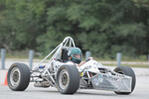
Another example of lack of perfect Ackermann geometry can be seen in the Red Bull F1 car below. You can see below that the outer wheel turns more than the inner wheel.
Whenever this question comes up, everybody starts talking about the "Ackerman Effect". In reality the concern is the type of tires you have. Corvettes are produced with "summer tires" to help with aggressive driving. Change the tires to all season tires and the noise/hopping goes away. I had the same problem on my 2015 Stingray. I changed to Michelin Pilot Sport All Season 4 ZP and the concern is gone. As far as I'm concerned, the ride improved also.
We've all felt it. It's completely normal and completely resolvable by replacing the tires. I went with Michelin AS4 tires and it no longer happens. Bonus points, I can now safely drive in the rain.
If you ever get silly and want to do something crazy like RTFM, you might find this little tidbit nestled away in the pages of the Owner's manual:
Tire Chatter/Hop
When driving at slow speeds and in
very tight turns, the vehicle may
have tire chatter/hop. This is normal
and the vehicle does not require
service.
When you go to A/S tires, the rubber is not as soft and that allows the tires to slip a little smoother during the slow sharp turns. The OEM tires are sticky as a gum eraser and refuses to slid nicely and not scare the new guys when they drive the Corvette.
Designer Imagines A Corvette That Looks More Like a Corvette Than the Corvette
Slideshow: A Jaguar designer's personal project imagines what a modern front-engined Corvette might look like if Chevrolet revisited the golden age of the Stingray.














 Slow turn question


 Yep, normal.