






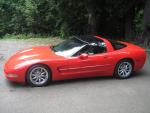



winter fuel storage

Advanced


Joined: Sep 2024
Posts: 82
Likes: 68
From: Lake Hartwelll GA

Non-ethanol full tank and a battery tender. One more thing, you have to visit it from time to time to let it know you still love it and you will be together again soon. 
More information from a recent thread can be seen here: is it a 1/4 tank of gas???
More information from a recent thread can be seen here: is it a 1/4 tank of gas???

Le Mans Master


Joined: Jun 2019
Posts: 5,470
Likes: 2,179
From: Loveland
You will see a 50/50 mix on opinions. I personally think it depends where you live. If you live in a dry climate 1/2 full. If you are in a wet humid climate keep it full and use Stabil and some octane booster depending how long you store it.
Last edited by kodpkd; Nov 16, 2024 at 10:32 AM.

Team Owner


Joined: Jul 2004
Posts: 28,459
Likes: 3,288
From: Hartford WI
It gets whatever level of fuel is in the tank unless it is a boat. I leave it to the storage department as the last car since I am usually the first out. They can hook it up to a tender. Winter air is dry and since I have a fully functioning evap system, it is pretty much sealed so not afraid of water vapor.
Team Owner
Joined: Jul 2004
Posts: 28,459
Likes: 3,288
From: Hartford WI

Drifting


Joined: Sep 2019
Posts: 1,913
Likes: 1,957
From: Colo Spgs, CO
Corvette Stories
The Best of Corvette for Corvette Enthusiasts

Top 10 Most Expensive Corvettes Ever Sold on Bring A Trailer
Brett Foote
10 Things Every Corvette Owner Needs (2026 Edition)
Michael S. Palmer
8 Most "Only Corvette Owners Understand" Quirks and Problems
Pouria Savadkouei
10 Reasons the C6 Z06 is Still A Performance Benchmark After 20 Years
Joe Kucinski
How Much Horsepower Every Corvette Engine "LOST" in 1972
Joe Kucinski
Top 10 DOs and DON'Ts for Protecting Your Convertible Top!
Michael S. Palmer
Top 10 Most Explosive Corvettes Ever Made: Power-to-Weight Ratio Ranked!
Joe Kucinski
150 hp to 1,250 hp: Every Corvette Generation Compared by the Specs That Matter
Joe Kucinski
8 Coolest Corvette Pace Cars (and Replicas) of All Time
Verdad Gallardo


CF Community Team

Joined: Apr 2016
Posts: 14,146
Likes: 7,433
From: Pittsburgh
2025 C6 of the Year Finalist - Unmodified
2024 C6 of the Year Finalist - Unmodified
2023 C6 of the Year Finalist - Unmodified
2022 C6 of the Year Finalist - Unmodified
2021 C6 of the Year Finalist - Unmodified
As you can see, there are mixed comments about how much fuel to leave in your tank...I personally leave whatever is left in the tank on my last drive but I do add Stabil to the tank. Long gone are the days of moisture getting into your tank & mixing with the fuel, modern tanks are constructed of plastic instead of steel & the tank is sealed from the atmosphere. It's the same thing people say with tires that will "flat spot" if left in the same position for an extended amount of time...modern radial tires do NOT flat spot
Last edited by 449er; Nov 17, 2024 at 07:21 AM.



Drifting

Joined: Sep 2004
Posts: 1,470
Likes: 442
Same here, as long as streets are dry and clear in winter months I drive mine, no need for any special efforts. Check tire pressures and keep battery on tender. Mine does sit in an unheated attached garage. I have car covers and don't even use them. Only **** thing I have with my Vettes is I don't drive them in rain or snow, they stay cleaner that way. I've got my truck and wife's Honda for that.
Team Owner
Joined: Jul 2004
Posts: 28,459
Likes: 3,288
From: Hartford WI
Same here, as long as streets are dry and clear in winter months I drive mine, no need for any special efforts. Check tire pressures and keep battery on tender. Mine does sit in an unheated attached garage. I have car covers and don't even use them. Only **** thing I have with my Vettes is I don't drive them in rain or snow, they stay cleaner that way. I've got my truck and wife's Honda for that.

Drifting
Joined: Apr 2018
Posts: 1,323
Likes: 928
From: Burnt Hills NY
Watch the video by Paul Koerner, the premiere Corvette Tech that GM hired away from a CT dealership for his knowledge, where explains exactly what fuel level to use when storing your C5, C6 and C7. For me this is an easy thing to do to prevent a possible huge repair bill. I don't see a downside. It's worth a watch. Here is the link.


Le Mans Master


Joined: Jun 2002
Posts: 5,036
Likes: 845
From: Rotonda West, FL 2015 Z51 M7 3LT
Oldtimer
Watch the video by Paul Koerner, the premiere Corvette Tech that GM hired away from a CT dealership for his knowledge, where explains exactly what fuel level to use when storing your C5, C6 and C7. For me this is an easy thing to do to prevent a possible huge repair bill. I don't see a downside. It's worth a watch. Here is the link.
Living where we are now, I just drive it.


Melting Slicks

Joined: Jul 2005
Posts: 2,649
Likes: 863
The way I understand the operation of the dual tank fuel pump system - there are fuel sending units in both tanks; fuel is pumped from the driver side tank to the engine, and the "jet pump" on the return line pulls fuel from the pass side tank into the driver side tank. So ,,,, the system is designed to keep the driver side tank full until the pass side tank is empty. So - under normal operating conditions - if the pass side tank is 1/4 full - the driver side tank is completely full. If the driver side tank is 1/4 full - the pass side tank is empty.
So - how would you achieve something on the order of 1/4 full on both tanks ???
Team Owner
Joined: Jul 2004
Posts: 28,459
Likes: 3,288
From: Hartford WI
Watch the video by Paul Koerner, the premiere Corvette Tech that GM hired away from a CT dealership for his knowledge, where explains exactly what fuel level to use when storing your C5, C6 and C7. For me this is an easy thing to do to prevent a possible huge repair bill. I don't see a downside. It's worth a watch. Here is the link.

Team Owner
Joined: Jul 2004
Posts: 28,459
Likes: 3,288
From: Hartford WI