






LT1 GDI owners

Thread Starter
Melting Slicks

Joined: Dec 2004
Posts: 3,120
Likes: 119
St. Jude Donor '10

This thread has been very enlightening. You walk into a dealership and ask them about the engine ( I've been shopping. ) and they are likely to use the direct injection as a selling point. From what I've learned here ( I was ignorant of this entire area prior to this and some other threads on or near this subject. ) GDI does have some positives.
Among the positives are better gas mileage and better ability to control engine knock,ping, pre-ignition etc.
All things considered it appears that most people who own GDI vettes, and their cars, don't have the time or miles for this problem to become a problem. So, the cars keep selling and very little chatter can be heard about this issue except in highly specialized discussions like this.
But, give it time......
Among the positives are better gas mileage and better ability to control engine knock,ping, pre-ignition etc.
All things considered it appears that most people who own GDI vettes, and their cars, don't have the time or miles for this problem to become a problem. So, the cars keep selling and very little chatter can be heard about this issue except in highly specialized discussions like this.
But, give it time......
The Regulatory agencies are only concerned (so far) with the efficiency they leave the factory with, not 20-40-60k miles down the road when these issues are severe.
Anything you wish to know about GDI, just ask. That is why Colorado Speed has me here helping. To educate.


Safety Car


Joined: Oct 2008
Posts: 4,912
Likes: 266
From: Charleston SC
This thread has been very enlightening. You walk into a dealership and ask them about the engine ( I've been shopping. ) and they are likely to use the direct injection as a selling point. From what I've learned here ( I was ignorant of this entire area prior to this and some other threads on or near this subject. ) GDI does have some positives.
Among the positives are better gas mileage and better ability to control engine knock,ping, pre-ignition etc.
All things considered it appears that most people who own GDI vettes, and their cars, don't have the time or miles for this problem to become a problem. So, the cars keep selling and very little chatter can be heard about this issue except in highly specialized discussions like this.
But, give it time......
Among the positives are better gas mileage and better ability to control engine knock,ping, pre-ignition etc.
All things considered it appears that most people who own GDI vettes, and their cars, don't have the time or miles for this problem to become a problem. So, the cars keep selling and very little chatter can be heard about this issue except in highly specialized discussions like this.
But, give it time......
Thread Starter
Melting Slicks
Joined: Dec 2004
Posts: 3,120
Likes: 119
St. Jude Donor '10
The Real interesting thing is how Ford Eco boost (which is part of those engines that are pretty bad with deposit) is now switching to a hybrid system of Port injection and Direct injection....not because they cared to clean their valves (because lets face it, that' s a good money generating problem to have) but because they (and I believe Mercedes is on that path as well) found out they could be even more efficient that way. The positive effect for the owner will be even less and perhaps no build up....


Drifting

Joined: Dec 2012
Posts: 1,630
Likes: 203
From: MI
This thread has been very enlightening. You walk into a dealership and ask them about the engine ( I've been shopping. ) and they are likely to use the direct injection as a selling point. From what I've learned here ( I was ignorant of this entire area prior to this and some other threads on or near this subject. ) GDI does have some positives.
Among the positives are better gas mileage and better ability to control engine knock,ping, pre-ignition etc.
All things considered it appears that most people who own GDI vettes, and their cars, don't have the time or miles for this problem to become a problem. So, the cars keep selling and very little chatter can be heard about this issue except in highly specialized discussions like this.
But, give it time......
Among the positives are better gas mileage and better ability to control engine knock,ping, pre-ignition etc.
All things considered it appears that most people who own GDI vettes, and their cars, don't have the time or miles for this problem to become a problem. So, the cars keep selling and very little chatter can be heard about this issue except in highly specialized discussions like this.
But, give it time......
Hell my dads 2015 GMC truck now has 70k miles. My 2009 CTS had GDI also....
I just wish we had more pictures and data. I have yet to see any GM GDI v8 with "major" carbon build. More than just a thin layer of carbon.
This picture is the highest mileage LT1 valve picture we have to date.
38k miles. in my opinion hes not down on "major power"
Last edited by MikeLsx; Aug 24, 2016 at 08:28 PM.
Thread Starter
Melting Slicks
Joined: Dec 2004
Posts: 3,120
Likes: 119
St. Jude Donor '10
And that is fine Mike, whatever your comfortable with. You saw the pictures of the member here that did the before and after dyno's and all his pictures, so if your comfortable with that power loss by all means ignore these threads. Same with the other few trouble makers. You have made your opinions clear. This is ONLY for those that do want to learn and discuss the technical aspects, opinions have been expressed until were all sick of them. DO as you choose.
Your 09 CTS is the LLT engine, very easy for you to look at them. Your intake manifold has a upper plenum that you only have to remove the perimeter bolts on (10mm socket), and the 4-13mm head bolts from the center and it comes right off. No down the runners with a boroscope and see and share those pictures.
Your 09 CTS is the LLT engine, very easy for you to look at them. Your intake manifold has a upper plenum that you only have to remove the perimeter bolts on (10mm socket), and the 4-13mm head bolts from the center and it comes right off. No down the runners with a boroscope and see and share those pictures.

Pro


Joined: Nov 2013
Posts: 693
Likes: 158
From: Milwaukee WI
Your posts yesterday (#361 & #363) were excellent and the very reason many of us are here. The criticisms are a distraction from the very fine information you actually have from experience and ongoing subject insight.

Moderator emeritus


Joined: Jun 2001
Posts: 18,599
Likes: 3,955
From: Jacksonville Florida BWO Dayton, Cincinnati, Bloomsbury NJ, Cincinnati
2015 C7 of the Year Finalist
In case any GM folks are reading this and taking notes...
I see the purpose and reasoning behind a catch can. I will neither confirm or deny that I might have a catch can on my car right now. I can confirm that the possible catch can on my car would not be there for any visit to my dealer.
I have been privy to installations and removals of catch cans on the LT1 engine and I can confirm that it is a <15 minute removal/go to stock operation.
That's all I can confirm or deny...
Elmer
I see the purpose and reasoning behind a catch can. I will neither confirm or deny that I might have a catch can on my car right now. I can confirm that the possible catch can on my car would not be there for any visit to my dealer.
I have been privy to installations and removals of catch cans on the LT1 engine and I can confirm that it is a <15 minute removal/go to stock operation.
That's all I can confirm or deny...
Elmer
Last edited by eboggs_jkvl; Aug 25, 2016 at 10:41 AM.
Safety Car
Joined: Oct 2008
Posts: 4,912
Likes: 266
From: Charleston SC
Like every GM engine is GDI.
Hell my dads 2015 GMC truck now has 70k miles. My 2009 CTS had GDI also....
I just wish we had more pictures and data. I have yet to see any GM GDI v8 with "major" carbon build. More than just a thin layer of carbon.
This picture is the highest mileage LT1 valve picture we have to date.
38k miles. in my opinion hes not down on "major power"
Hell my dads 2015 GMC truck now has 70k miles. My 2009 CTS had GDI also....
I just wish we had more pictures and data. I have yet to see any GM GDI v8 with "major" carbon build. More than just a thin layer of carbon.
This picture is the highest mileage LT1 valve picture we have to date.
38k miles. in my opinion hes not down on "major power"
Of course to the majority of owner, this won't matter, but this post is a technical/hotrod post, so it does here
 . good stuff!
Last edited by mirage2991; Aug 25, 2016 at 11:26 AM.
Corvette Stories
The Best of Corvette for Corvette Enthusiasts

Every 2027 Corvette Engine Explained
Joe Kucinski
Designer Imagines A Corvette That Looks More Like a Corvette Than the Corvette
Verdad Gallardo
10 Ugly Corvettes That We Still Kinda Love
Joe Kucinski
Top 10 Most Expensive Corvettes Ever Sold on Bring A Trailer
Brett Foote
10 Things Every Corvette Owner Needs (2026 Edition)
Michael S. Palmer
8 Most "Only Corvette Owners Understand" Quirks and Problems
Pouria Savadkouei
10 Reasons the C6 Z06 is Still A Performance Benchmark After 20 Years
Joe Kucinski
How Much Horsepower Every Corvette Engine "LOST" in 1972
Joe Kucinski
Top 10 DOs and DON'Ts for Protecting Your Convertible Top!
Michael S. Palmer
Drifting
Joined: Dec 2012
Posts: 1,630
Likes: 203
From: MI
And that is fine Mike, whatever your comfortable with. You saw the pictures of the member here that did the before and after dyno's and all his pictures, so if your comfortable with that power loss by all means ignore these threads. Same with the other few trouble makers. You have made your opinions clear. This is ONLY for those that do want to learn and discuss the technical aspects, opinions have been expressed until were all sick of them. DO as you choose.
Your 09 CTS is the LLT engine, very easy for you to look at them. Your intake manifold has a upper plenum that you only have to remove the perimeter bolts on (10mm socket), and the 4-13mm head bolts from the center and it comes right off. No down the runners with a boroscope and see and share those pictures.
Your 09 CTS is the LLT engine, very easy for you to look at them. Your intake manifold has a upper plenum that you only have to remove the perimeter bolts on (10mm socket), and the 4-13mm head bolts from the center and it comes right off. No down the runners with a boroscope and see and share those pictures.
Major should be used when things are VERY bad.
Last edited by MikeLsx; Aug 25, 2016 at 04:01 PM.
Thread Starter
Melting Slicks
Joined: Dec 2004
Posts: 3,120
Likes: 119
St. Jude Donor '10
Mirage this is very accurate, but the laymen does not realize this. That is why I share pictures of Port injection LS engines with well over 100-150-200k miles with zero deposits on them. Severe is anything that is document in dyno testing to show a reduction in power IMHO as that is not acceptable to me in any form, but I do understand there are, and probably most new Corvette and other GDI engine owners that will never be aware, or even care. So these there is nothing for them to worry about if they choose. I look at maintaining a vehicle to maintain, or exceed the performance it came with, and being the Corvette is all about performance, it seems more relevant than most other models.
That seems to be the main hang up....is being down 10-15 HP (or 20 as the 20k miles C7 owner was) enough to be considered severe when many spend $500 for a tune to get those gains, or a CAI, or $1500-$2000 to install long tubes, etc. Lighter wheels, and on and on.
Being in Professional racing a good part of my adult life, we spend a ton of $ to get 10-15-20 more HP and TQ. But for a grocery getter SUV, that may not be of any concern.
I am approaching all of this from a technical standpoint, and those that are concerned are the only ones this is targeted towards. We all know there are a good percentage of owners that have never even gone WOT or been to a track event, or even been over 100 MPH in their new vette. They will never know what is occurring and should not even be concerned.
Thanks again for the technical contribution here mirage, this is what I am hoping to see more of.
And Mike, sure wish I had you and your car to do the same testing on that the Aerospace Engineer did with his. That is what will help to gather more data. We, and others that are working on these solutions know exactly what is occurring, but for the general public to pay attention it takes more "average Joe's" to see this first hand.
That seems to be the main hang up....is being down 10-15 HP (or 20 as the 20k miles C7 owner was) enough to be considered severe when many spend $500 for a tune to get those gains, or a CAI, or $1500-$2000 to install long tubes, etc. Lighter wheels, and on and on.
Being in Professional racing a good part of my adult life, we spend a ton of $ to get 10-15-20 more HP and TQ. But for a grocery getter SUV, that may not be of any concern.
I am approaching all of this from a technical standpoint, and those that are concerned are the only ones this is targeted towards. We all know there are a good percentage of owners that have never even gone WOT or been to a track event, or even been over 100 MPH in their new vette. They will never know what is occurring and should not even be concerned.
Thanks again for the technical contribution here mirage, this is what I am hoping to see more of.
And Mike, sure wish I had you and your car to do the same testing on that the Aerospace Engineer did with his. That is what will help to gather more data. We, and others that are working on these solutions know exactly what is occurring, but for the general public to pay attention it takes more "average Joe's" to see this first hand.
Drifting
Joined: Dec 2012
Posts: 1,630
Likes: 203
From: MI
Mirage this is very accurate, but the laymen does not realize this. That is why I share pictures of Port injection LS engines with well over 100-150-200k miles with zero deposits on them. Severe is anything that is document in dyno testing to show a reduction in power IMHO as that is not acceptable to me in any form, but I do understand there are, and probably most new Corvette and other GDI engine owners that will never be aware, or even care. So these there is nothing for them to worry about if they choose. I look at maintaining a vehicle to maintain, or exceed the performance it came with, and being the Corvette is all about performance, it seems more relevant than most other models.
That seems to be the main hang up....is being down 10-15 HP (or 20 as the 20k miles C7 owner was) enough to be considered severe when many spend $500 for a tune to get those gains, or a CAI, or $1500-$2000 to install long tubes, etc. Lighter wheels, and on and on.
Being in Professional racing a good part of my adult life, we spend a ton of $ to get 10-15-20 more HP and TQ. But for a grocery getter SUV, that may not be of any concern.
I am approaching all of this from a technical standpoint, and those that are concerned are the only ones this is targeted towards. We all know there are a good percentage of owners that have never even gone WOT or been to a track event, or even been over 100 MPH in their new vette. They will never know what is occurring and should not even be concerned.
Thanks again for the technical contribution here mirage, this is what I am hoping to see more of.
And Mike, sure wish I had you and your car to do the same testing on that the Aerospace Engineer did with his. That is what will help to gather more data. We, and others that are working on these solutions know exactly what is occurring, but for the general public to pay attention it takes more "average Joe's" to see this first hand.
That seems to be the main hang up....is being down 10-15 HP (or 20 as the 20k miles C7 owner was) enough to be considered severe when many spend $500 for a tune to get those gains, or a CAI, or $1500-$2000 to install long tubes, etc. Lighter wheels, and on and on.
Being in Professional racing a good part of my adult life, we spend a ton of $ to get 10-15-20 more HP and TQ. But for a grocery getter SUV, that may not be of any concern.
I am approaching all of this from a technical standpoint, and those that are concerned are the only ones this is targeted towards. We all know there are a good percentage of owners that have never even gone WOT or been to a track event, or even been over 100 MPH in their new vette. They will never know what is occurring and should not even be concerned.
Thanks again for the technical contribution here mirage, this is what I am hoping to see more of.
And Mike, sure wish I had you and your car to do the same testing on that the Aerospace Engineer did with his. That is what will help to gather more data. We, and others that are working on these solutions know exactly what is occurring, but for the general public to pay attention it takes more "average Joe's" to see this first hand.
You personally have actual made me start to dislike my corvette. I got this car and really like it more than any other car i have ever owned. Some people here say the GDI problem is a problem, but you wont have problems until you put on a lot of miles. Which makes me feel little better, but you say the car is pretty much screwed at 10k+ miles.
Not saying you are wrong, I am just little disappointed the car I bought has a fatal flaw.
Thread Starter
Melting Slicks
Joined: Dec 2004
Posts: 3,120
Likes: 119
St. Jude Donor '10
DON"T dislike your car!! The C7 is the best, most advanced Corvette to date, and for a fraction of the cost will hold with, or beat most exotics costing manu=y times the $. This affects every single automaker in the World, some are worse than others as you see in these threads, it is just a new era of owning new vehicles and unlike the trend of the past 50-60 years, the consumer needs to now learn MORE about up-keep and how it all works VS the trend of less. And no where do I say, or hint that any GDI engine is screwed at 10k miles. This is just the average miles where you can begin to document power loss. And all seem to vary a bit depending on if full synthetic oil is used VS dexos blend, how well the rings seated in that first 100 or so miles, and how they are driven. (a regular WOT seems to show a reduction in severity and rate of formation. We do not see valve guides worn out of spec until 20-40K miles on the newer engines (rarely ever wore once carburetors went away until now), and even using the best air/oil separation system will only prevent up to 90% or so of this. There is always going to be some we cannot address forming from the EGR emulation of the VVT that back-fills the port behind the valve with burnt gasses.
And when we get new test vehicles in, (we test most every make/model we can get our hands on to get as broad of a picture at real World results) almost all claim, even at 50k miles, they have noticed no reduction in power and fuel economy, that si until a before and after dyno is performed with the manual valve cleaning done. Then it is night and day. The degradation is very gradual, nothing over night.
This was forced on all automakers (yes, it appears Chrysler as well has had to join in the GDI standard as they were the last hold-out). So it does not matter what you buy, it is the new standard.
I really would like to walk you through your CTS engine. It is so easy for you to reach the valves to see them personally.
The average new vehicle owner will have traded their vehicle before it is serious enough for the average driver to really feel the degradation. It is the used vehicle market that we foresee taking the biggest hit.
And that will take a few more years before there is a large enough public out-cry.
And when we get new test vehicles in, (we test most every make/model we can get our hands on to get as broad of a picture at real World results) almost all claim, even at 50k miles, they have noticed no reduction in power and fuel economy, that si until a before and after dyno is performed with the manual valve cleaning done. Then it is night and day. The degradation is very gradual, nothing over night.
This was forced on all automakers (yes, it appears Chrysler as well has had to join in the GDI standard as they were the last hold-out). So it does not matter what you buy, it is the new standard.
I really would like to walk you through your CTS engine. It is so easy for you to reach the valves to see them personally.
The average new vehicle owner will have traded their vehicle before it is serious enough for the average driver to really feel the degradation. It is the used vehicle market that we foresee taking the biggest hit.
And that will take a few more years before there is a large enough public out-cry.
Drifting
Joined: Dec 2012
Posts: 1,630
Likes: 203
From: MI
DON"T dislike your car!! The C7 is the best, most advanced Corvette to date, and for a fraction of the cost will hold with, or beat most exotics costing manu=y times the $. This affects every single automaker in the World, some are worse than others as you see in these threads, it is just a new era of owning new vehicles and unlike the trend of the past 50-60 years, the consumer needs to now learn MORE about up-keep and how it all works VS the trend of less. And no where do I say, or hint that any GDI engine is screwed at 10k miles. This is just the average miles where you can begin to document power loss. And all seem to vary a bit depending on if full synthetic oil is used VS dexos blend, how well the rings seated in that first 100 or so miles, and how they are driven. (a regular WOT seems to show a reduction in severity and rate of formation. We do not see valve guides worn out of spec until 20-40K miles on the newer engines (rarely ever wore once carburetors went away until now), and even using the best air/oil separation system will only prevent up to 90% or so of this. There is always going to be some we cannot address forming from the EGR emulation of the VVT that back-fills the port behind the valve with burnt gasses.
And when we get new test vehicles in, (we test most every make/model we can get our hands on to get as broad of a picture at real World results) almost all claim, even at 50k miles, they have noticed no reduction in power and fuel economy, that si until a before and after dyno is performed with the manual valve cleaning done. Then it is night and day. The degradation is very gradual, nothing over night.
This was forced on all automakers (yes, it appears Chrysler as well has had to join in the GDI standard as they were the last hold-out). So it does not matter what you buy, it is the new standard.
I really would like to walk you through your CTS engine. It is so easy for you to reach the valves to see them personally.
The average new vehicle owner will have traded their vehicle before it is serious enough for the average driver to really feel the degradation. It is the used vehicle market that we foresee taking the biggest hit.
And that will take a few more years before there is a large enough public out-cry.
And when we get new test vehicles in, (we test most every make/model we can get our hands on to get as broad of a picture at real World results) almost all claim, even at 50k miles, they have noticed no reduction in power and fuel economy, that si until a before and after dyno is performed with the manual valve cleaning done. Then it is night and day. The degradation is very gradual, nothing over night.
This was forced on all automakers (yes, it appears Chrysler as well has had to join in the GDI standard as they were the last hold-out). So it does not matter what you buy, it is the new standard.
I really would like to walk you through your CTS engine. It is so easy for you to reach the valves to see them personally.
The average new vehicle owner will have traded their vehicle before it is serious enough for the average driver to really feel the degradation. It is the used vehicle market that we foresee taking the biggest hit.
And that will take a few more years before there is a large enough public out-cry.
Probably going to end up selling my corvette anyways in the years to come. I am hoping for a OEM solution to this problem. The LT1 is just another growing pain for GDI engines.
Last edited by MikeLsx; Aug 26, 2016 at 02:46 PM.

Instructor

Joined: Nov 2015
Posts: 127
Likes: 22
I would just like someone to concede that all these C7s aren't equally affected by this issue. My C7 is dead stock. When it was new it usually trapped 92 mph in the eighth mile. Now it traps high 94 mph. 24000 miles and running stronger every day. Some of this can be attributed to break in but I doubt my valves are heavily coked or the car wouldn't be running so well. Until my speeds show a problem, I'm not digging into my valves.
Thread Starter
Melting Slicks
Joined: Dec 2004
Posts: 3,120
Likes: 119
St. Jude Donor '10
I would just like someone to concede that all these C7s aren't equally affected by this issue. My C7 is dead stock. When it was new it usually trapped 92 mph in the eighth mile. Now it traps high 94 mph. 24000 miles and running stronger every day. Some of this can be attributed to break in but I doubt my valves are heavily coked or the car wouldn't be running so well. Until my speeds show a problem, I'm not digging into my valves.
And in closing, if you removed your IM and performed a manual intake valve cleaning like the member here that did the before and after dyno tests, I would be amazed if you did not pick up a few more hundredths, if not close to a tenth as you are basing on ET's when new, and now after good ring seating (I suspect your rings are seated better than 90% of other owners as you broke yours in hard) imagine if your valves were clean as new.
Look at this advertisement for CNC performance heads for the LT based engines, and the valve designs, port porting, finishes of each, etc.
http://store.custombuiltmotors.com/e...62-blocks.html
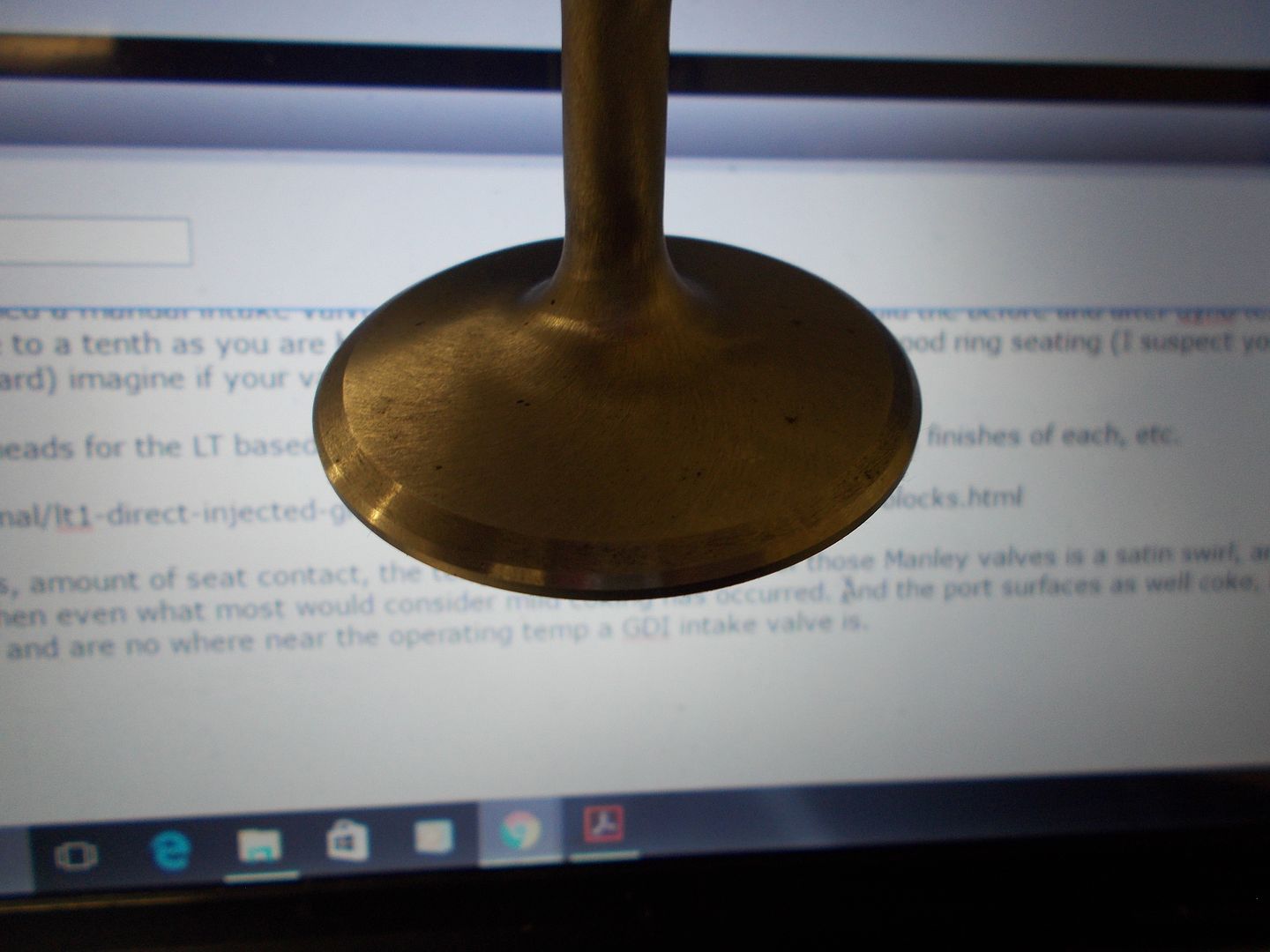
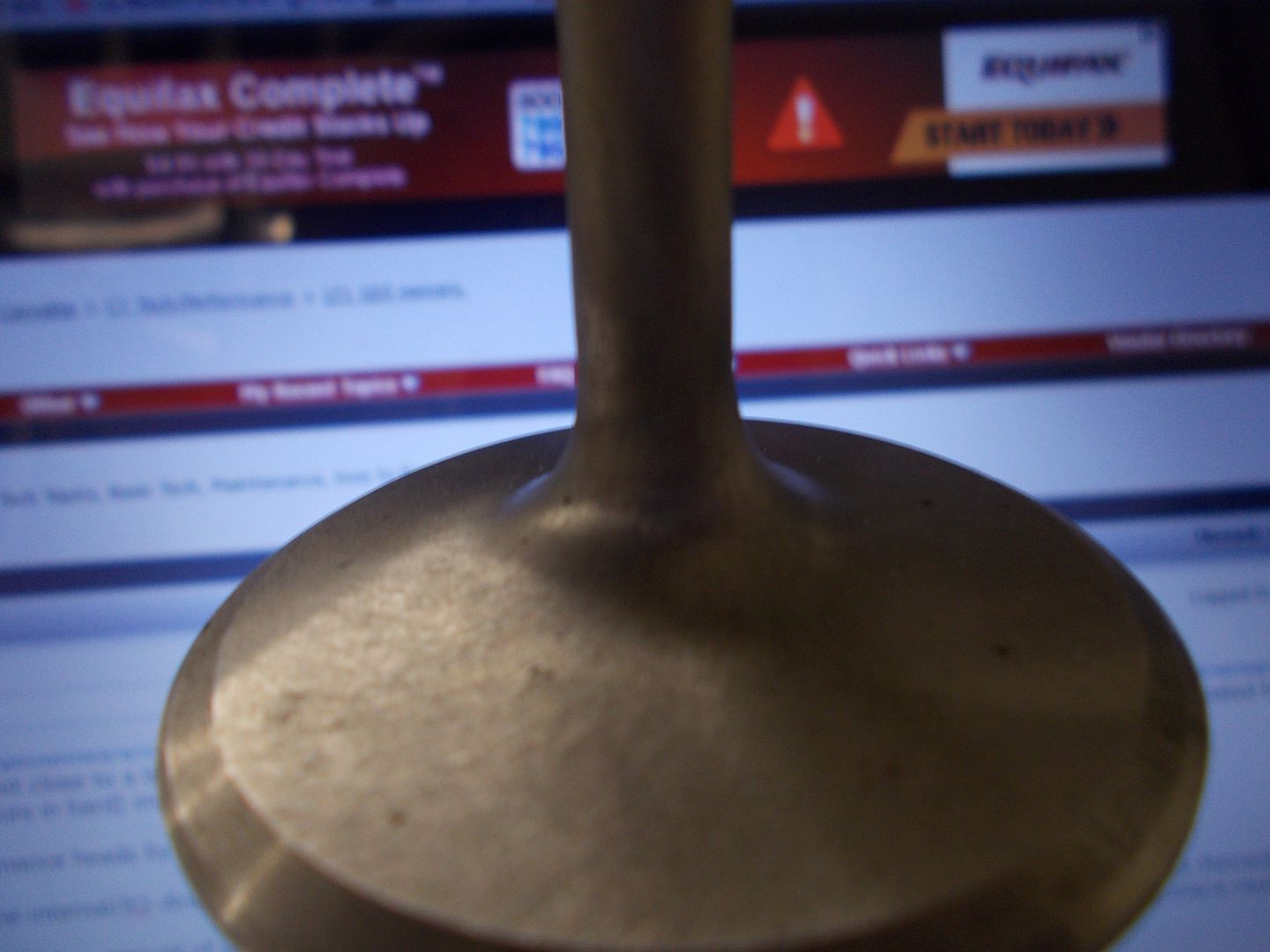
Every aspect of the valve shape, valve job angles, amount of seat contact, the texture on the back sides of those Manley valves is a satin swirl, and stem is thinned where the flow passes, all of this is rendered useless when even what most would consider mild coking has occurred. And the port surfaces as well coke, but no where near as severe as the valves as they transfer heat away and are no where near the operating temp a GDI intake valve is.
Look close at this valve here:


Look at the special texture of finish only where the flow passes, the shape of the short side radius where the stem attaches.
The thinned stem and how it transitions to the main stem. The valve seating angles (3).
No one is asking anyone to "tear into there valves", only remove their intake manifold, simple, minimal tools, and all gaskets are reusable. That gives you up close access to the valves.
Drifting
Joined: Dec 2012
Posts: 1,630
Likes: 203
From: MI
All through my threads I point this out. Ring seating has the biggest impact on power gains after initial break-in, but you drive your regularly at WOT it appears, and those engines show far less severity than those driven easy most of the time, with the ones babied the worse. The oil you run also has a direct impact on the rate and severity of coking. Using the dealer supplied synthetic blend results on far more severe deposits than and good full synthetic due to the amount of residue left when they burn onto the hot valves. Follow my threads and I always cover just what your referring to, just not redundant in every post. You also would have to list DA at the times of the runs your describing. We run up to a half second slower at Bandimeir than at West Palm. Ans can vary at West palm that much between hot summer and cool dry winter.
And in closing, if you removed your IM and performed a manual intake valve cleaning like the member here that did the before and after dyno tests, I would be amazed if you did not pick up a few more hundredths, if not close to a tenth as you are basing on ET's when new, and now after good ring seating (I suspect your rings are seated better than 90% of other owners as you broke yours in hard) imagine if your valves were clean as new.
Look at this advertisement for CNC performance heads for the LT based engines, and the valve designs, port porting, finishes of each, etc.
http://store.custombuiltmotors.com/e...62-blocks.html
Every aspect of the valve shape, valve job angles, amount of seat contact, the texture on the back sides of those Manley valves is a satin swirl, and stem is thinned where the flow passes, all of this is rendered useless when even what most would consider mild coking has occurred. And the port surfaces as well coke, but no where near as severe as the valves as they transfer heat away and are no where near the operating temp a GDI intake valve is.
Look close at this valve here:

Look at the special texture of finish only where the flow passes, the shape of the short side radius where the stem attaches.
The thinned stem and how it transitions to the main stem. The valve seating angles (3).
No one is asking anyone to "tear into there valves", only remove their intake manifold, simple, minimal tools, and all gaskets are reusable. That gives you up close access to the valves.
And in closing, if you removed your IM and performed a manual intake valve cleaning like the member here that did the before and after dyno tests, I would be amazed if you did not pick up a few more hundredths, if not close to a tenth as you are basing on ET's when new, and now after good ring seating (I suspect your rings are seated better than 90% of other owners as you broke yours in hard) imagine if your valves were clean as new.
Look at this advertisement for CNC performance heads for the LT based engines, and the valve designs, port porting, finishes of each, etc.
http://store.custombuiltmotors.com/e...62-blocks.html
Every aspect of the valve shape, valve job angles, amount of seat contact, the texture on the back sides of those Manley valves is a satin swirl, and stem is thinned where the flow passes, all of this is rendered useless when even what most would consider mild coking has occurred. And the port surfaces as well coke, but no where near as severe as the valves as they transfer heat away and are no where near the operating temp a GDI intake valve is.
Look close at this valve here:
Look at the special texture of finish only where the flow passes, the shape of the short side radius where the stem attaches.
The thinned stem and how it transitions to the main stem. The valve seating angles (3).
No one is asking anyone to "tear into there valves", only remove their intake manifold, simple, minimal tools, and all gaskets are reusable. That gives you up close access to the valves.
Last edited by MikeLsx; Aug 27, 2016 at 02:43 PM.
Instructor
Joined: Nov 2015
Posts: 127
Likes: 22
I think its kind of pointless for me and maybe others to check for coking at certain miles. I am waiting tell i have more miles to look at my valves. Because if i see a thin layer of carbon (like the pictures i posted of other memeber) I am not going to think much of it. I think its only worth checking when I want to see major build up, like the ones posted on BMW forums. something like this
Drifting
Joined: Dec 2012
Posts: 1,630
Likes: 203
From: MI

Team Owner


Joined: Jan 2007
Posts: 29,065
Likes: 1,839
From: cookeville tennessee
Mike drive your car man and have some fun in her. This stuff is not bad at all unless you overfill your oil in the car. If you drive it really hard are not just lower the level in it by 1/4 qt of oil and stuff will work much better to really slow the coking down.
Yes I have a catch can on my car with no blower on it so far. I am sure will put one like a TI small blower on it maybe this winter. But will only push it to about 650 rwhp and call it a day with all stock parts in the block.. The C7 is one of the best corvette's that GM has put out to dated.
Yes I have a catch can on my car with no blower on it so far. I am sure will put one like a TI small blower on it maybe this winter. But will only push it to about 650 rwhp and call it a day with all stock parts in the block.. The C7 is one of the best corvette's that GM has put out to dated.

Thread Starter
Melting Slicks
Joined: Dec 2004
Posts: 3,120
Likes: 119
St. Jude Donor '10
As I pointed out here and in posts in the past. No reason to dislike your car:
"DON"T dislike your car!! The C7 is the best, most advanced Corvette to date, and for a fraction of the cost will hold with, or beat most exotics costing many times the $. This affects every single automaker in the World, some are worse than others as you see in these threads, it is just a new era of owning new vehicles and unlike the trend of the past 50-60 years, the consumer needs to now learn MORE about up-keep and how it all works VS the trend of less. And no where do I say, or hint that any GDI engine is screwed at 10k miles. This is just the average miles where you can begin to document power loss. And all seem to vary a bit depending on if full synthetic oil is used VS dexos blend, how well the rings seated in that first 100 or so miles, and how they are driven. (a regular WOT seems to show a reduction in severity and rate of formation. We do not see valve guides worn out of spec until 20-40K miles on the newer engines (rarely ever wore once carburetors went away until now), and even using the best air/oil separation system will only prevent up to 90% or so of this. There is always going to be some we cannot address forming from the EGR emulation of the VVT that back-fills the port behind the valve with burnt gasses. "
Just in case you did not read the entire post.
"DON"T dislike your car!! The C7 is the best, most advanced Corvette to date, and for a fraction of the cost will hold with, or beat most exotics costing many times the $. This affects every single automaker in the World, some are worse than others as you see in these threads, it is just a new era of owning new vehicles and unlike the trend of the past 50-60 years, the consumer needs to now learn MORE about up-keep and how it all works VS the trend of less. And no where do I say, or hint that any GDI engine is screwed at 10k miles. This is just the average miles where you can begin to document power loss. And all seem to vary a bit depending on if full synthetic oil is used VS dexos blend, how well the rings seated in that first 100 or so miles, and how they are driven. (a regular WOT seems to show a reduction in severity and rate of formation. We do not see valve guides worn out of spec until 20-40K miles on the newer engines (rarely ever wore once carburetors went away until now), and even using the best air/oil separation system will only prevent up to 90% or so of this. There is always going to be some we cannot address forming from the EGR emulation of the VVT that back-fills the port behind the valve with burnt gasses. "
Just in case you did not read the entire post.