





Radiator hoses heat dissipation control?

Thread Starter
I'm Batman..


Joined: Apr 2014
Posts: 6,143
Likes: 921
From: Lehigh Acres FL
Tech Contributor
 Radiator hoses heat dissipation control?
In an effort to further reduce my engine bay temps, (already have a 160 stat and will be wrapping headers with DEI heat wrap) im curious if anyone has considered wrapping the actual radiator hoses with header heat wrap or even reflective thermal tape.
The reason I am asking is my intake charge pipe from my blower sits on the lower radiator hose a good anount and I was thinking that wrapping the hose with header wrap would help two fold, lowering engine bay temps as well as IAT temps. I've tried to adjust the intake piping, but theeres not enough wiggle room to make it not touch so another alternative is needed.
Thoughts? Would heat wrap cause the engine to actually run hotter? Would the hose deteriorate due to it trapping water in the wrap? Etc
Let me know what you think!
Ant
The reason I am asking is my intake charge pipe from my blower sits on the lower radiator hose a good anount and I was thinking that wrapping the hose with header wrap would help two fold, lowering engine bay temps as well as IAT temps. I've tried to adjust the intake piping, but theeres not enough wiggle room to make it not touch so another alternative is needed.
Thoughts? Would heat wrap cause the engine to actually run hotter? Would the hose deteriorate due to it trapping water in the wrap? Etc
Let me know what you think!
Ant

Le Mans Master


Joined: May 2000
Posts: 8,729
Likes: 1,508
From: Redmond WA
You could, but consider that you've got 8 aluminum tubes at 1200F shedding heat as quickly as aluminum does.
Then you've got a couple of rubber hoses at 200F shedding heat as slowly as rubber does.
I bet the win is so small relative to, for example, wrapping the exhaust that you'd never notice it. Can't hurt, of course. But it seems like a tiny, tiny factor.
Then you've got a couple of rubber hoses at 200F shedding heat as slowly as rubber does.
I bet the win is so small relative to, for example, wrapping the exhaust that you'd never notice it. Can't hurt, of course. But it seems like a tiny, tiny factor.
Last edited by davepl; Aug 6, 2017 at 02:12 PM.

Race Director

Joined: Jan 2014
Posts: 10,709
Likes: 7,102
From: Fulshear, TX
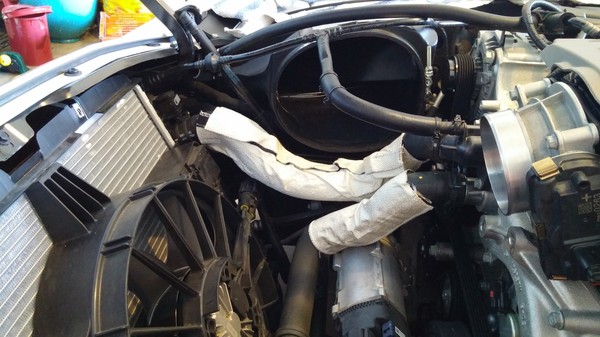
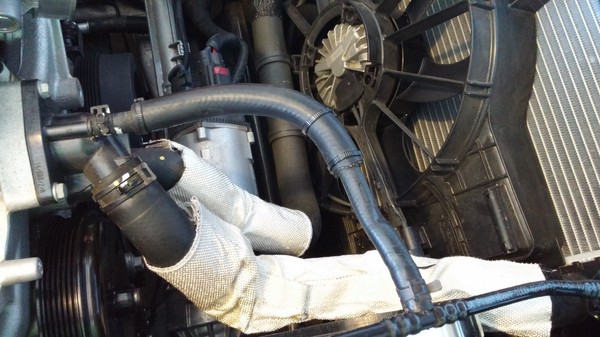
I put DEI heat sheath around mine to prevent the heat from soaking into my AFE intake. It has Velcro closure to very easy to put on. I left it a bit loose just to allow a little airflow around the hoses (similar to the small air gap on the DEI cat shields).
Last edited by Kracka; Aug 6, 2017 at 03:35 PM.
Thread Starter
I'm Batman..
Joined: Apr 2014
Posts: 6,143
Likes: 921
From: Lehigh Acres FL
Tech Contributor
You could, but consider that you've got 8 aluminum tubes at 1200F shedding heat as quickly as aluminum does.
Then you've got a couple of rubber hoses at 200F shedding heat as slowly as rubber does.
I bet the win is so small relative to, for example, wrapping the exhaust that you'd never notice it. Can't hurt, of course. But it seems like a tiny, tiny factor.
Then you've got a couple of rubber hoses at 200F shedding heat as slowly as rubber does.
I bet the win is so small relative to, for example, wrapping the exhaust that you'd never notice it. Can't hurt, of course. But it seems like a tiny, tiny factor.

Thread Starter
I'm Batman..
Joined: Apr 2014
Posts: 6,143
Likes: 921
From: Lehigh Acres FL
Tech Contributor
Race Director
Joined: Jan 2014
Posts: 10,709
Likes: 7,102
From: Fulshear, TX
Interior and exterior are cleaned prior to coating. A coater actually once told me the adhesion is better on used pipes after the steel has been heat cycled.
Thread Starter
I'm Batman..
Joined: Apr 2014
Posts: 6,143
Likes: 921
From: Lehigh Acres FL
Tech Contributor
Corvette Stories
The Best of Corvette for Corvette Enthusiasts

Every 2027 Corvette Engine Explained
Joe Kucinski
Designer Imagines A Corvette That Looks More Like a Corvette Than the Corvette
Verdad Gallardo
10 Ugly Corvettes That We Still Kinda Love
Joe Kucinski
Top 10 Most Expensive Corvettes Ever Sold on Bring A Trailer
Brett Foote
10 Things Every Corvette Owner Needs (2026 Edition)
Michael S. Palmer
8 Most "Only Corvette Owners Understand" Quirks and Problems
Pouria Savadkouei
10 Reasons the C6 Z06 is Still A Performance Benchmark After 20 Years
Joe Kucinski
How Much Horsepower Every Corvette Engine "LOST" in 1972
Joe Kucinski
Top 10 DOs and DON'Ts for Protecting Your Convertible Top!
Michael S. Palmer
Race Director
Joined: Jan 2014
Posts: 10,709
Likes: 7,102
From: Fulshear, TX
Ruben @ SoCal Porting and Michael @ SPCoating in Arlington, TX. I use the black 2000F coating nearest the heads and 1600F silver downstream from there; both have proven to be effective and durable.
Last edited by Kracka; Aug 6, 2017 at 05:37 PM.


Thread Starter
I'm Batman..
Joined: Apr 2014
Posts: 6,143
Likes: 921
From: Lehigh Acres FL
Tech Contributor

Melting Slicks


Joined: Mar 2001
Posts: 2,671
Likes: 850
From: New Jersey
So the little bit of heat that the wrapped radiator hoses don't dissipate is now being dissipated by the radiator...blowing the same total amount of hot air thru your engine compartment....seems pointless.
Last edited by ersatz928; Aug 7, 2017 at 08:30 AM.



Safety Car

Joined: Jun 2017
Posts: 4,786
Likes: 425
From: North Georgia, USA
When I put a "cold air intake" on any vehicle, the job isn't finished until the intake piping is very well insulated. That includes any bulkhead or compartment where the air filter sits. That compartment is also isolated from engine air completely Often the "kits" fit poorly and don't seal to the hood or the surrounding sheet metal. Foil covered soft foam insulation and metal foil all weather rated "duct tape" are used for both issues. Actually, sometimes I use fiberglass wrapped in foil and metal foil tape for the piping. "Frost king" makes some good insulation designed for pipes and HVAC ducts which works well for these situations
On other vehicles where the intake pipe and one of the radiator hoses snake around each other and are in close contact (the one that comes to mind immediately is the Chevy S10 and Blazer with the 4.3L V6), I also insulate the radiator hose.
On forced induction applications, I try to insulate everything after the intercooler, too.
If the air in the pipe is cooler than the air surrounding the pipe, and you want to keep it cooler, the first choice would would be polycarbonate pipe (provided temperatures are under about 240F). Second choice would be high temperature rated silicone rubber hoses, molded to the correct shape if possible. Stainless steel pipe would be a fairly distant third choice. Aluminum isn't even on the list of choices, unless it's only used between the compressor and the intercooler.
A low temperature thermostat can actually raise the air temperature under the hood. Especially when the vehicle stops for more than a few seconds.
More information is needed.
Are you running a stock exhaust? Stock catalytic converters? Or aftermarket cats in the stock locations? What tune are you running? Is the tune specifically matched to the thermostat temperature you're running?
The down side to a low temperature thermostat is that the computer can enrich the mixture due to the low reading from the ECT sensor. If the tuning map for ECT adjustments isn't matched to the thermostat, you'll be running rich with a lower temp thermostat, and that will put more unburned fuel in the exhaust stream, which makes the catlysts run hotter. If you're way below the target ECT temp, the cats can run a lot hotter. When you stop, the air around the cats is heated up a lot more due to the rich mixture from the coolant temp, and that hot air makes its way through the engine bay, heating everything else up.
Last edited by C6_Racer_X; Aug 7, 2017 at 10:06 AM.
Safety Car
Joined: Jun 2017
Posts: 4,786
Likes: 425
From: North Georgia, USA

Last edited by C6_Racer_X; Aug 7, 2017 at 10:02 AM.
Thread Starter
I'm Batman..
Joined: Apr 2014
Posts: 6,143
Likes: 921
From: Lehigh Acres FL
Tech Contributor

I'd wrap both if they are close together. I'd always wrap the intake pipe, though.
When I put a "cold air intake" on any vehicle, the job isn't finished until the intake piping is very well insulated. That includes any bulkhead or compartment where the air filter sits. That compartment is also isolated from engine air completely Often the "kits" fit poorly and don't seal to the hood or the surrounding sheet metal. Foil covered soft foam insulation and metal foil all weather rated "duct tape" are used for both issues. Actually, sometimes I use fiberglass wrapped in foil and metal foil tape for the piping. "Frost king" makes some good insulation designed for pipes and HVAC ducts which works well for these situations
On other vehicles where the intake pipe and one of the radiator hoses snake around each other and are in close contact (the one that comes to mind immediately is the Chevy S10 and Blazer with the 4.3L V6), I also insulate the radiator hose.
On forced induction applications, I try to insulate everything after the intercooler, too.
Aluminum is the worst possible material for a boosted intake pipe, unless you're boosted to the point where the air in the pipe is hotter than the air surrounding it. Then an aluminum pipe acts as part of the intercooler system.
If the air in the pipe is cooler than the air surrounding the pipe, and you want to keep it cooler, the first choice would would be polycarbonate pipe (provided temperatures are under about 240F). Second choice would be high temperature rated silicone rubber hoses, molded to the correct shape if possible. Stainless steel pipe would be a fairly distant third choice. Aluminum isn't even on the list of choices, unless it's only used between the compressor and the intercooler.
A low temperature thermostat can actually raise the air temperature under the hood. Especially when the vehicle stops for more than a few seconds.
More information is needed.
Are you running a stock exhaust? Stock catalytic converters? Or aftermarket cats in the stock locations? What tune are you running? Is the tune specifically matched to a low temperature thermostat of the temperature you're running?
The down side to a low temperature thermostat is that the computer can enrich the mixture due to the low reading from the ECT sensor. If the tuning map for ECT adjustments isn't matched to the thermostat, you'll be running rich with a lower temp thermostat, and that will put more unburned fuel in the exhaust stream, which makes the catlysts run hotter. If you're way below the target ECT temp, the cats can run a lot hotter. When you stop, the air around the cats is heated up a lot more due to the rich mixture from the coolant temp, and that hot air makes its way through the engine bay, heating everything else up.
When I put a "cold air intake" on any vehicle, the job isn't finished until the intake piping is very well insulated. That includes any bulkhead or compartment where the air filter sits. That compartment is also isolated from engine air completely Often the "kits" fit poorly and don't seal to the hood or the surrounding sheet metal. Foil covered soft foam insulation and metal foil all weather rated "duct tape" are used for both issues. Actually, sometimes I use fiberglass wrapped in foil and metal foil tape for the piping. "Frost king" makes some good insulation designed for pipes and HVAC ducts which works well for these situations
On other vehicles where the intake pipe and one of the radiator hoses snake around each other and are in close contact (the one that comes to mind immediately is the Chevy S10 and Blazer with the 4.3L V6), I also insulate the radiator hose.
On forced induction applications, I try to insulate everything after the intercooler, too.
Aluminum is the worst possible material for a boosted intake pipe, unless you're boosted to the point where the air in the pipe is hotter than the air surrounding it. Then an aluminum pipe acts as part of the intercooler system.
If the air in the pipe is cooler than the air surrounding the pipe, and you want to keep it cooler, the first choice would would be polycarbonate pipe (provided temperatures are under about 240F). Second choice would be high temperature rated silicone rubber hoses, molded to the correct shape if possible. Stainless steel pipe would be a fairly distant third choice. Aluminum isn't even on the list of choices, unless it's only used between the compressor and the intercooler.
A low temperature thermostat can actually raise the air temperature under the hood. Especially when the vehicle stops for more than a few seconds.
More information is needed.
Are you running a stock exhaust? Stock catalytic converters? Or aftermarket cats in the stock locations? What tune are you running? Is the tune specifically matched to a low temperature thermostat of the temperature you're running?
The down side to a low temperature thermostat is that the computer can enrich the mixture due to the low reading from the ECT sensor. If the tuning map for ECT adjustments isn't matched to the thermostat, you'll be running rich with a lower temp thermostat, and that will put more unburned fuel in the exhaust stream, which makes the catlysts run hotter. If you're way below the target ECT temp, the cats can run a lot hotter. When you stop, the air around the cats is heated up a lot more due to the rich mixture from the coolant temp, and that hot air makes its way through the engine bay, heating everything else up.
Lets assume that everything else under the engine bay is already "handled" here. I don't want to get into a "how do I reduce engine bay temps overall. Let's shift the focus back to the main concern being the coolant hoses.
If they are heat wrapped will it causes increased heat or will it help reduce heat?
Will The hoses fall apart after a while due to getting wet and teapping water?
Will wrapping them cause concern for the expansion of the hose due to heat?
Another member also suggested that using a piece of radiator hose cut down lengthwise and wrapped around the coolant hose where the intake tune touches for extra protection and an increased thermal barrier. Thats also a great idea.
These are the things im trying to figure out.
Thread Starter
I'm Batman..
Joined: Apr 2014
Posts: 6,143
Likes: 921
From: Lehigh Acres FL
Tech Contributor
I've run 150,000 total miles on two vehicles with this pipe insulation on the upper radiator hose and thermostat outlet pipe. I've also put that same insulation on some friends' vehicles. I change hoses out between 60,000 and 75,000 miles, and I've never noticed a difference in the overall "crunchiness" of the upper and lower hoses. I can't speak to longer term effects, because I consider that the appropriate time/mileage for routine replacement.
Safety Car
Joined: Jun 2017
Posts: 4,786
Likes: 425
From: North Georgia, USA
A lot for me to cover here, forgive me if I leave anything out lol - the car is over 800HP and is an LT1, pushing 13+ PSI, so IAT gets a bit hot. Im running 30GPH of meth (100%, not 50/50) so its cooling the charge a good enough amount when I am at WOT. The car is tuned for the stat, and fan settings adjusted, by a very well know tuner. I've been in the tune with HPT so no worries with any of that. Candidly I am trying to find a way to have my cake and eat it too. The car is a high HP drag car, and is a full on show car. Applying insulation all over the intake tubing is not an option here, though I have no doubt your recommendations will help.
Lets assume that everything else under the engine bay is already "handled" here. I don't want to get into a "how do I reduce engine bay temps overall. Let's shift the focus back to the main concern being the coolant hoses.
Lets assume that everything else under the engine bay is already "handled" here. I don't want to get into a "how do I reduce engine bay temps overall. Let's shift the focus back to the main concern being the coolant hoses.
Getting the fans right is an important part of tuning for a lower temperature thermostat. But that's not the only issue, and some tuners are less aware of the other issues. The big thing is the fuel trim adjustments based on the engine coolant temperature sensor (ECT). Those need to match the thermostat. If you run a cooler temp thermostat than the tune is set up for (or if the tuner only adjusted the fan temps for the cooler thermostat), you'll see high fuel trims as the computer tries to warm the engine to the coolant temperature it expects for the thermostat the ECT fuel trim maps are set up for.
The way to verify you have those maps matched to your thermostat is some observation (recording a "trace file" is even better) of normal (calm) driving after the thing is warmed up. You want to watch the short term and long term fuel trims for both banks. If the thermostat matches the tuning maps, they should bounce around quite a bit, but should average pretty close to zero over ten to twenty miles of "normal" driving.
If your thermostat is too cool for your tune (or, looking at it the other way, your tune is too hot for your thermostat), you'll see higher averages for the fuel trims. I consider any average over about 5% (positive) fuel trim to be cause for concern. This can push things "past the peak" for a rich mixture, and can actually reduce power slightly under full load conditions.
Where the hoses are closer to other things (intake plumbing in particular), insulation reduces the heat transfer directly from the coolant in the coolant hose to the air (or whatever) in the nearby plumbing. It's also good, for example, to route refrigerant plumbing from the air conditioning away from the radiator hoses.
Even in "normal vehicles," if the intake plumbing is close to the radiator hose, it's worth insulating. Most of the air coming in through the radiator doesn't go over by the intake plumbing, so most of the heat transfered to the air through the radiator doesn't raise the intake air temps.
Another member also suggested that using a piece of radiator hose cut down lengthwise and wrapped around the coolant hose where the intake tune touches for extra protection and an increased thermal barrier. Thats also a great idea.
These are the things im trying to figure out.
These are the things im trying to figure out.
Race Director
Joined: Jan 2014
Posts: 10,709
Likes: 7,102
From: Fulshear, TX
You can sort of see it in this picture:
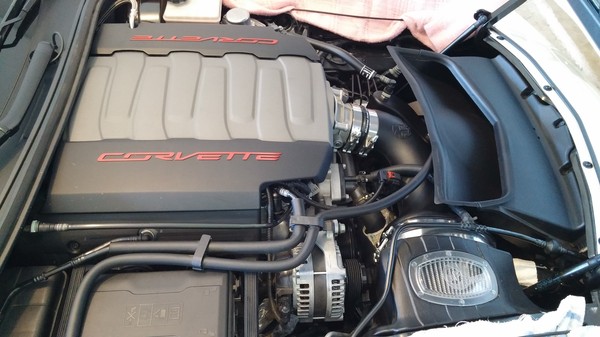
link to full size image: http://www.dsmstyle.com/photopost/da...0808151002.jpg
Last edited by Kracka; Aug 7, 2017 at 12:11 PM.