







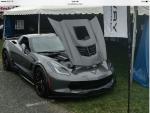


WEAPON-X "Boost Freeze" Chiller

Thread Starter
Safety Car

Joined: Jan 2012
Posts: 4,885
Likes: 486
From: Cin City
St. Jude Donor '14
 WEAPON-X "Boost Freeze" Chiller
With a well known name for the best heat exchangers and ancillary cooling mods on the market, we have been working on the next step in cooling for the past year and a half and after testing various combinations, we are finally ready to release our Boost Freeze Chiller! We have developed a complete plug and play system allowing you to tie into your OEM air conditioning system! This is the very first chiller system even available for the gen 6 Camaros, C7 Corvettes, CTS V gen 3s, and the ATS V and we also have the previous gens covered too  While this technology is not new, unfortunately to date, chiller kits have always been surrounded by mixed reviews from poorly designed kits with vastly incorrectly sized heat exchanger units, that required the OEM lines and wiring to be cut, brazed, welded, soldered, etc which means you needed someone that specializes in the AC field, and train-wreck forum threads between competing manufacturers bickering, accusations of them copying each other, and on and on. It was apparent that most of these guys were copying someone else's kit as in the end, a lot of consumers couldn't get their kits to work properly and received little support after, resulting in more bad PR for the chiller concept. However, simply put: the proven concept WORKS AMAZINGLY WELL when done properly! To prove this from a neutral source, the highly heralded Dodge Demon has a chiller from the factory, yes factory... we were shocked to see this!
How it works?
A chiller uses the OEM air conditioning system to reach freezing temperatures in the supercharger heat exchanger coolant to remove MORE heat from the compressed boosted air entering the engine, making it denser, allowing for MORE timing, and thus MORE POWER!!! (insert a Tim the Toolman AR AR AR ) Now a commonly understood principle is that the cars that run with the AC on lose lots of power during wide open throttle (WOT) for a few reasons, 1 the AMP draw is high, 2 it floods heat into the radiator from the AC hx, and 3 the older units wouldn't destroke themselves when they see this. AC compressors have continued to improve and the one on the LT cars is impressive. Most cars will shut the AC off during WOT for the aforementioned reasons; however, the new ones will actually reduce the stroke on them, not really consuming much power at all. In our testing on an 850whp LT4 Whipple car, we only observed about 20 LB FT of torque down low and and less than 10 WHP up top!
The Benefits
Our kit has a lot of bells and whistles as well and it's plug and play with custom billet fittings we machine in-house. The cabin air conditioning on our kit remains unaffected and still allows you to remain cool inside while your supercharger gets frost bitten too as it includes a cabin diverter valve so you can leave it in 50/50 mode splitting the AC, or put it into 100% HX mode so the supercharger coolant gets all of the BTU capacity to reduce the fluid temps even quicker. The kit also includes a thermostatically controlled valve that bypasses the heat exchanger(s) too because there comes a point when the coolant is below ambient temperature and running it through the aluminum heat exchanger will actually heat up the fluid. Lastly, we an optional have a Bluetooth display that you can adjust your temps and valve with while monitoring just how cold it gets. Consequently, our SPI Kit can also control the Chiller as well.
One of the most unique features of our kit is we have also developed a thermal cooling cell, which needs no ice or anything other than the top secret stuff inside of it LOL. It serves as two purposes, extra fluid capacity and extra BTU capacity. As the chilled fluid passes through it after the chiller, it charges the cell and once the fluid starts to heat up from the engine heat transfers that occur over the course of a run where the AC system is taxed by the external heat sources, the fluid is then chilled again by the cell as well to help with longer periods of time. This really helps the entire system, especially for in times of higher ambient air, longer runs, and other adverse conditions. A lot of guys have asked about the possibility of running this in road racing, and I didn't want to get into it before we had more product development; however, I do think it is possible on the LT cars. The main thing that is needed is to insulate all of the lines, fittings, etc and be able to keep the condensation off of the track. I am very interested in working with a road racer who is savvy when it comes to data logging and being able to provide the necessary data in return. The kit
System features:
Here is an older version of our Chiller on my 1150whp Gen 6 ZL1. This car is a MONSTER making 1100lbft of torque by 4200 RPMs with an 85mm rear mount turbo pushing through the stock Eaton 1.7L LT4 ported supercharger. It has been an interesting project for sure, we are not spinning the blower crazily at all with a 25% increase, but it's making 14 PSI on the 427 cubic inch LT4 engine as we have MAP sensors at various positions on the kit to log. 14 PSI with only a 25% increase on a 427 with our big valve heads is amazing. All together, the compound boost was around 24 PSI. The air temps coming out of this air to water box with 14 PSI from the turbo, but only 10 PSI after running the length of the car and going through the air to water box was just 46* as it entered the supercharger! So, the more dense air entering the supercharger along with the pushing of that air from the turbo greatly reduced the parasitic loss of the supercharger making the entire system more efficient.
On a test hit I made, the Air Temp post supercharger lobes was 99* at 142 MPH and having gone through 7 gears (10 speed auto). That is astounding at that power level!!
While this technology is not new, unfortunately to date, chiller kits have always been surrounded by mixed reviews from poorly designed kits with vastly incorrectly sized heat exchanger units, that required the OEM lines and wiring to be cut, brazed, welded, soldered, etc which means you needed someone that specializes in the AC field, and train-wreck forum threads between competing manufacturers bickering, accusations of them copying each other, and on and on. It was apparent that most of these guys were copying someone else's kit as in the end, a lot of consumers couldn't get their kits to work properly and received little support after, resulting in more bad PR for the chiller concept. However, simply put: the proven concept WORKS AMAZINGLY WELL when done properly! To prove this from a neutral source, the highly heralded Dodge Demon has a chiller from the factory, yes factory... we were shocked to see this!How it works?
A chiller uses the OEM air conditioning system to reach freezing temperatures in the supercharger heat exchanger coolant to remove MORE heat from the compressed boosted air entering the engine, making it denser, allowing for MORE timing, and thus MORE POWER!!! (insert a Tim the Toolman AR AR AR
) Now a commonly understood principle is that the cars that run with the AC on lose lots of power during wide open throttle (WOT) for a few reasons, 1 the AMP draw is high, 2 it floods heat into the radiator from the AC hx, and 3 the older units wouldn't destroke themselves when they see this. AC compressors have continued to improve and the one on the LT cars is impressive. Most cars will shut the AC off during WOT for the aforementioned reasons; however, the new ones will actually reduce the stroke on them, not really consuming much power at all. In our testing on an 850whp LT4 Whipple car, we only observed about 20 LB FT of torque down low and and less than 10 WHP up top!The Benefits
Our kit has a lot of bells and whistles as well and it's plug and play with custom billet fittings we machine in-house. The cabin air conditioning on our kit remains unaffected and still allows you to remain cool inside while your supercharger gets frost bitten too as it includes a cabin diverter valve so you can leave it in 50/50 mode splitting the AC, or put it into 100% HX mode so the supercharger coolant gets all of the BTU capacity to reduce the fluid temps even quicker. The kit also includes a thermostatically controlled valve that bypasses the heat exchanger(s) too because there comes a point when the coolant is below ambient temperature and running it through the aluminum heat exchanger will actually heat up the fluid. Lastly, we an optional have a Bluetooth display that you can adjust your temps and valve with while monitoring just how cold it gets. Consequently, our SPI Kit can also control the Chiller as well.
One of the most unique features of our kit is we have also developed a thermal cooling cell, which needs no ice or anything other than the top secret stuff inside of it LOL. It serves as two purposes, extra fluid capacity and extra BTU capacity. As the chilled fluid passes through it after the chiller, it charges the cell and once the fluid starts to heat up from the engine heat transfers that occur over the course of a run where the AC system is taxed by the external heat sources, the fluid is then chilled again by the cell as well to help with longer periods of time. This really helps the entire system, especially for in times of higher ambient air, longer runs, and other adverse conditions. A lot of guys have asked about the possibility of running this in road racing, and I didn't want to get into it before we had more product development; however, I do think it is possible on the LT cars. The main thing that is needed is to insulate all of the lines, fittings, etc and be able to keep the condensation off of the track. I am very interested in working with a road racer who is savvy when it comes to data logging and being able to provide the necessary data in return. The kit
System features:
- Plug and Play hardware for a hassle free installation
- 100% reversible
- Requires no tuning changes; however, the PCM calibration can be modified to achieve more power when temps are under a certain threshold (IAT Advance)
- Insulated chiller unit
- OEM quality hardware, lines, and fittings
- Thermostat controlled heat exchanger bypass when temperatures are below ambient
- Cabin diverter for race mode to channel ALL of the refrigerant to the chiller
- Bluetooth controller for Temperature monitor and custom programming settings
- Thermal Cooling cell to store extra BTU capacity
- Optional WXM Track Attack Heat Exchanger upgrade further more natural cooling
Here is an older version of our Chiller on my 1150whp Gen 6 ZL1. This car is a MONSTER making 1100lbft of torque by 4200 RPMs with an 85mm rear mount turbo pushing through the stock Eaton 1.7L LT4 ported supercharger. It has been an interesting project for sure, we are not spinning the blower crazily at all with a 25% increase, but it's making 14 PSI on the 427 cubic inch LT4 engine as we have MAP sensors at various positions on the kit to log. 14 PSI with only a 25% increase on a 427 with our big valve heads is amazing. All together, the compound boost was around 24 PSI. The air temps coming out of this air to water box with 14 PSI from the turbo, but only 10 PSI after running the length of the car and going through the air to water box was just 46* as it entered the supercharger! So, the more dense air entering the supercharger along with the pushing of that air from the turbo greatly reduced the parasitic loss of the supercharger making the entire system more efficient.
On a test hit I made, the Air Temp post supercharger lobes was 99* at 142 MPH and having gone through 7 gears (10 speed auto). That is astounding at that power level!!
Last edited by Ben@WeaponX; Aug 24, 2018 at 11:18 PM.
Thread Starter
Safety Car
Joined: Jan 2012
Posts: 4,885
Likes: 486
From: Cin City
St. Jude Donor '14
The results we are getting are phenomenal! We are seeing water temps in the 30* range on most cars and our LT 427 F1X car making 1300whp on 25 psi had 280* blower outlet temps and just 90* after at the top of a pull, and only about 100* through 3 gears!! It is just insane.
We had a 850whp CTS V3 on the dyno being tuned with our Whipple SPI kit and Corbin was making back to back to back pulls in 5th gear dialing it in and he said something like "What is going on with this car? Temps are still cold and these pulls are all within like 3 WHP of each other?!" He didn't know it had a chiller on it haha. The logs are on the shop laptop, so I'm trying to get those now to do a more in depth post.
Until then, who can tell me what this is?
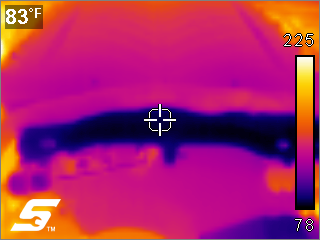
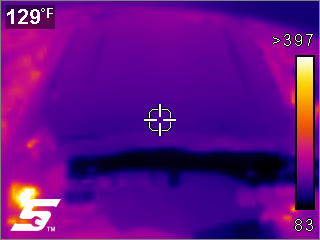
We had a 850whp CTS V3 on the dyno being tuned with our Whipple SPI kit and Corbin was making back to back to back pulls in 5th gear dialing it in and he said something like "What is going on with this car? Temps are still cold and these pulls are all within like 3 WHP of each other?!" He didn't know it had a chiller on it haha. The logs are on the shop laptop, so I'm trying to get those now to do a more in depth post.
Until then, who can tell me what this is?


Last edited by Ben@WeaponX; Sep 4, 2018 at 07:05 PM.
Thread Starter
Safety Car
Joined: Jan 2012
Posts: 4,885
Likes: 486
From: Cin City
St. Jude Donor '14
) but yes that is an 850whp CTS V with a Whipple, our SPI kit, and now our Chiller. This was after THREE back to back pulls and the dyno graphs were within THREE wheel HP of each other!
Thread Starter
Safety Car
Joined: Jan 2012
Posts: 4,885
Likes: 486
From: Cin City
St. Jude Donor '14


The temps in the front mount tank were 34* on the OUTSIDE of the tank prior to insulating it. The water temps inside were even lower
I cannot wait to share some of the testing from these test cars, after I compile the data!
1. For starters, guys claiming the OEM HX are enough to stave off heat from the increased boost are very very misinformed. On our Mustang dyno which simulates real world load, the X800 package could not even get through a single COLD pull without seeing knock/KR in the upper RPM band This is with the common 15% pulley too, so guys not addressing cooling with boost upgrades are leaving a LOT of power on the table.
2. Something I didn't consider, but makes complete sense from a physics standpoint is the chilled air in the intercooler bricks inside the supercharger had such a massive temperature drop that the logs showed 1-2 PSI LESS BOOST because the molecules are so much closer together, so the quality of volumetric air was vastly improved. So, the engine is safer and there is less stress on the internal components with a more efficient system.
3. Lastly, anyone whom has made back to back pulls on a supercharged car can tell you first hand, that the heat soaking robs power and this becomes exponential with the pulls. We were able to do hot pull after hot pull and the power was repeatable within just a 3% margin of error! Now a cold glory pull will still show major dividends for the guys who are getting it up to the starting line with minimal heat, but for real world applications where engine run time is a factor, the system is very impressive and continues to wow us!
This was nearly an hour after the car was shutoff in a 100* humid shop! Again, the entire system was insulated after as you want to guard the chiller system as much as possible from external heat influence.

Speaking of, the billet NX lid is a beautiful piece and there is some improved airflow with it; however, it absorbs heat much more than the OEM lid and any of you guys using it should consider having it ceramic coated prior to installation. You could cook an egg on that thing after running lol
Thread Starter
Safety Car
Joined: Jan 2012
Posts: 4,885
Likes: 486
From: Cin City
St. Jude Donor '14
Here is one of our test vehicles, a 2017 LT4 powered Camaro ZL1 with a 15% pulley, headers, etc and this compares the stock heat exchanger system to the chiller with both pulls being from a similar start as you can see the engine coolant is actually a few degrees cooler on the OEM heat exchanger pull vs the chiller pull. The chiller system was actually decreasing the Manifold Air Temps (teal blue line in the top bracket) prior to the pull, limited the total heat entered into the system, and then immediately started bringing it right back down! The OEM hx run had knock and higher boost; however, the chiller with no tuning changes allowed for approx 20whp more with less boost due to the dense air!
Thread Starter
Safety Car
Joined: Jan 2012
Posts: 4,885
Likes: 486
From: Cin City
St. Jude Donor '14
The Boost Freeze Plug and Play Chiller system is ready to go as we're ramping up production now! Also, keep in mind if you're close enough to Cincinnati that you want us to install, we're looking for a few more case studies on C7s. I'll have my ZR1 chiller going on later this month as well, but would like to get some data on the 1.7L, the Whipple, and any custom air to water setups on Centris too.
The system includes all high quality components including our WEAPON-X center air to water heat exchanger with AN fittings so we can do all high quality braided line, custom insulated coolant expansion tank, etc.
You guys can read all of the details on it here and pre-order one of the first 10 kits in the Group Buy at 20% off by using the code ICECOLD1:
https://weaponxmotorsports.com/produ...12464246423601
System features:
The system includes all high quality components including our WEAPON-X center air to water heat exchanger with AN fittings so we can do all high quality braided line, custom insulated coolant expansion tank, etc.
You guys can read all of the details on it here and pre-order one of the first 10 kits in the Group Buy at 20% off by using the code ICECOLD1:
https://weaponxmotorsports.com/produ...12464246423601
System features:
- Plug and Play hardware for a hassle free installation
- 100% reversible
- Requires no tuning changes; however, the PCM calibration can be modified to achieve cooler temps with fan reprogramming as well as more power when temps are under a certain threshold (IAT Advance)
- Insulated WEAPON-X AC Heat Exchanger unit
- OEM quality hardware
- Braided lines and high quality aluminum fittings
- WEAPON-X Chiller heat exchanger with AN fittings
- Thermostat controlled heat exchanger bypass when temperatures are below ambient
- Cabin diverter for race mode to channel ALL of the refrigerant to the chiller
- Controller for Temperature monitor and custom programming settings
- Insulated Coolant expansion tank to store extra BTU capacity
Corvette Stories
The Best of Corvette for Corvette Enthusiasts

Top 10 Most Expensive Corvettes Ever Sold on Bring A Trailer
Brett Foote
10 Things Every Corvette Owner Needs (2026 Edition)
Michael S. Palmer
8 Most "Only Corvette Owners Understand" Quirks and Problems
Pouria Savadkouei
10 Reasons the C6 Z06 is Still A Performance Benchmark After 20 Years
Joe Kucinski
How Much Horsepower Every Corvette Engine "LOST" in 1972
Joe Kucinski
Top 10 DOs and DON'Ts for Protecting Your Convertible Top!
Michael S. Palmer
Top 10 Most Explosive Corvettes Ever Made: Power-to-Weight Ratio Ranked!
Joe Kucinski
150 hp to 1,250 hp: Every Corvette Generation Compared by the Specs That Matter
Joe Kucinski
8 Coolest Corvette Pace Cars (and Replicas) of All Time
Verdad Gallardo
Thread Starter
Safety Car
Joined: Jan 2012
Posts: 4,885
Likes: 486
From: Cin City
St. Jude Donor '14
First off, sorry for the lack of info shared this week responding to PMs etc. I needed to get the dyno graphs off of the tower but I ended up sick a couple of days and am just now crawling back into action, but Monday will be the earliest chance I'll get. :biggrin:
It looks like we need to take a step back here and provide some education. First off, unlike the previous LS cars, the IAT2 is a pretty worthless PID on the Gen 5 LT engines, because the timing/spark table is based on "Manifold Air Temp" [MAT], which is a calculated algorithm that is barely affected by anything, even upgraded heat exchangers. IAT2 is valuable to show you what the air temps actually are coming out of the intercooler bricks, but that is only 1 part of the equation for allowable spark resulting in power.
MAT Timing table, NOT IAT2:
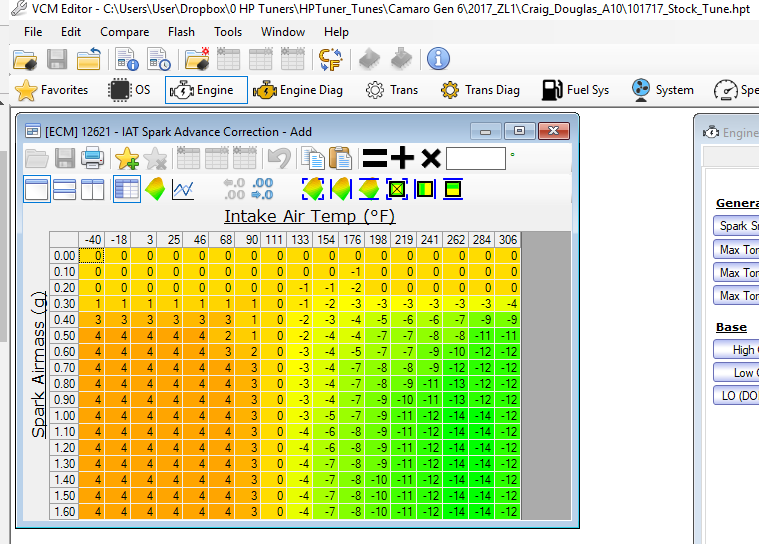
As you'll see in the following logs, the IAT2s NEVER get over 120*, but as you will see the IAT spark is pulling timing, because it's based on Manifold Air Temp, not IAT2. Ask ANY gen 5 tuner how long it takes those MAT temps to come back down to even a reasonable temperature, it's a half hour or so and back to starting point is about an hour. To see those temps drop down from 140* to under 120* in just minutes is absolutely astonishing!
It looks like we need to take a step back here and provide some education. First off, unlike the previous LS cars, the IAT2 is a pretty worthless PID on the Gen 5 LT engines, because the timing/spark table is based on "Manifold Air Temp" [MAT], which is a calculated algorithm that is barely affected by anything, even upgraded heat exchangers. IAT2 is valuable to show you what the air temps actually are coming out of the intercooler bricks, but that is only 1 part of the equation for allowable spark resulting in power.
MAT Timing table, NOT IAT2:

As you'll see in the following logs, the IAT2s NEVER get over 120*, but as you will see the IAT spark is pulling timing, because it's based on Manifold Air Temp, not IAT2. Ask ANY gen 5 tuner how long it takes those MAT temps to come back down to even a reasonable temperature
, it's a half hour or so and back to starting point is about an hour. To see those temps drop down from 140* to under 120* in just minutes is absolutely astonishing!
Thread Starter
Safety Car
Joined: Jan 2012
Posts: 4,885
Likes: 486
From: Cin City
St. Jude Donor '14
LT4 Camaro ZL1 with better cooling than the Z06's stock baseline dyno log
On a stock ZL1 (sans the NX lid and our no-tune intake) looking at logs you will see. With the stock pulley which is making just under 11 PSI of boost, the MAT on a hot day normally start over 130* and STAY over 130*, oh and you're pulling -3 to -4 of spark/timing at 133*.
Car starts with:
Engine coolant 178*
IAT1 99*
IAT2 109*
MAT 135*?!!!! Trust me, tuners HATE this new calculated value
By the time we get the car up to gear 7 (which is 1 to 1 on the 10 speed for accurate HP and TQ output):
Engine coolant 185*
IAT1 95*
IAT2 113*
MAT 132* - yes ECT, IAT1 and IAT2 are going up, and MAT went down?!!!
Top of gear 7:
Engine coolant 203*
IAT1 100*
IAT2 108*
MAT 139* and as you can see by this graph, you're losing -2* of timing and that is with the IAT2s just 8* over IAT1s and that MAT line continues to rise us the log stops and will soar to over 160*!
You can see there are tickles of knock [KR] as high as 2* over 5700 RPMs and we see this frequently on the long pull of a loaded dyno on a stock LT4 car.
Look below:
The RED boxed highlighted air temps are the values referenced above.
The YELLOW star shows the 2* being pulled on the STOCK calibration for IAT, yet the IAT2 value only shows 108*.
The PINK box around the Manifold Air Temp (MAT) which is what the IAT Spark Table references.
The YELLOW Bubble shows the knock aka KR on the STOCK calibration.
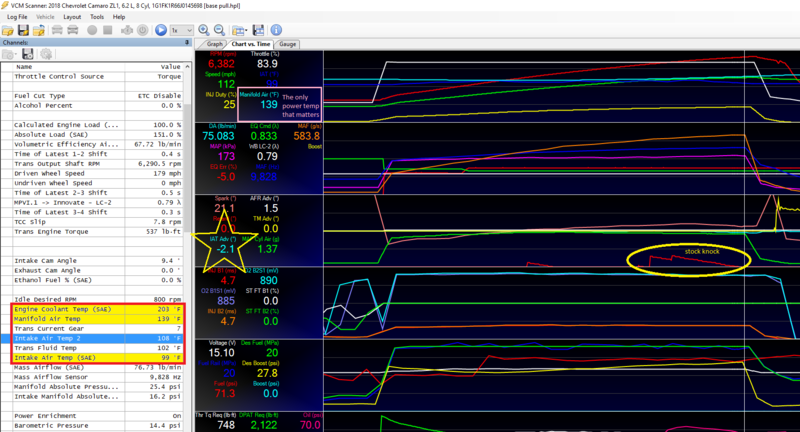
Car starts with:
Engine coolant 178*
IAT1 99*
IAT2 109*
MAT 135*?!!!! Trust me, tuners HATE this new calculated value
By the time we get the car up to gear 7 (which is 1 to 1 on the 10 speed for accurate HP and TQ output):
Engine coolant 185*
IAT1 95*
IAT2 113*
MAT 132* - yes ECT, IAT1 and IAT2 are going up, and MAT went down?!!!
Top of gear 7:
Engine coolant 203*
IAT1 100*
IAT2 108*
MAT 139* and as you can see by this graph, you're losing -2* of timing and that is with the IAT2s just 8* over IAT1s and that MAT line continues to rise us the log stops and will soar to over 160*!
You can see there are tickles of knock [KR] as high as 2* over 5700 RPMs and we see this frequently on the long pull of a loaded dyno on a stock LT4 car.
Look below:
The RED boxed highlighted air temps are the values referenced above.
The YELLOW star shows the 2* being pulled on the STOCK calibration for IAT, yet the IAT2 value only shows 108*.
The PINK box around the Manifold Air Temp (MAT) which is what the IAT Spark Table references.
The YELLOW Bubble shows the knock aka KR on the STOCK calibration.

Thread Starter
Safety Car
Joined: Jan 2012
Posts: 4,885
Likes: 486
From: Cin City
St. Jude Donor '14
LT4 Camaro ZL1 9% Pulley - dyno logs
Now I want you guys to see just HOW HOT the temps get and stay!!! Here are 5 dyno pulls, all with the same combo approx 33 minutes apart start to finish, around 8-10m between each pull and while it's not a legit comparison to a car on the track with heat entering on the straights and coming out of the turns and cooling off between with the fans on blast.
Intimidator's 2.3 aka 9% Upper Pulley:
On this ZL1 looking at logs, you will see. With the 2.3 upper pulley making nearly 13 PSI of boost, the MAT on a hot day normally start over 130* and STAY over 130*, but since it's been tuned, we removed the IAT spark pull from the 133* column, so the next threshold is 154*.
Dyno Pul #1 at 2:20PM
Car starts with:
Engine coolant 126*
IAT1 82*
IAT2 84*
MAT 112*
By the time we get the car up to gear 6 (shorter pulls for tuning so it's nto as long and the car doesn't get as hot):
Engine coolant 171*
IAT1 84*
IAT2 93*
MAT 122*
Top of gear 7:
Engine coolant 174*
IAT1 91*
IAT2 91*
MAT 125* - Not bad right? Well unless you're pushing your car up to the starting line, you're not going to see this in the real world, read on
Look below:
The RED boxed highlighted air temps are the values referenced above.
The PINK box around the Manifold Air Temp (MAT) which is what the IAT Spark Table references.
The YELLOW Bubble shows the knock aka KR on the modified calibration.
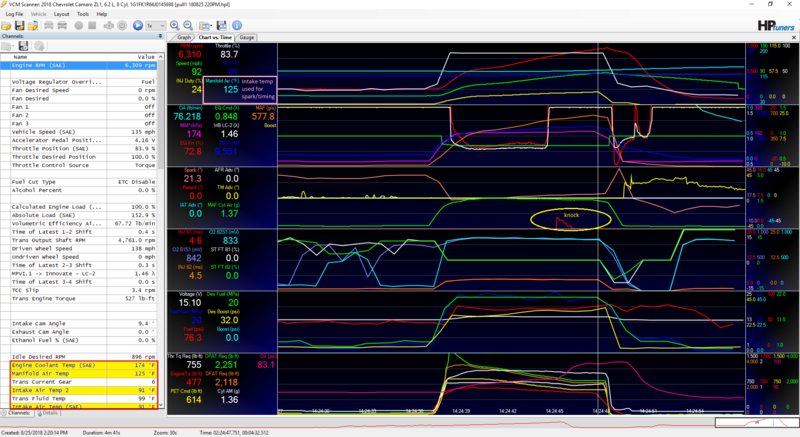
----------------------------------------------------------------------------------
Dyno Pul #2 at 2:29PM - the car sat on the dyno with the fans on it and the entire system was heat soaked in 9 minutes shut off and the MAT was already NOT happy, despite the Engine coolant, IAT1, and IAT2 being reasonable, and remember MAT is what our power is based on.
Car starts with:
Engine coolant 180*
IAT1 88*
IAT2 106*
MAT 145* - HOT after sitting 9 min
By the time we get the car up to gear 6:
Engine coolant 171*
IAT1 88*
IAT2 106*
MAT 140*
Top of gear 6:
Engine coolant 174*
IAT1 86*
IAT2 99*
MAT 141* - pulling .2* of timing already despite the window being opened to 154* IAT spark pull
Look below:
The RED boxed highlighted air temps are the values referenced above.
The PINK box around the Manifold Air Temp (MAT) which is what the IAT Spark Table references.
The YELLOW Bubble shows the knock aka KR on the modified calibration.
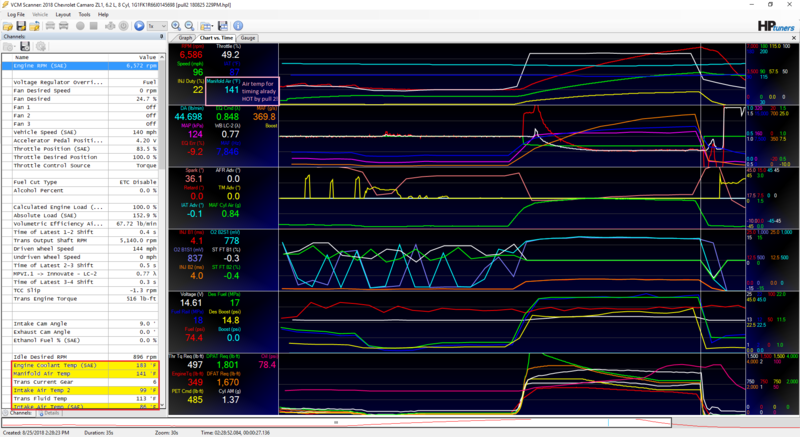
-----------------------------------------------------------------------------------
Dyno Pul #3 at 2:39PM - the car sat on the dyno with the fans on it and the entire system was even MORE heat soaked in another 10 minutes after just a NINE SECOND PULL and the MAT was pissed off now LOL, despite the Engine coolant, IAT1, and IAT2 ALL still being reasonable, and don't forget again, the MAT aka Manifold Air Temp is what our power is based on.
Car starts with:
Engine coolant 171*
IAT1 91*
IAT2 104*
MAT 171* - REALLY HOT after sitting 10 min
By the time we get the car up to gear 6:
Engine coolant 172*
IAT1 88*
IAT2 104*
MAT 152*
Top of gear 6:
Engine coolant 174*
IAT1 88*
IAT2 102*
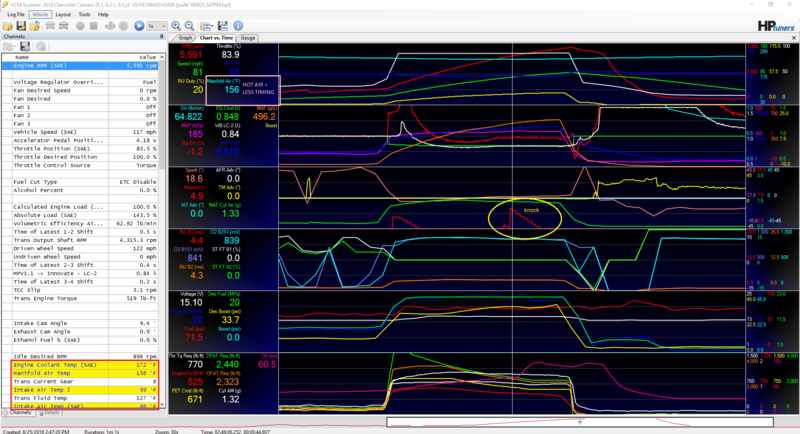
MAT 151* and up to 157* just 14 seconds later as the car is winding down on the rollers before the log stops. Just think of how hot the system gets when you're on and off the throttle on a real world road course.
As you can see the knock is back as high as 5* with just 18* of timing on a 9% pulley! I'd love to know if you road course guys are logging KR, especially if you're modded.
Look below:
The RED boxed highlighted air temps are the values referenced above.
The PINK box around the Manifold Air Temp (MAT) which is what the IAT Spark Table references.
The YELLOW Bubble shows the knock aka KR on the modified calibration.
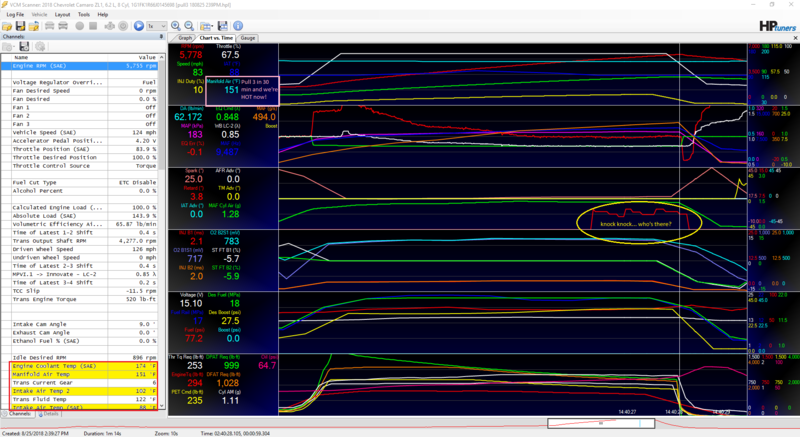
-----------------------------------------------------------------------------------
Dyno Pul #4 at 2:47PM - the car sat on the dyno with the fans on it and the MAT seems to somewhat settle into this 17X* area as the previous pull was only 8 minutes previous and the temps are only a little hotter than run 3 starting out, but still a timing killer at that heat range, despite again the Engine coolant, IAT1, and IAT2 ALL still being reasonable, and don't forget again, the MAT aka Manifold Air Temp is what our power is based on.
Car starts with:
Engine coolant 181*
IAT1 95*
IAT2 104*
MAT 174* - REALLY HOT after sitting 8 min
By the time we get the car up to gear 6:
Engine coolant 172*
IAT1 88*
IAT2 104*
MAT 152*
Top of gear 6:
Engine coolant 174*
IAT1 88*
IAT2 102*
MAT 151*
Knock spike is still there at 5600 RPM at nearly 5* with just a 9% pulley with less than 19* of timing.
Look below:
The RED boxed highlighted air temps are the values referenced above.
The PINK box around the Manifold Air Temp (MAT) which is what the IAT Spark Table references.
The YELLOW Bubble shows the knock aka KR on the modified calibration.
-----------------------------------------------------------------------------------
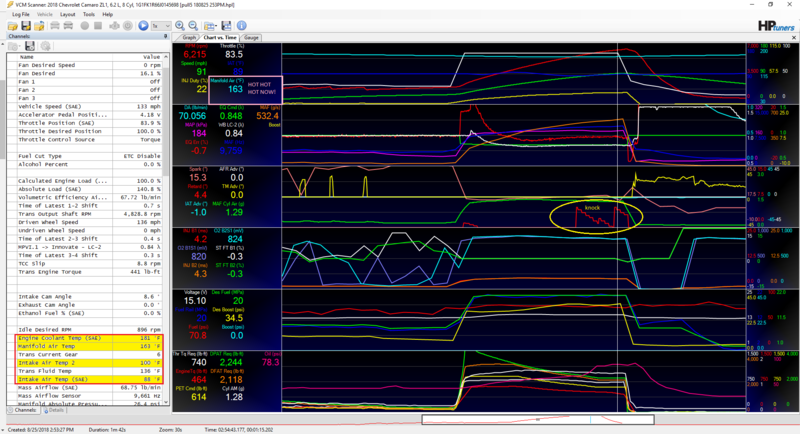
Dyno Pul #5 at 2:53PM - the car sat on the dyno with the fans on it and the entire system was even MORE heat soaked in just 6 minutes after just a NINE SECOND PULL and the MAT was pissed off now LOL, despite the Engine coolant, IAT1, and IAT2 ALL still being reasonable, and don't forget again, the MAT aka Manifold Air Temp is what our power is based on.
Car starts with:
Engine coolant 189*
IAT1 93*
IAT2 104*
MAT 182* - and now it is REALLY REALLY HOT after sitting less at just 6 min
By the time we get the car up to gear 6:
Engine coolant 178*
IAT1 90*
IAT2 106*
MAT 164*
Top of gear 6:
Engine coolant 183*
IAT1 90*
IAT2 100*
MAT 163* - and as you can see, the knock is aggressive again with just 13 PSI and less than 18* of timing!
Look below:
The RED boxed highlighted air temps are the values referenced above.
The PINK box around the Manifold Air Temp (MAT) which is what the IAT Spark Table references.
The YELLOW Bubble shows the knock aka KR on the modified calibration.
Intimidator's 2.3 aka 9% Upper Pulley:
On this ZL1 looking at logs, you will see. With the 2.3 upper pulley making nearly 13 PSI of boost, the MAT on a hot day normally start over 130* and STAY over 130*, but since it's been tuned, we removed the IAT spark pull from the 133* column, so the next threshold is 154*.
Dyno Pul #1 at 2:20PM
Car starts with:
Engine coolant 126*
IAT1 82*
IAT2 84*
MAT 112*
By the time we get the car up to gear 6 (shorter pulls for tuning so it's nto as long and the car doesn't get as hot):
Engine coolant 171*
IAT1 84*
IAT2 93*
MAT 122*
Top of gear 7:
Engine coolant 174*
IAT1 91*
IAT2 91*
MAT 125* - Not bad right? Well unless you're pushing your car up to the starting line, you're not going to see this in the real world, read on
Look below:
The RED boxed highlighted air temps are the values referenced above.
The PINK box around the Manifold Air Temp (MAT) which is what the IAT Spark Table references.
The YELLOW Bubble shows the knock aka KR on the modified calibration.

----------------------------------------------------------------------------------
Dyno Pul #2 at 2:29PM - the car sat on the dyno with the fans on it and the entire system was heat soaked in 9 minutes shut off and the MAT was already NOT happy, despite the Engine coolant, IAT1, and IAT2 being reasonable, and remember MAT is what our power is based on.
Car starts with:
Engine coolant 180*
IAT1 88*
IAT2 106*
MAT 145* - HOT after sitting 9 min
By the time we get the car up to gear 6:
Engine coolant 171*
IAT1 88*
IAT2 106*
MAT 140*
Top of gear 6:
Engine coolant 174*
IAT1 86*
IAT2 99*
MAT 141* - pulling .2* of timing already despite the window being opened to 154* IAT spark pull
Look below:
The RED boxed highlighted air temps are the values referenced above.
The PINK box around the Manifold Air Temp (MAT) which is what the IAT Spark Table references.
The YELLOW Bubble shows the knock aka KR on the modified calibration.

-----------------------------------------------------------------------------------
Dyno Pul #3 at 2:39PM - the car sat on the dyno with the fans on it and the entire system was even MORE heat soaked in another 10 minutes after just a NINE SECOND PULL and the MAT was pissed off now LOL, despite the Engine coolant, IAT1, and IAT2 ALL still being reasonable, and don't forget again, the MAT aka Manifold Air Temp is what our power is based on.
Car starts with:
Engine coolant 171*
IAT1 91*
IAT2 104*
MAT 171* - REALLY HOT after sitting 10 min
By the time we get the car up to gear 6:
Engine coolant 172*
IAT1 88*
IAT2 104*
MAT 152*
Top of gear 6:
Engine coolant 174*
IAT1 88*
IAT2 102*
MAT 151* and up to 157* just 14 seconds later as the car is winding down on the rollers before the log stops. Just think of how hot the system gets when you're on and off the throttle on a real world road course.
As you can see the knock is back as high as 5* with just 18* of timing on a 9% pulley! I'd love to know if you road course guys are logging KR, especially if you're modded.
Look below:
The RED boxed highlighted air temps are the values referenced above.
The PINK box around the Manifold Air Temp (MAT) which is what the IAT Spark Table references.
The YELLOW Bubble shows the knock aka KR on the modified calibration.

-----------------------------------------------------------------------------------
Dyno Pul #4 at 2:47PM - the car sat on the dyno with the fans on it and the MAT seems to somewhat settle into this 17X* area as the previous pull was only 8 minutes previous and the temps are only a little hotter than run 3 starting out, but still a timing killer at that heat range, despite again the Engine coolant, IAT1, and IAT2 ALL still being reasonable, and don't forget again, the MAT aka Manifold Air Temp is what our power is based on.
Car starts with:
Engine coolant 181*
IAT1 95*
IAT2 104*
MAT 174* - REALLY HOT after sitting 8 min
By the time we get the car up to gear 6:
Engine coolant 172*
IAT1 88*
IAT2 104*
MAT 152*
Top of gear 6:
Engine coolant 174*
IAT1 88*
IAT2 102*
MAT 151*
Knock spike is still there at 5600 RPM at nearly 5* with just a 9% pulley with less than 19* of timing.
Look below:
The RED boxed highlighted air temps are the values referenced above.
The PINK box around the Manifold Air Temp (MAT) which is what the IAT Spark Table references.
The YELLOW Bubble shows the knock aka KR on the modified calibration.

-----------------------------------------------------------------------------------
Dyno Pul #5 at 2:53PM - the car sat on the dyno with the fans on it and the entire system was even MORE heat soaked in just 6 minutes after just a NINE SECOND PULL and the MAT was pissed off now LOL, despite the Engine coolant, IAT1, and IAT2 ALL still being reasonable, and don't forget again, the MAT aka Manifold Air Temp is what our power is based on.
Car starts with:
Engine coolant 189*
IAT1 93*
IAT2 104*
MAT 182* - and now it is REALLY REALLY HOT after sitting less at just 6 min
By the time we get the car up to gear 6:
Engine coolant 178*
IAT1 90*
IAT2 106*
MAT 164*
Top of gear 6:
Engine coolant 183*
IAT1 90*
IAT2 100*
MAT 163* - and as you can see, the knock is aggressive again with just 13 PSI and less than 18* of timing!
Look below:
The RED boxed highlighted air temps are the values referenced above.
The PINK box around the Manifold Air Temp (MAT) which is what the IAT Spark Table references.
The YELLOW Bubble shows the knock aka KR on the modified calibration.

Thread Starter
Safety Car
Joined: Jan 2012
Posts: 4,885
Likes: 486
From: Cin City
St. Jude Donor '14
LT4 Camaro ZL1 15% Pulley - dyno logs without and WITH BOOST FREEZE CHILLER!
So, what you can see is the Manifold Air Temps aka MAT will actually go DOWN once it's hot on the 9% pulley, and you can clearly see the IAT2s are very close to the IAT1s the entire time and never got over 120*. But, beyond the cold pull, the MAT are just insane and every SINGLE pull beyond the first cold pull was over the first threshold for timing pulling with the stock calibration, and you can remove this, but do so, and you're seeing a lot of knock in the upper RPM band.
Next, we jumped up to the 15% pulley with headers thinking we can get a little more boost with less restriction from the cats right? Let's check it out...
Intimidator's 2.175 aka 15% Upper Pulley:
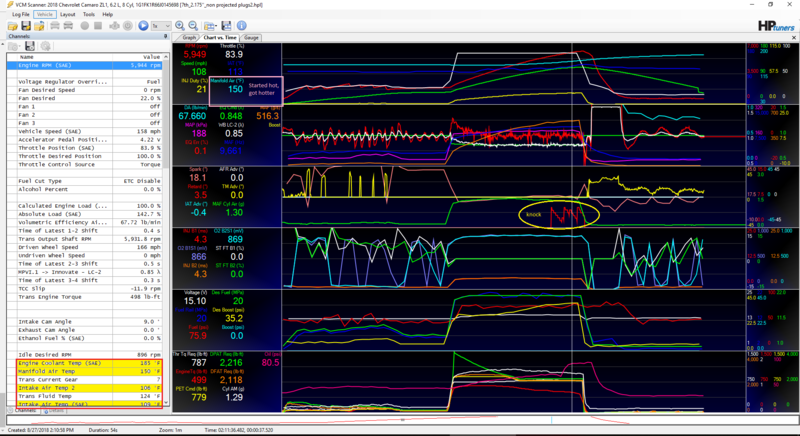
On this ZL1 looking at logs, you will see. With the 2.175 upper pulley with headers makes a peak of 13.4 PSI of boost so we gained and lost some with headers. The MAT started hot on this pull despite letting the engine cool off from some previous pulls with this combo, dialing it in. I'll skip those for this since the previous group showed the drastic jumps in Manifold Air Temps from run to run and just focus on the amazing chiller results.
Dyno Pul #1 at 2:10PM
Car starts with:
Engine coolant 167*
IAT1 97* - muggy day
IAT2 104*
MAT 140* at the start and it KEPT GOING UP
By the time we get the car up to gear 7 (gear 1 to 1 for accurate hp/tq):
Engine coolant 172*
IAT1 97*
IAT2 106*
MAT 140*
Top of gear 7:
Engine coolant 174*
IAT1 113*
IAT2 106*
MAT 151* and just 16 seconds later were up to 168*!!! - This 15% combo causes the MAT to keep heating up more and more and again this combo would knock regardless of adding more fuel and pulling some timing until it wasn't worth the upgrade.
Look below:
The RED boxed highlighted air temps are the values referenced above.
The PINK box around the Manifold Air Temp (MAT) which is what the IAT Spark Table references.
The YELLOW Bubble shows the knock aka KR on the modified calibration.
-------------------------------------------------------------------------------------
Intimidator's 2.175 aka 15% Upper Pulley WITH THE BOOST FREEZE CHILLER:
On this ZL1 looking at logs, you will see. With the 2.175 upper pulley with headers makes a peak of 13.4 PSI of boost so we gained and lost some with headers. The MAT started hot on this pull despite letting the engine cool off from some previous pulls with this combo, dialing it in. I'll skip those for this since the previous group showed the drastic jumps in Manifold Air Temps from run to run and just focus on the amazing chiller results.
Dyno Pul #1 at 2:10PM
Car starts with:
Engine coolant 145*
IAT1 93* - muggy day
IAT2 99*
MAT 115* at the start and it KEPT GOING DOWN
By the time we get the car up to gear 7 (gear 1 to 1 for accurate hp/tq):
Engine coolant 176*
IAT1 95*
IAT2 102*
MAT 112* - LOOK AT ALL PREVIOUS RUNS, NEVER DID IT GO DOWN WHEN IT WAS UNDER 140*!
Top of gear 7:
Engine coolant 174*
IAT1 138*
IAT2 108*
MAT 124* - This was 27* colder than the previous pull with the stock heat exchangers, despite removing the side cooler for the chiller.
Look below:
The RED boxed highlighted air temps are the values referenced above.
The PINK box around the Manifold Air Temp (MAT) which is what the IAT Spark Table references.
NOTICE LESS BOOST AND 4* MORE TIMING!
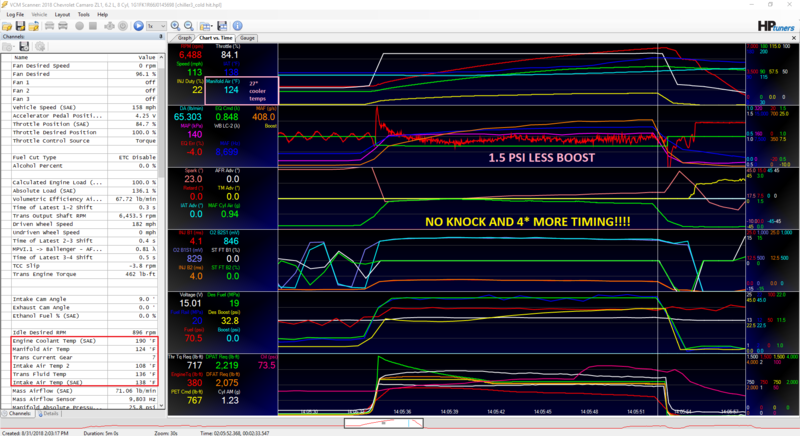
So looking at this, the stock heat exchanger system can stave off an increase in manifold air with just a 9% pulley but it will still show knock; however, a 15% pulley cannot stave off the increased manifold air temps and that is why we have the Triple X Heat Exchangers in the X800 package. Those have 150% more fluid and drastically improve the MATs as well as the recovery time. You guys pushing the car with the stock hx system are not getting the most out of your car's potential power!
This was the point where we stopped pushing the car and didn't add the ported supercharger because the setup was not happy as it was. We added the chiller setup without ANY other modifications and the results were nothing short of phenomenal:
IMPRESSIVE RESULTS!!!
Next, we jumped up to the 15% pulley with headers thinking we can get a little more boost with less restriction from the cats right? Let's check it out...
Intimidator's 2.175 aka 15% Upper Pulley:
On this ZL1 looking at logs, you will see. With the 2.175 upper pulley with headers makes a peak of 13.4 PSI of boost so we gained and lost some with headers. The MAT started hot on this pull despite letting the engine cool off from some previous pulls with this combo, dialing it in. I'll skip those for this since the previous group showed the drastic jumps in Manifold Air Temps from run to run and just focus on the amazing chiller results.
Dyno Pul #1 at 2:10PM
Car starts with:
Engine coolant 167*
IAT1 97* - muggy day
IAT2 104*
MAT 140* at the start and it KEPT GOING UP
By the time we get the car up to gear 7 (gear 1 to 1 for accurate hp/tq):
Engine coolant 172*
IAT1 97*
IAT2 106*
MAT 140*
Top of gear 7:
Engine coolant 174*
IAT1 113*
IAT2 106*
MAT 151* and just 16 seconds later were up to 168*!!! - This 15% combo causes the MAT to keep heating up more and more and again this combo would knock regardless of adding more fuel and pulling some timing until it wasn't worth the upgrade.
Look below:
The RED boxed highlighted air temps are the values referenced above.
The PINK box around the Manifold Air Temp (MAT) which is what the IAT Spark Table references.
The YELLOW Bubble shows the knock aka KR on the modified calibration.

-------------------------------------------------------------------------------------
Intimidator's 2.175 aka 15% Upper Pulley WITH THE BOOST FREEZE CHILLER:
On this ZL1 looking at logs, you will see. With the 2.175 upper pulley with headers makes a peak of 13.4 PSI of boost so we gained and lost some with headers. The MAT started hot on this pull despite letting the engine cool off from some previous pulls with this combo, dialing it in. I'll skip those for this since the previous group showed the drastic jumps in Manifold Air Temps from run to run and just focus on the amazing chiller results.
Dyno Pul #1 at 2:10PM
Car starts with:
Engine coolant 145*
IAT1 93* - muggy day
IAT2 99*
MAT 115* at the start and it KEPT GOING DOWN
By the time we get the car up to gear 7 (gear 1 to 1 for accurate hp/tq):
Engine coolant 176*
IAT1 95*
IAT2 102*
MAT 112* - LOOK AT ALL PREVIOUS RUNS, NEVER DID IT GO DOWN WHEN IT WAS UNDER 140*!
Top of gear 7:
Engine coolant 174*
IAT1 138*
IAT2 108*
MAT 124* - This was 27* colder than the previous pull with the stock heat exchangers, despite removing the side cooler for the chiller.
Look below:
The RED boxed highlighted air temps are the values referenced above.
The PINK box around the Manifold Air Temp (MAT) which is what the IAT Spark Table references.
NOTICE LESS BOOST AND 4* MORE TIMING!

So looking at this, the stock heat exchanger system can stave off an increase in manifold air with just a 9% pulley but it will still show knock; however, a 15% pulley cannot stave off the increased manifold air temps and that is why we have the Triple X Heat Exchangers in the X800 package. Those have 150% more fluid and drastically improve the MATs as well as the recovery time. You guys pushing the car with the stock hx system are not getting the most out of your car's potential power!
This was the point where we stopped pushing the car and didn't add the ported supercharger because the setup was not happy as it was. We added the chiller setup without ANY other modifications and the results were nothing short of phenomenal:
- We were able to advance the timing 4* more gaining a great amount of HP
- The boost DROPPED a pound and a half due to the cooler temps in the intercooler bricks
- The IAT2s although worthless for tuning the Gen5 LTs show the true benefit were just 102 at the start of the pull, dropped down to 100, and then ended at 108* despite the IAT1s being 133* at the end as it was sucking in hot air with the hood open. That fought off over 30* of temps as it drew the air into the supercharger, then compressed it giving off even MORE heat, and then cooled it back down to nearly 100* as it entered the cylinders.
IMPRESSIVE RESULTS!!!
Last edited by Ben@WeaponX; Sep 7, 2018 at 07:27 PM.
Thread Starter
Safety Car
Joined: Jan 2012
Posts: 4,885
Likes: 486
From: Cin City
St. Jude Donor '14
2.5" pulley vs. 2.3" pulley
Here is an interesting comparison that shows the heat in the pull towards the top of the RPM range. This was Intimidator's baseline with our intake and the NX lid vs. the 9% 2.3" pulley. There is nearly a 50 lb-ft difference in torque down low, BUT with the IAT aka Manifold Air Temps reaching 150*, the peak horse power was about the same!


Thread Starter
Safety Car
Joined: Jan 2012
Posts: 4,885
Likes: 486
From: Cin City
St. Jude Donor '14
2.3" pulley vs 2.175" 15% pulley
Here was the same comparison only the 2.3" vs the 2.175" pulley and when the engine isn't on a cold pull, the additional boost really nets very little power.


Thread Starter
Safety Car
Joined: Jan 2012
Posts: 4,885
Likes: 486
From: Cin City
St. Jude Donor '14
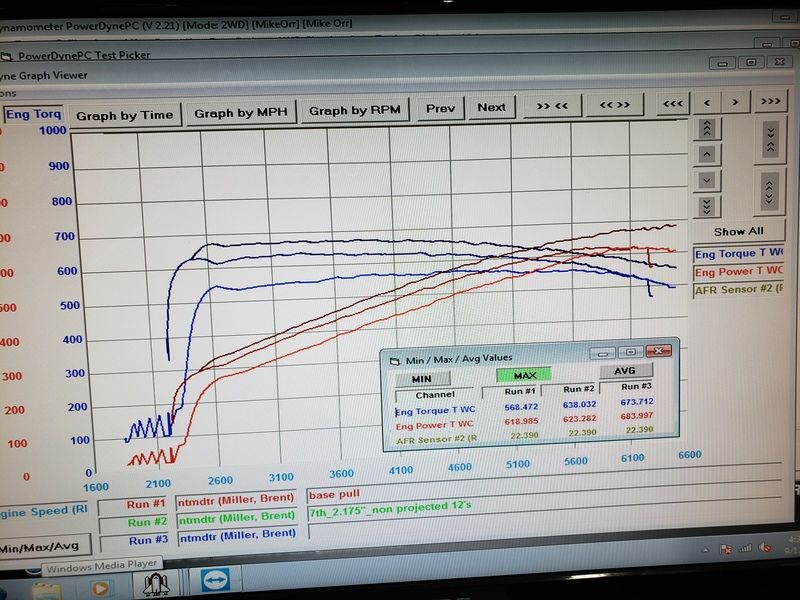
Proof in the power of the Boost Freeze Chiller
Here is the proof that you all desire in the power of the chiller system. As you saw above, it's capable of 30* water temps and that thermostat is actually on the outlet of the expansion tank, not measuring the temp of the water inside, so realistically it's sub freezing and requires a coolant mix
Here is Intimidator's:
baseline 2.5" upper pulley (stock), our intake, and the NX lid resulting in 619hp/568tq
vs.
2.175" aka 15% pulley resulting in 623hp/638tq
Gain: 4hp/70tq
Note: Usually when you see the Torque number higher than the HP on a PD supercharged setup it is telling you that your setup isn't as efficient as it should be - having either air restrictions or heat issues)
vs.
2.175" aka 15% pulley and Boost Freeze Chiller resulting in 684hp/674tq!!!!
Gain: 61hp/36tq
Note: These numbers make sense from a thermodynamics stand point as well because these pulley setups don't heat soak as much down low where the torque numbers are the highest on a PD blower. The heat gets into them throughout the pulley and they suffer up top in the RPM range. The split is lower at the bottom and keeps increasing at the top! Usually, you are only down in the lower RPM range off the line, so the torque is great to get you out of the hole, but your car spends the rest of it's LIFE in the upper RPM range when you're drag, track, or roll racing.
So, the chiller adding 36 lb-ft of torque down low with the extra 4* of timing and carrying that out to net 61 whp in the upper RPM range is a VERY impressive thing. This is not adding power, but giving you the power in a perfect world and making that repeatable when making pulls over and over on a hot day.
As for the cost, a heads/cam kit installed is over $6,000 and will net you approx 60whp on an 860whp Whipple car (which is about a 7% HP increase) as we have tested this with a max effort Whipple on a stock LT4 engine vs. our heads cam package. This is getting you about 60whp on a 690whp car for half the price and a 9% HP gain, lowered temps, lowered boost, is safer on the engine. Now consider this, if we had done the lower pulley instead of the upper, we could've replaced that 2psi of boost with a ring swap and gone to our stage 4 pulley, which is a 23% increase and shown 100whp gains I would venture to bet.
Here is Intimidator's:
baseline 2.5" upper pulley (stock), our intake, and the NX lid resulting in 619hp/568tq
vs.
2.175" aka 15% pulley resulting in 623hp/638tq
Gain: 4hp/70tq
Note: Usually when you see the Torque number higher than the HP on a PD supercharged setup it is telling you that your setup isn't as efficient as it should be - having either air restrictions or heat issues)
vs.
2.175" aka 15% pulley and Boost Freeze Chiller resulting in 684hp/674tq!!!!
Gain: 61hp/36tq
Note: These numbers make sense from a thermodynamics stand point as well because these pulley setups don't heat soak as much down low where the torque numbers are the highest on a PD blower. The heat gets into them throughout the pulley and they suffer up top in the RPM range. The split is lower at the bottom and keeps increasing at the top! Usually, you are only down in the lower RPM range off the line, so the torque is great to get you out of the hole, but your car spends the rest of it's LIFE in the upper RPM range when you're drag, track, or roll racing.
So, the chiller adding 36 lb-ft of torque down low with the extra 4* of timing and carrying that out to net 61 whp in the upper RPM range is a VERY impressive thing. This is not adding power, but giving you the power in a perfect world and making that repeatable when making pulls over and over on a hot day.
As for the cost, a heads/cam kit installed is over $6,000 and will net you approx 60whp on an 860whp Whipple car (which is about a 7% HP increase) as we have tested this with a max effort Whipple on a stock LT4 engine vs. our heads cam package. This is getting you about 60whp on a 690whp car for half the price and a 9% HP gain, lowered temps, lowered boost, is safer on the engine. Now consider this, if we had done the lower pulley instead of the upper, we could've replaced that 2psi of boost with a ring swap and gone to our stage 4 pulley, which is a 23% increase and shown 100whp gains I would venture to bet.
