When you click on links to various merchants on this site and make a purchase, this can result in this site earning a commission. Affiliate programs and affiliations include, but are not limited to, the eBay Partner Network.
With all of the alignment threads since the C7 was introduced why hasn't there been a definitive sticky that everyone could reference that would show the baseline factory alignment specs and then recommended alignment specs for a variety of driving habits? What I've read suggests the factory C7 specs are pretty aggressive and are likely to torch your tires if driven regularly on the street.
Recently I determined front tires were needed and likely due to too much negative camber as the inside edges have worn off any hint of tread on the inside edges and possibly affected by a bit of toe-out as well. While I'm unlikely to go to 0-degree camber I sure would like to see what the factory spec is as compared to another one that provides good tire wear yet still allows for very spirited driving on country roads or an opportunity for flat out gettin it without becoming a handful matted in high gear. Most of us I'd guess would like to protect our tires and aren't likely to push cornering to the limit. I've seen references to this PDF http://www.pfadtracing.com/blog/wp-c...-9.12.2011.pdf, however, it's dead. I've also seen references to the C6 specs and while they may be good are they the best for the C7, which is why I'm suggesting we need a sticky on this.
Is there a spec that won't wipe off the inside of the front tires yet let me autocross it or try a track day knowing I don't have the aggressive spec'd alignment for pushing it?
Does anyone have really good before and after specs to share?
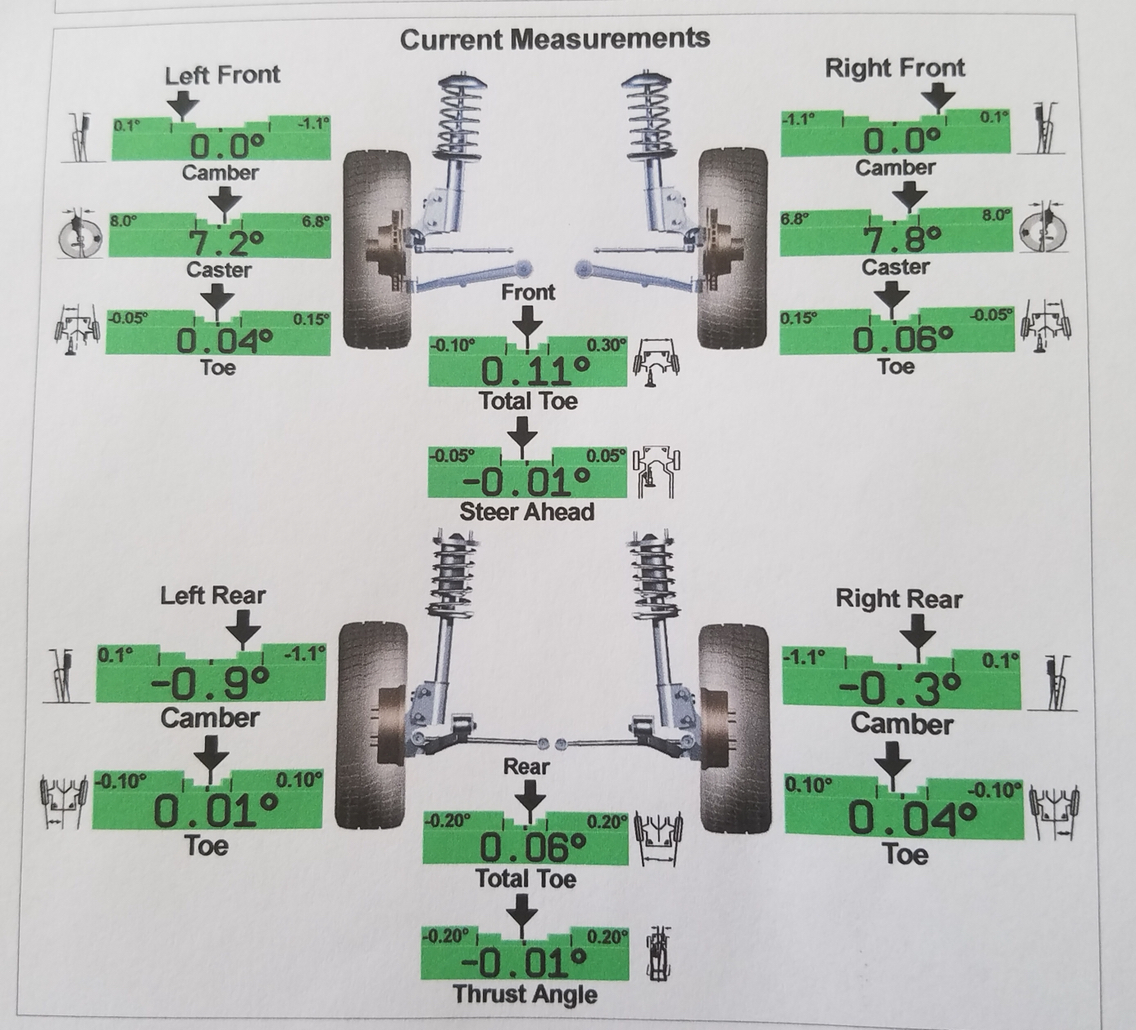
After having a set of fronts shredded due to the aggressive factory alignment, I had this done. Much better wear but the shop did tell me not to run this set up on the track.
I like the caster and toe but I'm not sure about the camber. I think the factory spec may be Left -0.2° and Right -0.5° but based on my tire wear I'm thinking the camber is much greater. I want as much info as possible before I take it in for the alignment and find out what I really have going on.
You can run a lot of camber in the front and have even tire wear. It all comes down to toe.
I run -2* in the front of mine with -1.7 rear, 0 toe front and .15 total toe rear (LG rear toe arms) and have perfect wear. I have about 7k miles on a set of MPSS and have perfect tire wear even after doing a couple of 1500 mile plus highway drives.
The real issue with the C7 alignment specs, see below, is the +/- Camber range allowed and still be within spec. I had my Grand Sport aligned at 400 miles, free as a warranty item. If I had just said, check alignment, the dealer tech could have just put it on their Hunter Alignment machine and fixed the only item, in Red, out of spec. One toe just slightly out. Then my rear Camber would have been left with the -1.6 degrees (both) as received from the factory. The centerline is -1.1 degrees and allowed range -0.5 to -1.7 degrees. -1.6 is within spec but very aggressive.
I gave the Service Writer a spread sheet with the GM specs spelled out in Min Max columns not just tolerance. And what I wanted in the last column for each item. All of my requests were within the GM spec range but selected for better tire wear. I requested Camber just under centerline for not at the lowest (least amount) of Camber allowed. A compromise between handling and tie wear. Toes were the GM centerline spec, which is close to “0.”
Took tech 35 to 45 minutes versus the <10 it could have to fix one toe and ligitimenty say, “all’s fine.”
All done on warranty and in fact the tech invited me into the service bay to watch the Hunter screen as he made changes (I had been standing outside the service bay door, my usual MO.). Gave him a nice tip!
The above are taken from the GM Factory Service Manual. As you can see there is a wide tolerance for each setting.
Note: GM calls for setting Rear Caster. This is something that is uncommon and most shops don't know anything about it and when you ask will think your are talking about front caster. Measuring Rear Caster requires Special Tools that are not available with any alignment machine. If the shop says their machine can do it make sure they know you are talking about Rear Caster and ask them if they have the two special tools required to perform the measurement. When the mechanic sets rear caster they have to hand write the settings on the alignment sheet since the machine doesn't know about it.
The following are the DSC Alignment Specs which have taken the place of the C5 Pfadt Specs:
The DSC specs call for a small amount of front and rear toe out (minus sign). However, I adjust front toe for a slight amount of toe in which cuts down on inner tire wear and helps keep the car more stable on roads that have a lot of pavement seams/patches crisscrossing the road. With the toe in I have found the cars don't suddenly follow a track across the road while you are holding the steering wheel straight. Of course if you don't live in a County that patches its pot holes by taking a small paver and wandering back and forth across the road this may not be necessary.
Bill
Last edited by Bill Dearborn; Nov 26, 2018 at 11:10 AM.
The above are taken from the GM Factory Service Manual. As you can see there is a wide tolerance for each setting.
Note: GM calls for setting Rear Caster. This is something that is uncommon and most shops don't know anything about it and when you ask will think your are talking about front caster. Measuring Rear Caster requires Special Tools that are not available with any alignment machine. If the shop says their machine can do it make sure they know you are talking about Rear Caster and ask them if they have the two special tools required to perform the measurement. When the mechanic sets rear caster they have to hand write the settings on the alignment sheet since the machine doesn't know about it.
The following are the DSC Alignment Specs which have taken the place of the C5 Pfadt Specs:
The DSC specs call for a small amount of front and rear toe out (minus sign). However, I adjust front toe for a slight amount of toe in which cuts down on inner tire wear and helps keep the car more stable on roads that have a lot of pavement seams/patches crisscrossing the road. With the toe in I have found the cars don't suddenly follow a track across the road while you are holding the steering wheel straight. Of course if you don't live in a County that patches its pot holes by taking a small paver and wandering back and forth across the road this may not be necessary.
Bill
Thanks Bill! I happen to live in a county where I think the roads are worse than yours and I'm certain the city where I live doesn't own a pavement roller, OMG I can't believe how bad some of the city streets are! Some of the crowns in the road are truly amazing to drive on, especially when the pavement has been overheated and created ruts from excess weight. Anyway, I digress...so I question the GM versus the DSC spec. GM says Left -0.2° and Right -0.5° camber and DSG suggests -1.2° for Street/Occasional track use, that's -1.0° and -0.7° more negative camber than GM unless my alignment is truly whacked I can't imagine going even more negative on the camber and eating the tires up.
I'm sure your alignment is not optimal if you are getting significant wear but camber is not your main wear angle when at levels close to stock spec .Your toe is messed up .
I'm sure your alignment is not optimal if you are getting significant wear but camber is not your main wear angle when at levels close to stock spec . Your toe is messed up .
Something is messed up and I know the only way to know is to get it on the rack and then decide. At least I have a few specs to compare to. I need to find a good local shop and talk to the alignment tech and manager before I come in so we both have agreed on expectations. I also wonder why the DSC spec is in both degrees and millimeters? It seems that they'd stick to the measurement that GM uses so a conversion wouldn't be necessary.
Also -0.5 mm = -0.028125° Link to calculator removed due to confusion
I still think it would be good for all C7 owners and other respective generations to publish sticky's for alignment specs.
Last edited by Gnarley Z51; Nov 28, 2018 at 11:01 PM.
You can run a lot of camber in the front and have even tire wear. It all comes down to toe.
I run -2* in the front of mine with -1.7 rear, 0 toe front and .15 total toe rear (LG rear toe arms) and have perfect wear. I have about 7k miles on a set of MPSS and have perfect tire wear even after doing a couple of 1500 mile plus highway drives.
It all comes down to setup.
Are those specs good for both 18/19 and 19/20 inch tires?
You can run a lot of camber in the front and have even tire wear. It all comes down to toe.
I run -2* in the front of mine with -1.7 rear, 0 toe front and .15 total toe rear (LG rear toe arms) and have perfect wear. I have about 7k miles on a set of MPSS and have perfect tire wear even after doing a couple of 1500 mile plus highway drives.
It all comes down to setup.
subieworx,
Are those specs good for both 18/19 and 19/20 inch tires?
How much camber do you run?
And, are the adjustable rear links pretty much a must have item to get the alignment correct for tire wear?
.
Last edited by HorsePower Junkie; Nov 28, 2018 at 04:38 AM.
I also wonder why the DSC spec is in both degrees and millimeters? It seems that they'd stick to the measurement that GM uses so a conversion wouldn't be necessary.
Converting in that style is not directly applicable to alignments. Alignments read in inches or mm have those measurements read at a nominal diameter in relation to the wheel. In a string alignment the larger the wheel the more the toe measurements increase. On a modern machine that isn't the case, but there is a nominal diameter that is used to set the toe distance that must be taken into account when converting to degrees.
At my shop we do all measurements in degrees as it is the most directly transferable from one car to another with no ambiguity.
I work in degrees and suspect most everyone else here prefers that also sticking to one type of measurement in the spec rather than a combination of measurements. I find the DSC specs confusing and bet they use them as the equipment they use operates that way and rather than adjusting their machine so all measurements and printouts are in degrees they leave them in a combination that's not user or reader-friendly leaving anyone to question a conversion. It's really interesting their print-outs are that way as GM and others shown are all uniform using measurements in degrees.
Degrees are better but I have been at shops that have machines that read in mm. To convert from mm to degrees you need to realize no matter whether you are using strings or lasers the measurement is basically the same. Lasers just replace the strings.
The stock rear rim diameter is 20 inches. If you measure toe from a string and get 0.5 mm toe out you can get the angle (x) by using trig functions. You know the opposite side of the angle (0.5 mm) and the adjacent side of the angle (508 mm= 20 in x 25.4mm/in). Tan (x)= 0.5/508=.0000984. To get the (x) we need to calculate the arc tangent of .0000984. x=arctan (.0000984) = .056379 degrees or 0.06 degrees. So one 1 mm rear toe = 0.12 degrees and 1.5mm rear toe = 0.18 degrees.
On the front 19 inch rim 0.5 mm of toe equals .059362 degrees or .06 degrees and you can multiply by 2 or 3 to get the angles for 1 mm or 1.5 mm.
Since the numbers don't have to be dead nuts on we can round the DSC front toe recommendation to -0.06 degrees toe out and the rear toe recommendation to -0.06 degrees toe out with the stock toe links and if you have the Granatelli toe links set toe in of +0.18 degrees.
Basic High School Trigonometry that most people should be able to look up.
Bill
Last edited by Bill Dearborn; Nov 28, 2018 at 11:46 AM.
So if my base model Stingray with 18/19 inch wheels will never see the track, and I would like good tire wear with a little infrequent spirited hill country curvy road driving, do I even need the adjustable rear links? And, what specs should I have all 4 wheels set at for good tire wear?
You need to be careful with 0 camber. That measurement is taken at static resting conditions. For street driving speeds, even what some call "spirited" there is little downforce, and the cars tend to lift. When that happens, the camber can go slightly positive in the front. With positive camber, the toe in also increases because the steering gear is in front of the knuckles. Now you can have an unstable steering condition and the car can wander. Hit a bump and get a bump-steer event and then it is ditch-city. Though generally the front is designed to avoid bump-steer, this is one time you might get it and not want it. The car will feel "darty"
The folks that have posted so far that say you can get away with a lot more camber than you think as long as toe is close to 0 for street are correct. I think Subie and others have posted many times that you can drive a truck through the factory specs. Yes you can get into terrible tire wear conditions with the factory settings. I personally feel the DSC settings have too much toe in allowance, but I set my car for my style of driving, and align to get the contact patch as big as I can and as uniform. I watch for the contact patch rolling the corners where the sidewall composition does not have the same grip AND is thinner that the tread.
I work in degrees and suspect most everyone else here prefers that also sticking to one type of measurement in the spec rather than a combination of measurements..... It's really interesting their print-outs are that way as GM and others shown are all uniform using measurements in degrees.
Perhaps of interest, I set my street rod chassis up before the car was finished and could have it aligned properly by using a long aluminum tube and ruler for setting toe. I cut a wood board that set on the wheel rim and the camber adjustment was made with level and feeler gauges. As Bill said, it just takes some trigonometry to convert from degrees to a linear measurement.
I use the specs TCI, who built my chassis, provided. Had to drive ~40 miles to have the interior done before I had it aligned. When I did have it set with an alignment machine, it was almost right on their specs!
So if my base model Stingray with 18/19 inch wheels will never see the track, and I would like good tire wear with a little infrequent spirited hill country curvy road driving, do I even need the adjustable rear links? And, what specs should I have all 4 wheels set at for good tire wear?
Thanks
.
You don't need adjustable rear links. Set camber to around -1 with 0 toe front and rear and you will be good.
I work in degrees and suspect most everyone else here prefers that also sticking to one type of measurement in the spec rather than a combination of measurements. I find the DSC specs confusing and bet they use them as the equipment they use operates that way and rather than adjusting their machine so all measurements and printouts are in degrees they leave them in a combination that's not user or reader-friendly leaving anyone to question a conversion. It's really interesting their print-outs are that way as GM and others shown are all uniform using measurements in degrees.
mils does not = mm. Mils, as Im sure you know, is a unit of angle measurement. mm is millimeter, as in 1/1000 of a meter. Distance measurement









 C7 alignment sticky???