When you click on links to various merchants on this site and make a purchase, this can result in this site earning a commission. Affiliate programs and affiliations include, but are not limited to, the eBay Partner Network.
Does forced induction increase the bore, stroke, or both?
Sort of a mental exercise, but if you're trying to explain the benefits of forced induction, for me, the big "aha" moment came when I realized that a motor with 15psi of boost doesn't just burn harder or hotter over the same crank rotation. It also burns longer, with more energy being released later in the burn.
That lead me to thinking, since it changes the power vs rotation timing, that it effectively changes stroke. But it's much easier to convince myself that the stroke is identical, unchanged, and what's really going on is that it's as if the cylinder were suddenly 100% bigger with the same stroke - and that's an increase in bore.
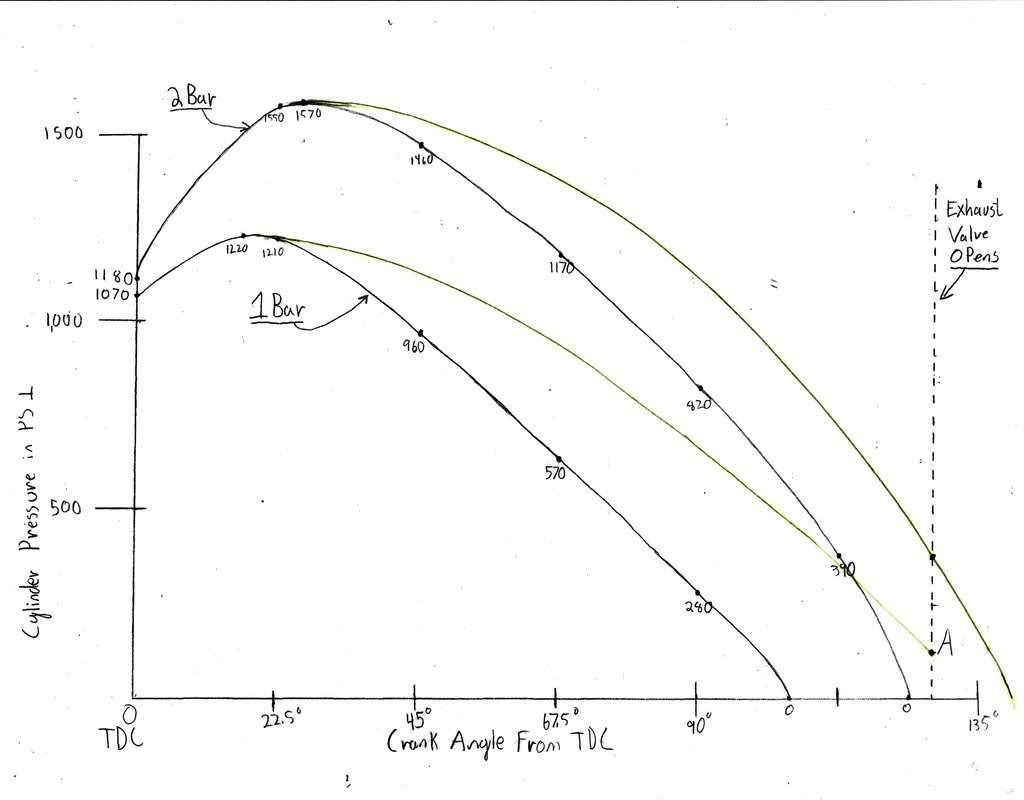
So the "blower makes bore bigger" is easy to explain, but I'm still looking for a good explanation/description of the burn time. This graph helps a lot - but again, seems to extend both bore and stoke.
Can anyone make a meaningful explanatory analogy out of this "extends the stroke" issue, or is it a lost cause? :-). Basically I'm trying to explain why it's different than Nitrous, and why it's "gentle" on parts.
I'm confused at why you are looking at this in relation to bore and stroke. It's more air volume moving through the motor. More air through = more power.
Stroke and bore are fixed, what you're seeking is Boyle's Law that relates changes in pressure and volume. Increase the volume with more air and fuel equals a higher pressure.
I *think* I get what OP is saying. The bigger the bore, the longer it takes for the fuel to be completely burned. If you picture a center fire cylinder head, it would take longer for the flame front to reach the ends in a bigger bore.
I'm just not sure where he gets the idea that a boosted engine burns longer. I'm saying it's not true- I've just never heard that. Typically, you're knock limited with timing. If anything, typically, a boosted engine will have earlier (retarded) spark timing, starting the burn earlier.
You're also looking at cam angles, not necessarily cylinder pressures. Supercharged engines have less overlap because they have positive pressure and can blow the exhaust out pretty easily. They can also rely on positive pressure, rather than vacuum from cylinder drop, to fill the cylinder. That changes timing too. But I've never heard that the burn is longer or slower. I also haven't designed (or ****, even talked about) an engine in a decade.
Originally Posted by James Dean
Your bore and stroke remain the same, you are effectively raising your compression ratio when using boost.
Compression ratio isn't the right term. You're increasing volumetric efficiency and combustion pressure, but not the compression ratio. You have more air which means more fuel and more power.
Last edited by village idiot; May 21, 2019 at 02:25 PM.
I also have never heard of forced induction increasing the "time" spent pushing down the piston HOWEVER with use of nitrous I have heard that the pressure on the piston is more spread out and does last longer (of course I have never verified this in any way, shape or form) AFAIK, it is generally believed that the optimum "push" on the piston happens at 15 deg ATDC. Not the ignition timing, but the crank angle where mechanical advantage is greatest.
Last edited by d16dcoe45; May 22, 2019 at 04:45 PM.
Yeah, the power made is basically the area under the curve of [cylinder pressure * piston offset (think crank angle, because leverage)]. Problem being, the more leverage (piston offset), the more the piston has dropped meaning lower pressure.
Most every chart I've seen changing ignition timing gets different peak pressure at different time, but they all fall off to about the same, anyway.
Just a generic one I pulled off google, but it gives you an idea of what I'm talking about.
But yeah, the physics (and chemistry) of combustion are super complicated and you really need to get into some pretty rough calculus to figure stuff out. With that said, I've never heard of a boosted engine prolonging combustion.With earlier spark and longer combustion, you'd in theory have much more efficient engine. If it does, it's beyond anything I ever remember seeing or learning about- and I took masters level ICE classes.Only thing I know of that kept pressures/temps higher, longer was Air Fuel Ratio- and not in a good way.
Last edited by village idiot; May 22, 2019 at 05:13 PM.
I think I follow what he is trying to do as well BUT can't use the mechanical volume as it doesn't change!
It really does change as if the compression ratio was higher so the result is similar, higher compression more power. In a diesel you can get 20:1 as no ignition occurs until fuel is injected so an instant very high pressure rise!
Could view it as the volumetric efficiency increases over ~150%. etc.
So this got me digging- and by digging I mean googling .
I found an SAE article from about 20 years ago about HCCI (basically, gas and air are pre-mixed and it ignites with pressure like a diesel) comparing combustion times for emissions purposes (because emissions are super sensitive to peak cylinder pressures and burn time). Interesting read but here's what you're looking for if you're not in the mood to nerd out:
For the supercharged cases, the com-
bustion duration is longer than for the NA cases.This
depends on that a greater amount of mixture should
burn in the supercharged cases. Hence, if the duration of
combustion is to be the same for a supercharged case as
for a NA case, the rate of combustion must be higher for
the supercharged case, for a given value of λ.
(λ. is basically air fuel ratio)
But keep in mind, this is pressure ignited, not spark. If it's spark ignited, does the earlier (retarded) spark adjust for that? Also, what the author seems to be implying is more fuel = longer burn time. So that may not be because of a supercharger, but because more air+fuel (and in theory, a 700hp supercharged engine has as much air+fuel in the cylinders as a 700hp NA engine, but given SC is less efficient, it's probably more like 700hp SC engine has the same amount of air +fuel as a 750hp engine).
If you look at the charts for 1 vs 2 bar of boost (ethanol is easiest to compare because they're on top of each other), peak pressure is later and higher pressures are later.
I think I follow what he is trying to do as well BUT can't use the mechanical volume as it doesn't change!
It really does change as if the compression ratio was higher so the result is similar, higher compression more power. In a diesel you can get 20:1 as no ignition occurs until fuel is injected so an instant very high pressure rise!
Could view it as the volumetric efficiency increases over ~150%. etc.
Don't mix up compression and cylinder pressures Compression ratio is all about thermal efficiency.
Pressure * piston offset = torque on the crank. Torque on the crank * rpm = power at the crank.
Last edited by village idiot; May 22, 2019 at 05:37 PM.
Don't mix up compression and cylinder pressures Compression ratio is all about thermal efficiency.
Pressure * piston offset = torque on the crank. Torque on the crank * rpm = power at the crank.
No, I was just relating the higher cylinder pressure to the same as that achieved with higher compression.
Actually this whole analogy isn't working.
If you can stuff twice the air and fuel in the same size combustion chamber when the spark ignites the energy released is ~twice. Yep depends on flame front propagation speed, pressure versus crack angle etc, etc --not perfect but close!
-
No, I was just relating the higher cylinder pressure to the same as that achieved with higher compression.
Actually this whole analogy isn't working.
If you can stuff twice the air and fuel in the same size combustion chamber when the spark ignites the energy released is ~twice. Yep depends on flame front propagation speed, pressure versus crack angle etc, etc --not perfect but close!
Kind of.
The amount of air you draw in is basically completely unrelated to compression ratio. Really, the size of the combustion chamber isn't a big factor either. Sure, you have expansion ratios and whatnot, but you'd be surprised how similar power gross numbers (ie: "power at the pistons") will be for a large or small engine with the same mass air flow, as long as it's not a crazy difference. The losses due to friction will be different and whatnot, but outside of that, it will be pretty similar. Assuming you burn all the gas, it's the same amount of energy.
The higher cylinder pressure from compression isn't really "it." What really matters is the cylinder pressure gain you get from combustion. The compression gain from "compression rato" is moot. It takes (academically) just as much energy to compress the air as it does when it pushes back.
IE:
Total Cylinder pressure = Z
Combustion pressure increase = Y
Compression pressure increase = X
Your net power is going to be, basically Z = Y + X, but you also have to subtract X because of the energy going into compressing it in the first place. Imagine no combustion. A high compression engine would make zero net power, even if it had the highest compression ratio ever. Your net power is all from pressure increase in combustion.
All the CR does is make for more efficiency (thermal efficiency, that is).
^^^
Yep, as I said it's not worth tying to use analogies.
Twice as much air at ~15 psi boost over 100% volumetric efficiency in a NA ICE provided in by a turbo or supercharger, matched with the proper amount of fuel and the bang during combustion is twice as big. Yep the pressure varies as the piston moves down the bore and the angle the rod makes etc, are all factors. But best just keep it simple for an explanation, IMO.
Compression ratio isn't the right term. You're increasing volumetric efficiency and combustion pressure, but not the compression ratio. You have more air which means more fuel and more power.
Maybe the "ratio" part isn't quite correct.
However, a turbocharger or supercharger definitely increases compression. It adds an additional stage of compression, in front of the intake valves, making the engine a two stage compressor.
this one's quite a stretch if you know anything about astronomy, but if you think of the air:fuel charge as 2 stars of equal size: a TINY white dwarf & a HUGE neutron, the dwarf would represent the N/A cylinder charge while the neutron is the FI cylinder. the neutron has a lot more mass/density & therefore emits a lot more energy and has a stronger gravitational field than the contrasting star of equal size.
















 Does forced induction increase the bore, stroke, or both?




















 Compression ratio is all about thermal efficiency.