




C7 coolant

Instructor


Joined: Mar 2020
Posts: 215
Likes: 62
From: PA

Gm says to change the Dex at 5 years or 150K miles. Change it at 5 years as it doesn't change color like the old green coolants that got all rusty did. It isn't hard to do if you do it yourself other than getting rid of the old coolant. Remember the coolant had a 40/60 ratio of Dex/Water when shipped from the factory so you can't purchase 50/50 mix. C7 Coolant capacity is 11.3 quarts. There are two ways to get the proper mix on the change over. One way is by mixing 4 quarts of Dex with 6 quarts of water. Then just pull the drain plug on the radiator and let the coolant drain into a large pan. Once empty refill with your new mix and be done with it. If you want to get all of the old coolant out of the engine and heater core then it takes more effort. First, drain the coolant then refill with clean drinking water and run the engine until the thermostat opens. After a minute of operating with the thermostat open shut off engine and drain the coolant again. Repeat until the drained coolant is clear. Then add 4.5 quarts of DexCool and top off with clean drinking water. The biggest problem is getting rid of the old coolant as it is poisonous. It causes liver damage and Animals and Kids like to drink the stuff because it tastes sweet.
Bill
Bill
Thanks in advance for your reply.

Burning Brakes


Joined: Nov 2022
Posts: 910
Likes: 430
From: MN
As I live in MN I would appreciate the additional cold weather protection, -18F isn't uncommon, and I never track and don't expect to need the 265F summer protection.

Team Owner


Joined: Jul 2004
Posts: 28,475
Likes: 3,291
From: Hartford WI
Additives for lubrication would not be at sufficient concentration? Maybe not get as much sediment out as you could if you flush everything out? If you don't feel like doing it right, have a shop hook up a flush machine and do it. I plan to have it flushed out at a dealer this spring.

Intermediate
Joined: Dec 2022
Posts: 33
Likes: 16
Distilled water is fine
The Hyperlube linked article is confusing distilled water and reverse osmosis water.
Distilled water is NOT completely stripped of minerals. It does not have most contaminants, so it is a “cleaner” water than tap water. But it does still have most minerals.
Reverse osmosis water IS completely stripped of virtually everything- contaminants AND minerals.
The removal of the minerals does create problems when using RO water and metal piping. RO water will pull minerals out of the piping (or any metal structure it contacts- radiator/water pump/etc), eventually causing pinhole leaks in the piping. That’s why it’s strongly recommended to use plastic piping with RO water.
I’d be very comfortable using distilled water in my cooling system, but would avoid RO water at all costs.
Unfortunately, most of the “spring” water that’s sold out there is actually RO water with some level of minerals added back in. You have to carefully read the labels to see what you’re actually getting.
Distilled water is NOT completely stripped of minerals. It does not have most contaminants, so it is a “cleaner” water than tap water. But it does still have most minerals.
Reverse osmosis water IS completely stripped of virtually everything- contaminants AND minerals.
The removal of the minerals does create problems when using RO water and metal piping. RO water will pull minerals out of the piping (or any metal structure it contacts- radiator/water pump/etc), eventually causing pinhole leaks in the piping. That’s why it’s strongly recommended to use plastic piping with RO water.
I’d be very comfortable using distilled water in my cooling system, but would avoid RO water at all costs.
Unfortunately, most of the “spring” water that’s sold out there is actually RO water with some level of minerals added back in. You have to carefully read the labels to see what you’re actually getting.

Tech Contributor


Joined: Oct 1999
Posts: 41,058
Likes: 9,820
From: Charlotte, NC (formerly Endicott, NY)
Bill

Race Director

Joined: Feb 2001
Posts: 11,308
Likes: 2,096
From: Grapevine Tx
2018 C3 of Year Finalist
2016 C3 of the Year Finalist
Nooby C7 GS owner here. Coming from a 72 LT-1 to this. I take it the radiator has a drain petcock on it, but where are you adding the coolant. The reservoir tank or is there a cap on the radiator itself that I can't see?

Melting Slicks


Joined: Jun 2019
Posts: 2,040
Likes: 928
From: near philly
and yeah there's a petcock driver side way down at the bottom, a little snug for a hand but still pretty accessible
I just drained and flushed mine with straight water until it came out clear, warmed up each time of course and then drained once more (which only actually drains maybe half) and then added straight concentrate coolant to get it back to the proper percentage
Race Director
Joined: Feb 2001
Posts: 11,308
Likes: 2,096
From: Grapevine Tx
2018 C3 of Year Finalist
2016 C3 of the Year Finalist
add it back in the reservoir tank itself
and yeah there's a petcock driver side way down at the bottom, a little snug for a hand but still pretty accessible
I just drained and flushed mine with straight water until it came out clear, warmed up each time of course and then drained once more (which only actually drains maybe half) and then added straight concentrate coolant to get it back to the proper percentage
and yeah there's a petcock driver side way down at the bottom, a little snug for a hand but still pretty accessible
I just drained and flushed mine with straight water until it came out clear, warmed up each time of course and then drained once more (which only actually drains maybe half) and then added straight concentrate coolant to get it back to the proper percentage
Corvette Stories
The Best of Corvette for Corvette Enthusiasts

Top 10 Most Expensive Corvettes Ever Sold on Bring A Trailer
Brett Foote
10 Things Every Corvette Owner Needs (2026 Edition)
Michael S. Palmer
8 Most "Only Corvette Owners Understand" Quirks and Problems
Pouria Savadkouei
10 Reasons the C6 Z06 is Still A Performance Benchmark After 20 Years
Joe Kucinski
How Much Horsepower Every Corvette Engine "LOST" in 1972
Joe Kucinski
Top 10 DOs and DON'Ts for Protecting Your Convertible Top!
Michael S. Palmer
Top 10 Most Explosive Corvettes Ever Made: Power-to-Weight Ratio Ranked!
Joe Kucinski
150 hp to 1,250 hp: Every Corvette Generation Compared by the Specs That Matter
Joe Kucinski
8 Coolest Corvette Pace Cars (and Replicas) of All Time
Verdad Gallardo
Pro


Joined: Nov 2013
Posts: 693
Likes: 158
From: Milwaukee WI
Team Owner
Joined: Jul 2004
Posts: 28,475
Likes: 3,291
From: Hartford WI
add it back in the reservoir tank itself
and yeah there's a petcock driver side way down at the bottom, a little snug for a hand but still pretty accessible
I just drained and flushed mine with straight water until it came out clear, warmed up each time of course and then drained once more (which only actually drains maybe half) and then added straight concentrate coolant to get it back to the proper percentage
and yeah there's a petcock driver side way down at the bottom, a little snug for a hand but still pretty accessible
I just drained and flushed mine with straight water until it came out clear, warmed up each time of course and then drained once more (which only actually drains maybe half) and then added straight concentrate coolant to get it back to the proper percentage
Burning Brakes
Joined: Nov 2022
Posts: 910
Likes: 430
From: MN
Team Owner
Joined: Jul 2004
Posts: 28,475
Likes: 3,291
From: Hartford WI
Isn't that the definition of "a waste of time"? You can achieve your goals with a total fluid flush once and for all for 5 years. Probably longer but they recommend 5 years which means the lubrication levels will be more than sufficient. OTOH, you are guessing that doing this once a year MAY have sufficient lubrication and spending a lot of time to MAYBE achieve your goals. Not to mention that the sediment in the block might still be there.

Burning Brakes
Joined: Nov 2022
Posts: 910
Likes: 430
From: MN
Isn't that the definition of "a waste of time"? You can achieve your goals with a total fluid flush once and for all for 5 years. Probably longer but they recommend 5 years which means the lubrication levels will be more than sufficient. OTOH, you are guessing that doing this once a year MAY have sufficient lubrication and spending a lot of time to MAYBE achieve your goals. Not to mention that the sediment in the block might still be there.
I can see the "full flush" method taking the better part of a day, whereas the radiator drain and fill ... maybe 30 minutes?
Then again, maybe I can find a shop that will do a full flush with some sort of machine, for not many dinero.
Melting Slicks
Joined: Jun 2019
Posts: 2,040
Likes: 928
From: near philly
I don't think so, it's much quicker to drain and fill the radiator 2.5 times in five years, once every five years drain and fill and run the engine multiple times to get all the coolant out, and then figure out how to dispose of many gallons of diluted antifreeze.
I can see the "full flush" method taking the better part of a day, whereas the radiator drain and fill ... maybe 30 minutes?
Then again, maybe I can find a shop that will do a full flush with some sort of machine, for not many dinero.
I can see the "full flush" method taking the better part of a day, whereas the radiator drain and fill ... maybe 30 minutes?
Then again, maybe I can find a shop that will do a full flush with some sort of machine, for not many dinero.
It's really fast because you start with a hot engine after a drive, so when you refill with straight water and run it to make sure the thermo opens up it warms up super fast because half the water is already hot, plus the engine is hot, etc.
So the several "warm ups" required for the flush seriously only take 5 minutes each, and then maybe let it sit and idle for another 5 each time just to be sure it's circulating.
Once you hear the cooling fans kick on you know the thermo has been open for at least a minute or so.
bottom line, I agree with your theory on a partial drain each year achieving the same goal, but it certainly is no major time commitment to just do the full flush
Team Owner
Joined: Jul 2004
Posts: 28,475
Likes: 3,291
From: Hartford WI
I don't think so, it's much quicker to drain and fill the radiator 2.5 times in five years, once every five years drain and fill and run the engine multiple times to get all the coolant out, and then figure out how to dispose of many gallons of diluted antifreeze.
I can see the "full flush" method taking the better part of a day, whereas the radiator drain and fill ... maybe 30 minutes?
Then again, maybe I can find a shop that will do a full flush with some sort of machine, for not many dinero.
I can see the "full flush" method taking the better part of a day, whereas the radiator drain and fill ... maybe 30 minutes?
Then again, maybe I can find a shop that will do a full flush with some sort of machine, for not many dinero.

Advanced
Joined: May 2023
Posts: 61
Likes: 26
From: Louisville KY
When I was in the Coast Guard we used 50/50 mix in all our engines. Some engine manufacturers recommended additives like NalCool and NalFleet.
Some specified distilled water, others said tap water.
There are so many companies selling their snake oil for additives to fuel, oil, anti freeze etc.
I’m 69 and have been wrenching on engines big and small, gas, diesel, AVGas, Jet fuel and propane since I was 10. 27 years Military, 15 years aviation.
Best rule to follow is the manufacturer recommendations. It keeps the warranty intact and protects the engine.
Just remember if you do a full flush the heater has to be running so water pushes the coolant thru the heater core.
Flushing machines make it so much easier as the old coolant is flushed out as water is added. When clear you throw a switch and the pre measured coolant is added while the clean water is pushed out.
The only hassle if you do it yourself is proper disposal of the old coolant. I work hard to protect the environment and have seen some pretty bad contamination of the soil which lead to water contamination rendering wells unusable.
Team Owner
Joined: Jul 2004
Posts: 28,475
Likes: 3,291
From: Hartford WI
There are test strips you can use to determine the amount of additives remaining in the anti freeze.
Best rule to follow is the manufacturer recommendations. It keeps the warranty intact and protects the engine.
Flushing machines make it so much easier as the old coolant is flushed out as water is added. When clear you throw a switch and the pre measured coolant is added while the clean water is pushed out.
The only hassle if you do it yourself is proper disposal of the old coolant. I work hard to protect the environment and have seen some pretty bad contamination of the soil which lead to water contamination rendering wells unusable.
Best rule to follow is the manufacturer recommendations. It keeps the warranty intact and protects the engine.
Flushing machines make it so much easier as the old coolant is flushed out as water is added. When clear you throw a switch and the pre measured coolant is added while the clean water is pushed out.
The only hassle if you do it yourself is proper disposal of the old coolant. I work hard to protect the environment and have seen some pretty bad contamination of the soil which lead to water contamination rendering wells unusable.
What is your opinion on why, back in 2000s, Ford used the Powerstroke from International and decided to use their green coolant and use additives every 15K instead of the International recommended one?
Definitely. I would prefer a machine to do that job.
I don't have wells on my property so that's not my issue. OTOH, I'd suspect my neighbors would turn someone in they saw dumping coolant in the storm drains.

2nd Gear
Joined: Jan 2025
Posts: 2
Likes: 0
Do not use Distilled Water in your Cooling System!
The following is from another thread in this forum that I read by: Jeff Hy-per Web Crew;
"I would reconsider using distilled water, however. You want a mineral-free (hence why GM calls for clean, drinkable water,) but you also want an ionically balanced water, something that distilled water is not.
https://www.hyperlube.com/blog/blog/...ooling-system/
Quote:
Many people have “heard” that distilled water is the best water to use in a cooling system. This is wrong! While it is certainly true that distilled water’s purity prevents electrolysis and scale/deposit formation, it unfortunately comes with a potentially very damaging side effect.
During the distillation process, water is vaporized into its gaseous phase, so all its impurities are left behind. These impurities include a number of minerals, including “calcium” and “magnesium,” the two components of water “hardness.” The water is then condensed back into its liquid phase, so the resulting liquid is pure water – in fact, some of the purest water on earth. But the problem is that when water is distilled, or “stripped,” of its minerals and impurities, the resulting solution is composed of chemically imbalanced “ions.” This leaves distilled water “ionically hungry,” so it will actually strip electrons from the metals in a cooling system as it attempts to chemically re-balance itself. As it chemically removes electrons from the metals of cooling system components, distilled water eventually does extreme damage that could lead to cooling system failure.
So what’s the answer? Softened water. During the water softening process, the same impurities and minerals are removed from water as during the distillation process – but with one very important distinction. Rather than STRIPPING the impurities from water, softening EXCHANGES the impurities with a sodium ion. The resulting solution is chemically and ionically balanced, making softened water very stable, very pure, and non-threatening to cooling system metals.
There seems to be a perceptual issue with regard to the usage of softened water in cooling systems by auto enthusiasts. Many mistakenly believe that because salt is added to water softeners, then softened water must contain salt, a substance of course known to be very corrosive. Nothing could be further from the truth. The salt you add to a water softener is NaCl, or sodium chloride.
During the softening process, only the sodium ion is exchanged into the water. Therefore, softened water does NOT contain corrosive salt.
What are the benefits of using softened water? Soft water lacks most of the impurities of tap water, meaning it far less conductive (i.e. less damage from electrolysis) and will not form deposits (i.e. less possibility of overheating). However, if you use Hy-per Lube Super Coolant, you don’t need to use softened water. Hy-per Lube Super Coolant contains molybdate, a form of the semi-precious metal “molybdenum,” which is proven to be extremely effective in preventing galvanic action and electrolysis – regardless of what type of water is used. Hy-Per Lube Super Coolant also contains polymer dispersants which keep water hardness in solution, thus preventing the formation of insulative scales and deposits. So regardless of whether you use softened water or tap water, you need not worry about these issues when you use Hy-Per Lube Super Coolant. This is actually one of the important benefits of the product, because not everybody has easy access to softened water.
But please – PLEASE! – do not use distilled water in your automotive cooling system."
"I would reconsider using distilled water, however. You want a mineral-free (hence why GM calls for clean, drinkable water,) but you also want an ionically balanced water, something that distilled water is not.
https://www.hyperlube.com/blog/blog/...ooling-system/
Quote:
WHY YOU SHOULD NEVER USE DISTILLED WATER IN YOUR COOLING SYSTEM
- Posted on: Apr 26 2018
- By: Hy-per Web Crew
Many people have “heard” that distilled water is the best water to use in a cooling system. This is wrong! While it is certainly true that distilled water’s purity prevents electrolysis and scale/deposit formation, it unfortunately comes with a potentially very damaging side effect.
During the distillation process, water is vaporized into its gaseous phase, so all its impurities are left behind. These impurities include a number of minerals, including “calcium” and “magnesium,” the two components of water “hardness.” The water is then condensed back into its liquid phase, so the resulting liquid is pure water – in fact, some of the purest water on earth. But the problem is that when water is distilled, or “stripped,” of its minerals and impurities, the resulting solution is composed of chemically imbalanced “ions.” This leaves distilled water “ionically hungry,” so it will actually strip electrons from the metals in a cooling system as it attempts to chemically re-balance itself. As it chemically removes electrons from the metals of cooling system components, distilled water eventually does extreme damage that could lead to cooling system failure.
So what’s the answer? Softened water. During the water softening process, the same impurities and minerals are removed from water as during the distillation process – but with one very important distinction. Rather than STRIPPING the impurities from water, softening EXCHANGES the impurities with a sodium ion. The resulting solution is chemically and ionically balanced, making softened water very stable, very pure, and non-threatening to cooling system metals.
There seems to be a perceptual issue with regard to the usage of softened water in cooling systems by auto enthusiasts. Many mistakenly believe that because salt is added to water softeners, then softened water must contain salt, a substance of course known to be very corrosive. Nothing could be further from the truth. The salt you add to a water softener is NaCl, or sodium chloride.
During the softening process, only the sodium ion is exchanged into the water. Therefore, softened water does NOT contain corrosive salt.
What are the benefits of using softened water? Soft water lacks most of the impurities of tap water, meaning it far less conductive (i.e. less damage from electrolysis) and will not form deposits (i.e. less possibility of overheating). However, if you use Hy-per Lube Super Coolant, you don’t need to use softened water. Hy-per Lube Super Coolant contains molybdate, a form of the semi-precious metal “molybdenum,” which is proven to be extremely effective in preventing galvanic action and electrolysis – regardless of what type of water is used. Hy-Per Lube Super Coolant also contains polymer dispersants which keep water hardness in solution, thus preventing the formation of insulative scales and deposits. So regardless of whether you use softened water or tap water, you need not worry about these issues when you use Hy-Per Lube Super Coolant. This is actually one of the important benefits of the product, because not everybody has easy access to softened water.
But please – PLEASE! – do not use distilled water in your automotive cooling system."

Team Owner
Joined: Jul 2004
Posts: 28,475
Likes: 3,291
From: Hartford WI
1937
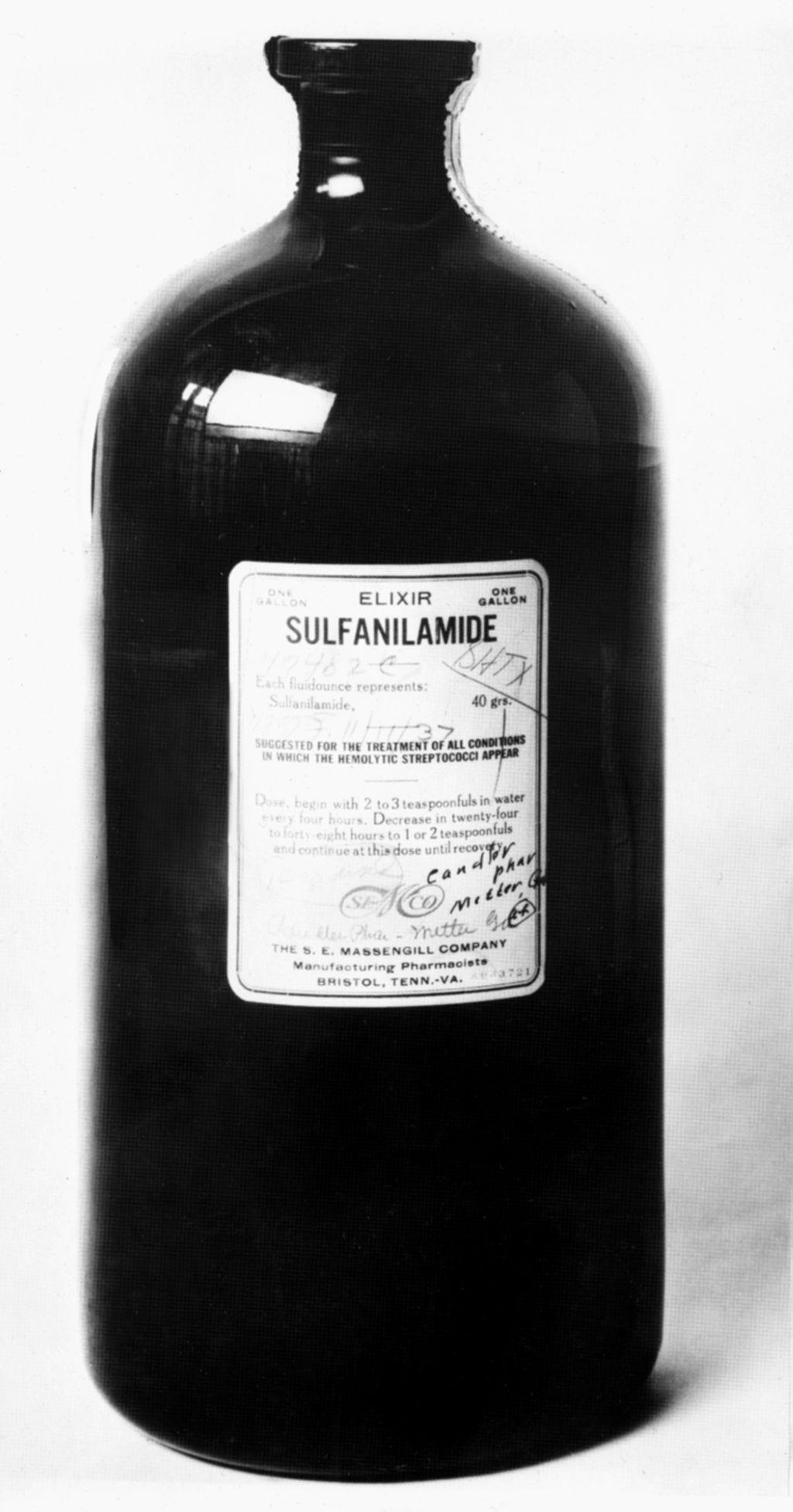 Elixir of Sulfanilamide. Source: FDA, https://flickr.com/photos/39736050
Elixir of Sulfanilamide, containing the poisonous solvent diethylene glycol, kills 107 persons, many of whom are children, highlighting the need to establish drug safety before marketing and to enact the pending food and drug law.