





Brake Fade Warning

Thread Starter
Pro


Joined: Jul 2019
Posts: 532
Likes: 517
 Brake Fade Warning
Got the first stage brake fade warning at the track yesterday. Didn’t notice it until I pulled off the track after the last session, which is an issue itself. There was no warning light, only a text message on the info screen. Not something you would pick up during a track session.
It was hot that day, low 90’s. There were 4 sessions totaling 90 minutes of track time. There was only an hour cool down between the last 2 sessions.
I was running Carbotech 12 pads on stock rotors and Castrol SRF fluid. There was no sign of brake fade. Not happy about this. It’s a Z51 car and had all the recommended track prep.
It was hot that day, low 90’s. There were 4 sessions totaling 90 minutes of track time. There was only an hour cool down between the last 2 sessions.
I was running Carbotech 12 pads on stock rotors and Castrol SRF fluid. There was no sign of brake fade. Not happy about this. It’s a Z51 car and had all the recommended track prep.

Le Mans Master


Joined: Aug 2000
Posts: 5,529
Likes: 1,943
From: Austin Texas
I would suggest moving the sensor to where it does not read the pad temps.

Racer

Joined: Feb 2020
Posts: 377
Likes: 435
Got the first stage brake fade warning at the track yesterday. Didn’t notice it until I pulled off the track after the last session, which is an issue itself. There was no warning light, only a text message on the info screen. Not something you would pick up during a track session.
It was hot that day, low 90’s. There were 4 sessions totaling 90 minutes of track time. There was only an hour cool down between the last 2 sessions.
I was running Carbotech 12 pads on stock rotors and Castrol SRF fluid. There was no sign of brake fade. Not happy about this. It’s a Z51 car and had all the recommended track prep.
It was hot that day, low 90’s. There were 4 sessions totaling 90 minutes of track time. There was only an hour cool down between the last 2 sessions.
I was running Carbotech 12 pads on stock rotors and Castrol SRF fluid. There was no sign of brake fade. Not happy about this. It’s a Z51 car and had all the recommended track prep.
Thread Starter
Pro
Joined: Jul 2019
Posts: 532
Likes: 517
‘what sensor? There doesn’t seem to be any sensor connected to the pads or rotor. I tried to find the way it evaluates brake fade, and even asked Tadge, but got no answers. It may be proprietary. At any rate, the car is supposed to be trackable, I’m not doing endurance racing. They say it’s OK to use different brake fluid, so if it’s measuring fluid temp, that would be pretty foolish, as the SRF fluid is pretty bulletproof.

Race Director


Joined: Aug 2016
Posts: 12,812
Likes: 10,229
From: Garden Valley CA
My guess is there is a temperature monitor somewhere in the system. They could use an algorithm similar to what they use for oil life or tire temperature to predict the likelihood of the brake fluid boiling. Or perhaps they have a way of measuring how "compressive" the brake fluid is getting.
Safety Car


Joined: Nov 2007
Posts: 4,148
Likes: 392
Did you use the cool down lap to cool down the car and brakes? Sounds like you might have had a brake heat soak going on. Car stopped hot brakes with no cooling air passing through the rotors. Well known problem on race cars.
Corvette Stories
The Best of Corvette for Corvette Enthusiasts

Top 10 Most Expensive Corvettes Ever Sold on Bring A Trailer
Brett Foote
10 Things Every Corvette Owner Needs (2026 Edition)
Michael S. Palmer
8 Most "Only Corvette Owners Understand" Quirks and Problems
Pouria Savadkouei
10 Reasons the C6 Z06 is Still A Performance Benchmark After 20 Years
Joe Kucinski
How Much Horsepower Every Corvette Engine "LOST" in 1972
Joe Kucinski
Top 10 DOs and DON'Ts for Protecting Your Convertible Top!
Michael S. Palmer
Top 10 Most Explosive Corvettes Ever Made: Power-to-Weight Ratio Ranked!
Joe Kucinski
150 hp to 1,250 hp: Every Corvette Generation Compared by the Specs That Matter
Joe Kucinski
8 Coolest Corvette Pace Cars (and Replicas) of All Time
Verdad Gallardo

Melting Slicks

Joined: Nov 2005
Posts: 2,074
Likes: 309
GrassRoots Motorsports magazine installed an LS3 in one of their project cars and found that they had very high oil temperatures for no apparent reason. After discussions with GM powertrain engineers they discovered that the LS3 does not measure oil temps but instead calculates them. I suspect this is the same type of thing and it's just an estimate. I think that probably the car doesn't know how much it weighs; driver and passenger weight is going to vary a lot along with luggage, so they probably just assume a certain weight, like maximum curb weight to be on the safe side, and then from there they can calculate how much brake energy is being used.

Heel & Toe

Joined: Sep 2010
Posts: 17
Likes: 7
You’ll never feel brake fade since everything is electronic. There’s no physical link between the pedal and brake system. All pedal feedback is simulated with a solenoid. There are also no temp sensors anywhere. Everything is calculated based on an algorithm. Stuff like an e diff and ABS are also making assumptions based on the stock pad friction coefficients so changing pads to non stock ones can impact other things to some degree

Safety Car
Joined: Jul 2019
Posts: 4,079
Likes: 2,414
From: Florida
You’ll never feel brake fade since everything is electronic. There’s no physical link between the pedal and brake system. All pedal feedback is simulated with a solenoid. There are also no temp sensors anywhere. Everything is calculated based on an algorithm. Stuff like an e diff and ABS are also making assumptions based on the stock pad friction coefficients so changing pads to non stock ones can impact other things to some degree
You will not feel a soft pedal. That is by design. If you get a fade warning switch to cool downs.
It shouldn't be easy to trigger.
After the event always look for real signs of overheating. Always inspect calipers / seals after.

Race Director

Joined: Sep 2016
Posts: 13,180
Likes: 10,528
GM has stated that the brake fade warning system is calibrated to the OEM brake pads, and may not work correctly with aftermarket pads.
Here's Tadge on how the system works:
https://www.corvetteblogger.com/2021...arning-system/
Here's Tadge on how the system works:
“What does the Brake Fade Warning System actually measure? Is it the brake fluid or rotor temperature, or does it somehow quantitate actual brake fade?”
From Tadge Juechter via Chevrolet.com:
The Brake Fade Warning Assist System (FWA) was developed to quantify brake fade and provide both an alert to the driver (Level 1) and a measure of protection for the driver and vehicle in the case of more severe fade (Level 2). The electro-hydraulic brake assist system in the C8 is constantly monitoring many data channels and evaluating them to determine if the system is operating properly. In the case of fade warning, it has been developed to monitor the vehicle usage, determine when the brake usage is high enough to have a risk of fade, and react when that fade occurs.
Brake fade is a very complex phenomenon and is not strictly a function of any one input (for example, temperature). Instead, there are many inputs that will affect brake fade, including but not limited to temperature (rotor bulk temperature and pad temperature), brake power, vehicle speed, ambient conditions, pad thickness and pad conditioning (previous burnish, taper wear, previous high temp exposure, etc.). Additionally, we monitor for fluid boil, which can occur with or without brake fade, especially in the case of older brake fluid or the use of aggressive race friction, which has a much higher metallic content and conducts more heat into the brake fluid. Both of these conditions are complex, so any single measurement point is not enough to detect fade reliably. Instead, when aggressive brake usage is detected, we monitor brake pressure, wheel slip, vehicle deceleration and fluid consumption per brake corner. These inputs allow us to detect and appropriately react to fade, without prematurely warning the driver and allowing full use of the vehicle on the track.
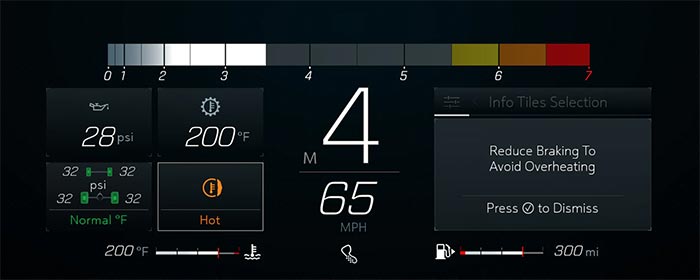
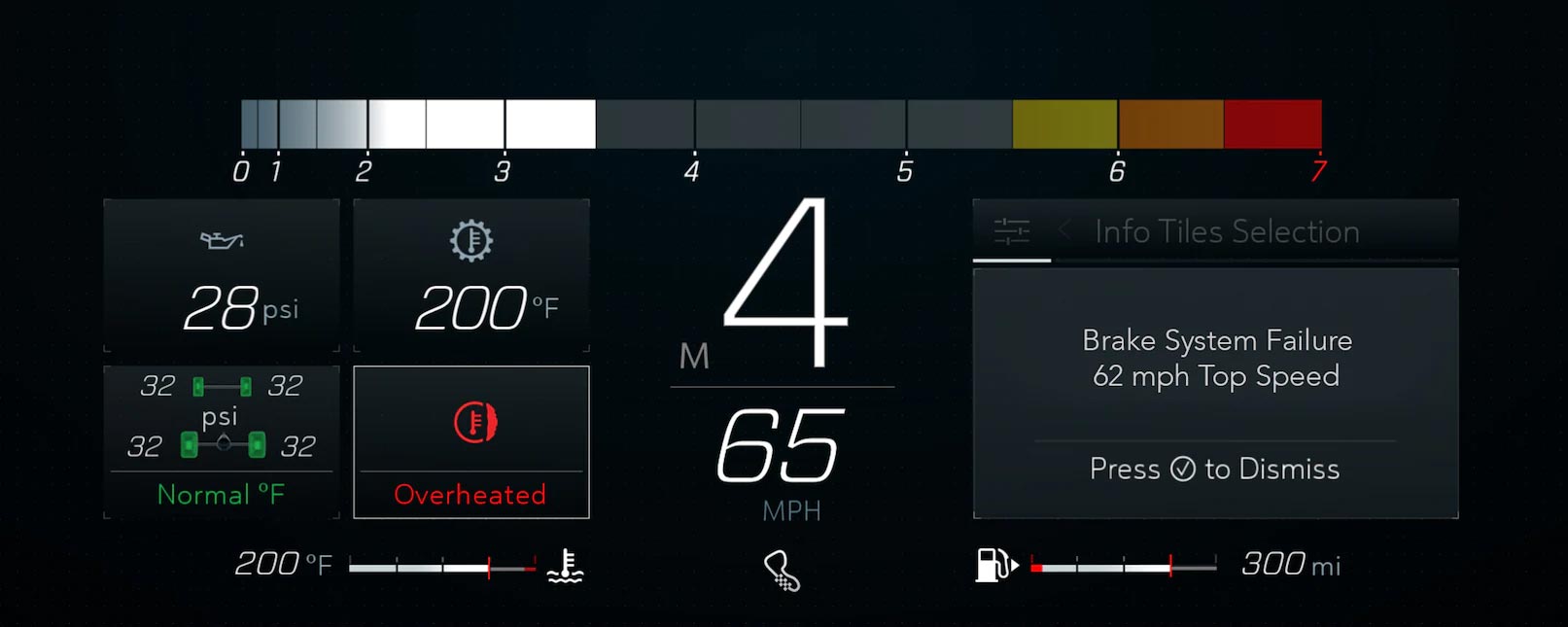
Level 1 warning is just that – a warning that the brakes are nearing a concerning level of fade and that the driver should back up their braking points and reduce brake usage to maintain brake temperature and normal vehicle operation. If this is done, the vehicle will exit fade warning and the driver can resume lapping as before. Above is what the driver will see in the Driver Information Center (right side of the cluster).
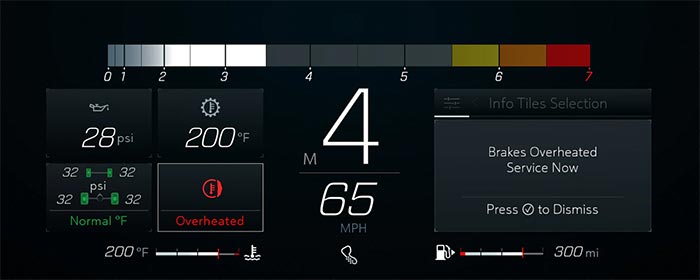
Level 2 is more serious, as it is linked to fluid boil or substantial brake fade. Level 2 speed limits the vehicle to 62mph, and sets a diagnostic trouble code (DTC). One advantage of our new electro-hydraulic brake assist system is that it can actually continue to supply fluid in the case of a boil condition on track, or isolate a brake corner in the case of a leak, and can therefore provide a significant amount of deceleration, even when the brake fluid has boiled. However, once the fluid has boiled, it is compromised and must be replaced prior to additional brake usage. This is why there is a speed limit and warning that must be cleared after fresh brake fluid has been flushed. An updated version of the Track Preparation Guide was recently released, which provides more guidance on this warning to help ensure our customers are able to continue to enjoy their track day, should they boil their brake fluid.
However, since the FWA system was developed with the production rotors, pads and calipers, we must recommend using the OEM hardware when on track, as we cannot guarantee that the fade warning system will behave as designed if parts are changed.
We note that last part of Tadge’s answer about the Brake Fade Warning System being developed with stock brake components. In research for this post, we found one user on the Corvette Forum who was utilizing aftermarket Carbotech brake pads and Castrol SRF fluid which is said to be “boil-proof” and during a track date, his Brake Fade Warning System gave him the level 1 alert even though he felt no actual brake fade. So that is something keep that in mind if you are using non-stock brake pads and fluid.
From Tadge Juechter via Chevrolet.com:
The Brake Fade Warning Assist System (FWA) was developed to quantify brake fade and provide both an alert to the driver (Level 1) and a measure of protection for the driver and vehicle in the case of more severe fade (Level 2). The electro-hydraulic brake assist system in the C8 is constantly monitoring many data channels and evaluating them to determine if the system is operating properly. In the case of fade warning, it has been developed to monitor the vehicle usage, determine when the brake usage is high enough to have a risk of fade, and react when that fade occurs.
Brake fade is a very complex phenomenon and is not strictly a function of any one input (for example, temperature). Instead, there are many inputs that will affect brake fade, including but not limited to temperature (rotor bulk temperature and pad temperature), brake power, vehicle speed, ambient conditions, pad thickness and pad conditioning (previous burnish, taper wear, previous high temp exposure, etc.). Additionally, we monitor for fluid boil, which can occur with or without brake fade, especially in the case of older brake fluid or the use of aggressive race friction, which has a much higher metallic content and conducts more heat into the brake fluid. Both of these conditions are complex, so any single measurement point is not enough to detect fade reliably. Instead, when aggressive brake usage is detected, we monitor brake pressure, wheel slip, vehicle deceleration and fluid consumption per brake corner. These inputs allow us to detect and appropriately react to fade, without prematurely warning the driver and allowing full use of the vehicle on the track.
Level 1 warning is just that – a warning that the brakes are nearing a concerning level of fade and that the driver should back up their braking points and reduce brake usage to maintain brake temperature and normal vehicle operation. If this is done, the vehicle will exit fade warning and the driver can resume lapping as before. Above is what the driver will see in the Driver Information Center (right side of the cluster).
Level 2 is more serious, as it is linked to fluid boil or substantial brake fade. Level 2 speed limits the vehicle to 62mph, and sets a diagnostic trouble code (DTC). One advantage of our new electro-hydraulic brake assist system is that it can actually continue to supply fluid in the case of a boil condition on track, or isolate a brake corner in the case of a leak, and can therefore provide a significant amount of deceleration, even when the brake fluid has boiled. However, once the fluid has boiled, it is compromised and must be replaced prior to additional brake usage. This is why there is a speed limit and warning that must be cleared after fresh brake fluid has been flushed. An updated version of the Track Preparation Guide was recently released, which provides more guidance on this warning to help ensure our customers are able to continue to enjoy their track day, should they boil their brake fluid.
However, since the FWA system was developed with the production rotors, pads and calipers, we must recommend using the OEM hardware when on track, as we cannot guarantee that the fade warning system will behave as designed if parts are changed.
We note that last part of Tadge’s answer about the Brake Fade Warning System being developed with stock brake components. In research for this post, we found one user on the Corvette Forum who was utilizing aftermarket Carbotech brake pads and Castrol SRF fluid which is said to be “boil-proof” and during a track date, his Brake Fade Warning System gave him the level 1 alert even though he felt no actual brake fade. So that is something keep that in mind if you are using non-stock brake pads and fluid.
E-Ray, 3LZ, ZER, LIFT


Joined: Sep 2007
Posts: 35,014
Likes: 12,398
From: NE South Carolina
^^^
 There certainly is no wire near the caliper!
I thought it would be something like what Tadge mentions:
"Instead, when aggressive brake usage is detected, we monitor brake pressure, wheel slip, vehicle deceleration and fluid consumption per brake corner. These inputs allow us to detect and appropriately react to fade, without prematurely warning the driver and allowing full use of the vehicle on the track."
Not sure what monitored inputs they use to define aggressive brake usage versus non, but easy to measure brake pressure as that is what they use to define eBrake applied pressure.
BTW, there is a mechanical link from Brake pedal to master cylinder. It would require a lot of foot pressure if eBrake pump where not operating. This is from my PDF re C8 hybrid. It's from an article written by Jason Cammisa in October 2019, a month before the leaked article that had the C8 Hybrid Details. 'We interpret the C8’s by-wire braking system as a tacit admission that a hybrid variant is coming. It’s here that we’ll see the full benefit of the mid-engine layout: it’ll likely have electric motors on the front wheels."
He goes on to say: "Once you start thinking about a hybrid Corvette (by-wire assist) really starts to pay dividends. Hybrids use blended brake systems that continually shift braking duties between regenerative braking and conventional friction braking. This leads to inconsistent and unusual pedal feel that a by-wire assist eliminates!"
In that article eBrake is called "electric assist" or "by-wire assist" rather than brake by wire, a better description!
There certainly is no wire near the caliper!I thought it would be something like what Tadge mentions:
"Instead, when aggressive brake usage is detected, we monitor brake pressure, wheel slip, vehicle deceleration and fluid consumption per brake corner. These inputs allow us to detect and appropriately react to fade, without prematurely warning the driver and allowing full use of the vehicle on the track."
Not sure what monitored inputs they use to define aggressive brake usage versus non, but easy to measure brake pressure as that is what they use to define eBrake applied pressure.
BTW, there is a mechanical link from Brake pedal to master cylinder. It would require a lot of foot pressure if eBrake pump where not operating. This is from my PDF re C8 hybrid. It's from an article written by Jason Cammisa in October 2019, a month before the leaked article that had the C8 Hybrid Details. 'We interpret the C8’s by-wire braking system as a tacit admission that a hybrid variant is coming. It’s here that we’ll see the full benefit of the mid-engine layout: it’ll likely have electric motors on the front wheels."
He goes on to say: "Once you start thinking about a hybrid Corvette (by-wire assist) really starts to pay dividends. Hybrids use blended brake systems that continually shift braking duties between regenerative braking and conventional friction braking. This leads to inconsistent and unusual pedal feel that a by-wire assist eliminates!"
In that article eBrake is called "electric assist" or "by-wire assist" rather than brake by wire, a better description!
Last edited by JerryU; May 29, 2023 at 04:26 PM.