When you click on links to various merchants on this site and make a purchase, this can result in this site earning a commission. Affiliate programs and affiliations include, but are not limited to, the eBay Partner Network.
1.7 seconds per lap. Most drivers could gain that with a $250 hour of instruction and one less cheeseburger per week.
OK, I yield, I cannot prove that 1.7 seconds per lap on a non-competitive track day is irrelevant.
And it was the manufacturer doing the testing, so that's rock-solid. And no, I'm not going to buy a Z51 and a park bench to go there and provide an independent comparison, so I must be wrong.
Both I am sure are effective on the track, but they both look to me like a modified piece of earth moving equipment.
Any similarities you see aren't accidental but deliberate and practically necessary. Being able to move volumes of stuff in a controlled, fluid-like manner is the idea, be it dirt or air. It's similar to how Tadge has admitted to the LT2 making high-pitched agricultural noises--may not be the most elegant solution but more importantly gets the job done.
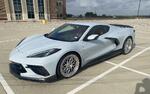
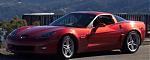
Good question for the designers. They're named in watermarks for the red C8 and end caps for the blue one.
Edit: I found this data posted by AJ Hartman who offers these 3 options for the wing element. The AMT wing also uses the Fulcrum 12 from the same supplier (Faircloth Composites) which looks like ~1,320 lbs of downforce:
Since the "down force" is behind the rear axle, that means it lighten the front axle, reducing grip for turns. Understeer city.
Fulcrums work that way.
Great for NHRA, because you don't steer those, you aim those.
On a road course, where steering is desirable?
Not-so-much.
Also, it'll reduce terminal speeds as it's an air brake.
Whatever wing you get.. I hope you get a front lip also. The regular Z51 will still look too small for this massive wing. It wont balance out.
Already stated that I have no plans of getting these but good advice for anybody thinking about it. Even GM wouldn't let me configure the Z51 wing and/or splitter alone for aero balance reasons. Had to either get both paired together, or neither at all. Not sure if it's changed since then. AMT Motorsport did say, "The car will definitely be even faster when paired with our forthcoming splitter, but with the wing alone, the car is verifiably quicker and more fun to drive." The blue test car seems to already have had a massive front splitter but from another company (looks like Verus Engineering's), not AMT's "forthcoming splitter." And both C8s might possibly have Verus canards:
I've known about Verus since their early startup days when they queried the BRZ forums and I gave my feedback for their first product design, a BRZ swan neck wing. Very knowledgeable aerodynamics engineers.
Last edited by switchlanez; Sep 2, 2024 at 07:21 PM.
what happened to the notion of "pushing down" on the mounting arms rather than "pulling away" from them?
There's still wayyy more downforce pushing down than rearward pulling (specifically 1,320 lbs downward, not rearward). And it's not as clear in the red car as it is in the blue car but the base (hidden under the hatch) of each upright transfers the bulk of the load downward along the vertical axis against the chassis:
Remember Corvette Racing/GM also built swan necks into the Z06 GT3.R, both their own and those sold to privateers. Because the downforce still pushes the wing down against the uprights, not back.
i noticed the support structure reiterated above and never implied that it pushed 'backwards'.
my point was that most wing supports are mounted underneath the airfoil - where the wing compresses the supporting material into the frame as downforce increases... instead of pulling away from the mounting structure as these do (pulling down when the supports are above).
i noticed the support structure reiterated above and never implied that it pushed 'backwards'.
my point was that most wing supports are mounted underneath the airfoil - where the wing compresses the supporting material into the frame as downforce increases... instead of pulling away from the mounting structure as these do (pulling down when the supports are above).
That has to do with picking the more optimal area for wind breakage caused by the uprights to occur. From chats with Verus Engineering in the BRZ forum it's more ideal for the bottom of the airfoil to be completely clear of wind obstruction by uprights and instead mount them over the top to generate more downforce than your typical wing you described. The cons of this are design and packaging. Their structures require more elaborate engineering considerations and require a lot more space as we can see in the two examples posted.
Anybody that thinks 1.7 seconds is a trivial change in lap times is not somebody who would ever be in the market for a spoiler for any reason beyond looks.
1.7 seconds is an enormous change in lap times.
I think both of these wings are, unfortunately, pretty ugly. But if I were doing time trials regularly I would probably get the AMT.
Here is Verus's first product, the BRZ swan neck wing, followed by their C8 wing which is more conventional:
And here are their airflow simulation diagrams. The C8's wing shows some airflow breakage at the uprights:
Whereas the BRZ's swan neck shows less breakage, if any:
I posit that Verus opted out of a swan neck design for the C8 due to packaging/complexity/cost challenges as I mentioned earlier in the cons of a swan neck. Otherwise their potential swan neck solution would probably look not too far off from the two I posted. That leads to why these wings are interesting to me: Because the big bad Verus chickened out and went the easy route with a conventional wing (admittedly more aesthetically digestible) whereas these ************* used their ingenuity to go ***** to the wall for the more optimal airflow configuration. I'd never get it myself (for reasons). But mad respect. When they choose a design with peak difficulty and their Frankenstein creations work as intended, I can't fault them for it. But when other people do, especially in consensus, that makes me love these pioneers more for being contrarian and sticking to their unpopular conviction in function over form.
Last edited by switchlanez; Sep 11, 2024 at 11:15 PM.
hmm... hadn't seen the airflow dynamics of the swan design before (granted, a more accurate comparison would show both wing styles on the same vehicle to rule out the cars' different airflow characteristics). thanks for that explanation.
it appears the additional fastener beefiness it'd require may be worth it after all. not sure if it's just for accessibility or practicality... but you don't really see airplanes with engine nacelles mounted to the low-pressure (top) side of the wing, so maybe they're onto something.